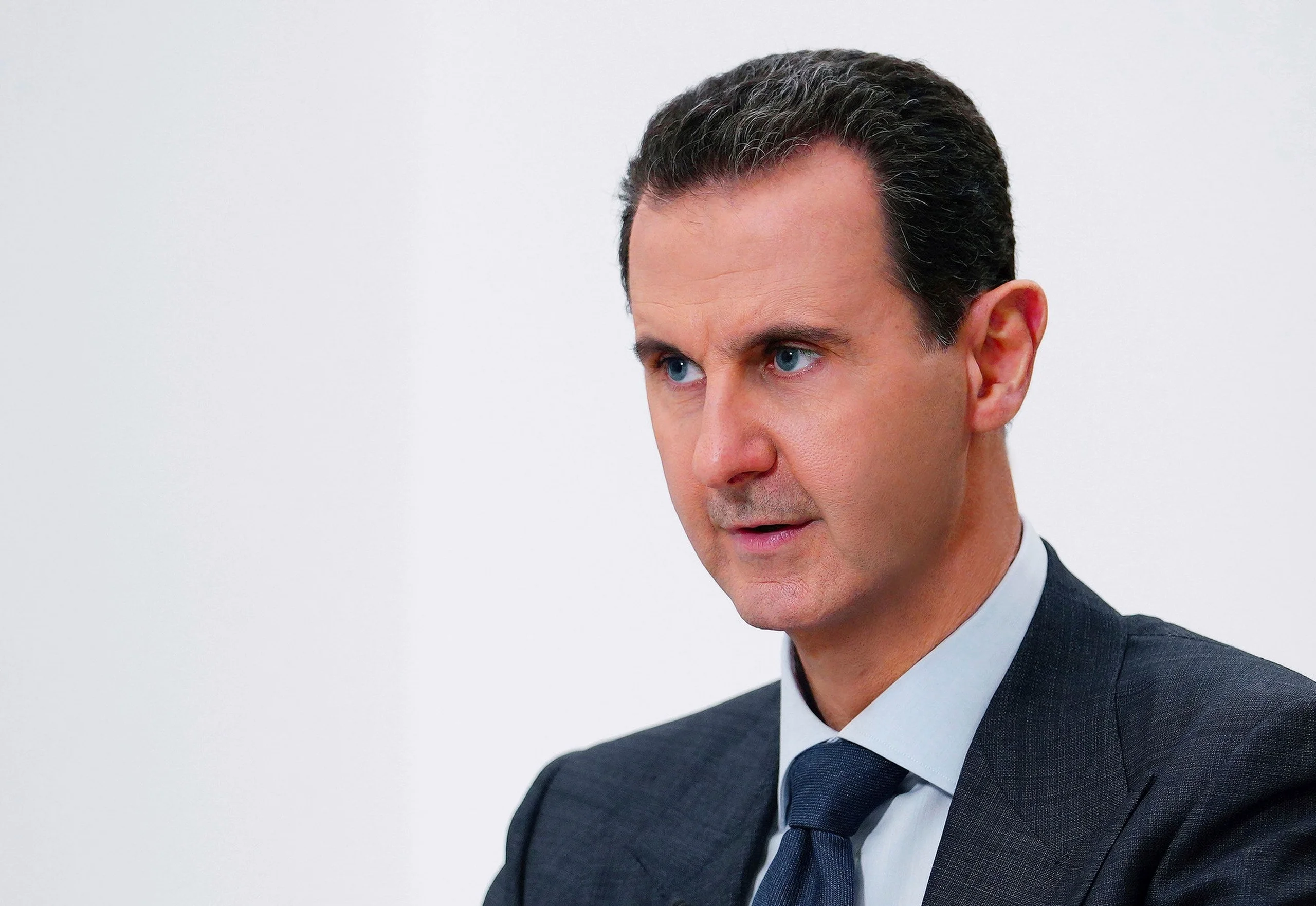
Bashar al-Assad
 Syria
Syriastatesperson•ophthalmologist•military leader
Also known as: The Lion of Damascus, Al-Bashar
Birthday
September 11, 1965
Birth Sign
Virgo
Birthplace
Damascus, Syria
Age
61 years old
Height
5 ft 10 in (1.78 m)
About
Bashar Hafez al-Assad is a former Syrian statesperson and medical doctor who served as the President of Syria from July 2000 until his overthrow in December 2024. He succeeded his father, Hafez al-Assad, after the elder Assad died in June 2000. As president, he held the titles of Commander-in-Chief of the Syrian Arab Armed Forces and Secretary-General of the Central Command of the Arab Socialist Ba'ath Party. His rule was defined by the brutal suppression of dissent during the Syrian Civil War and the eventual collapse of his regime following a rapid rebel offensive.
Before entering politics, Assad trained as an ophthalmologist in Damascus and London. His life changed drastically in 1994 when his older brother Bassel died in a car crash, forcing Bashar to abandon his medical career and enter the military academy to become the heir apparent. He rose through the ranks quickly, taking command of forces in Lebanon before ascending to the presidency. His tenure ended abruptly in December 2024 when he fled Damascus for Moscow, where he currently resides under Russian political asylum.
Early Life & Background
Bashar Hafez al-Assad was born on September 11, 1965, into the Alawite minority within Syria's ruling Ba'athist family. His early years were spent in the shadow of his father, Hafez al-Assad, who had seized power in a coup in 1970 and ruled with an iron fist. Unlike his elder brother Bassel, who was groomed from childhood to succeed their father, Bashar was not expected to hold high office. He pursued a quiet life focused on medicine, attending the University of Damascus where he earned a degree in ophthalmology in 1988.
In the early 1990s, Bashar moved to London to specialize further at the Western Eye Hospital. During this time, he lived a relatively normal life away from the intense scrutiny of Syrian politics, even dating and marrying Asma Akhras, a British-Syrian investment banker. His trajectory shifted irrevocably in January 1994 when Bassel died in a car accident while driving a Porsche 968 in the United Kingdom. The tragedy forced Bashar to return immediately to Damascus. He resigned his medical practice, entered the Syrian Military Academy, and underwent accelerated training to fill the void left by his brother. By 1998, he had risen to the rank of Colonel and assumed command of Syrian occupation forces in Lebanon, effectively ending his identity as a doctor and cementing his role as the designated successor.
Career Growth
Bashar al-Assad's political ascent began in earnest following the death of his father, Hafez al-Assad, on June 10, 2000. Just weeks later, on July 17, 2000, Bashar was elected President of Syria in a referendum where he received 97 percent of the vote in a single-candidate election. Initially, his presidency sparked hope among Syrians and the international community. Known for his liberal upbringing in London, he signaled potential reforms that led to the "Damascus Spring" in 2000 and 2001, a brief period of intellectual debate and calls for democracy.
Those hopes dissipated rapidly by 2002 as Assad cracked down on dissidents, arrested opposition leaders, and shut down independent newspapers. His administration maintained tight control over the country while facing increasing pressure over human rights abuses. In 2005, following the assassination of Lebanese Prime Minister Rafic Hariri, Syria was forced to withdraw its troops from Lebanon after decades of occupation. The situation escalated dramatically in 2011 when protests inspired by the Arab Spring turned into a full-scale civil war. Assad ordered a violent crackdown that resulted in hundreds of thousands of deaths and massive displacement.
The conflict dragged on for over a decade, with Assad surviving international isolation and chemical weapons accusations thanks to critical military intervention from Russia in 2015 and Iran in 2013. By 2021, his regime had regained control over most of Syrian territory, though the nation lay in ruins. The final chapter of his rule came in November 2024 when rebel coalitions launched a successful offensive. On December 8, 2024, as rebel forces entered Damascus, Assad fled to Moscow and was granted asylum by the Russian government. In August 2026, a Syrian court sentenced him to death in absentia for war crimes and crimes against humanity.
Career Timeline
Public Image & Style
Bashar al-Assad is one of the most polarizing figures in modern history. To his supporters, particularly within the Alawite community and some sectarian groups, he is viewed as a necessary protector of stability against chaos, terrorism, and foreign interference. They see his rule as a bulwark against the fragmentation of Syria. Conversely, the vast majority of the international community and the Syrian opposition view him as a brutal dictator responsible for systematic torture, mass killings, and the use of chemical weapons against civilians. His public image is characterized by a serious demeanor, often captured in photos with military personnel or signing decrees. Media coverage frequently depicts him as the face of totalitarianism and the failure of democratic transitions in the Middle East.
Fame & Fandom (iFAMOUS Rankings)
iFANN has not yet collected fame data for this person. While Bashar al-Assad commands a base of loyalists known as "Assad loyalists" or "Ba'athists," these groups do not constitute a traditional fandom in the cultural sense. Their support is driven by political allegiance, religious sect, and fear rather than celebrity worship. These loyalists engage in online campaigns to defend his legacy and organize physical demonstrations, but they lack the organized fan culture, merchandise, or creative projects seen with entertainment figures. The global reaction to him has been overwhelmingly negative, marked by widespread protests, sanctions, and demands for accountability rather than adoration.
Interesting Facts and Legends
Bashar al-Assad was once a practicing ophthalmologist who briefly worked in a hospital in Damascus before being recalled to military duty. He is the only member of his family to have been educated in the West, having spent several years studying in London. Despite his reputation as a hardline dictator, he initially gained cautious optimism from Western leaders in 2000, a sentiment that vanished within two years. He is known for his distinctively thinning hair in his later years and typically appears in public wearing formal suits or military fatigues. A persistent legend among his supporters claims he personally visited wounded soldiers in hospitals during the early days of the civil war, though independent verification remains scarce.
Notable Quotes
“I am a democrat." (2005 interview with The Economist)”
“We will fight terrorism... we will not surrender to any pressure." (Early civil war era)”
“Those who want to talk about the future must accept the reality of today." (Refusal to step down)”
Family & Personal Life
Bashar al-Assad comes from the prominent Alawite clan of the Assad family. His father, Hafez al-Assad, ruled Syria for three decades until his death in 2000. His older brother, Bassel al-Assad, died in a car crash in 1994, which paved the way for Bashar's succession. He has a younger brother, Maher al-Assad, who serves as the commander of the Republican Guard and is considered one of the most powerful figures in the regime. Bashar is married to Asma al-Assad, whom he met while both were students in London. They have two sons together: Hafez, born in 2001, and Karim, born in 2004. There are also unverified reports of a daughter named Zainab. The family lived in the presidential palace in Damascus until fleeing in 2024.
Notable Connections
Hafez al-Assad, Asma al-Assad, Maher al-Assad, Vladimir Putin, Ahmed al-Sharaa, Rafic Hariri.
Relationships & Dating History
Bashar al-Assad has been married to only one person throughout his public life. He wed Asma Akhras in 2000. The couple met while both were studying in London, where she was an investment banker specializing in IT. Upon marriage, she converted to Islam and adopted the name Asma al-Assad. Known internationally as the "First Lady," she became a polarizing figure due to her British upbringing and perceived support for the regime's tactics. She accompanied him during the civil war but has largely remained out of the public eye since his flight in 2024.
There are no credible public records of other romantic relationships or dating history prior to his marriage. Asma al-Assad remains his sole spouse. Following his ouster and flight to Russia in December 2024, the couple is effectively separated geographically. Assad resides in Moscow under Russian protection, while Asma's current whereabouts are reported as uncertain, with some sources suggesting she may be in Syria under house arrest or protection by the new interim authorities. They have two sons, Hafez and Karim.
- MarriedAsma al-Assad2000 - presentCurrentMet in London; she is the First Lady of Syria.
Salary, Net Worth In 2026
$15 Billion
iFANN Editorial Team estimate
Estimating the net worth of Bashar al-Assad presents unique challenges due to the nature of his wealth accumulation and the current political climate. For decades, his fortune was intertwined with state assets, oil revenues, and illicit trade networks controlled by the Syrian regime. Credible investigative reports historically placed his personal wealth between $5 billion and $15 billion at the height of his power. This wealth was derived from extensive corruption, including kickbacks on reconstruction contracts, control of key industries, and the seizure of assets from opponents.
Following his flight to Moscow in December 2024 and the establishment of a new interim government in Syria, the status of his assets has shifted dramatically. Domestic properties, bank accounts, and businesses have likely been frozen or seized by the new authorities. As of 2026, Assad resides in Russia on political asylum, relying on provisions provided by the Russian state. No specific liquid net worth figures exist for 2026 because he is a fugitive under sentence of death, and his remaining assets are subject to international sanctions and confiscation proceedings. The iFANN Editorial Team estimates his historical peak value at approximately $15 Billion based on available records, though his current accessible wealth is effectively nil.
Awards & Accolades
View 6 records, honours and achievementsKnown For
President of Syria
2000 · Political Leader
Syrian Civil War
2011 · Commander-in-Chief
Flight from Damascus
2024 · Former Head of State
Keywords
Sources
Quick Facts
- Profession
- statesperson, ophthalmologist, military leader
- Born
- September 11, 1965
- Birthplace
- Damascus, Syria
- Gender
- Male
- Spouse
- Asma al-Assad
- Birth Sign
- Virgo
Personal Details
- Full Name
- Bashar Hafez al-Assad
- Height
- 5 ft 10 in (1.78 m)
- Spouse
- Asma al-Assad
- Children
- Hafez al-Assad, Karim al-Assad
- Education
- University of Damascus (Ophthalmology), Western Eye Hospital London
Frequently Asked Questions
What happened to Bashar al-Assad in 2024?
Is Bashar al-Assad dead?
How many people died under Bashar al-Assad's rule?
Why was Bashar al-Assad sentenced to death?
Who is Bashar al-Assad's wife?
Similar People
Join the community
fans discussing