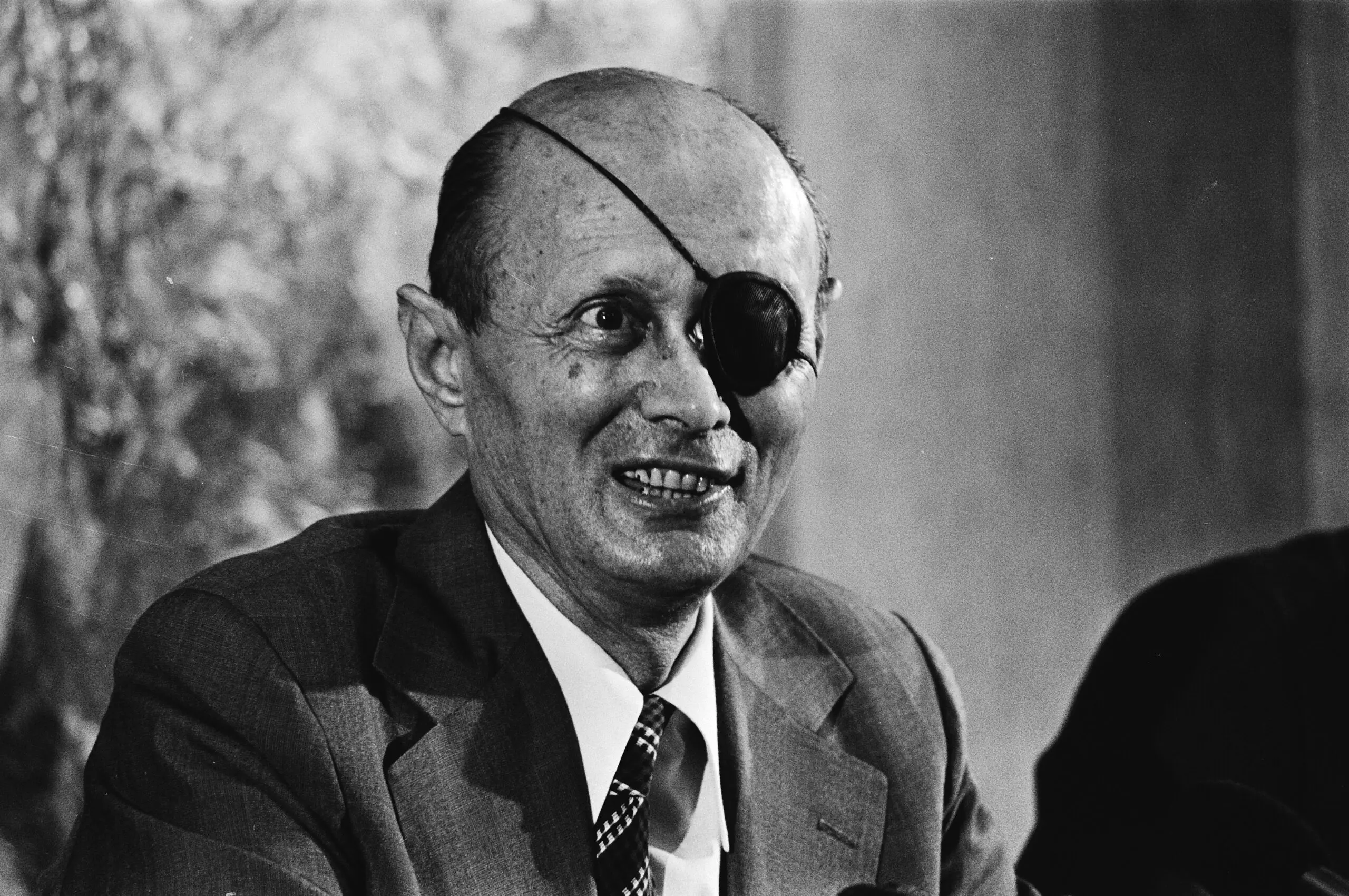
Moshe Dayan
 Israel
military personnel•politician•archaeologist
Also known as: Moshe Daian
Birthday
May 20, 1915
Birth Sign
Taurus
Birthplace
Degania Alef, Mandatory Palestine
Age
Died at 66
About
Moshe Dayan was an Israeli military leader, politician, and amateur archaeologist whose career shaped the nation's formative decades. He became a worldwide symbol of the new state of Israel through his roles as commander of the Jerusalem front in the 1948 Arab-Israeli War, Chief of the General Staff of the Israel Defense Forces from 1953 to 1958, and Defense Minister during the Six-Day War in 1967.
Dayan's distinctive eyepatch, the result of a sniper's bullet during World War II, made him instantly recognizable. He was a close associate of David Ben-Gurion and later served as Foreign Minister under Menachem Begin, playing a key role in negotiating the Egypt-Israel peace treaty. His legacy is complex: a warrior who led Israel to crucial victories and a statesman who pursued peace.
Dayan passed away on October 16, 1981, at the age of 66, leaving behind a legacy that continues to be studied and debated.
Early Life & Background
Moshe Dayan was born on May 20, 1915, in Degania Alef, one of the first kibbutzim in Mandatory Palestine. His parents, Shmuel and Devorah Dayan, were pioneers from Ukraine who had settled in the region as part of the early Zionist movement. Growing up on the kibbutz, Dayan was immersed in the agricultural and communal life that defined the settlement.
At the age of 14, he joined the Haganah, the pre-state Jewish defense force, and received his first military training. During the Arab Revolt of 1936-1939, he served under Orde Wingate in the Special Night Squads, where he learned unconventional warfare tactics that would later influence his military thinking.
In 1941, during a raid against Vichy French forces in Lebanon, a sniper's bullet struck the binoculars he was holding, shattering his left eye and causing severe injuries. He was forced to wear a black eyepatch for the rest of his life, which became his trademark. Despite the injury, Dayan continued his military career, rising through the ranks of the Haganah and later the Israel Defense Forces.
Career Growth
Dayan's breakthrough came during the 1948 Arab-Israeli War, when he commanded the Jerusalem front and led the capture of key positions. His success brought him to the attention of David Ben-Gurion, who appointed him as the fourth Chief of Staff of the IDF in 1953. In that role, he oversaw the 1956 Sinai Campaign, where Israel's swift victory against Egypt demonstrated his strategic acumen.
After leaving the military, Dayan entered politics. He was elected to the Knesset in 1959 and served as Minister of Agriculture. In 1965, he left Mapai with Ben-Gurion to co-found the Rafi party alongside Shimon Peres. In 1967, just before the Six-Day War, he was appointed Defense Minister, a move that boosted public confidence and led to Israel's decisive victory.
The Yom Kippur War of 1973 proved a turning point. Dayan, as Defense Minister, bore significant blame for Israel's unpreparedness, and he resigned with Golda Meir's government in early 1974. In 1977, he was expelled from the Labor Party for joining Menachem Begin's Likud-led government as Foreign Minister. In that role, he played a pivotal part in negotiating the Egypt-Israel peace treaty, signed in 1979, which earned him international acclaim.
Career Timeline
Public Image & Style
Moshe Dayan's public image was defined by his distinctive eyepatch, which made him one of the most recognizable figures in the world. He was often photographed with a cigarette in hand, projecting an air of confidence and defiance. The media portrayed him as a tough, pragmatic military leader, a 'crusader for peace' in later years.
Dayan's blunt speaking style and willingness to make controversial decisions earned him both admiration and criticism. He was seen as a symbol of Israeli strength and resilience, but also as a figure who bore responsibility for the failures of the Yom Kippur War. His legacy remains a subject of debate among historians and the public.
His eyepatch became a cultural icon, often referenced in popular culture as a shorthand for military leadership and determination.
Fame & Fandom (iFAMOUS Rankings)
Moshe Dayan stands as the 76th most famous person in Israel and the 16th most famous person from Israel, according to the iFANN Global Fame Rankings. These placements have held steady through the latest cycle, cementing his status as a towering figure whose image transcends generations. His enduring presence reflects a global attention that spans media coverage, search activity, and cultural consumption signals worldwide.
Despite this massive reach, Dayan does not possess a fandom in the modern sense of organized clubs or ritualistic fan behavior. He was a statesman and military commander rather than an entertainer, so there is no official moniker for his supporters, nor do fans gather for birthday campaigns or social media pushes. The reverence he commands comes from his role as a foundational icon of the state of Israel, maintained through historical education and national memory rather than active fan activism. While discussions about his legacy occasionally resurface in contemporary political analysis, they stem from his impact on history rather than the whims of a dedicated fanbase.
Interesting Facts and Legends
Moshe Dayan was an avid amateur archaeologist who collected thousands of artifacts, many later donated to the Israel Museum, often carrying a small notebook to record finds during his travels. A chain smoker, he frequently appeared with a cigarette in hand, projecting a distinct air of defiance alongside his blunt speaking style. His autobiography 'Story of My Life' (1976) and 'Living with the Bible' (1978) reflected his deep interest in the land's history. His eyepatch, once sold on eBay, became a symbol of his persona.
The legends surrounding Dayan are rooted in verified milestones that shaped his iconic status. During World War II, he lost his left eye to a sniper's bullet in Syria in 1941, an injury that gave him his instantly recognizable look. This image became the face of Israel's victory in the Six-Day War in 1967, where he served as Defense Minister. Another notable chapter involved his 1966 tour of Vietnam, where he publicly criticized U.S. arrogance regarding the war effort, showcasing his independent and contrarian stance. When he died of a heart attack in 1981, world leaders like Ronald Reagan mourned him as a courageous soldier and great statesman, ensuring his legacy endures as a symbol of security and statecraft.
Notable Quotes
“If you want to make peace, you don't talk to your friends. You talk to your enemies.”
“Israel must be like a wildcat, ready to spring at any moment.”
“We are a small country, but we have a big heart.”
“The past is not dead; it is not even past.”
“I have always believed that the land of Israel is the heart of the Jewish people.”
Family & Personal Life
Moshe Dayan married Ruth Schwartz in 1935. The couple had three children: Yael, a writer and politician; Udi, a sculptor; and Assi, a film director and actor. Ruth Dayan became a prominent peace activist and founded the Maskit fashion house, which promoted traditional crafts. The couple divorced in 1971, but Ruth continued to use the Dayan name.
Dayan's family was deeply tied to the land of Israel. His father, Shmuel, was a member of the first Knesset and a founder of the moshav movement. His daughter Yael followed in his footsteps as a member of the Knesset, and his son Assi became a celebrated filmmaker.
Ruth Dayan passed away in 2026 at the age of 103, outliving Moshe by 45 years. Her death marked the end of an era for the family.
Notable Connections
Relationships & Dating History
Moshe Dayan married Ruth Schwartz in 1935. Their marriage lasted 36 years, during which they had three children. The couple divorced in 1971, though they remained on amicable terms. Ruth went on to become a prominent peace activist and passed away in 2026 at the age of 103.
After his divorce, Dayan was linked to several women, but he never remarried. His most notable relationship was with actress and singer Shoshana Damari, with whom he had a long-term affair that was widely reported. The relationship ended before his death.
At the time of his death in 1981, Dayan was single, having been divorced for a decade. His personal life was often overshadowed by his public duties, and he remained devoted to his family throughout his life.
- MarriedRuth Dayan1935 - 1971Married for 36 years; had three children together; divorced in 1971.
- DatedShoshana Damari1970 - 1975Long-term affair; widely reported in the press.
Death & Aftermath
Died
October 16, 1981 (aged 66)
Death Place
Kibbutz Mishmar HaEmek
Cause of Death
Cancer of the colon
Upon the announcement of Moshe Dayan's passing, Israel declared a day of national mourning that saw moments of silence across the country and widespread media coverage honoring his legacy. Tributes poured in from high-ranking officials, including Prime Minister Menachem Begin and President Chaim Herzog, who hailed him as a courageous soldier and a great Israeli statesman whose leadership was the envy of the world. The global community also expressed grief, with leaders from the United States and other nations sending condolences to mark the loss of a figure who had become a worldwide symbol of the new state. Dayan passed away on October 16, 1981, at his home in Kibbutz Mishmar HaEmek following a long battle with cancer.
Medical records indicate that he underwent surgery for colon cancer in 1978 and suffered from recurring complications thereafter, spending his final days in relative privacy under the care of family and medical staff. The official cause of death was confirmed as cancer of the colon through hospital statements and family confirmation rather than a post-mortem forensic ruling. The funeral took place two days later on October 18, 1981, as a state ceremony held at Kibbutz Mishmar HaEmek where thousands of mourners gathered. The service featured traditional Jewish rites and military honors befitting his status as a former Chief of Staff of the IDF and Defense Minister, attended by government officials, military leaders, and members of the public before he was buried in the kibbutz cemetery.
In the posthumous era, his legacy has been preserved through the Moshe Dayan Center for Middle Eastern and African Studies at Tel Aviv University and various cultural works, including a documentary series exploring his life and the First Family of Israel. Modern tributes continue to emerge, such as the approval of the Moshe Dayan Transportation Hub expansion by the Israel Ministry of Transportation in 2023, designed by HQ Architects and SOM to serve as a contemporary monument to his name.
Net Worth (Estate Value)
$10 Million
iFANN Editorial Team estimate
Moshe Dayan's net worth at the time of his death in 1981 was modest by modern standards. As a public servant, his income came from his military and political salaries, as well as royalties from his books. His autobiography 'Story of My Life' and other writings contributed to his estate. Per iFANN's editorial analysis, the estate's value as of 2026 is estimated at $10 million, reflecting the ongoing royalties from his books and the sale of his personal effects, including his famous eyepatch, which was auctioned on eBay. The estate is managed by his children, who have preserved his legacy. Dayan's financial situation was never a focus of his public life; he was known for his dedication to the state rather than personal wealth. His estate's value today is largely a result of the historical significance of his belongings and writings.
Awards & Accolades
View 2 records, honours and achievementsKnown For
Six-Day War
1967 · Defense Minister
Sinai Campaign
1956 · Chief of Staff
Egypt-Israel Peace Treaty
1979 · Foreign Minister
Keywords
Sources
Quick Facts
- Profession
- military personnel, politician, archaeologist
- Born
- May 20, 1915
- Birthplace
- Degania Alef, Mandatory Palestine
- Died
- October 16, 1981
- Death Place
- Tel Aviv, Israel
- Gender
- Male
- Spouse
- Ruth Dayan
- Birth Sign
- Taurus
- Children
- Yael Dayan, Udi Dayan, Assi Dayan
Personal Details
- Full Name
- Moshe Dayan
- Spouse
- Ruth Dayan
- Children
- Yael Dayan, Udi Dayan, Assi Dayan
Frequently Asked Questions
Who was Moshe Dayan?
What was Moshe Dayan's net worth?
Why was Moshe Dayan famous?
How did Moshe Dayan die?
Is Moshe Dayan still alive?
Similar People
Join the community
fans discussing