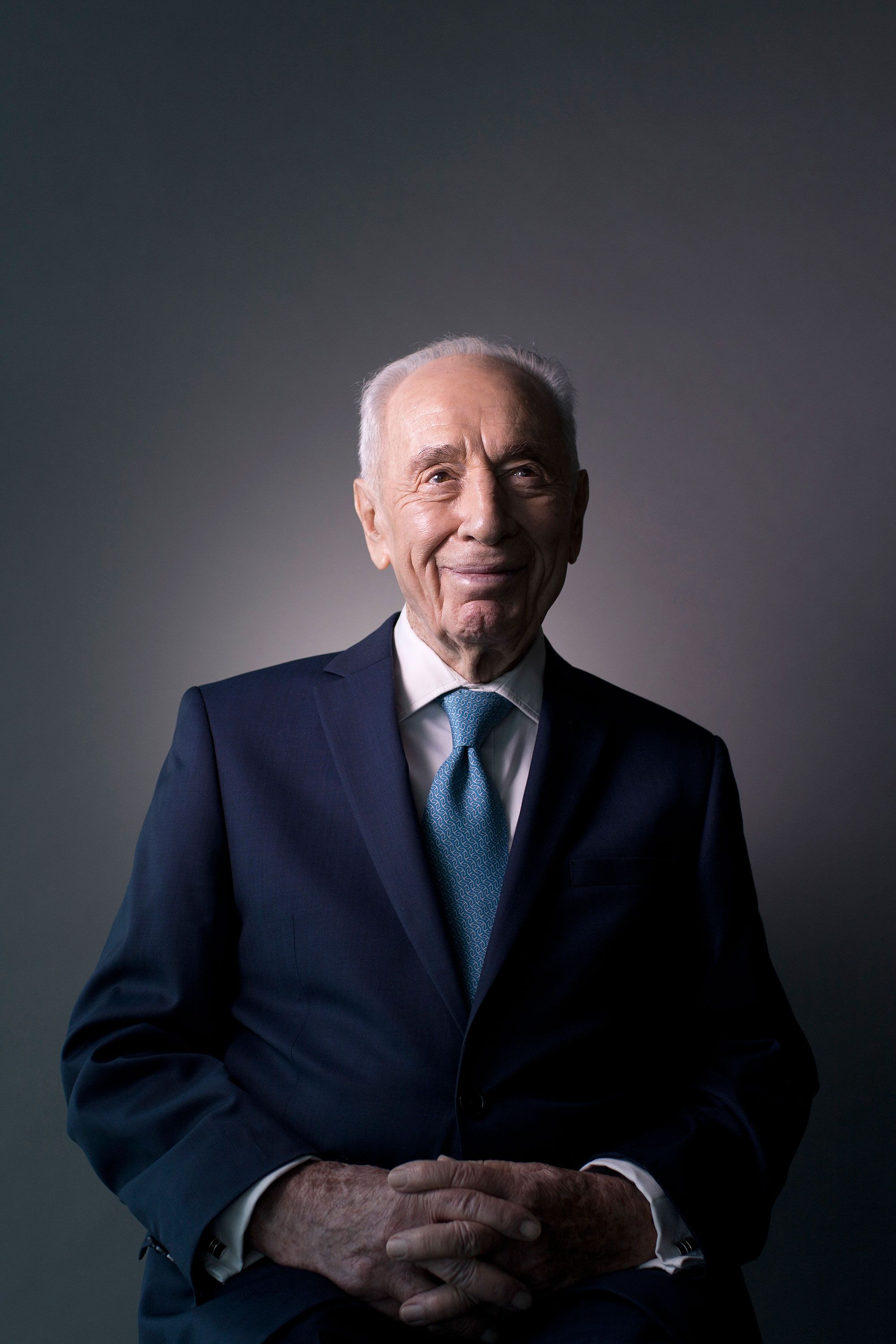
Shimon Peres
 Israel
Also known as: Szymon Perski, Shimon Persky
Birthday
August 2, 1923
Birth Sign
Leo
Birthplace
Višnieva, Poland
Age
Died at 93
About
Shimon Peres was an Israeli statesman who served as prime minister from 1984 to 1986 and again from 1995 to 1996, and as president from 2007 to 2014. His political career spanned seven decades, during which he held positions in twelve cabinets and represented five political parties. First elected to the Knesset in November 1959, he served continuously until 2006, making him the longest-serving member in the Knesset's history. At his retirement in 2014, he was the world's oldest head of state and the last living link to Israel's founding generation.
Peres was the architect of the Oslo Accords, the 1993 peace agreement with the Palestinian leadership, for which he, Yitzhak Rabin, and Yasser Arafat received the Nobel Peace Prize in 1994. He also engineered the Israel-Jordan peace treaty the same year. After Rabin's assassination in 1995, Peres stepped in as prime minister, but lost the 1996 election to Benjamin Netanyahu. In 1996, he founded the Peres Center for Peace, dedicated to fostering tolerance and cooperation across the Middle East. He died on September 28, 2016, at Sheba Medical Center, following a stroke. He was 93 years old, leaving behind a legacy of tireless diplomacy and a vision for a peaceful region.
Early Life & Background
Born Szymon Perski on August 2, 1923, in the small Polish town of Višnieva, Shimon Peres grew up in a secular Jewish family. His father, Yitzhak, was a timber merchant, and his mother, Sara, was a teacher. The family spoke Hebrew and Yiddish at home, and his grandfather, a rabbi, influenced his early education. When Peres was 11, his father immigrated to Palestine, and the family followed in 1934, settling in Tel Aviv. Peres adopted the Hebrew name "Shimon Peres" upon arrival.
He attended Balfour High School and joined the "Hanoar Haoved" (Working Youth) movement, aligning himself with labor Zionism. At age 17, he was elected secretary of the movement. In 1939, he co-founded Kibbutz Alumot in the Lower Galilee. He also studied at the Ben Shemen agricultural boarding school, where he developed a passion for agriculture and leadership.
Peres joined the Haganah, the underground Jewish defense force, in 1947 and was recruited by David Ben-Gurion, who recognized his sharp intellect. During Israel's War of Independence in 1948, he was appointed head of the navy's personnel department. In 1952, at age 28, he became deputy director general of the Ministry of Defense, and in 1953 he was promoted to director general, a post he held until 1959. In this role, he was instrumental in building Israel's defense industry and securing French arms, including the Dassault Mirage fighter jets. In 1956, he participated in the secret negotiations leading to the Protocol of Sèvres, a pact that preceded the Suez Crisis.
Career Growth
Peres's political career took off when he was first elected to the Knesset in November 1959 as a member of Mapai. He served as Deputy Minister of Defense from 1959 to 1965. In 1963, he negotiated with President John F. Kennedy to secure the sale of Hawk anti-aircraft missiles, a historic first for U.S.-Israel military relations. After a split in Mapai, he joined Ben-Gurion's Rafi party in 1965, later returning to the Labor Party in 1968. He held various ministerial posts through the 1970s, including Minister of Defense from 1974 to 1977, during which he oversaw the Entebbe raid.
After Labor's defeat in 1977, Peres became party leader and Leader of the Opposition. He first served as Prime Minister from 1984 to 1986 as part of a national unity government, implementing the 1985 Economic Stabilization Plan that tamed hyperinflation. He also oversaw the withdrawal of Israeli forces from Lebanon in 1985. In the 1990s, as Foreign Minister under Yitzhak Rabin, he was the architect of the Oslo Accords, earning the Nobel Peace Prize in 1994. That same year, he engineered the Israel-Jordan peace treaty. After Rabin's assassination in 1995, Peres became Prime Minister for the second time, serving until his 1996 election loss to Benjamin Netanyahu.
In 1996, he founded the Peres Center for Peace. He later served as Minister for Regional Cooperation (1999-2001) and Vice Premier (2001-2002) under Ariel Sharon. In 2005, he joined Sharon's new Kadima party. In 2007, he was elected President of Israel, a role he held until 2014, using his moral authority to advocate for peace and innovation.
Career Timeline
Public Image & Style
Peres's public image evolved dramatically over his career. In his early years, he was seen as a defense hawk, instrumental in building Israel's military capabilities. Later, he became known as a dove and peace advocate, particularly after the Oslo Accords. He was often described as a "dreamer" and an "optimist." His signature style included tailored suits, a warm smile, and eloquent, philosophical speeches. He was known for his wit and ability to quote poetry and literature. The Peres Center for Peace and Innovation serves as the custodian of his legacy, hosting events and educational programs. He remains a beloved figure among Israelis who remember the founding generation, and his legacy is celebrated in Israel and among Jewish communities worldwide.
Fame & Fandom (iFAMOUS Rankings)
Shimon Peres stood as a towering figure in the Middle East, a statesman whose influence rippled far beyond the borders of his homeland. His enduring presence is quantified by global metrics that place him as the 38th most famous person in Middle East, a position he held steady through cycles of regional change. Within his own nation, his stature was even more pronounced; he ranked as the 16th most famous person in Israel and the 11th most famous person from Israel. These placements reflect a legacy built on decades of statecraft rather than fleeting celebrity, anchoring him firmly in the collective memory of a generation that founded a modern state. The iFANN Global Fame Rankings capture this sustained attention across media and historical archives without needing to dissect the specific signals behind the numbers.
Unlike pop stars or entertainers, Peres never cultivated a formal fandom with a specific name or organized fan clubs. There were no crowds fainting at his appearances or subway ads funded by admirers. Instead, his supporters engaged with his vision through political institutions and the Peres Center for Peace & Innovation. This organization remains the primary vehicle for those wishing to honor his work, focusing on peace-building and technological advancement rather than celebrity memorabilia. While he lacked a fanbase in the traditional sense, his death in 2016 triggered a wave of national mourning that underscored his status as the last living link to Israel's founding generation. Tributes continue to this day, including the inauguration of a square in Paris in 2026, proving that his legend transcends the typical boundaries of fame to become part of history itself.
Interesting Facts and Legends
Shimon Peres left behind a rich literary legacy, having authored over a dozen books that ranged from memoirs and poetry collections to works of political philosophy. His poems were translated into multiple languages, reflecting a deep connection to literature that often infused his speeches. He championed a "New Middle East" vision in his 1993 book, advocating for regional economic integration long before it became a common talking point. A lifelong optimist, he famously noted that while optimists and pessimists die the same way, they live differently. He also wrote children's books and held the record as the world's oldest head of state upon retiring in 2014 at age 90.
The stories surrounding Peres are less about viral moments and more about historic milestones. He was the first Israeli president to visit the Vatican, meeting Pope Francis in 2014, an act that symbolized his diplomatic reach. Following his death in September 2016, the narrative of his life evolved into a defining chapter of Israeli history. By February 2026, his legacy was cemented further when a square in Paris was inaugurated to honor his life of diplomacy, described by Mayor Ariel Weil as a symbol of fraternity. Additionally, a medical center in Beersheba bears his name, ensuring his impact on public infrastructure endures for future generations.
Notable Quotes
“Optimists and pessimists die the same way, but they live differently.”
“The peace we are striving for is not a piece of paper, but a shared future.”
“I am a dreamer, but I am also a doer.”
“We have to be fast, we have to be smart, and we have to be first.”
Family & Personal Life
Peres married Sonia Gelman in 1945, and they remained married until her death in 2011. Sonia was known for her aversion to public life and rarely appeared at official functions. They had three children: daughter Zvia (born 1947) and sons Yonatan (born 1952) and Nehemia "Chemi" (born 1955). The family lived in Tel Aviv, and later in Manhattan while Peres studied at New York University. His son Chemi is a venture capitalist and heads the Peres Center for Peace and Innovation. Peres was survived by his three children, eight grandchildren, and several great-grandchildren.
Notable Connections
Shimon Peres was closely associated with several key figures in Israeli and international politics. David Ben-Gurion was his mentor, who brought him into the defense establishment. He worked alongside Yitzhak Rabin, with whom he shared the Nobel Peace Prize. He also had a long political rivalry and partnership with Yitzhak Shamir. Internationally, he engaged with U.S. presidents from John F. Kennedy to Barack Obama, and with leaders like Yasser Arafat and King Hussein of Jordan.
Relationships & Dating History
Shimon Peres had a single, lifelong marriage. He married Sonia Gelman in 1945, and they remained together until her death on January 20, 2011. Sonia was a quiet, private woman who shunned the public spotlight and rarely accompanied her husband to official events. They met in their youth in Tel Aviv, where both were active in the Labor Zionist youth movement. The couple had three children: Zvia, Yonatan, and Chemi. Sonia died at her home in Tel Aviv at age 87, after a long illness. Peres was widowed for the remaining five years of his life and did not remarry. At the time of his death in 2016, he was survived by his children and grandchildren.
- MarriedSonia Peres1945 - 2011Married for 66 years until her death; they had three children together.
Death & Aftermath
Died
September 28, 2016 (aged 93)
Death Place
Jerusalem, Jerusalem District, Israel
Cause of Death
Massive stroke leading to coma
The family of Shimon Peres and the Israeli government officially confirmed his passing early on the morning of September 28, 2016, at Hadassah Medical Center in Jerusalem. The announcement followed a severe stroke that had sent the former president into a coma days earlier, ending a life that spanned nine decades of public service. Initial reports fluctuated between the 27th and 28th of September before the hospital clarified the exact moment biological functions ceased. Peres had been hospitalized since September 20 after suffering a mild stroke, but his condition deteriorated rapidly over the following week until a massive stroke left him unconscious and unresponsive to medical stabilization efforts.
His final public appearance occurred earlier in the year, with his last days marked by sparse updates describing him as sleeping before he passed. Global reaction arrived immediately, with President Reuven Rivlin declaring a seven-day period of national mourning across Israel. World leaders including US President Barack Obama, UN Secretary-General Ban Ki-moon, French President François Hollande, and German Chancellor Angela Merkel issued tributes honoring his legacy as an architect of peace. Vigils were held in major cities worldwide, and a moment of silence was observed in the Knesset while the White House released statements praising his contributions to the Middle East peace process.
A state funeral took place on September 30, 2016, at Mount Herzl in Jerusalem, attended by hundreds of dignitaries and featuring eulogies from Israeli leaders and performances by the Israel Philharmonic Orchestra. Peres was buried in the military section of the cemetery next to other founders of the state. Posthumously, the Peres Center for Peace and Innovation continued its work under his son Chemi Peres, and dedications such as the planned Shimon Peres Square in Paris reflected his enduring international stature.
Net Worth (Estate Value)
$10 Million
iFANN Editorial Team estimate
iFANN currently estimates Shimon Peres had a net worth of $10 million at the time of his death in 2016. This figure reflects his salary as a public official, book royalties from his numerous publications, and speaking fees. Peres lived modestly in a Tel Aviv apartment, far from the opulence of many world leaders. His estate is managed by his children, particularly his son Chemi Peres, who is a venture capitalist and heads the Peres Center for Peace and Innovation. The estate's primary revenue sources include ongoing book royalties, documentary licensing deals (including the 2026 Netflix documentary "Never Stop Dreaming: The Life and Legacy of Shimon Peres"), and the operations of the Peres Center, which receives funding from donations and international grants. As of 2026, the estate's value remains approximately $10 million, with no significant posthumous revenue surge reported.
Awards Won (7)
Shimon Peres received numerous prestigious awards throughout his career, most notably the Nobel Peace Prize in 1994, shared with Yitzhak Rabin and Yasser Arafat for the Oslo Accords. He was also honored with the Presidential Medal of Freedom in 2012, the Congressional Gold Medal in 2014, and the Grand Cross of the Legion of Honour from France in 2008. His other honors include the Indira Gandhi Prize, the Prince of Asturias Award, and the Charlemagne Prize.
1994 · Peace
Oslo Accords
2012 · Civilian Honor
Lifetime achievement
Known For
Oslo Accords
1993 · Architect and Foreign Minister
Nobel Peace Prize
1994 · Co-recipient
President of Israel
2007 · President
Prime Minister of Israel
1984 · Prime Minister
Keywords
Sources
Quick Facts
- Profession
- politician, writer, poet
- Born
- +1923-08-02
- Birthplace
- Višnieva, Poland
- Died
- +2016-09-28
- Death Place
- Sheba Medical Center, Israel
- Gender
- Male
- Spouse
- Sonia Peres
- Birth Sign
- Leo
- Children
- Zvia, Yonatan, Chemi
- Education
- New York University, Harvard University
Personal Details
- Full Name
- Szymon Perski
- Spouse
- Sonia Peres
- Children
- Zvia Peres, Yonatan Peres, Chemi Peres
- Education
- New York University, Harvard University
Frequently Asked Questions
How old was Shimon Peres when he died?
What was Shimon Peres's net worth at his death?
Is Shimon Peres still alive in 2026?
What is Shimon Peres best known for?
How did Shimon Peres contribute to Israeli innovation?
Social Media
Join the community
fans discussing