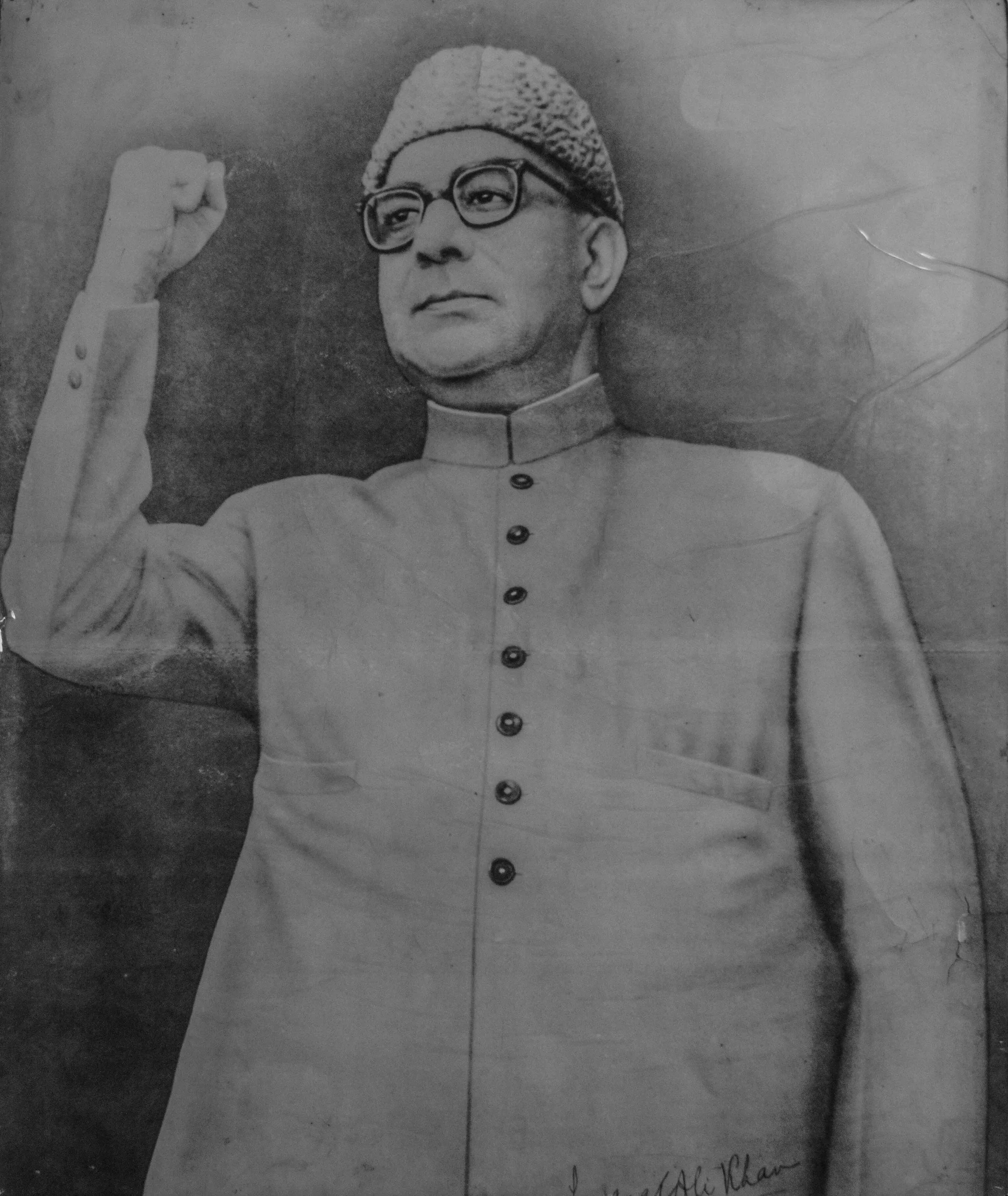
Liaquat Ali Khan
 Pakistan
Also known as: Nawabzada Liaquat Ali Khan, Quaid-e-Millat, Shaheed-e-Millat, Right Hand of the Quaid
Birthday
October 1, 1895
Birth Sign
Libra
Birthplace
Karnal, British India (present-day Haryana, India)
Age
Died at 56
About
Liaquat Ali Khan stands as the founding father and first Prime Minister of Pakistan, serving from the nation's inception in August 1947 until his assassination in October 1951. A distinguished lawyer, diplomat, and statesman, he is revered in Pakistan with the titles Quaid-e-Millat (Leader of the Nation) and Shaheed-e-Millat (Martyr of the Nation). Born on October 1, 1895, in Karnal, Punjab, he emerged as a central figure in the struggle for Indian independence and the subsequent creation of Pakistan, working inextricably alongside Muhammad Ali Jinnah. His legacy is defined by his role in establishing the foundational structures of a new state, navigating it through its most volatile early years.
As the head of government, he established the foundations of Pakistan's foreign policy, aligning the country with the Western Bloc during the early Cold War while simultaneously managing internal crises. He championed the Objectives Resolution in 1949, which laid the constitutional groundwork for Pakistan as an Islamic democracy. His leadership navigated the fledgling state through critical challenges, including the massive refugee crisis resulting from partition and the complex negotiations regarding water rights with India.
Early Life & Background
Born Nawabzada Liaquat Ali Khan into a wealthy, aristocratic Muslim family, his upbringing was steeped in education and political engagement. His father, Nawab Abdul Wahid, was a prominent landowner and member of the Imperial Legislative Council, while his mother, Zain-un-Nissa Begum, came from a noble lineage. He received his early education at home with private tutors before enrolling at the Muir Central College in Allahabad. In 1912, he moved to Aligarh Muslim University, where he completed his Bachelor of Arts degree in 1913.
His pursuit of higher learning took him to London, where he enrolled at Lincoln's Inn to study law. There, he earned his B.A. from Oxford University (Balliol College) in 1918 and qualified as a barrister in 1920. During his time in England, he became deeply involved in the Indian independence movement, associating with figures like Mahatma Gandhi and Jawaharlal Nehru initially, though he later shifted his allegiance to the All-India Muslim League. Upon returning to India, he practiced law in Delhi and joined the All-India Muslim League in 1923, quickly distinguishing himself through his oratory skills and legal acumen.
Career Growth
Following the partition of India, Liaquat Ali Khan was appointed the first Prime Minister of Pakistan on August 14, 1947. Simultaneously, he held the portfolios of Foreign Minister, Defense Minister, and Minister for Frontier Regions, consolidating immense power to navigate the fledgling state through its most critical years. During World War II, he had already served as Finance Member of the Viceroy's Executive Council (1946), managing the financial aspects of the war effort. He served as the General Secretary of the All-India Muslim League from 1936 to 1947, effectively becoming the organization's chief strategist. His tenure ended abruptly with his assassination on October 16, 1951, in Rawalpindi.
Career Timeline
Public Image & Style
Liaquat Ali Khan is viewed with solemn reverence as a founding father and martyr. His image is ubiquitous in Pakistani schools, government buildings, and currency. He was known for wearing traditional Western-style suits during official duties and sherwani during cultural events, often sporting a neatly trimmed beard. Unlike modern celebrities, his public persona was defined by statesmanship and political gravitas rather than fashion or entertainment. He is remembered for his diplomatic skill and his unwavering commitment to the creation of Pakistan. Contemporary accounts describe him as chubby and moderate even as he fell, an event that instantly transformed him into a martyr. Decades later, conspiracy theories regarding Cold War espionage or internal rivals continue to circulate as folklore surrounding the attack, though the shooting itself remains an undisputed historical fact. Recent research has also brought to light newly revealed files from 1947 showing early cooperation efforts between Nehru and Liaquat, adding nuance to the lore of early India-Pakistan relations.
Fame & Fandom (iFAMOUS Rankings)
Liaquat Ali Khan commands a legacy defined not by the chaotic energy of modern celebrity culture, but by the solemn reverence accorded to a founding father who gave his life for his nation. His public presence is maintained through state-sponsored commemoration and deep historical study rather than fan clubs or viral trends. While recent news snippets occasionally confuse his name with contemporary figures, the enduring admiration for the first Prime Minister remains rooted in political mythology and the tragic narrative of his martyrdom. There is no formal organization of fans, nor do followers gather for birthday billboards or stream his speeches as entertainment; instead, he stands as a symbol of national identity where interaction was once formal governance and now serves as a subject of profound historical inquiry. This unique form of fandom treats his memory with the gravity of a sacred trust, ensuring his story survives without the need for organized campaigns or self-branding. The global scale of this remembrance is captured in the iFANN Global Fame Rankings. As of September 2026, iFANN's Global Fame Engine has evaluated this person, but they do not currently hold a placement in the published rankings. Fandom name: none documented in iFANN data.
Interesting Facts and Legends
Born in Karnal in 1895, Liaquat Ali Khan served as the first prime minister of Pakistan until his assassination in 1951. He earned the titles Quaid-e-Millat and Shaheed-e-Millat for his pivotal role in the independence movement alongside Muhammad Ali Jinnah. A persistent legend in Pakistani historiography describes him as the indispensable "Right Hand of the Quaid," a narrative that underscores his critical partnership during the partition of India. The defining moment of his life occurred on October 16, 1951, when he was shot while delivering a speech at Iqbal Park in Rawalpindi. Contemporary accounts describe him as chubby and moderate even as he fell, an event that instantly transformed him into a martyr. Decades later, conspiracy theories regarding Cold War espionage or internal rivals continue to circulate as folklore surrounding the attack, though the shooting itself remains an undisputed historical fact. Recent research has also brought to light newly revealed files from 1947 showing early cooperation efforts between Nehru and Liaquat, adding nuance to the lore of early India-Pakistan relations.
Notable Quotes
“We must be united. We must be strong. We must be free.”
“Pakistan is not just a piece of land; it is an idea.”
“I am ready to sacrifice my life for the cause of Pakistan.”
Family & Personal Life
Liaquat Ali Khan was married to Ra'ana Liaquat Ali Khan (née Ra'ana Sultanpuri) in 1920. She was a pioneering feminist and women's rights activist in South Asia. They met through their shared involvement in social work and the freedom struggle. Ra'ana was instrumental in establishing the All Pakistan Women's Association and served as Pakistan's first Ambassador to the Netherlands, Turkey, and Morocco. Their marriage lasted until his death in 1951. They had four children: Iftikhar Ali Khan, Nusrat Bhutto (who later married Zulfikar Ali Bhutto, making her the mother of Benazir Bhutto), Kamran Mirza, and Ayesha Jalal.
Notable Connections
Relationships & Dating History
Liaquat Ali Khan's personal life was characterized by a singular, long-term partnership rooted in political and social activism. He was married to Ra'ana Liaquat Ali Khan (née Ra'ana Sultanpuri) in 1920. She was a pioneering feminist and women's rights activist in South Asia. They met through their shared involvement in social work and the freedom struggle. Ra'ana was instrumental in establishing the All Pakistan Women's Association and served as Pakistan's first Ambassador to the Netherlands, Turkey, and Morocco. Their marriage lasted until his death in 1951. They had four children: Iftikhar Ali Khan, Nusrat Bhutto, Kamran Mirza, and Ayesha Jalal. The marriage ended with his assassination. There were no other public romantic relationships or marriages.
- MarriedRa'ana Liaquat Ali Khan1920 - 1951Met through social work; she was a pioneering feminist and diplomat.
Death & Aftermath
Died
October 16, 1951 (aged 56)
Death Place
Rawalpindi, Pakistan
Cause of Death
Gunshot wounds
The assassination of Pakistan's first Prime Minister sent a profound shock through the nation, transforming Rawalpindi and Karachi into scenes of immediate, widespread mourning. Flags flew at half-mast across the country as citizens gathered in streets and mosques to pray for the fallen leader, while international tributes poured in from world leaders including Indian Prime Minister Jawaharlal Nehru, Winston Churchill, and the United Nations. This outpouring of grief quickly cemented Liaquat Ali Khan's status as a martyr, with his name becoming synonymous with sacrifice and his legacy woven into the political discourse of generations.
On October 16, 1951, at approximately 7:40 PM, Khan was addressing a public rally at Company Bagh when he was shot by Said Akbar, a Pathan from Afghanistan, during a speech that had lasted roughly thirty minutes. The assassin fired two shots from a revolver; one struck Khan in the abdomen, and the other grazed his neck. Khan collapsed immediately and died shortly after being rushed to the nearby Civil Hospital. While Akbar confessed to the crime, his death in prison just four days later on October 20, 1951, ruled officially as suicide but widely suspected to be foul play, effectively silenced the primary witness.
Investigations over the decades have failed to conclusively identify any masterminds or confirm theories regarding foreign intelligence involvement, leaving the full extent of the conspiracy unresolved. A massive state funeral followed the next day, attended by hundreds of thousands of mourners who lined the route from his residence to the burial site. He was laid to rest in the garden of his home within what is now Liaquat National Bagh, where a mausoleum and museum stand today. Recent news in 2025 and 2026 regarding "funerals of Martyr Liaquat Ali" refers to contemporary individuals sharing his name, not the historical statesman.
Net Worth (Estate Value)
$0
iFANN Editorial Team estimate
As a politician and statesman of the mid-20th century, Liaquat Ali Khan did not accumulate wealth in the modern commercial sense. Historical estimates suggest his personal wealth was modest, derived from his family's landholdings and his salary as a civil servant and politician. His family retained the ancestral property in Karnal and Rawalpindi. The "estate" today is primarily symbolic, represented by the mausoleum and the legacy of his descendants. No posthumous commercial ventures generate revenue for his estate; his legacy is maintained through government institutions and historical archives. There are no credible sources assigning a specific dollar value to his net worth in 2026, as his estate was absorbed into the state or family trust following his death.
Awards & Accolades
View 3 records, honours and achievementsKnown For
First Prime Minister of Pakistan
1947 · Prime Minister
Father of the Nation
1947 · Founding Father
Keywords
Sources
Quick Facts
- Profession
- politician, diplomat, lawyer
- Born
- October 1, 1895
- Birthplace
- Karnal, British India
- Died
- October 16, 1951
- Death Place
- Rawalpindi, Pakistan
- Gender
- Male
- Spouse
- Ra'ana Liaquat Ali Khan
- Birth Sign
- Libra
Personal Details
- Full Name
- Nawabzada Liaquat Ali Khan
- Spouse
- Ra'ana Liaquat Ali Khan
- Children
- Iftikhar Ali Khan · Nusrat Bhutto · Kamran Mirza · Ayesha Jalal
- Education
- Aligarh Muslim University; Lincoln's Inn; Balliol College, Oxford
Frequently Asked Questions
Who was Liaquat Ali Khan?
How did Liaquat Ali Khan die?
What is Liaquat Ali Khan's wife's name?
Why is Liaquat Ali Khan called Shaheed-e-Millat?
Did the CIA kill Liaquat Ali Khan?
Join the community
fans discussing