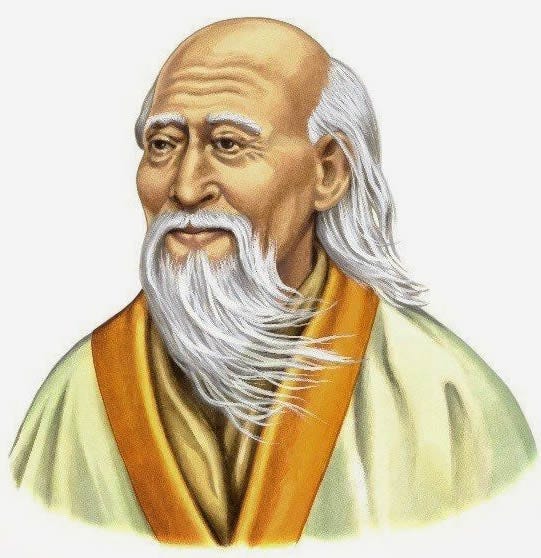
Laozi
Also known as: Lao Tzu, Lao-Tsu, Laotze, Li Er, Boyang
Birthday
January 1, 604 BCE
Birth Sign
Capricorn
Birthplace
Quren, Chu (modern Luyi County, Henan, China)
Age
Died at 104
About
Laozi, meaning "Old Master," was the legendary Chinese philosopher credited with authoring the Tao Te Ching, the foundational text of Taoism. Modern scholarship regards him as a composite figure, with the text compiled by multiple authors during the Warring States period. Traditional accounts place his birth in the 6th century BCE in the state of Chu, where he served as the Zhou dynasty's royal archivist in Luoyang. His ideas, centered on the Dao, Wu Wei, and natural harmony, have shaped Chinese culture for over two millennia, influencing everything from governance and medicine to martial arts and poetry. The Tao Te Ching remains one of the most translated works in world literature, second only to the Bible.
Early Life & Background
Traditional narratives paint Laozi as a figure of extraordinary wisdom from birth. Legends claim he emerged from his mother's womb after a 62-year gestation, already elderly with white hair, hence his name. He grew up in the village of Quren in the state of Chu, during the declining years of the Spring and Autumn period. Appointed as the Zhou court's royal archivist, he gained access to the empire's vast collection of ancient records and rituals. This position placed him at the center of intellectual life, where he reportedly met Confucius around 520 BCE. Confucius sought his advice on history and ceremony, leaving the encounter deeply impressed, comparing Laozi to a dragon that rides the wind and clouds. As the Zhou dynasty continued its decline, Laozi grew disillusioned. He resigned his post and set out westward, passing through the Hankao Pass. The gatekeeper, Yin Xi, recognizing his wisdom, pleaded with him to record his insights before disappearing into the wilderness. In response, Laozi composed the Tao Te Ching, 81 chapters of about 5,000 Chinese characters, in a single session, then vanished, never to be seen again.
Career Growth
The Tao Te Ching became the cornerstone of Taoism, one of China's three great philosophical traditions. Its influence grew slowly at first, with the first known commentary by Heshang Gong appearing around 200 CE. The Tang dynasty (618–907) transformed Laozi's status: Emperor Gaozu claimed descent from him, elevating the philosopher to imperial ancestor and granting Taoism state patronage. In 743 CE, Emperor Xuanzong deified Laozi as the "Supreme Mysterious and Primordial Emperor," ordering temples built in his honor. The text was included in the Daozang (Taoist Canon) during the Ming dynasty (1436–1445). From the 19th century onward, the Tao Te Ching spread globally, becoming one of the most translated books in history. Modern scholarship, however, has complicated the picture: the Mawangdui silk manuscripts (168 BCE) and Guodian bamboo slips (c. 300 BCE) reveal textual variations, suggesting the received version is a composite. Today, the work continues to inspire new translations, commentaries, and even AI-generated interpretations, with over 250 English translations alone by 2024.
Career Timeline
Public Image & Style
Laozi is universally depicted as an elderly sage with a long white beard, flowing robes, and a calm, knowing expression, often riding a water buffalo westward. This image, codified in Chinese art over centuries, symbolizes the wise recluse who withdraws from worldly corruption. The Tao Te Ching itself is known for its poetic, paradoxical, and aphoristic style, short chapters that reward meditation rather than logical analysis. Followers of Taoism celebrate his traditional birthday on the 15th day of the 2nd lunar month with temple pilgrimages, especially to Mount Qingcheng in Sichuan and Luyi County in Henan. In modern popular culture, Laozi's quotes are widely shared as inspirational content on social media, with the hashtag #TaoWisdom generating millions of posts. His persona resonates with those seeking simplicity, mindfulness, and an alternative to consumerist culture.
Fame & Fandom (iFAMOUS Rankings)
Laozi holds no current placement in the iFANN Global Top 1,000 or any scope-specific ranking list, a status confirmed by the August 2026 evaluation cycle. While he does not compete for a numeric rank against modern celebrities, his enduring presence transcends standard fame metrics. The ancient philosopher commands a unique form of global recognition that defies contemporary charting systems. His influence is measured not in viral moments but in the sheer volume of translations and the depth of philosophical adherence spanning millennia. Unlike pop stars who rely on fanbases to drive visibility, Laozi's reach is institutionalized through religious Daoism, academic study, and centuries of cultural osmosis. There is no formal fandom name attached to his legacy; followers identify themselves as Taoists, scholars, or practitioners rather than members of a collective like the Beyhive or Swifties. No organized birthday campaigns, subway advertisements, or streaming chart pushes exist for him, as his relevance is woven into the fabric of history rather than driven by modern marketing. Yet, the resonance of his work remains potent. In 2026, new translations continued to emerge, exploring environmentalist themes, while a meme coin bearing his name briefly captured speculative financial attention. These modern echoes do not constitute a fandom in the traditional sense but highlight how his wisdom adapts to new eras. The absence of a ranked position simply reflects the limitations of applying 21st-century fame engines to a figure whose impact predates the concept of celebrity itself.
Interesting Facts and Legends
The title Tao Te Ching translates to 'The Classic of the Way and Virtue,' a text containing exactly 5,000 Chinese characters in its standard version. Laozi's birth surname Li has grown to become the most common surname in both China and Vietnam. Archaeological discoveries have preserved fragments of his teachings for over two millennia; the oldest known copies are the Mawangdui silk manuscripts from 168 BCE, while the Guodian bamboo slips offer even earlier partial versions dating to around 300 BCE. Beyond these textual facts, legendary narratives shape his identity. The most iconic story recounts his departure at the Hangu Pass, where the border guard Yin Xi begged the weary sage to record his wisdom before vanishing westward on a water buffalo. This tale explains the origin of the Tao Te Ching and remains a staple of Chinese art. Ancient folklore also places Laozi as a contemporary of Confucius, describing a meeting where the younger Confucius sought advice only to be gently rebuked for being too rigid, with Confucius later calling Laozi a dragon he could not comprehend. Over time, this historical figure transformed into a deity known as Taishang Laojun, central to the religious pantheon of Daoism.
Notable Quotes
“The Tao that can be told is not the eternal Tao. The name that can be named is not the eternal name.”
“A journey of a thousand miles begins with a single step.”
“Those who know do not speak. Those who speak do not know.”
“When you are content to be simply yourself and don't compare or compete, everybody will respect you.”
“He who knows others is wise; he who knows himself is enlightened.”
“I have just three things to teach: simplicity, patience, compassion. These three are your greatest treasures.”
Family & Personal Life
Traditional accounts mention a wife, though her name is unrecorded. The couple had one son, Li Zong, who became a military officer in the state of Wei. No other family details survive. Modern scholarship considers these biographical elements likely later inventions to humanize a legendary figure.
Notable Connections
Laozi is traditionally linked with Confucius, who reportedly sought his counsel. Zhuangzi expanded on his ideas in the Zhuangzi. Yin Xi, the gatekeeper, is his legendary disciple. Early commentators Heshang Gong and Wang Bi shaped the received text. Sima Qian wrote the first biography.
Relationships & Dating History
Traditional lore attributes a wife to Laozi, though no name or details survive. She is said to have predeceased him. Their son, Li Zong, continued the family line. A more significant relationship in Taoist tradition is with Yin Xi, the gatekeeper at Hankao Pass. Yin Xi recognized Laozi's wisdom and compelled him to write the Tao Te Ching. Some Taoist texts portray Yin Xi as Laozi's primary disciple and later an immortal. As of 2026, no living romantic partner is associated with the historical or legendary figure.
- MarriedUnnamed wifeTraditional accounts mention a wife, but her name and life details are unrecorded.
- DatedYin XiLegendary gatekeeper who received the Tao Te Ching; some traditions view him as a disciple or spiritual companion.
Death & Aftermath
Died
500 BCE (aged 104)
Death Place
Unknown
Cause of Death
Disappearance into legend
Traditional accounts describe the end of Laozi not as a cessation of life but as a departure, with the philosopher leaving the Zhou capital to ride a water buffalo westward through the Hangu Pass. This legendary exit occurred around 500 BCE, marking the final public appearance of the man credited with authoring the Daodejing before he vanished into the mountains of the West at the request of the pass guard Yin Xi. While some traditions suggest he lived to an extraordinary age of over 160 years, these details remain unconfirmed folklore rather than verified historical fact.
The circumstances of his passing are defined by this disappearance rather than a recorded death event, meaning no body was ever found for burial or cremation and no funeral service took place. Centuries later, the reaction to his absence evolved into deep veneration, with figures like the Tang Dynasty claiming him as an ancestor and religious communities establishing temples dedicated to his teachings. His legacy survives entirely through the Daodejing, which remains one of the most translated works in world literature, inspiring countless commentaries and new translations from scholars like David Bentley Hart in recent years.
Net Worth (Estate Value)
$0
iFANN Editorial Team estimate
As of 2026, the ancient philosopher Laozi accumulated no personal wealth during his lifetime, and the text he is credited with authoring has remained in the public domain for centuries, generating no direct royalties for any estate. The commercial ecosystem surrounding the *Tao Te Ching* remains vast, with translations, commentaries, adaptations, merchandise, and media inspired by the work generating billions of dollars annually through third-party publishers and creators. No formal estate exists to manage these derivative revenues. Per iFANN's editorial analysis, the philosopher's net worth stands at $0, yet his cultural capital remains immeasurable.
Awards & Accolades
View 13 records, honours and achievementsKnown For
Tao Te Ching
c. 500 BCE · Author
Keywords
Quick Facts
- Profession
- philosopher, archivist, writer
- Born
- 604 BCE
- Birthplace
- Quren, Chu (modern Luyi County, Henan, China)
- Died
- c. 500 BCE
- Gender
- Male
- Birth Sign
- Capricorn
Personal Details
- Full Name
- Li Er
- Children
- Li Zong (son)
- Education
- Self-taught through Zhou dynasty archives
Frequently Asked Questions
Is Laozi a real historical figure?
What is the Tao Te Ching about?
Did Laozi meet Confucius?
How old was Laozi when he died?
What is Laozi's net worth?
Similar People
Join the community
fans discussing