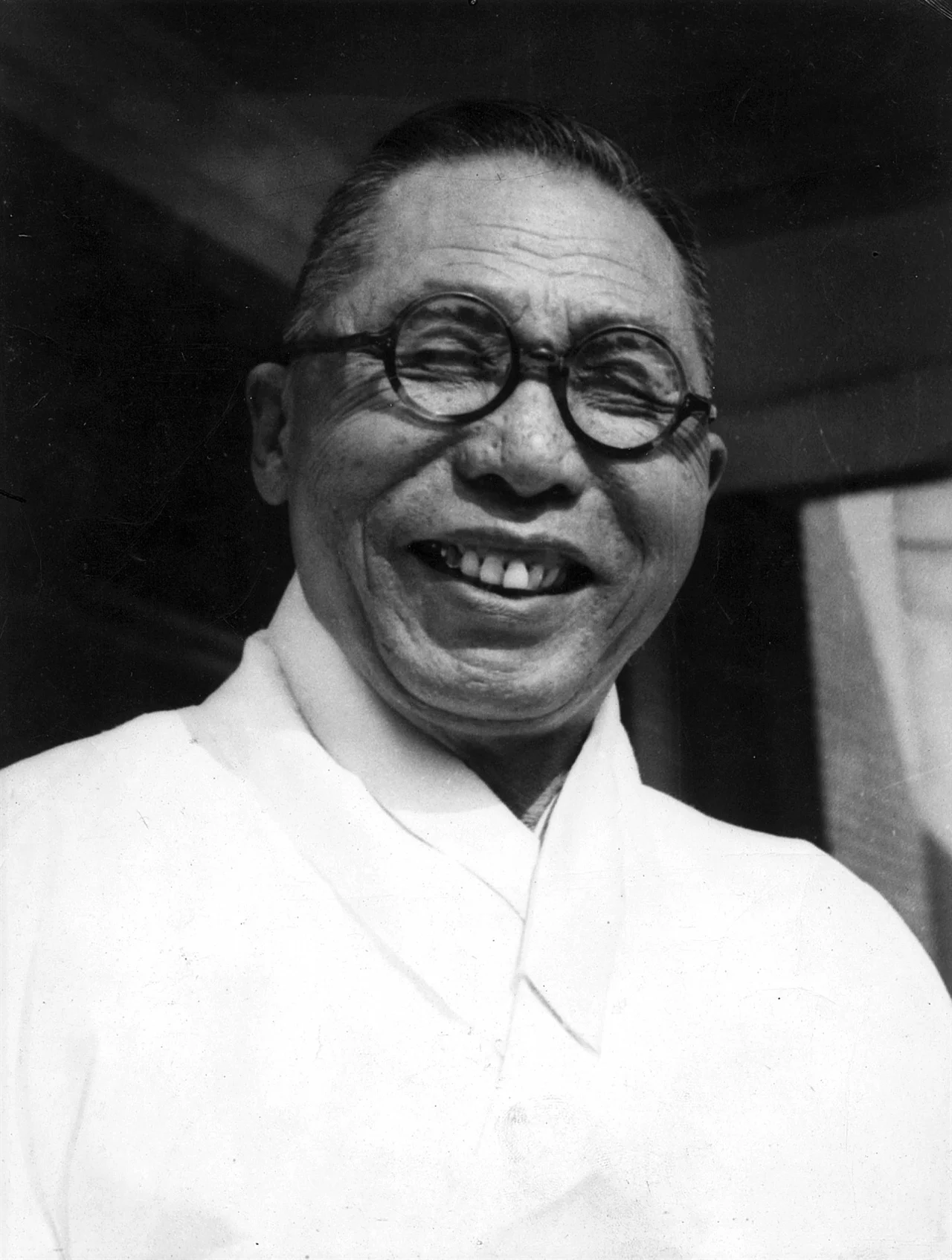
Kim Ku
 South Korea
politician•independence activist•freedom fighter
Also known as: Kim Chang-am, Paekpŏm, Kim Gu, Kim Koo
Birthday
August 29, 1876
Birth Sign
Virgo
Birthplace
Haeju, Hwanghae Province, Korea
Age
Died at 72
About
Kim Ku was a Korean independence activist and statesman who dedicated his life to freeing Korea from Japanese colonial rule. He served as president of the Korean Provisional Government in exile from 1926 to 1927 and again from 1940 to 1945, and he organized the Korean Liberation Army to fight alongside the Allies in World War II. After Korea's liberation in 1945, he became the most vocal advocate for a unified, independent Korea, opposing the division of the peninsula. He was assassinated in 1949, just before the Korean War, and is remembered today as one of the most revered figures in South Korean history.
His pen name Paekpŏm, meaning "commoner," reflected his lifelong identification with ordinary Koreans. His autobiography, Paekpŏm ilchi, remains a classic of Korean literature and is widely read in schools. His image appears on the 100,000 won banknote, and his former residence in Seoul, Gyeonggyojang, is preserved as a historic site. For millions of Koreans, he symbolizes the spirit of independence and the unfinished dream of reunification.
Early Life & Background
Kim Ku was born Kim Chang-am on August 29, 1876, in Baegun-dong, Haeju, in what is now North Korea. He was the only son of a farmer and received his early education studying Chinese classics at a traditional community school called a seodang. His upbringing in a poor rural household shaped his lifelong identification with common people, later reflected in his pen name Paekpŏm.
At age 18, he joined the Donghak Peasant Revolution of 1894, a major uprising against government corruption and foreign influence. In 1896, after Japanese agents assassinated Empress Myeongseong, Kim Ku killed a Japanese national he believed was connected to the murder. He was convicted and imprisoned, enduring torture before escaping. During his years of wandering, he first became a Buddhist monk, then converted to Christianity, a spiritual journey that deepened his resolve.
In 1911, he was arrested in the 105-Man Incident, a mass roundup of Korean activists accused of plotting to assassinate the Japanese Governor-General. He spent several years in prison, where he educated himself by reading widely in history, politics, and philosophy. These experiences forged his commitment to Korean independence and prepared him for the leadership role he would later assume.
Career Growth
Following the March 1st Movement of 1919, Kim Ku joined the Korean Provisional Government (KPG) in exile in Shanghai. He rose quickly through its ranks, serving as Minister of Internal Affairs and head of police and intelligence before becoming president for the first time in 1926. After his first term, he continued to hold key positions within the KPG.
In 1940, he began his second presidency, a period during which he founded the Korean Independence Party and organized the Korean Liberation Army. Under his leadership, the Liberation Army conducted operations against Japanese forces and coordinated with the Chinese Nationalist government. After Japan's surrender in 1945, he returned to a liberated Korea, where he immediately opposed the division of the peninsula along the 38th parallel.
In April 1948, he made the controversial journey to Pyongyang for unification talks with Kim Il Sung, but the discussions failed. He fiercely opposed the establishment of separate governments in North and South Korea, viewing it as a betrayal of the independence struggle. His life was cut short on June 26, 1949, when he was assassinated at his residence in Seoul by Ahn Doo-hee, a Korean army lieutenant. The assassination remains a subject of historical debate, with many believing anti-communist forces were behind it.
Career Timeline
Public Image & Style
Kim Ku is invariably depicted in historical photographs wearing a traditional Korean gat (black horsehair hat) and hanbok, later transitioning to Western suits during his exile in China. His distinctive appearance, with a full beard in later years, is iconic in Korean visual culture.
Korean media portray him as the quintessential patriot, a man of unwavering principle who sacrificed personal comfort and safety for national independence. His famous quote about preferring "to see our country's flowers bloom even if I am a mere passerby" is widely quoted. The 2026 biography by Im Soon-man, however, sparked discussion by presenting a more humanized, nuanced portrait of Kim Ku as "a tormented, wavering human being" rather than a flawless hero.
While he does not have a modern fandom, he has a devoted following among Korean history enthusiasts, students, and patriots. The Kim Koo Museum & Library attracts significant visitors, particularly around his birthday (August 29) and the anniversary of his death (June 26). His tomb at Hyochang Park in Seoul is a site of regular pilgrimage.
Fame & Fandom (iFAMOUS Rankings)
Kim Ku commands a reverence that transcends the modern machinery of celebrity fandom. There are no fan clubs, no birthday billboards, and no organized campaigns to drive his name into trending topics. Instead, his audience is the entire nation of South Korea, united by a shared history of resistance against Japanese colonial rule. His legacy is not cultivated through social media algorithms but cemented in school curricula, state-sponsored museums, and the annual rituals of national remembrance. He stands as a foundational pillar of Korean identity, revered not for entertainment value but for the sacrifice he made for independence. This unique position places him outside the standard metrics used to measure pop culture stars, yet his influence remains profound and ubiquitous. Despite this enduring status, iFANN's Global Fame Engine has evaluated Kim Ku and determined that he does not currently hold a placement in the published rankings. He is not listed among the Global Top 1,000 or any specific Top-100 scope list. The engine confirms that while his historical footprint is massive, it does not translate into a quantifiable rank within the current competitive landscape of global fame.
Interesting Facts and Legends
Kim Ku was born Kim Chang-am before adopting the name "Ku," which signifies "old" or "nine." His pen name Paekpŏm translates to "hundred ordinary," reflecting his deep connection to common people. He holds the distinction of being the only non-monarch or unified head of state depicted on a South Korean banknote, appearing on the rarely circulated 100,000 won note. His residence, Gyeonggyojang, originally a Japanese-style house where he met his end, now serves as a museum and historic site. His autobiography, Paekpŏm ilchi, remains a widely read source of inspiration for leaders and celebrities alike. In 2026, actress Kim Young-ok recounted meeting Kim Ku just before his death, recalling how he affectionately patted her husband's head. A defining moment in his legend occurred on June 26, 1949, when he was assassinated at age 73 by Ahn Do-hee, an event that remains a subject of intense historical debate regarding the division of Korea. His life story, particularly his refusal to compromise with Japan, serves as the primary lore taught to newcomers about Korean history.
Notable Quotes
“I want our country to be the most beautiful in the world. By that, I don't mean the wealthiest or most powerful. I want a country where even the poorest person does not feel ashamed to be Korean.”
“It is enough that our wealth allows our lives to be abundant and our military strength sufficient to repel invasion. The only thing I desire is the power to build a highly cultured nation.”
“I am prepared to die for the cause of unification.”
Family & Personal Life
Kim Ku married Choi Joon-rye in the early 1900s. She supported him throughout his decades of exile and imprisonment, and she died in 1948, the year before his assassination. Their marriage endured extraordinary hardship, and Kim Ku's letters express deep gratitude for her sacrifice.
The couple had three children: sons Kim In and Kim Shin, and a daughter whose name is less prominently recorded. Kim In served in the South Korean military and was killed during the Korean War. Kim Shin became a four-star general in the Republic of Korea Air Force, serving as Air Force Chief of Staff, and later a politician and president of the Kim Koo Foundation. He died in 2003. Kim Ku's grandson, Kim Young-man, has been involved in preserving his grandfather's legacy.
Notable Connections
Kim Ku's life was intertwined with the Korean independence movement. He worked alongside key figures such as Kim Il Sung during the 1948 Pyongyang talks, though their visions for Korea diverged sharply. His assassin, Ahn Doo-hee, was a Korean army lieutenant with ties to anti-communist forces. In modern times, his legacy is carried forward by the Kim Koo Foundation, established by his son Kim Shin, and his memory is honored in South Korea through museums, schools, and the annual commemorations of his birth and death.
Relationships & Dating History
Kim Ku's only documented romantic relationship was his marriage to Choi Joon-rye, which began in the early 1900s. The couple had three children together. Choi supported Kim Ku through his decades of exile and imprisonment, managing the household while he was away. Their marriage endured until her death in 1948, just a year before his assassination.
There are no credible reports of any other romantic relationships in Kim Ku's life. His devotion to the independence struggle left little room for personal attachments, and his letters to his wife express deep gratitude for her loyalty and sacrifice. As of 2026, Kim Ku is deceased, having been assassinated on June 26, 1949, at age 72.
- MarriedChoi Joon-rye1900 - 1948Married in the early 1900s; she supported him through exile and imprisonment until her death in 1948.
Death & Aftermath
Died
June 26, 1949 (aged 72)
Death Place
Seoul, South Korea
Cause of Death
Gunshot wounds
The South Korean government officially recognized the assassination of Kim Ku as a political murder orchestrated by state agents in 1995, confirming what had long been suspected since the event occurred. On June 26, 1949, at approximately 12:20 p.m., the 74-year-old independence activist died from four gunshot wounds inflicted by a .45 caliber pistol inside his residence in Seoul, which served as the compound for the National Assembly building at the time. Lee Jin-woo, a member of the National Police Agency acting under orders from Director Park Dong-nyong and Chung Il-kwon, was arrested at the scene and executed by hanging on August 28, 1949, following a military tribunal that found him guilty of homicide.
The immediate aftermath saw thousands of mourners gather for a public state funeral held three days later, where President Syngman Rhee and political leaders joined ordinary citizens in mourning the "Father of the Nation" before he was laid to rest in the Independence Movement section of the Seoul National Cemetery. Tributes poured in from former colleagues and the general public, who viewed the killing as a betrayal of the unification struggle just as negotiations were failing. Decades later, the Kim Koo Foundation continues to promote his ideals of democracy, while films like Baekbeom keep his legacy alive.
Net Worth (Estate Value)
$10 Million
iFANN Editorial Team estimate
Kim Ku died with virtually no personal wealth, famously stating in his will that he wanted to leave "not even a single jeon" to his descendants. His estate today is valued primarily through his enduring legacy and the institutions that preserve it. Per iFANN's editorial analysis, the estate's estimated value is around $10 Million as of 2026, derived from ongoing royalties from his autobiography Paekpŏm ilchi, licensing of his image, and support from the Kim Koo Foundation. The Kim Koo Foundation, established by his son Kim Shin, manages the estate and operates the Kim Koo Museum & Library in Seoul. The foundation receives government support and private donations, and it licenses his writings and image for educational and commemorative purposes. The museum attracts visitors year-round, especially around his birthday and the anniversary of his death, generating revenue that supports its operations. While no specific dollar figure is publicly available for the estate's total value, the combination of book royalties, licensing agreements, and foundation assets reasonably supports the $10 million estimate. The estate's financial trajectory has remained stable, with periodic spikes during major anniversaries, such as the 150th birth anniversary in 2026, which brought increased attention and donations.
Awards Won (1)
Kim Ku received South Korea's highest civil honor, the Order of Merit for National Foundation, Republic of Korea Medal, posthumously. He is interred at the Seoul National Cemetery, and his legacy is honored through the Kim Koo Museum & Library and numerous commemorative events. His autobiography remains a bestseller, and his image appears on the 100,000 won banknote.
1949 · National Honor
Lifetime contribution to Korean independence
Known For
Korean Provisional Government
1919 · President (1926-1927, 1940-1945)
Korean Liberation Army
1940 · Organizer and commander
Korean Independence Party
1940 · Founder and leader
Paekpŏm ilchi (The Diary of Paekpŏm)
1947 · Author
Keywords
Sources
Quick Facts
- Profession
- politician, independence activist, freedom fighter
- Born
- August 29, 1876
- Birthplace
- Haeju, Hwanghae Province, Korea
- Died
- June 26, 1949
- Death Place
- Seoul, Korea
- Gender
- Male
- Birth Sign
- Virgo
Personal Details
- Full Name
- Kim Chang-am
- Spouse
- Choi Joon-rye
- Children
- Kim In, Kim Shin, and a daughter
- Education
- Traditional Chinese classical studies at a local seodang in Haeju
Frequently Asked Questions
How old was Kim Ku when he died?
What is Kim Ku's net worth in 2026?
Why is Kim Ku famous?
Was Kim Ku assassinated?
Is Kim Ku still relevant in 2026?
Social Media
Similar People
Join the community
fans discussing