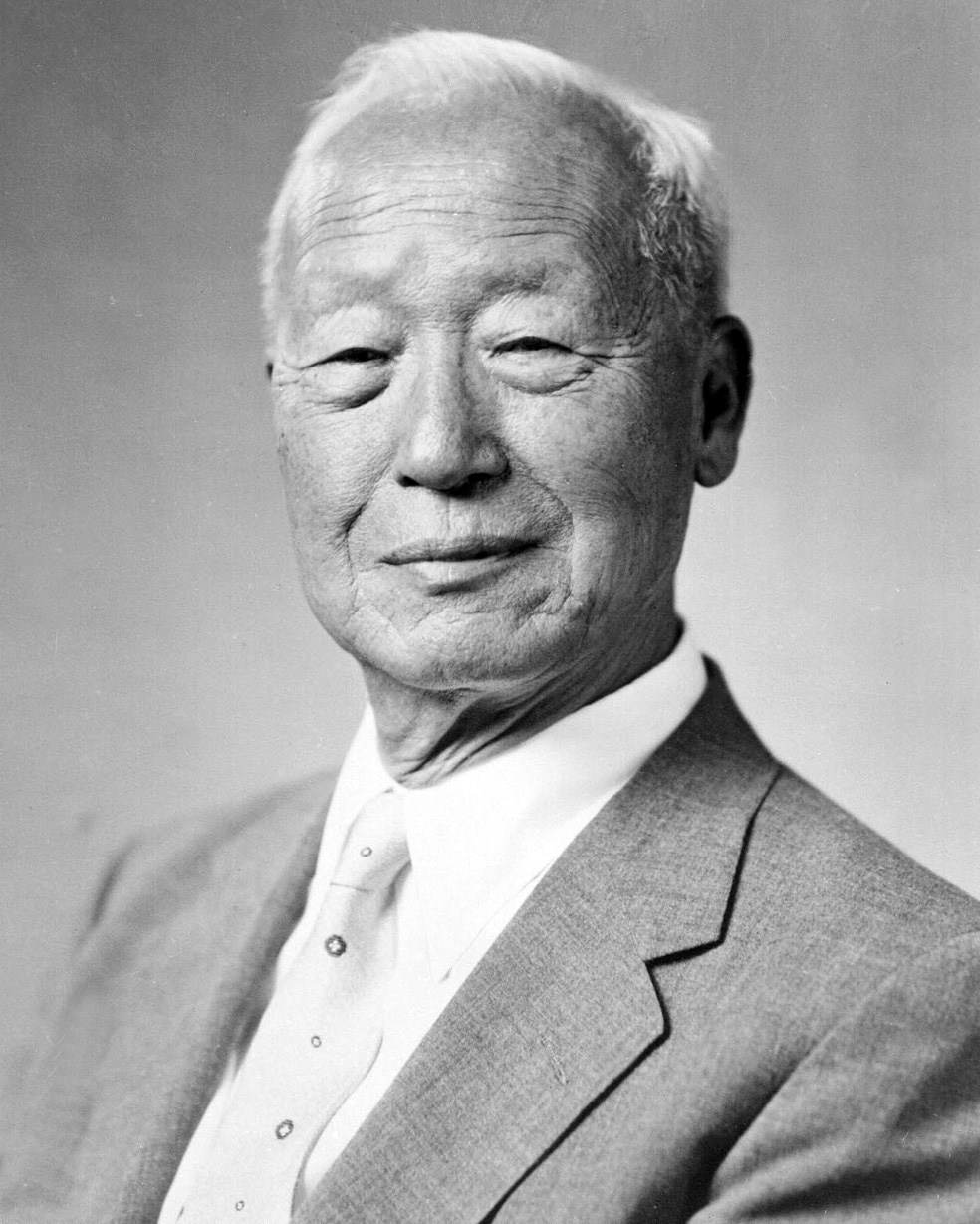
Syngman Rhee
 South Korea
Birthday
+1875-03-26
Birth Sign
Sagittarius
Birthplace
Haeju
Age
Died at 90
About
Syngman Rhee, the first president of South Korea, was born on March 26, 1875, in Haeju, a town in what is now North Korea. A politician, journalist, and writer by profession, he devoted his early life to Korean independence activism. After converting to Christianity at a local Methodist school, Rhee was imprisoned in 1899 for his political activities. Upon his release in 1904, he traveled to the United States, where he earned degrees from American universities and met Presidents Theodore Roosevelt and Woodrow Wilson. He returned to Korea briefly from 1910 to 1912, then settled in Hawaii in 1913. In 1919, following the Japanese suppression of the March First Movement, Rhee joined the Korean Provisional Government in exile in Shanghai, serving as its first president from 1919 until his impeachment in 1925, and again as its last president from 1947 to 1948. He then returned to US-controlled Korea and, on July 20, 1948, was elected the first president of the Republic of Korea by the National Assembly, ushering in the First Republic. Rhee's presidency was marked by staunch anti-communism and close alignment with the United States. He was in office during the outbreak of the Korean War in 1950, when North Korea invaded the South. He refused to sign the armistice agreement that ended the conflict in 1953, hoping instead to reunify the peninsula by force. After the war, South Korea's economy remained heavily dependent on American aid, though Rhee did achieve significant progress in reducing illiteracy. His rule grew increasingly authoritarian; after being re-elected in 1956, he pushed through a constitutional change to eliminate the two-term limit, despite widespread protests. In March 1960, he ran uncontested for a third term after his opponent, Chough Pyung-ok, died of cancer. The subsequent vice-presidential election, won by Rhee's ally Lee Ki-poong, was widely seen as rigged, sparking the student-led April Revolution. Police fired on demonstrators in Masan, and the ensuing scandal forced Rhee to resign on April 26, 1960, paving the way for the Second Republic. After resigning, Rhee spent a month at his residence in Seoul before departing for Hawaii on May 29, 1960. He maintained that he left for medical treatment, not exile, and that he simply never had the chance to return home. He lived in Honolulu for the rest of his life and died of a stroke on July 19, 1965, at the age of 90. His legacy remains deeply contested: he is remembered as a founding father who fought for Korean independence, but also as a leader whose authoritarian methods and economic failures left a mixed record.
Fame & Fandom
Syngman Rhee stands as the 90th most famous person in South Korea and the 60th most famous person from South Korea, rankings that hold steady within the iFANN Global Fame Rankings. These placements reflect a legacy that endures through decades of historical study rather than fleeting pop culture moments. While he never cultivated a fanbase with a formal name or organized rituals, his presence remains a focal point for political discourse and academic inquiry. The support he commands today is strictly intellectual and ideological, split between those who view him as the foundational father of the nation and critics who emphasize his authoritarian methods.
There are no fan clubs, viral campaigns, or parasocial interactions surrounding his memory. Instead, the "fandom" for Rhee manifests as intense debate within the National Assembly and among historians. Recent discussions in 2025 and 2026 have seen figures defending his contributions to liberal democracy while others critique his role in the Korean War. His story is one of polarized reverence, where commemoration often sparks controversy rather than unified celebration. The restoration of historical artifacts like the flag he waved in New York serves not as a fan tribute but as an act of national preservation. This unique dynamic ensures his fame remains deeply rooted in the gravity of history rather than the lightness of celebrity.
Interesting Facts and Legends
Syngman Rhee earned degrees from American universities before settling in Hawaii, eventually meeting Presidents Theodore Roosevelt and Woodrow Wilson during his time abroad. He converted to Christianity at a local Methodist school early in life, a conversion that shaped his later activism. In 1899, he was imprisoned for his political activities, only to be released four years later to continue his work for independence. After returning briefly to Korea from 1910 to 1912, he moved permanently to Hawaii in 1913. He later earned a Ph.D. from Princeton University and led a Korean government-in-exile from 1919 to 1939.
A defining moment in his life occurred during the April Revolution of 1960, when mass protests against his fraudulent re-election forced his resignation and exile to Hawaii. He passed away there in 1965. Historical accounts frequently cite his leadership style as a mix of nationalist fervor and authoritarian control, noting his purging of National Assembly members and mass arrests of opponents. Recent debates have framed his legacy as either a necessary strongman for a nascent democracy or a corrupt dictator who served U.S. interests, ensuring his story remains a subject of intense scrutiny rather than simple admiration.
Death & Aftermath
Died
+1965-07-19 (aged 90)
Death Place
Mokpo, Jeollanam-do, South Korea
Cause of Death
Heart attack (myocardial infarction)
Official medical observation at Mokpo Hospital confirmed that Syngman Rhee passed away from a heart attack on July 19, 1965. The former president had traveled from his long exile in Hawaii to Seoul to address rising political tensions but fell ill shortly after arriving and was admitted while en route to a planned meeting with President Park Chung-hee. His final public interaction occurred briefly in Mokpo before his collapse, marking the end of a life defined by decades of independence activism and presidential leadership. Public reaction reflected the polarized legacy of his tenure, as official tributes remained muted under the new military regime while conservative circles honored him as a founding father. A funeral service took place on July 22, 1965, at the Seoul Cemetery attended by family members and select government officials, though the scale was limited compared to his status as a former president due to the sensitive political climate.
Posthumously, recognition of Rhee has fluctuated through the decades, with modern scholarship and conservative groups seeking to rehabilitate his image as a nationalist leader despite his exclusion from recent Liberation Day ceremonies. Memorials have been held periodically, including a notable ceremony in Tokyo on July 19, 2026, highlighting his role in South Korea's founding, while portraits of him occasionally appear in protests where demonstrators invoke his memory alongside other late presidents. Several books and academic studies have analyzed his influence on the Cairo Declaration and U.S.
Awards & Accolades
Keywords
Quick Facts
- Profession
- politician, journalist, writer
- Born
- +1875-03-26
- Birthplace
- Haeju
- Died
- +1965-07-19
- Death Place
- Honolulu
- Gender
- Male
- Spouse
- Park Seung-seon, Franziska Donner
- Birth Sign
- Sagittarius
Personal Details
- Spouse
- Park Seung-seon, Franziska Donner
Join the community
fans discussing