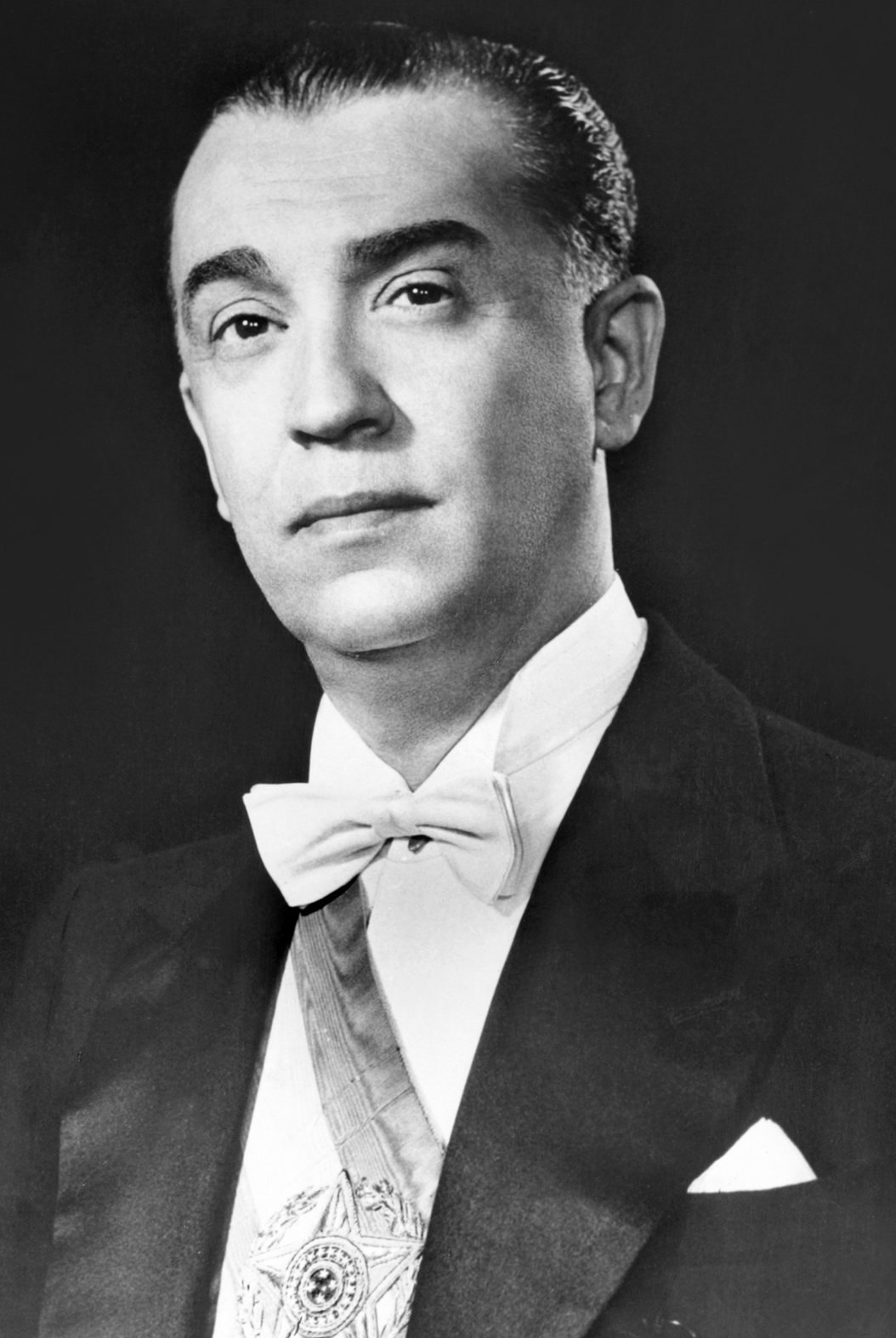
Juscelino Kubitschek
 Brazil
Birthday
+1902-09-12
Birth Sign
Virgo
Birthplace
Diamantina
Age
Died at 73
About
Juscelino Kubitschek de Oliveira, known widely as JK, was a physician and politician who rose to become Brazil's 21st president. Born in the historic mining town of Diamantina, Minas Gerais, on September 12, 1902, Kubitschek's early life was marked by his father's early death. He pursued a medical career, graduating from the Federal University of Minas Gerais in 1927 and further specializing in urology in Paris. His political journey began in the 1930s, serving as chief of staff to Benedito Valadares in Minas Gerais before being elected as a federal deputy. After a pause for his medical practice during the Estado Novo, he returned to public service, becoming mayor of Belo Horizonte in 1940 and later governor of Minas Gerais in 1951, where he focused on industrialization and infrastructure projects.
Fame & Fandom
Juscelino Kubitschek is currently the 48th most famous person in Brazil, holding steady from the previous cycle, and stands as the 98th most famous person from Brazil, up from 103rd last cycle. These placements reflect his enduring stature within the iFANN Global Fame Rankings, which track global attention across media coverage, search, and consumption signals worldwide. The longevity of his name carries a weight that few historical figures match, cementing his status not merely as a past leader but as an active presence in national consciousness.
While he commands this digital prominence, Kubitschek does not possess a formal fandom with chants or organized social media campaigns. There is no specific moniker for his supporters, nor are there fan-funded projects or charity drives driven by a dedicated group of followers. His legacy survives through institutional memory rather than contemporary celebrity culture. He is universally known by the initials JK, a shorthand that serves as the primary identifier in Brazilian history and infrastructure. This reverence is maintained at the Memorial JK in Brasília, a site that hosts diplomatic visits and serves as a national monument rather than a shrine for fans. His granddaughter, Anna Christina Kubitschek Pereira, acts as a custodian of this history, preserving the narrative without managing a fan club. Engagement remains rooted in civic pride and political discourse, where citizens reference his achievements during debates on nationalism and progress.
Interesting Facts and Legends
The defining legend of Kubitschek's presidency was his slogan "50 years of progress in 5," a promise to transform Brazil's economy and infrastructure within a single term. This ambition materialized in the rapid construction of Brasília, a new capital built from scratch in the central plateau and inaugurated in April 1960. The city itself remains the physical manifestation of this legendary feat of engineering. Another pivotal story concerns his death in 1976. For decades, it was accepted folklore that he died in a tragic car accident, but the National Truth Commission revealed in 2013 that the crash was actually a murder orchestrated by the military dictatorship after his brakes were tampered with. This revelation transformed a traffic fatality into a major political scandal. More recently, the bridge bearing his name in northern Brazil collapsed, killing over ten people and linking his legacy to a modern tragedy regarding infrastructure safety. Finally, his Czech ancestry is a verified biographical fact often highlighted in international diplomatic exchanges between Brazil and the Czech Republic.
Death & Aftermath
Died
+1976-08-22 (aged 73)
Death Place
Resende, Rio de Janeiro, Brazil
Cause of Death
Sabotaged brake failure (murder)
Juscelino Kubitschek spent his final morning driving from São Paulo to Rio de Janeiro with his wife Sarah and son Cláudio, traveling in a Ford Falcon driven by his personal chauffeur. As the vehicle approached the Ponte do Infinito in Resende on August 22, 1976, it allegedly lost control and plunged into a ravine, killing the former president at age 73. For decades, official narratives attributed this tragedy to mechanical failure or driver error, but a 2013 investigation by the National Truth Commission overturned that account, concluding the brakes had been sabotaged by agents of the military dictatorship under President Ernesto Geisel.
The commission determined the regime viewed Kubitschek as a threat due to his planned 1978 presidential run, orchestrating the crash to eliminate him. Public reaction in 1976 featured widespread mourning across Brazil, with tributes pouring in from political peers honoring his legacy of optimism and development. Thousands lined the streets for his funeral procession in Rio de Janeiro before his body was transported to Brasília, where he was laid to rest in a mausoleum that remains a site of pilgrimage today. While no criminal trials followed the 2013 revelation due to the deaths or retirements of high-ranking officials, the Truth Commission issued a formal report identifying state responsibility and naming the specific military units involved.
Posthumous recognition has flourished through the Memorial JK museum in Brasília, managed in part by family descendants like Anna Christina Kubitschek Pereira. His name adorns major infrastructure including the Juscelino Kubitschek International Airport and the Juscelino Kubitschek Bridge, while scholarships and foundations continue to support education. Academic and journalistic interest surged after 2013, spawning documentaries and books that re-examine his life and the dark history of the dictatorship.
Awards & Accolades
Keywords
Quick Facts
- Profession
- physician, politician, writer
- Born
- +1902-09-12
- Birthplace
- Diamantina
- Died
- +1976-08-22
- Death Place
- Resende
- Gender
- Male
- Spouse
- Sarah Kubitschek
- Birth Sign
- Virgo
Personal Details
- Spouse
- Sarah Kubitschek
Join the community
fans discussing