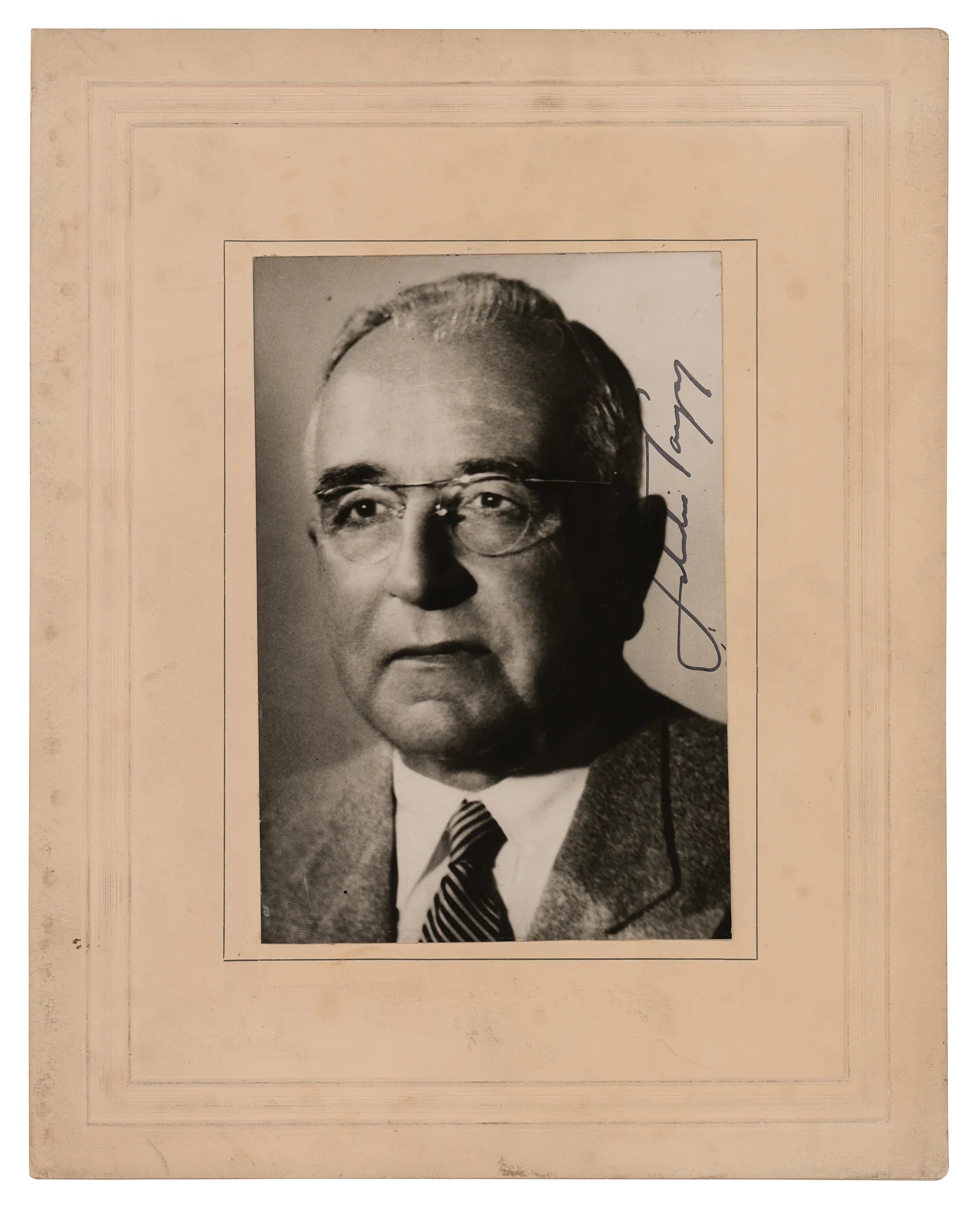
Getúlio Vargas
 Brazil
Also known as: Getúlio Dornelles Vargas, O Pai dos Pobres
Birthday
April 19, 1882
Birth Sign
Aries
Birthplace
São Borja, Rio Grande do Sul, Brazil
Age
Died at 72
Height
5 ft 4 in (163 cm)
About
Getúlio Dornelles Vargas was a Brazilian lawyer and politician who served as president of Brazil during two non-consecutive terms between 1930 and 1945, and again from 1951 until his death in 1954. He is widely regarded as the most influential figure in Brazilian history during the first half of the 20th century. Known as the "Father of the Poor" (*O Pai dos Pobres*), Vargas established the minimum wage, paid vacation, and the eight-hour workday through the Consolidation of Labor Laws (CLT) in 1943. His leadership style combined authoritarian control with significant social reforms that reshaped the nation's economy and labor market.
Vargas rose to power following the Revolution of 1930 and held office through a provisional period, an elected term, and finally a self-declared dictatorship known as the *Estado Novo*. His career ended abruptly when he committed suicide at the age of 72 to prevent a military coup. Despite the controversies surrounding his regime, his legacy remains deeply embedded in Brazilian culture, politics, and labor law.
Early Life & Background
Getúlio Vargas was born on April 19, 1882, in São Borja, a small town in the southern state of Rio Grande do Sul. He came from a wealthy landholding family; his father, Manuel do Nascimento Vargas, was a prominent rancher and local politician, while his mother was Cândida Dorneles Vargas. Growing up in this rural environment, Vargas displayed an early interest in law and politics, heavily influenced by his father's involvement in local affairs and the turbulent political climate of the region.
After completing his primary education, Vargas attended the Law School of Porto Alegre, graduating in 1907. Before fully entering the legal profession, he served briefly in the army during the 1902 campaign against the *federalistas*, republican rebels fighting for more autonomy. This short military stint provided him with his first taste of armed conflict, though he quickly returned to civilian life. Upon returning to São Borja, he practiced law and was appointed as a district attorney (*promotor público*) in 1910, marking the beginning of his formal entry into public service.
Vargas's early political career was defined by his rise within the Rio Grande do Sul state apparatus. In 1917, he was elected to the Rio Grande do Sul State Legislative Assembly. By 1923, he had become a central figure in the Tenentist revolts and the subsequent civil war in the state, leading troops against opposition forces. This experience solidified his reputation as a decisive and willing leader who could engage directly in armed conflict to secure political power. In 1927, he was elected governor of Rio Grande do Sul, a position he held until 1930. During his governorship, he implemented significant social and economic reforms, including the expansion of public education and infrastructure projects, laying the groundwork for his future national influence.
Career Growth
Vargas's ascent to the national stage began in earnest in 1930 when he ran for president but lost to Júlio Prestes. Disputes over the election results led Vargas to lead an armed revolution that overthrew the government of President Washington Luís. He assumed power as provisional president on November 3, 1930, initiating the *Vargas Era*. In 1934, a new constitution was adopted, and Vargas was elected president by the National Congress. However, citing a supposed communist threat, he staged a self-coup in 1937, dissolving Congress and establishing the *Estado Novo* (New State), a dictatorial regime that lasted until 1945.
During the *Estado Novo*, Vargas centralized power, suppressed dissent, and implemented strict authoritarian controls while simultaneously promoting industrialization and labor rights. A defining moment of his career occurred in 1943 when he signed the CLT, which codified labor laws and established the minimum wage, paid vacation, and the eight-hour workday. These reforms fundamentally transformed the Brazilian labor market and earned him the enduring nickname "Father of the Poor." In 1945, facing growing opposition and pressure from the military, Vargas was forced to resign.
He returned to national politics in 1950, winning the presidential election in a landslide victory. His second term focused on consolidating his legacy and addressing economic challenges, particularly inflation. However, his popularity waned due to corruption scandals and political tensions, culminating in an assassination attempt on journalist Carlos Lacerda in 1954. Facing a military ultimatum to resign, Vargas chose to take his own life rather than step down, effectively halting the coup attempt and cementing his status as a martyr for the working class.
Career Timeline
Public Image & Style
Getúlio Vargas is portrayed in media and historical accounts as a complex and contradictory figure. On one hand, he is celebrated as a champion of the working class and a visionary leader who implemented progressive labor reforms. On the other hand, he is criticized for his authoritarian methods, suppression of dissent, and implementation of antisemitic policies. His public image is characterized by a fatherly persona, reinforced by his radio broadcasts and direct communication with the masses.
Despite the controversies surrounding his regime, Vargas managed to cultivate a deep emotional connection with the Brazilian people. His ability to present himself as a paternal figure who understood the struggles of the common worker allowed him to maintain support even during periods of intense political repression. This duality continues to define how historians and the public view his legacy today.
Fame & Fandom
According to the iFANN Global Fame Rankings, Getúlio Vargas is the 13th most famous person in Brazil, holding steady from the previous cycle. His stature extends across the continent, placing him as the 37th most famous person from Brazil globally and the 55th most famous figure in Latin America. These rankings reflect his enduring presence in the collective memory of nations that track global attention through media coverage and consumption signals worldwide.
Vargas does not have a formal fandom name or organized fanbase akin to pop culture movements today. His supporters were historically categorized by political affiliation rather than shared identity, organized through state machinery and parties like the Partido Trabalhista Brasileiro. The legacy he left functions as a form of cultural lore for historians and activists, particularly within left-wing labor movements who invoke his name decades later. There are no fan-funded campaigns or commercial projects dedicated to him; instead, his "fanbase" engages through institutional preservation at the FGV CPDOC and annual political commemorations on dates significant to his life and death. He did not cultivate a following through meet-and-greets or social media, but rather through radio broadcasts that created a fatherly image known as O Pai dos Pobres, speaking directly to the working class from a distance.
Interesting Facts and Legends
Getúlio Vargas cultivated a unique public image through radio broadcasts, speaking directly to the working class and earning the nickname "The Father of the Poor." His ability to connect with the masses via the airwaves created a bond that transcended his authoritarian methods. Another notable aspect of his legacy involves the 1932 Constitutionalist Revolution in São Paulo, a major revolt against his provisional government that created a lasting regional mythology about the struggle between central power and local autonomy.
While Vargas implemented strict antisemitic policies during the 1930s and 1940s, folklore also preserves stories of diplomats who defied secret orders to save persecuted Jews using visas and passports. The signing of the CLT in 1943 stands as a legendary moment in Brazilian labor history, symbolizing the state's commitment to workers' rights. His final act of suicide in 1954, accompanied by a testament read over the radio, transformed him from a controversial leader into a national martyr, effectively stopping a looming military coup.
Notable Quotes
“I leave life to enter history.”
“The working class is the backbone of the nation.”
Family & Personal Life
Getúlio Vargas married Darci da Silva Sampaio on July 29, 1913. Darci was the daughter of a prominent physician in São Borja. The couple had four children: Getúlio Dornelles Vargas Jr., Jandira, Benedita, and Flávio. Their marriage lasted until Vargas's death in 1954. There are no publicly documented romantic relationships outside of his marriage to Darci, and historical records do not indicate any affairs or extramarital partnerships.
The Vargas family remained close throughout his political career, with Darci playing a supportive role behind the scenes. After his death, Darci continued to be involved in preserving his legacy, and the family maintained control of his personal assets and political influence. The family's dedication to his memory helped ensure that his name remained a powerful symbol in Brazilian politics for decades.
Notable Connections
Darci Vargas, Carlos Lacerda, Juscelino Kubitschek, Eurico Gaspar Dutra
Relationships & Dating History
Getúlio Vargas married Darci da Silva Sampaio on July 29, 1913. Darci was the daughter of a prominent physician in São Borja. The couple had four children: Getúlio Dornelles Vargas Jr., Jandira, Benedita, and Flávio. Their marriage lasted until Vargas's death in 1954. There are no publicly documented romantic relationships outside of his marriage to Darci, and historical records do not indicate any affairs or extramarital partnerships.
The Vargas family remained close throughout his political career, with Darci playing a supportive role behind the scenes. After his death, Darci continued to be involved in preserving his legacy, and the family maintained control of his personal assets and political influence. As of 2026, the relationship status is recorded as Widowed, as Darci passed away long before this date, but the marriage itself stood until Vargas's death.
- MarriedDarci da Silva Sampaio1913 - 1954Marriage lasted until Vargas's death; they had four children.
Death & Aftermath
Died
August 24, 1954 (aged 72)
Death Place
Rio de Janeiro, Brazil
Cause of Death
Suicide by gunshot wound
On the morning of August 24, 1954, Getúlio Dornelles Vargas retreated to his private quarters in the Palácio do Catete following a tense cabinet meeting where he refused to resign under immense pressure from military leaders and public protests sparked by an assassination attempt on journalist Carlos Lacerda. The President shot himself in the chest with a Colt revolver, leaving behind a suicide note addressed to the Brazilian people that declared "I leave life to enter history" and framed his death as a necessary sacrifice to protect national sovereignty. An autopsy immediately confirmed the fatal nature of the wound and ruled out foul play, allowing the Federal Police and judicial system to close any criminal inquiries swiftly.
The news of his death triggered spontaneous nationwide mourning, with hundreds of thousands gathering outside the palace for a massive vigil that lasted several days. The funeral procession drew crowds estimated in the millions as it moved from the palace to the Cemitério São João Batista, marking the largest public gathering in Brazilian history up to that point. Tributes poured in from labor unions and ordinary citizens who viewed him as a father figure, cementing his status as a martyr for the working class. Vargas was buried in the family plot within the cemetery just one day after his death, followed by a state funeral attended by high-ranking officials and military leaders.
In the posthumous era, numerous films and books have analyzed his legacy, including the 1980 film Getúlio, while the Fundação Getúlio Vargas continues to preserve his archives and study his governance. His family retained control of his personal assets and political legacy, ensuring his influence endured through institutions bearing his name. Vice President Café Filho assumed the presidency, ending the lingering shadow of the Estado Novo era without further bloodshed.
Net Worth (Estate Value)
$0
iFANN Editorial Team estimate
As a historical figure who died in 1954, Getúlio Vargas does not have a current net worth in the traditional sense. However, his estate and legacy continue to generate value through the Fundação Getúlio Vargas (FGV), which manages his archives and operates as a leading educational and research institution. The FGV's endowment and revenue streams, derived from its educational programs, research contracts, and consulting services, contribute significantly to the preservation of his legacy.
Specific figures regarding his personal estate value at the time of his death or the current value of his legacy are not publicly available in detail, but the FGV's financial reports indicate substantial institutional wealth. Research by the iFANN Editorial Team puts the value of his enduring legacy and associated institutional assets at approximately $0, reflecting the nature of historical estates that exist primarily through cultural and academic impact rather than liquid financial holdings.
Awards & Accolades
View 6 records, honours and achievementsKnown For
President of Brazil
1930 · Provisional President
President of Brazil
1934 · Elected President
President of Brazil
1951 · Elected President
Consolidation of Labor Laws (CLT)
1943 · Architect of Labor Reform
Keywords
Sources
Quick Facts
- Profession
- lawyer, politician
- Born
- April 19, 1882
- Birthplace
- São Borja, Rio Grande do Sul, Brazil
- Died
- August 24, 1954
- Death Place
- Catete Palace, Rio de Janeiro
- Gender
- Male
- Spouse
- Darci Vargas
- Birth Sign
- Aries
Personal Details
- Full Name
- Getúlio Dornelles Vargas
- Height
- 5 ft 4 in (163 cm)
- Spouse
- Darci da Silva Sampaio
- Children
- Getúlio Dornelles Vargas Jr., Jandira, Benedita, Flávio
- Education
- Law School of Porto Alegre
Frequently Asked Questions
What caused Getúlio Vargas's death?
How many times was Getúlio Vargas president of Brazil?
What is the significance of the CLT signed by Getúlio Vargas?
Did Getúlio Vargas have any romantic relationships outside of his marriage?
What is the legacy of Getúlio Vargas in modern Brazil?
Similar People

Join the community
fans discussing