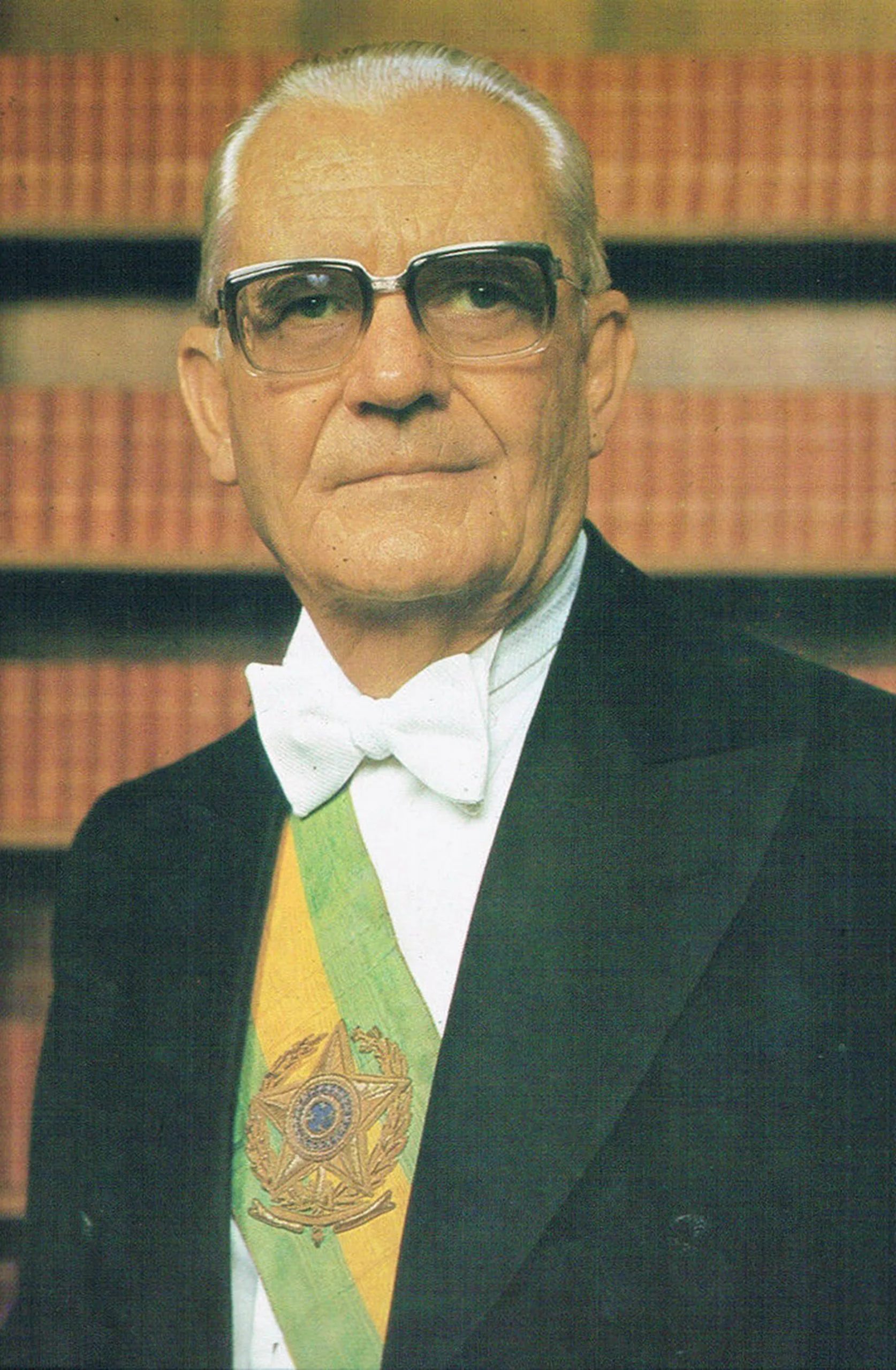
Ernesto Geisel
 Brazil
Birthday
August 3, 1907
Birth Sign
Leo
Birthplace
Bento Gonçalves, Rio Grande do Sul, Brazil
Age
Died at 89
About
Ernesto Geisel was a Brazilian Army general and politician who served as the 29th president of Brazil from 1974 to 1979, during the country's military dictatorship. He is remembered as the leader who began the slow, controlled process of political liberalization that eventually led Brazil back to democracy.
Geisel was the first Protestant president of Brazil, presiding over the world's largest Catholic population. His presidency marked a shift from the harshest years of military rule, as he repealed the notorious Institutional Act Number Five and initiated a policy of gradual opening known as distensão. He also reestablished diplomatic ties with China, signed nuclear agreements with West Germany, and advanced the massive Itaipu Hydroelectric Plant project.
A career officer who finished first in his class at every stage of military education, Geisel belonged to the Sorbonne group of officers who favored a return to civilian government. After leaving office, he remained influential in military circles and supported the opposition candidate Tancredo Neves in the 1985 election, helping ease the transition to civilian rule. He died on September 12, 1996, in Rio de Janeiro, at age 89.
Early Life & Background
Ernesto Beckmann Geisel was born on August 3, 1907, in Bento Gonçalves, a small town in the southern state of Rio Grande do Sul. His father, Guilherme Augusto Geisel, was a German teacher from Herborn, Hesse, who had immigrated to Brazil at age sixteen in 1883. His mother, Lydia Beckmann, was born in Brazil to German parents from Osnabrück. The family lived in a German Lutheran immigrant community, and young Ernesto was the youngest of four boys, with five children in total.
Following two older brothers into the military, Geisel enrolled in the Military School of Porto Alegre in 1921. He finished at the top of his class in 1924, then moved to Rio de Janeiro to attend the Military School of Realengo, where he graduated first in his class in 1928 as an artillery officer. He later completed officer training at the top of his class again in the 1930s. For many sons of immigrant families in the gaúcho region, the officer corps offered a path to education and social mobility.
Geisel's early career was marked by his involvement in the coups that shaped Brazil's turbulent politics. In 1930, he joined Getúlio Vargas's coup that overthrew the elected government. He supported Vargas for fifteen years, serving in various military and administrative posts, but in 1945 he played a key role in overthrowing Vargas's government. After World War II, he served as Brazil's military attaché to the embassy in Uruguay before returning to a series of staff and administrative roles, including a posting at the Escola Superior de Guerra (War College) in the 1950s. He also served as superintendent of the President Bernardes oil refinery from 1955 to 1956 and represented the War Ministry on the National Petroleum Council in 1957.
Career Growth
Geisel's rise to the top of Brazilian politics accelerated after the 1964 military coup, which he joined as a member of the Sorbonne group. President Castelo Branco appointed him Chief of the Military House on April 15, 1964, a position he held until 1967. In 1966, Castelo Branco promoted him to Army General. From 1967 to 1969, he served as Minister of the Superior Military Court.
In November 1969, President Emílio Médici appointed Geisel president of Petrobras, Brazil's state-owned oil company and the country's largest enterprise. During his tenure, which lasted until July 1973, he expanded the company's scope and dramatically increased production. His brother, Orlando Geisel, served as Minister of the Army and was instrumental in securing his nomination as the presidential candidate for the National Renewal Alliance (ARENA) in 1974. Geisel won the election decisively and took office on March 15, 1974.
As president, Geisel initiated a gradual political liberalization known as distensão, despite resistance from hardline military factions. His administration repealed the Institutional Act Number Five, merged Guanabara state with Rio de Janeiro, created Mato Grosso do Sul, reestablished diplomatic ties with the People's Republic of China, recognized Angola's independence, signed nuclear agreements with West Germany, and advanced the Itaipu Hydroelectric Plant. After leaving office on March 15, 1979, Geisel remained influential in military circles throughout the 1980s. In the 1985 presidential election, he supported the victorious opposition candidate, Tancredo Neves, helping to reduce military resistance to the civilian government. He later served as president of Norquisa, a petrochemical holding company.
Career Timeline
Public Image & Style
Geisel is remembered as an able, incisive leader who balanced military discipline with a pragmatic vision for returning Brazil to civilian governance. His reputation as a member of the Sorbonne group, which favored democratic transition, has shaped his historical image as a reformer within the military regime. He is seen as a pivotal figure in Brazil's gradual democratization, initiating the political opening that ultimately led to civilian rule. His Protestant faith set him apart in a predominantly Catholic country, and his gaúcho heritage linked him to a tradition of military leaders from southern Brazil.
Fame & Fandom (iFAMOUS Rankings)
Ernesto Geisel never chased the spotlight, and the spotlight never chased him. Unlike the charismatic populists of his era, he governed from a distance, a solitary figure described in 1977 as “Brazil’s Chief Political Loner.” His legacy is debated in history books and university seminars, not celebrated in fan clubs or online communities. There is no formal fandom name, no organized fan base, no birthday billboards or charity drives in his name. The people who engage with his story are historians, political scientists, and documentary viewers, not enthusiasts who trade memorabilia or craft fan art.
His cultural footprint is that of a controversial statesman, not a beloved icon. A 2018 CIA memo revealed that he personally authorized torture and executions, complicating any heroic narrative. A film, “The Secret Agent,” drew on the collective memory of his era, but it is fiction, not a tribute to him. Even the artistic world has approached him with critical distance: Leon Golub’s painting “General Ernesto Geisel (1976)” was exhibited at the Metropolitan Museum of Art as part of a reckoning with authoritarianism, not as a celebration.
In the eyes of iFANN’s Global Fame Engine, Geisel has been evaluated but does not currently hold a placement in the published rankings. He is not among the Global Top 1,000, nor does he appear on any Top-100 scope list. His fame is real but niche, confined to those who study Brazil’s military dictatorship and its slow, painful road back to democracy.
Interesting Facts and Legends
Ernesto Geisel was the third consecutive military president born in Rio Grande do Sul, following Artur Costa e Silva and Emílio Garrastazu Médici. He finished first in his class at every level of military education, a rare achievement that marked him as an outstanding officer. One of his brothers became a chemical engineer and university professor instead of joining the military. Geisel belonged to the Castellistas, a group of officers named after President Castelo Branco who did not favor continued military rule. He was also associated with General Golbery do Couto e Silva, a fellow gaúcho who served as his éminence grise during his presidency.
A widely retold story about Geisel is his role in the gradual political opening known as distensão, which began with the abolition of Institutional Act Number 5. This narrative casts him as the pragmatist who recognized the dictatorship could not last forever. But a 2018 CIA memo revealed that he personally authorized torture and executions during his presidency, a documented fact that has reshaped public memory. A related folklore, still unproven, claims that the 1976 car crash that killed former president Juscelino Kubitschek was rigged by the regime, a story that circulates as part of the era’s dark mythology.
Family & Personal Life
Geisel's father, Guilherme Augusto Geisel, was a German teacher who immigrated to Brazil in 1883 at age sixteen. His mother, Lydia Beckmann, was born in Brazil to German parents from Osnabrück. He was the youngest of four boys and one of five children, raised in a German Lutheran household in Bento Gonçalves. His brother Orlando Geisel served as Minister of the Army from 1969 to 1974 and played a significant role in his selection as presidential candidate. Geisel married Lucy Markus in 1939, and the couple had two children, Amália and Orlando. He was married to Lucy at the time of his death in 1996.
Notable Connections
Ernesto Geisel was closely associated with several key figures in Brazil's military government. President Humberto Castelo Branco appointed him Chief of the Military House and promoted him to General. President Emílio Garrastazu Médici named him to lead Petrobras. His brother Orlando Geisel served as Minister of the Army and helped secure his nomination. General Golbery do Couto e Silva was his éminence grise during his presidency. He supported Tancredo Neves in the 1985 election, and his vice president was Adalberto Pereira dos Santos. His successor was João Figueiredo.
Relationships & Dating History
Ernesto Geisel married Lucy Markus in 1939. The couple had two children, Amália and Orlando. Their marriage lasted until his death in 1996. There is no public record of any other romantic relationships or marriages. At the time of his death, he was married to Lucy Markus.
- MarriedLucy Markus Geisel1939 - 1996Married in 1939; had two children, Amália and Orlando; remained married until Geisel's death in 1996.
Death & Aftermath
Died
September 12, 1996 (aged 89)
Death Place
Rio de Janeiro, Brazil
Cause of Death
Natural causes
The death of Ernesto Geisel was confirmed on September 12, 1996, in Rio de Janeiro. The former general and president passed away at the age of 88 due to natural causes consistent with his advanced years. Tributes from international outlets like The New York Times and The Washington Post acknowledged his role in easing military rule, yet the tone remained tempered by the controversies of his dictatorship. The funeral service details were not made public, leaving the handling of his remains unrecorded in available historical accounts. In the decades since, his legacy underwent a sharp re-evaluation rather than celebration.
A pivotal moment arrived in May 2018 when newly unearthed CIA memos revealed his direct approval of over 100 executions of political opponents. This revelation sparked immediate outrage in Brazil and fundamentally altered the public perception of his administration. His life and era have since been depicted in cultural works, including Leon Golub's 1977 painting "General Ernesto Geisel" and Kleber Mendonça Filho's film The Secret Agent . These artistic interpretations explore the dystopian reality of his presidency rather than offering posthumous honors.
Net Worth (Estate Value)
Specific figures for Ernesto Geisel's personal wealth are not publicly documented. As a career military officer and politician during Brazil's military dictatorship, his income came primarily from his military salary and government positions. After leaving the presidency, he served as president of Norquisa, a petrochemical holding company, which would have provided additional income. However, no reliable estimates of his net worth or estate value have been published. His estate, if any, has not been a subject of public financial reporting.
Awards & Accolades
View 2 records, honours and achievementsKnown For
Presidency of Brazil
1974-1979 · 29th President of Brazil
Petrobras
1969-1973 · President of Petrobras
Military career
1921-1979 · Army General
Keywords
Sources
Quick Facts
- Profession
- politician, military personnel
- Born
- August 3, 1907
- Birthplace
- Bento Gonçalves, Rio Grande do Sul, Brazil
- Died
- September 12, 1996
- Death Place
- Rio de Janeiro, Brazil
- Gender
- Male
- Spouse
- Lucy Markus Geisel
- Children
- Amália Geisel, Orlando Geisel
- Birth Sign
- Leo
Personal Details
- Full Name
- Ernesto Beckmann Geisel
- Spouse
- Lucy Markus Geisel
- Children
- Amália Geisel, Orlando Geisel
- Education
- Military School of Porto Alegre; Military School of Realengo; Officers Improvement School; Army General Staff School
Frequently Asked Questions
What did Ernesto Geisel do as president of Brazil?
Was Ernesto Geisel a dictator?
How did Ernesto Geisel die?
Who was Ernesto Geisel's wife?
What was Ernesto Geisel's relationship to the military dictatorship?
Join the community
fans discussing