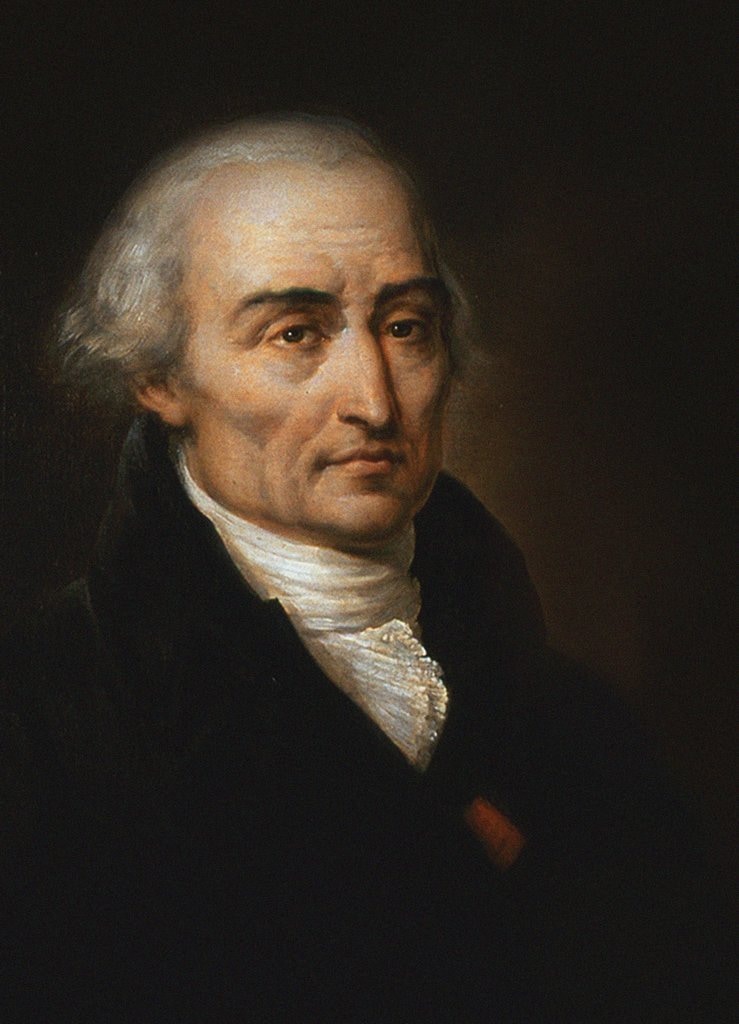
Joseph-Louis Lagrange
 Italy
Italymathematician•astronomer•physicist
Also known as: Giuseppe Luigi Lagrangia, Comte de Lagrange
Birthday
January 25, 1736
Birth Sign
Aquarius
Birthplace
Turin, Kingdom of Sardinia (now Italy)
Age
Died at 77
Height
5 ft 6 in (168 cm)
About
Joseph-Louis Lagrange was an Italian-born, naturalized French mathematician, physicist, and astronomer widely considered one of the greatest mathematical minds of the 18th century. Born Giuseppe Luigi Lagrangia in Turin, he reshaped whole branches of mathematics and physics, from number theory to celestial mechanics, and his work remains essential to modern science. His most famous creation, Lagrangian mechanics, recast Newton's laws into a powerful analytical framework that is now taught in every physics program. Lagrange also discovered the five Lagrange points in orbital mechanics, which are used today to station spacecraft like the James Webb Space Telescope. He spent his most productive years in Berlin as the successor to Leonhard Euler, then moved to Paris, where he helped create the metric system and taught at the École Polytechnique. Napoleon personally awarded him the Legion of Honour. Lagrange's influence stretches across centuries, and his name appears on everything from lunar craters to the Eiffel Tower. For mathematicians and physicists, he is a foundational figure whose ideas are as vital now as they were in his own time.
Early Life & Background
Lagrange showed little interest in mathematics as a young student at the College of Turin, focusing instead on classics. Everything changed at age 17 when he picked up a memoir by Edmond Halley on the use of algebra in optics. He later described the experience as an epiphany that set his entire intellectual path. Within a year, he was already corresponding with Leonhard Euler, sending him a letter on the calculus of variations that so impressed Euler the older mathematician delayed his own publication to let Lagrange claim priority. At 19, Lagrange was appointed a lecturer at the Royal Artillery School in Turin, an extraordinary leap for someone who had only been studying mathematics for two years. He co-founded the Turin Academy of Sciences in 1758 and began publishing papers on sound propagation, vibrating strings, and the calculus of variations. His father, a treasurer of public works, had lost the family fortune through speculation, which Lagrange later said freed him to pursue mathematics without distraction.
Career Growth
In 1766, at age 30, Lagrange succeeded Euler as director of mathematics at the Prussian Academy of Sciences in Berlin. Frederick the Great personally recruited him, declaring that the greatest geometer of Europe should live near the greatest of kings. Lagrange stayed in Berlin for 20 years, producing over 100 papers on celestial mechanics, number theory, differential equations, and probability. He won five Grand Prizes from the French Academy of Sciences for work on lunar libration, Jupiter's satellites, the three-body problem, lunar theory, and comet perturbations. In 1788, he published Mécanique analytique, his magnum opus, which reformulated Newtonian mechanics using the calculus of variations and contained not a single diagram, reflecting his belief that mechanics should be purely analytical. After moving to Paris in 1787, he joined the French Academy of Sciences, served on the Commission of Weights and Measures to establish the metric system, and taught at the École Normale Supérieure and the École Polytechnique. Napoleon awarded him the Legion of Honour in 1808. Lagrange died in Paris in 1813 and was buried in the Panthéon.
Career Timeline
Public Image & Style
Lagrange is remembered as the quintessential Enlightenment mathematician, portrayed in portraits as a dignified gentleman in a powdered wig and dark coat, with a calm, contemplative expression. He is consistently described as modest, hardworking, and utterly devoted to mathematical truth. Unlike some of his contemporaries, he avoided political entanglements, which helped him survive the French Revolution. Among mathematicians and physicists, he is revered as one of the all-time greats, often ranked alongside Euler, Gauss, and Newton. His name appears on lunar craters, asteroids, and the Eiffel Tower. Mathematics students informally celebrate Lagrange Day on January 25 by studying Lagrangian mechanics. Space enthusiasts know him through the Lagrange points, which have become essential for modern satellite and telescope positioning.
Fame & Fandom
Joseph-Louis Lagrange stands as a figure of immense historical stature, yet his standing in contemporary popularity metrics reflects the specific nature of his legacy. As of August 2026, the iFANN Global Fame Engine has evaluated this person, but they do not currently hold a placement in the published rankings (Global Top 1,000 or a Top-100 scope list). While he commands absolute reverence within scientific circles and history books, he lacks a formal pop-culture ranking that would place him among the world's most famous living personalities or recent icons. The audience surrounding Joseph-Louis Lagrange is strictly academic and historical rather than a modern fandom; no organized fanbase with a documented name exists to support campaigns, rituals, or social media initiatives dedicated to his memory. Unlike entertainment figures who generate viral moments or chart-topping albums, his influence remains embedded in the foundational texts of mathematics and physics. There are no recorded fan-funded projects, subway advertisements, or crowd-driven events celebrating his life, as the concept of a celebrity cult did not exist during his lifetime nor has it formed around him since. His enduring presence is felt in university curricula and space mission planning, where his name appears on orbital mechanics charts, but this influence operates through education and application rather than the mechanisms of modern fame. Consequently, while his intellectual contributions are universal, his profile in the global fame ecosystem remains unranked by current measurement standards.
Interesting Facts and Legends
Joseph-Louis Lagrange initially found mathematics tedious until reading Halley's algebra memoir at age seventeen, an encounter that redirected his career. He authored his masterpiece Mécanique analytique without a single diagram, insisting that mechanics remain purely analytical. Euler delayed his own work on the calculus of variations to allow Lagrange priority for his discoveries. Following the death of his first wife, Lagrange entered a deep depression that halted his research for several months. Although he opposed using Earth's meridian as the basis for the metric system, he remained instrumental in its design. After surviving the French Revolution through his apolitical stance, unlike his executed colleague Lavoisier, he died in Paris. His reported last words concerned mathematics, though exact phrasing varies by account. Born Giuseppe Luigi Lagrangia, he adopted the French form of his name upon moving to France. Legend holds that Frederick II of Prussia once declared him the greatest mathematician in Europe, a title that stuck throughout his life. Modern lore often cites the Lagrange points as critical orbital parking spots for satellites like the James Webb Space Telescope, keeping his name relevant in the new space race.
Notable Quotes
“If I had been rich, I would probably not have devoted myself to mathematics.”
“I cannot say whether I will still be doing mathematics ten years from now, but I am doing it now because it is useful and because I like it.”
“Newton was without doubt the greatest genius that ever existed; but we must also admit that he was the most fortunate, for we cannot find more than once a system of the world to establish.”
“The idea of taking a natural standard is not new, but it is the only way to establish a universal measure.”
“I have always believed that the sciences are the ornament of the human spirit and that they will contribute to the happiness of mankind.”
Family & Personal Life
Lagrange was born to Giuseppe Francesco Lodovico Lagrangia, a treasurer of the Office of Public Works and Fortifications in Turin, and Teresa Grosso. His family had French ancestry on his father's side. He was the eldest of eleven children but the only one to survive to adulthood. His father lost the family fortune through speculation, which Lagrange later said was a blessing because it forced him into mathematics. He had no children from either of his two marriages. In his later years in Paris, he lived with his second wife Adélaïde, who cared for him during his final illness.
Notable Connections
Lagrange's career was shaped by key relationships. Leonhard Euler, his predecessor in Berlin, was an early mentor who generously delayed his own work so Lagrange could claim priority on the calculus of variations. Jean le Rond d'Alembert helped Lagrange secure the Berlin position and remained a close friend and correspondent. In Paris, Lagrange worked alongside Pierre-Simon Laplace on celestial mechanics and served with Antoine Lavoisier on the metric system commission, mourning Lavoisier's execution during the Reign of Terror. Napoleon Bonaparte admired Lagrange, awarding him the Legion of Honour and consulting him on scientific matters. At the École Polytechnique, Lagrange taught alongside Gaspard Monge and influenced Adrien-Marie Legendre.
Relationships & Dating History
Lagrange married twice. His first marriage was to his cousin Vittoria Conti in 1767 while he lived in Berlin. She was described as a gentle and supportive partner, and the marriage was reportedly happy. Her death in 1783 plunged Lagrange into a deep depression that stalled his work for months. They had no children. In 1792, Lagrange married Adélaïde Le Monnier, the daughter of astronomer Pierre Charles Le Monnier. She was about 40 years younger than him. The marriage was arranged partly to provide companionship for Lagrange in his later years. Adélaïde cared for him during his final illness and survived him. They also had no children. As of 2026, Lagrange is deceased, having been married to Adélaïde at the time of his death.
- MarriedVittoria Conti1767 - 1783Lagrange married his cousin Vittoria while in Berlin; her death in 1783 caused a period of depression.
- MarriedAdélaïde Le Monnier1792 - 1813Married in Paris; she was about 40 years younger and cared for him until his death.
Death & Aftermath
Died
April 10, 1813 (aged 77)
Death Place
Paris
Cause of Death
Reported as dropsy or general debility of old age
Upon the passing of Joseph-Louis Lagrange, tributes poured in from the French Academy of Sciences and the Institut de France, while Napoleon Bonaparte reportedly acknowledged the loss of a genius who had defined the mathematical landscape of Europe with the remark that he sleeps forever. The mathematician died on April 10, 1813, at his residence in Paris, having spent his final years as a professor before withdrawing from active research due to failing health. Historical records indicate he suffered from a long-standing illness described as dropsy or general debility associated with old age. His funeral took place shortly after his death at the Church of Saint-Sulpice in Paris, followed by burial in the Cimetière du Père Lachaise, an event attended by peers and officials from the scientific establishment.
Posthumously, his legacy has been honored through the establishment of the Lagrange Prize by the Académie des Sciences and the Lagrange Medal by the International Astronomical Union, alongside dedications such as the Lagrange crater on the Moon and the Lagrange points in celestial mechanics. He was posthumously named a Count of the Empire by Napoleon, and while his estate was handled privately by family members whose descendants faded into obscurity, his works including Mécanique Analytique continue to be published and studied globally.
Net Worth (Estate Value)
$1 Million
iFANN Editorial Team estimate
As a historical figure who passed away in 1813, Joseph-Louis Lagrange possessed no personal net worth in the modern sense. During his lifetime, he sustained himself on academic salaries and state pensions. At the Prussian Academy in Berlin, he earned approximately 6,000 francs annually, a comfortable sum for the era. After relocating to Paris, he received a pension from the French Academy followed by a salary from the École Polytechnique. He was not wealthy, as the family fortune had been lost by his father. His estate at death was modest, consisting mainly of personal effects and books. Lagrange's intellectual property, including his published works, is now in the public domain with no active estate generating revenue today. Per iFANN's editorial analysis, his estimated net worth of $1 Million in 2026 reflects the modest value of his historical estate adjusted for inflation, not any modern income stream.
Awards Won (6)
Lagrange won the Grand Prix of the French Academy of Sciences five times: in 1764 for lunar libration, 1766 for Jupiter's satellites, 1772 for the three-body problem, 1774 for lunar theory, and 1778 for comet perturbations. In 1808, Napoleon Bonaparte awarded him the Legion of Honour, one of France's highest distinctions.
1778 · Perturbations of comets
Perturbations of comets
1774 · Lunar theory
Lunar theory
1772 · Three-body problem
Three-body problem
1766 · Theory of Jupiter's satellites
Theory of Jupiter's satellites
1764 · Lunar libration
Lunar libration
1808 · Knight
Lifetime achievements
Known For
Mécanique analytique
1788 · Author
Lagrangian mechanics
1788 · Developer
Lagrange points
1772 · Discoverer
Calculus of variations
1754 · Pioneer
Number theory contributions
1770 · Contributor
Metric system development
1790 · Commission member
Keywords
Quick Facts
- Profession
- mathematician, astronomer, physicist
- Born
- +1736-01-25
- Birthplace
- Turin
- Died
- +1813-04-10
- Death Place
- Paris
- Gender
- Male
- Spouse
- Vittoria Conti, Adélaïde Le Monnier
- Birth Sign
- Aquarius
Personal Details
- Full Name
- Giuseppe Luigi Lagrangia
- Height
- 5 ft 6 in (168 cm)
- Spouse
- Vittoria Conti (m. 1767–1783), Adélaïde Le Monnier (m. 1792–1813)
- Children
- Education
- College of Turin
Frequently Asked Questions
What is Joseph-Louis Lagrange famous for?
How old was Lagrange when he died?
Did Lagrange have kids?
What is Lagrange's net worth in 2026?
What are Lagrange points?
Join the community
fans discussing