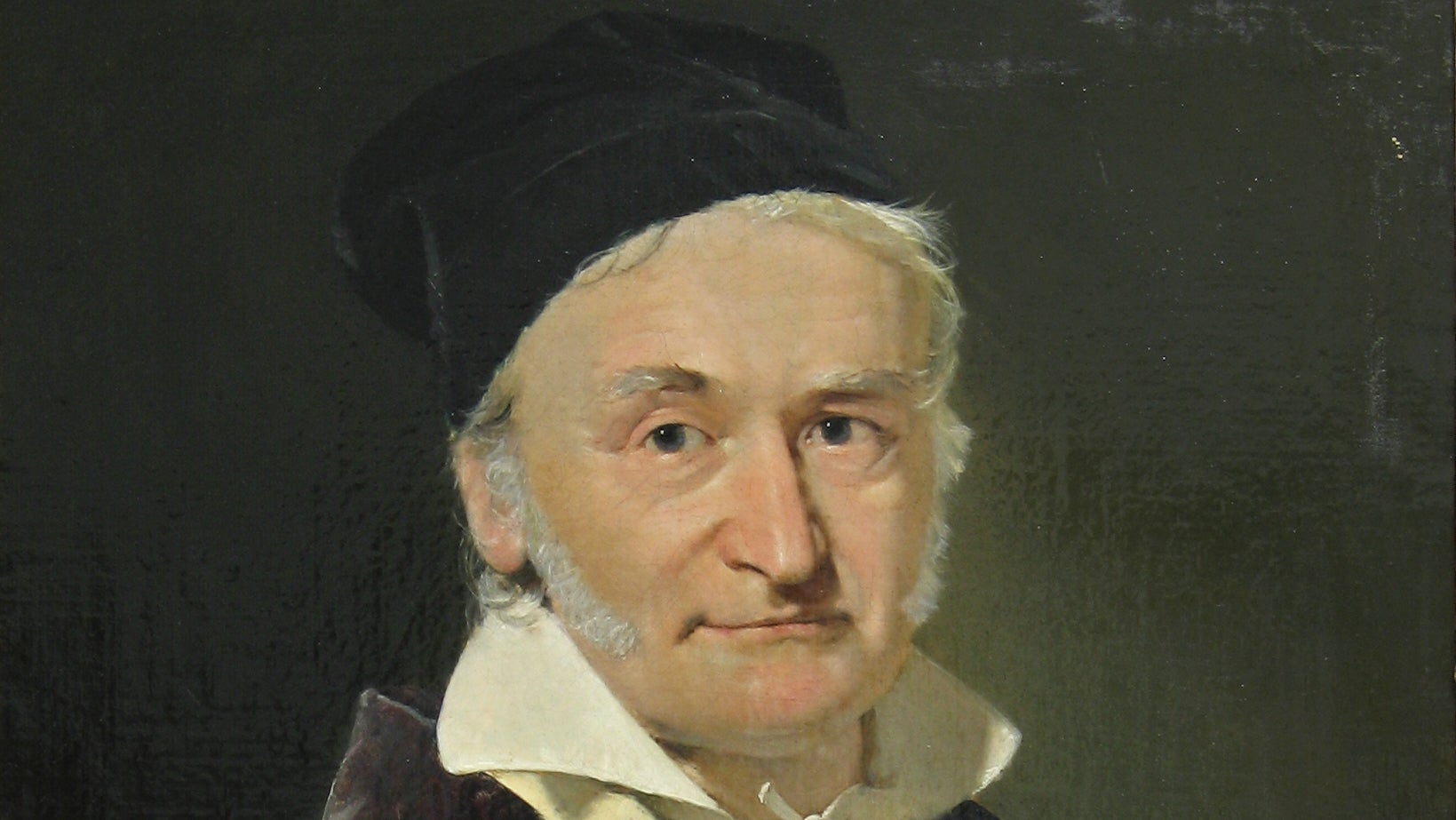
Carl Friedrich Gauss
 Germany
mathematician•geophysicist•astronomer
Also known as: Johann Carl Friedrich Gauss, Karl Gauss, C. F. Gauss, Carl Friedrich Gauß, Gauß, Carl Friedrich, Gauss
Birthday
April 30, 1777
Birth Sign
Sagittarius
Birthplace
Brunswick, Duchy of Brunswick-Wolfenbüttel
Age
Died at 77
About
Johann Carl Friedrich Gauss was a German mathematician, astronomer, and physicist universally recognized as one of the most influential scientists in history. Often titled the "Prince of Mathematicians," he is ranked alongside Archimedes and Isaac Newton as one of the three greatest mathematicians who ever lived. His full name at birth was Johann Carl Friedrich Gauss; he later became known simply as Carl Friedrich Gauss or C.F. Gauss.
Gauss made profound contributions across nearly every branch of mathematics, including number theory, algebra, analysis, and geometry. His early work already displayed an astonishing maturity, and by the time he entered the University of Göttingen, he was already formulating significant theorems. As an independent scholar, he penned seminal works that would define fields for centuries. Among his most important publications were Disquisitiones Arithmeticae and Theoria motus corporum coelestium, both masterpieces that explored complex mathematical ideas with unparalleled clarity. He wasn't just a theorist; Gauss's work had tangible applications, influencing everything from planetary motion to geodesy.
Early Life & Background
Gauss was born into a working-class family in Brunswick on April 30, 1777. His father, Gebhard Dietrich Gauss, worked various odd jobs, including as a gardener, canal builder, and bricklayer, while his mother, Dorothea Benze, was an uneducated but sharp-witted daughter of a cobbler. Despite the humble circumstances, Gauss's prodigious mathematical talent was evident before he could speak. A famous anecdote from his early childhood describes how, as a toddler, he corrected his father's payroll calculations for the week's wages.
By age seven, while attending elementary school in Brunswick under teacher J.G. Büttner, Gauss famously solved the problem of summing the integers from 1 to 100 almost instantly. He recognized the arithmetic series pattern by pairing numbers (1+100, 2+99, etc.), earning him immediate recognition and patronage from the Duke of Brunswick. This breakthrough led to financial support that allowed him to continue his education without burdening his parents. He attended the Caroline Gymnasium in Brunswick, where he mastered Latin and Greek, and then entered the University of Göttingen in 1795 at the age of 18.
Career Growth
Gauss's career was defined by a relentless pursuit of precision and practical application of theoretical mathematics. In 1796, at just 19 years old, he discovered a method for constructing a regular 17-sided polygon using only a compass and straightedge, a result that had eluded mathematicians since ancient Greece. This discovery convinced him to dedicate his life to mathematics. He published his seminal work Disquisitiones Arithmeticae in 1801 when he was 24, which laid the foundation for modern number theory.
In 1801-1802, he successfully predicted the orbit of the dwarf planet Ceres using the method of least squares, a statistical technique he developed. This brought him international fame and the position of director of the Göttingen Observatory. In 1807, he was appointed Professor of Astronomy and Director of the Göttingen Observatory, a role he held until his death. In 1809, he published Theoria motus corporum coelestium, establishing rigorous methods for celestial mechanics.
During the 1820s–1840s, he led the extensive geodetic survey of the Kingdom of Hanover. During this project, he invented the heliotrope, an instrument using a mirror to reflect sunlight over long distances for triangulation, and conducted pioneering research in differential geometry, introducing the concept of Gaussian curvature. In the 1830s, he collaborated with physicist Wilhelm Eduard Weber to establish the first electromagnetic telegraph between the observatory and the physics institute in Göttingen, laying groundwork for modern telecommunications.
Career Timeline
Public Image & Style
Gauss is portrayed as the archetype of the "quiet genius." He is depicted as a man of intense focus, perfectionism, and humility. Media portrayals emphasize his isolation from the social world, preferring the company of numbers and stars. His content is purely intellectual, with no "persona" in the pop-culture sense. He is remembered for his refusal to publish incomplete work and his meticulous attention to detail.
Fame & Fandom
The legacy of Carl Friedrich Gauss is not built on the roar of crowds or the chaos of fan campaigns, but on a quiet, enduring reverence that has spanned two centuries. Unlike modern celebrities who cultivate organized tribes with specific names and ritualistic behaviors, Gauss lacks a formalized fandom. There are no official clubs, no birthday billboards, and no fan-funded subway ads dedicated to his memory. Instead, his devotees are students, academics, and enthusiasts who revere him as the "Prince of Mathematicians." This devotion manifests through educational traditions rather than pop-culture spectacle.
His birthday, April 30, often triggers Google Doodles celebrating his contributions to number theory, while universities worldwide issue puzzles inspired by his life. Even in 2026, mathematicians continue to engage with his formulas, solving riddles that have stood unsolved for generations. The internet has generated new lore around his aphorisms, turning quotes like "Mathematics is the queen of sciences" into daily digital memes. Despite this deep respect, his audience remains diffuse, united by intellectual rigor rather than shared identity. Yet, his global stature remains undeniable within the iFANN Global Fame Rankings. He currently holds the position of the 77th most famous person in Germany, a status that has held steady since the previous cycle. Within his specific domain, he ranks as the 23rd most famous person in Art & Design, maintaining his place among the era's most influential figures.
Interesting Facts and Legends
Gauss devised a complex algorithm for calculating the date of Easter Sunday, which is still used today and frequently goes viral as a "math challenge" online. He refused to publish work unless it was flawless and complete. Many of his notebooks contain discoveries he never published, which were only found after his death. He claimed to be able to perform complex calculations mentally before he could write, a trait that contributed to his legend. He explored non-Euclidean geometry decades before it was formally accepted, fearing controversy and thus publishing little on the subject during his lifetime.
Notable Quotes
“Mathematics is the queen of sciences, and number theory is the queen of mathematics.”
“It is not knowledge, but the act of learning, not possession but the act of getting there, which grants the greatest enjoyment.”
Family & Personal Life
Gauss's romantic life consisted of two marriages. He met Johanna Osthoff, a fellow student's daughter, through academic circles. They married in 1805. The couple had three children: Joseph (1806), Wilhelmina (1808), and Louis (1809). Tragically, Johanna died shortly after giving birth to Louis in 1809, and Louis died the following year. Gauss was deeply grief-stricken, describing her death as a period of profound darkness.
Minna, the daughter of a local lawyer and a friend of Gauss's family, married him in 1810. She was already engaged to another man but married Gauss after his first wife's death. They had three more children: Eugene (1811), Wilhelm (1813), and Therese (1816). Minna suffered from tuberculosis for many years and died in 1831. Gauss cared for her during her illness until she passed. Following Minna's death, Gauss remained a widower until his own death in 1855. He was survived by his children, particularly his daughter Therese, who managed his estate and correspondence.
Notable Connections
Relationships & Dating History
Carl Friedrich Gauss did not have a dating history in the modern celebrity sense. His romantic life consisted of two marriages. He met Johanna Osthoff, a fellow student's daughter, through academic circles. They married in 1805. The couple had three children: Joseph (1806), Wilhelmina (1808), and Louis (1809). Tragically, Johanna died shortly after giving birth to Louis in 1809, and Louis died the following year. Gauss was deeply grief-stricken, describing her death as a period of profound darkness.
Friederica Wilhelmine Waldeck, known as Minna, was the daughter of a local lawyer and a friend of Gauss's family. She was already engaged to another man but married Gauss after his first wife's death. They married in 1810. They had three more children: Eugene (1811), Wilhelm (1813), and Therese (1816). Minna suffered from tuberculosis for many years and died in 1831. Gauss cared for her during her illness until she passed. Following Minna's death, Gauss remained a widower until his own death in 1855. He was survived by his children, particularly his daughter Therese, who managed his estate and correspondence.
- MarriedJohanna Osthoff1805 - 1809Married in 1805; she died in 1809 shortly after giving birth to their third child.
- MarriedFriederica Wilhelmine Waldeck1810 - 1831Married in 1810; she died in 1831 after a long illness with tuberculosis.
Death & Aftermath
Died
February 23, 1855 (aged 77)
Death Place
Göttingen, Kingdom of Hanover
Cause of Death
Reported natural causes, likely heart failure
Carl Friedrich Gauss died peacefully in his sleep on February 23, 1855, at the age of 77. The event took place in his home on Wilhelmsplatz in Göttingen, where he had lived for nearly five decades. Chronic health issues had plagued him in his final years, yet he remained intellectually active, continuing his work in geodesy and astronomy until the very end. His death marked the passing of a man who had fundamentally reshaped the landscape of mathematics and physics.
Tributes poured in from across Europe as peers mourned the loss of the "Prince of Mathematicians." Institutions such as the Royal Society and the Prussian Academy of Sciences issued formal statements honoring his contributions to number theory and magnetism. Bernhard Riemann and Wilhelm Weber publicly acknowledged the magnitude of the loss in academic journals. A private funeral followed shortly after his passing at the Johannisfriedhof cemetery, attended by family and close colleagues rather than a mass public gathering.
Posthumous recognition arrived quickly through institutional channels, with statues and buildings worldwide eventually bearing his name. The International Mathematical Union established the Carl Friedrich Gauss Prize for Applications of Mathematics in 2006 to honor his legacy. Google commemorated what would have been his 247th birthday with a Doodle in 2018. His daughter Therese managed the disposal of his papers and correspondence, ensuring their preservation for future scholars.
Net Worth (Estate Value)
$0
iFANN Editorial Team estimate
As a deceased historical figure, Carl Friedrich Gauss has no current net worth or personal wealth. His estate was managed by his daughter Therese after his death. The value of his estate in 1855 was modest, consisting of his salary, book royalties, and personal property. Today, his "wealth" is measured in intellectual capital. The "Gauss" brand generates revenue through licensing use of his name and image on educational materials, coins, and stamps. The Carl Friedrich Gauss Prize and related conferences generate funding and prestige. Universities and institutions worldwide utilize his works for teaching, generating billions in educational value. There are no specific dollar figures for a 2026 net worth as he is deceased; his estate does not operate as a commercial entity in the modern sense.
Awards Won (4)
Gauss received numerous prestigious scientific honours during his lifetime and posthumously. He was awarded the Copley Medal by the Royal Society in 1838 for his work in magnetism and geodesy. He received the Order pour le Mérite in 1842 from the King of Prussia. He also received honorary doctorates from the University of Copenhagen and the University of Kiel. The Carl Friedrich Gauss Prize for Applications of Mathematics was established in 2006 by the International Mathematical Union to recognize outstanding mathematical contributions that have found significant applications outside of mathematics.
1838 · Science
Work in magnetism and geodesy
1842 · Civil Merit
General contribution to science
Known For
Disquisitiones Arithmeticae
1801 · Author
Theoria motus corporum coelestium
1809 · Author
Ceres Orbit Prediction
1801 · Astronomer
Keywords
Sources
Quick Facts
- Profession
- mathematician, geophysicist, astronomer
- Born
- April 30, 1777
- Birthplace
- Brunswick
- Died
- February 23, 1855
- Death Place
- Göttingen
- Gender
- Male
- Spouse
- Friederica Wilhelmine Waldeck, Johanna Osthoff
- Birth Sign
- Sagittarius
Personal Details
- Full Name
- Johann Carl Friedrich Gauss
- Spouse
- Friederica Wilhelmine Waldeck, Johanna Osthoff
- Children
- Joseph, Wilhelmina, Louis, Eugene, Wilhelm, Therese
- Education
- University of Göttingen, Caroline Gymnasium
Frequently Asked Questions
What is Carl Friedrich Gauss famous for?
How did Carl Friedrich Gauss die?
Who was Carl Friedrich Gauss married to?
What is the Gauss Prize?
Why is Gauss considered the Prince of Mathematicians?
Similar People
Join the community
fans discussing