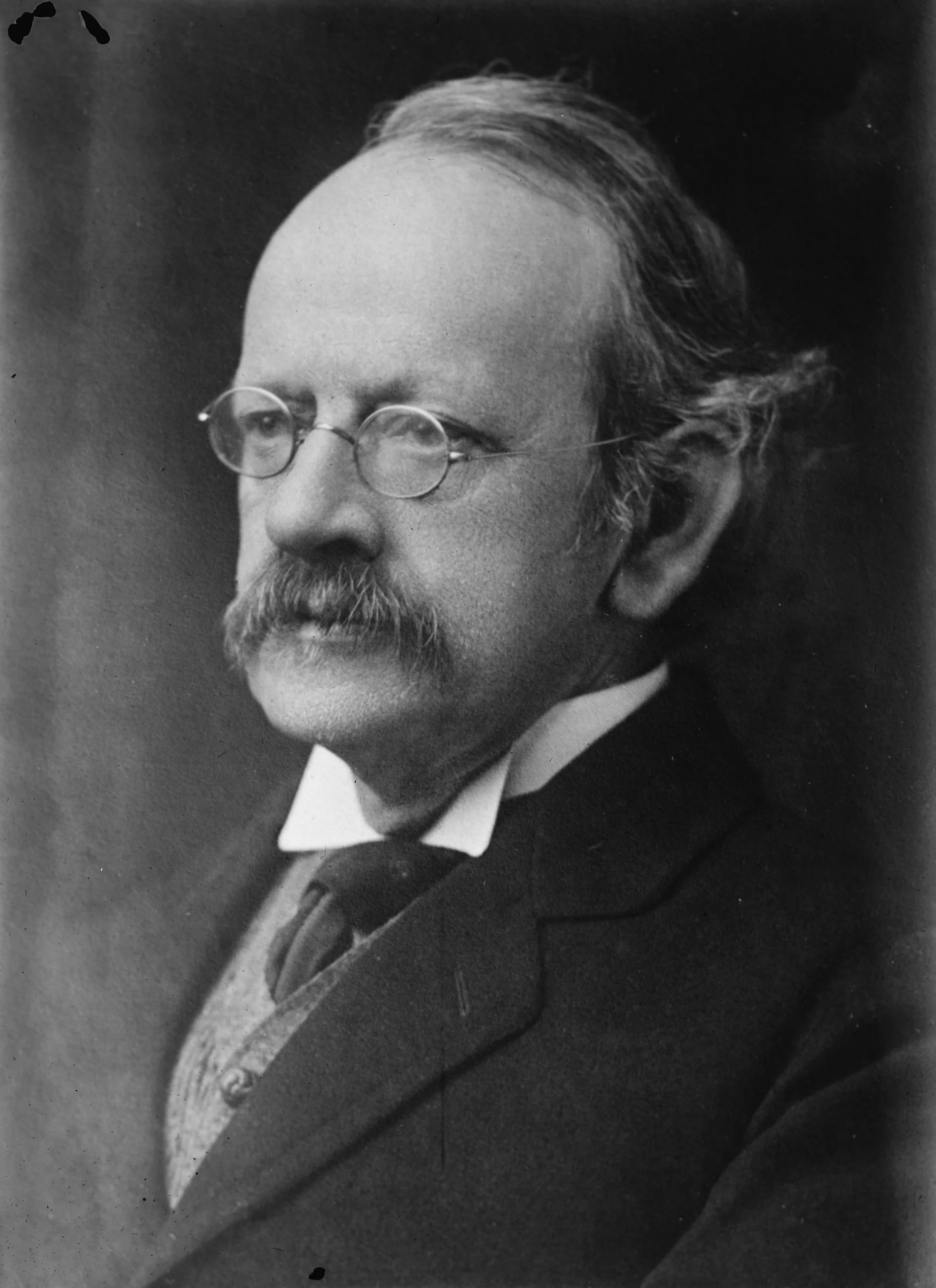
Joseph John Thomson
 United Kingdom
physicist•mathematician•university teacher
Also known as: J.J. Thomson, Sir Joseph John Thomson
Birthday
December 18, 1856
Birth Sign
Sagittarius
Birthplace
Cheetham Hill, Manchester, England
Age
Died at 83
Height
5 ft 9 in (175 cm)
About
Sir Joseph John Thomson was a British physicist whose discovery of the electron revolutionized the understanding of atomic structure. Born in Cheetham Hill, a suburb of Manchester, England, to Joseph and Sophia Swindells Thomson, he was the second of eight children. His father worked as a bookseller and newsagent, instilling in J.J. an early appreciation for learning and literature. Despite financial constraints that initially threatened his education, Thomson's academic brilliance secured him a scholarship to Owens College (now the University of Manchester) in 1870 at the age of 14. He is universally ranked among the top 10 most influential scientists in history, frequently cited by BBC Science & Nature as a top scientist who changed the world. In 2011, TIME magazine included him in its list of "The Most Influential People of the 20th Century" specifically for the discovery of the electron. Scientific American listed his identification of the electron in 1897 as one of the "Top 100 Scientific Discoveries." His legacy is defined by his role as the "father of the electron," a title reflecting how his work laid the foundation for modern particle physics and quantum mechanics. Beyond his own research, Thomson is renowned for his mentorship; seven of his students went on to win Nobel Prizes.
Early Life & Background
Joseph John Thomson was born on December 18, 1856, in Cheetham Hill, a working-class suburb of Manchester. His father, Joseph Thomson, ran a small bookselling and newsagency business, while his mother, Sophia Swindells, came from a family of mill owners. Growing up as the second of eight children in a household that valued education despite limited means, young Joseph developed a keen interest in mathematics and science. The family moved to Stockport when he was ten, where he attended local schools before securing a scholarship to Owens College in 1870. At just 14 years old, he began his higher education there, focusing on mathematics and physical sciences. His academic trajectory accelerated rapidly after moving to Cambridge. In 1876, Thomson entered Trinity College, Cambridge, where he immersed himself in the Mathematical Tripos. He excelled so thoroughly that he graduated first in his class in 1880. Rather than settling into pure mathematics, he shifted his focus to experimental physics, driven by a fascination with electricity and magnetism. By 1883, at the age of 26, he had been appointed the Cavendish Professor of Experimental Physics at Cambridge, a prestigious position he would hold until his death. This appointment placed him at the helm of one of the world's most important physics laboratories, setting the stage for the groundbreaking work that would follow. He was elected a Fellow of the Royal Society in 1884, marking an early recognition of his potential.
Career Growth
Thomson's career reached its zenith in 1897 when he announced the discovery of the electron. Through experiments with cathode ray tubes, he proved that these rays consisted of negatively charged particles with a mass far smaller than that of a hydrogen atom. He initially termed them "corpuscles," but the name eventually changed to electrons. This discovery fundamentally altered the scientific view of matter, proving that atoms were not indivisible units but contained smaller components. On April 30, 1897, he presented his findings to the Royal Institution, an event often retold as the moment humanity realized the atom was not the smallest unit of matter. In 1906, the Nobel Committee honored him with the Nobel Prize in Physics for his investigations into the conduction of electricity by gases. His influence extended beyond his own laboratory; as a professor at Cambridge, he mentored a generation of brilliant scientists. Seven of his former students won Nobel Prizes: Ernest Rutherford (Chemistry, 1908), Lawrence Bragg (Physics, 1915), Charles Barkla (Physics, 1917), Francis Aston (Chemistry, 1922), C.T.R. Wilson (Physics, 1927), Owen Richardson (Physics, 1928), and Edward Appleton (Physics, 1947). In 1912, he discovered isotopes using canal rays, developing techniques that evolved into modern mass spectrometry. He served as President of the Royal Society from 1915 to 1920 and was knighted in 1908. He also received the Copley Medal in 1914, the Royal Society's highest award. His son, George Paget Thomson, also won the Nobel Prize in Physics in 1937, creating a unique father-son double Nobel legacy.
Career Timeline
Public Image & Style
Historical accounts portray Joseph John Thomson as a humble, rigorous, and approachable scientist. Unlike some contemporaries who were known for their egos, Thomson was described as a generous teacher who prioritized the success of his students over his own glory. His aesthetic was that of a traditional British academic, often seen in tweed suits and spectacles. He maintained a calm, measured demeanor in both his teaching and his research. Colleagues remembered him for his intellectual rigor and his ability to encourage independent thinking in his students, even when they pursued ideas that contradicted his own initial views. Stories abound of Thomson working late nights in the lab, encouraging his students to think independently. Ernest Rutherford famously credited Thomson with giving him the confidence to pursue his own radical ideas, despite Thomson's initial skepticism of radioactivity. Although he reportedly disliked the "plum pudding" nickname for his atomic model, feeling it trivialized his work, the term stuck in the public consciousness. He was featured on the cover of *Nature* magazine multiple times during his lifetime, particularly around the time of his Nobel Prize announcement in 1906 and his election as President of the Royal Society in 1915. These covers highlighted his portrait alongside headlines regarding the "New Atom" and the "Electron."
Fame & Fandom
iFANN has not yet collected fame data for this person. As a historical figure from the early 20th century, he does not appear in modern celebrity rankings or global attention metrics tracked by the iFANN engine. There is no organized fandom for Joseph John Thomson in the pop-culture sense. However, the scientific community maintains a strong reverence for his work. Students of physics and chemistry often refer to him affectionately as "J.J." or "the father of the electron." Fan-like activities include academic conferences, commemorative lectures, and the preservation of his laboratory notebooks. There are no fan clubs, but his legacy is actively celebrated in educational campaigns and museum exhibits worldwide. In 2025, the Royal Society and the University of Cambridge hosted symposiums titled "JJ Thomson: The Man Who Found the Electron," celebrating his legacy and the continued relevance of his mass spectrometry techniques in modern chemistry. Educational resources released in 2026 continue to use his "plum pudding model" as a teaching tool to explain the evolution of atomic theory. Official accounts dedicated to his legacy exist on platforms like Twitter/X and Instagram under university and museum handles (e.g., @CavendishLab, @RoyalSociety), but these are institutional accounts, not personal profiles.
Interesting Facts and Legends
The atomic model proposed by Thomson in 1904 is famously known as the "plum pudding" model. It depicted the atom as a sphere of positive charge with negatively charged electrons embedded within it, much like plums in a dessert. Although this model was later disproven by Ernest Rutherford's gold foil experiment, it was the first to incorporate subatomic particles into the structure of the atom. Thomson holds a unique distinction in scientific history as one of only four pairs of father and son to both win Nobel Prizes. His son, George Paget Thomson, shared the 1937 Nobel Prize in Physics for demonstrating that electrons could diffract like waves. Additionally, Thomson mentored more Nobel laureates than any other single supervisor in history, earning him the title "the father of nuclear physics" from some historians. He was inducted posthumously into the National Inventors Hall of Fame for the discovery of the electron. He received honorary doctorates from several universities including the University of Manchester, the University of Glasgow, and the University of Dublin. While the element thomsonium was once proposed in his name, it never gained official recognition from IUPAC.
Notable Quotes
“The electron is a particle of negative electricity... which is a constituent of all matter.”
“Science is not a collection of facts, but a way of thinking.”
“I am convinced that the future of physics lies in the study of the electron.”
Family & Personal Life
Joseph John Thomson married Rose Elizabeth Elisabeth Downes in 1890. The couple had five children together: two sons, George Paget Thomson and Joseph John Thomson Jr., and three daughters. Rose supported his scientific endeavors throughout their marriage and managed their household while he focused on his research at the Cavendish Laboratory. She predeceased him, passing away in 1928. Thomson remained widowed for the remaining twelve years of his life. His family life was relatively private compared to modern public figures, reflecting the Victorian values of the time. His son George followed in his footsteps to become a distinguished physicist, continuing the family's scientific legacy. Thomson was known for his modest demeanor and intellectual rigor rather than a flamboyant public image. Historical records indicate he was of average height for a man of his era, estimated around 5 feet 9 inches (175 cm), with a build typical of a scholar. He maintained a calm, measured demeanor in both his teaching and his research, a trait that likely influenced his domestic environment.
Notable Connections
George Paget Thomson, Ernest Rutherford, Francis William Aston, Lord Rayleigh, Max Planck
Relationships & Dating History
Joseph John Thomson married Rose Elizabeth Elisabeth Downes in 1890. The couple had five children together: two sons, George Paget Thomson and Joseph John Thomson Jr., and three daughters. Rose supported his scientific endeavors throughout their marriage and managed their household while he focused on his research at the Cavendish Laboratory. She predeceased him, passing away in 1928. Thomson remained widowed for the remaining twelve years of his life until his own death in 1940. There are no public records of other romantic relationships, divorces, or engagements during his lifetime. His personal life was kept relatively private, consistent with the norms for Victorian-era scientists. He is associated with notable colleagues such as Lord Rayleigh, his predecessor as Cavendish Professor, and Max Planck, a contemporary peer. His relationship with his student Ernest Rutherford was particularly significant, marked by mutual respect despite initial disagreements on radioactivity.
- MarriedRose Elizabeth Elisabeth Downes1890 - 1928She died in 1928; they had five children.
Death & Aftermath
Died
August 30, 1940 (aged 83)
Death Place
Cambridge, England
Cause of Death
Natural causes related to old age and general frailty
Sir Joseph John Thomson passed away on August 30, 1940, at his home in Cambridge, England. He was 83 years old when he died from natural causes associated with advanced age and declining health following a period of weakness. His death marked the end of an era for British physics, as he had led the Cavendish Laboratory for nearly six decades. The scientific community mourned him deeply, with tributes pouring in from institutions around the globe that recognized his role as the "father of the electron." A memorial service took place at St. Mary the Great church in Cambridge before his burial at Mill Road Cemetery. Posthumous honors continued to accumulate for decades after his passing. While the element thomsonium was once proposed in his name, it never gained official recognition from IUPAC. More enduring are the awards established in his memory, such as the J.J. Thomson Medal and Prize awarded by the Institute of Physics. Educational campaigns and museum exhibits worldwide have kept his legacy alive, ensuring that students continue to study his plum pudding model and his pioneering work in mass spectrometry. In recent years, symposiums held by the Royal Society and the University of Cambridge have celebrated his contributions to atomic theory, highlighting how his discoveries paved the way for modern particle physics. His quote, "Science is not a collection of facts, but a way of thinking," continues to inspire students and educators globally.
Net Worth (Estate Value)
$0
iFANN Editorial Team estimate
As a deceased historical figure from the early 20th century, Joseph John Thomson does not have a publicly tracked net worth in 2026. His estate value is not quantified in modern financial terms. During his lifetime, he earned a salary as a professor and received the Nobel Prize money, which was approximately £1,000 at the time, equivalent to roughly £100,000 today. His wealth was derived primarily from his academic salary and the prestige of his position, rather than commercial ventures or endorsements. There are no posthumous revenue streams managed by an estate in the manner of modern celebrities; any royalties from textbooks or patents related to his work are negligible or non-existent as his discoveries were foundational science, not commercial products. He did not appear on modern celebrity magazine covers like *Vogue* or *GQ*, nor did he engage in commercial endorsements. His financial standing was that of a highly respected academic, comfortable but not wealthy by modern standards, relying on his institution's support and the modest stipends associated with his various honors.
Awards Won (3)
Joseph John Thomson received the Nobel Prize in Physics in 1906 for his investigations into the conduction of electricity by gases. He was elected a Fellow of the Royal Society in 1884 and served as its President from 1915 to 1920. In 1908, he was knighted by King Edward VII for his services to science. He also received the Copley Medal in 1914, the Royal Society's highest award, for his contributions to physics. Posthumously, he was inducted into the National Inventors Hall of Fame.
1906 · Physics
Investigations on the conduction of electricity by gases
1914 · Physics
Contributions to physics
Known For
Discovery of the Electron
1897 · Scientific Discovery
Nobel Prize in Physics
1906 · Award Winner
Plum Pudding Model
1904 · Scientific Theory
Keywords
Sources
Quick Facts
- Profession
- physicist, mathematician, university teacher
- Born
- December 18, 1856
- Birthplace
- Cheetham Hill
- Died
- August 30, 1940
- Death Place
- Cambridge
- Gender
- Male
- Spouse
- Rose Thomson
- Birth Sign
- Sagittarius
Personal Details
- Full Name
- Sir Joseph John Thomson
- Height
- 5 ft 9 in (175 cm)
- Spouse
- Rose Elizabeth Elisabeth Downes
- Children
- George Paget Thomson · Joseph John Thomson Jr. · Three daughters
- Education
- Owens College (now University of Manchester), Trinity College, Cambridge
Frequently Asked Questions
Who discovered the electron?
Did Joseph John Thomson win a Nobel Prize?
How many Nobel laureates did J.J. Thomson mentor?
What is the Plum Pudding model?
Is Joseph John Thomson still alive?
Similar People
Join the community
fans discussing