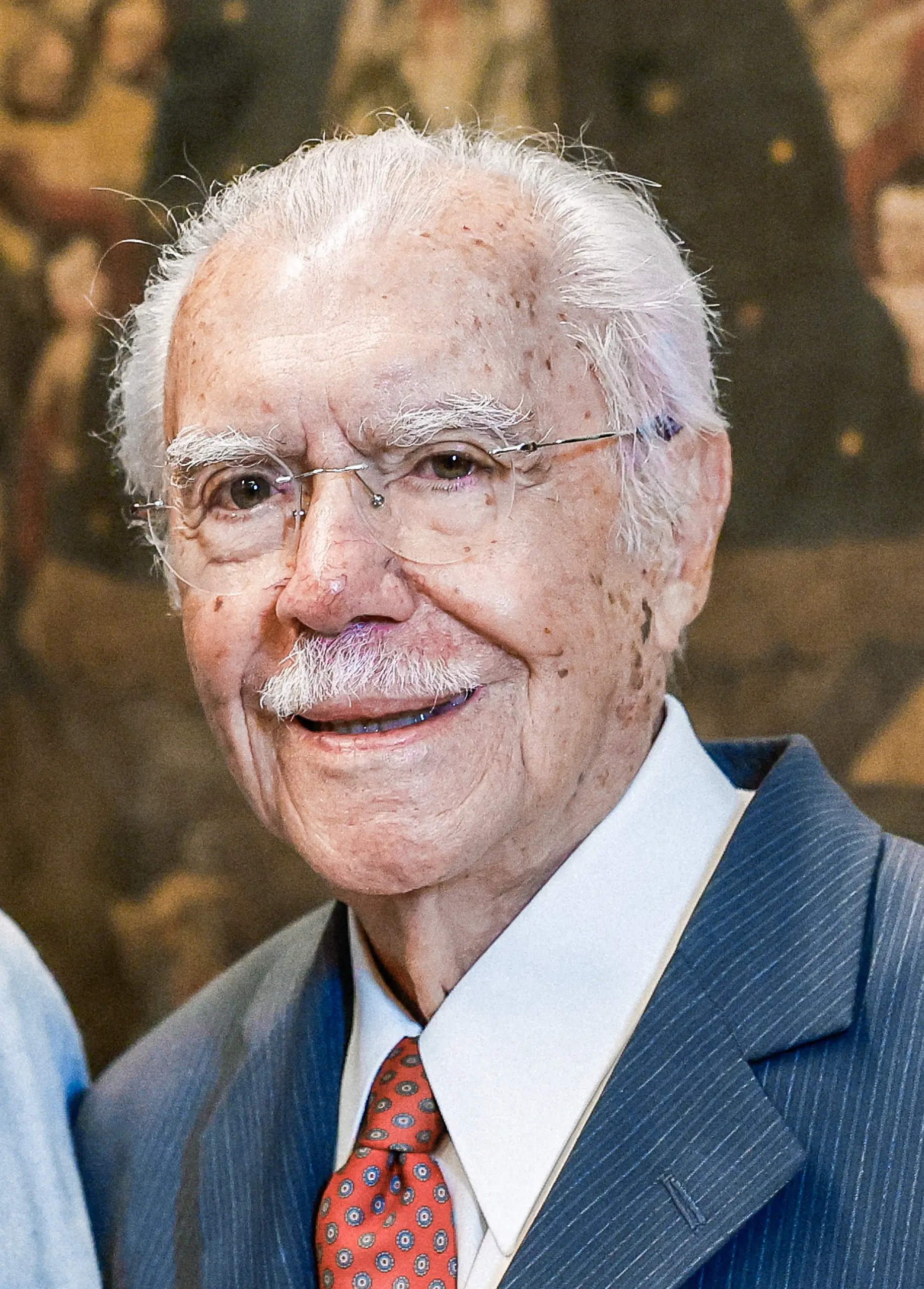
José Sarney
 Brazil
Also known as: Jose Sarney, José Ribamar Ferreira de Araújo Costa, Zé do Sarney
Birthday
April 24, 1930
Birth Sign
Taurus
Birthplace
Pinheiro, Maranhão, Brazil
Age
96 years old
Height
5 ft 7 in (170 cm)
About
José Sarney is a Brazilian politician, lawyer, and writer who served as the 31st president of Brazil from 1985 to 1990. He is the oldest living former Brazilian president, having turned 96 in 2026. Sarney's political career spanned six decades, making him one of the most enduring figures in Brazilian public life.
His presidency came under extraordinary circumstances: elected vice president on the ticket of Tancredo Neves, he assumed office after Neves's death, becoming the first civilian leader after 21 years of military rule. His time in office was defined by the struggle against hyperinflation and the drafting of the 1988 Constitution, which remains Brazil's democratic framework.
After leaving the presidency, Sarney returned to the Senate, serving until 2015 and holding the position of Senate president three times. Today he is remembered as a central, if controversial, figure in Brazil's transition to democracy.
Early Life & Background
José Ribamar Ferreira de Araújo Costa was born on April 24, 1930, in Pinheiro, a town in the northeastern state of Maranhão. His father, Sarney de Araújo Costa, was a wealthy landowner and sugarcane producer, and his mother was Kiola Ferreira. The family had Portuguese roots, tracing back to Viseu. From childhood, he went by the nickname "Zé do Sarney," which came from his father's unusual surname, acquired because he was born on land owned by an Englishman named "Sir Ney."
Sarney attended Colégio Marista and the Licéu Maranhense before enrolling at the Federal University of Maranhão, where he earned a law degree in 1953. During his university years, he led the Maranhão state student union and worked briefly as a journalist and lawyer. After graduating, he launched a postmodernist literary journal called A Ilha, showing early interests that combined law, politics, and the arts.
His political career began in 1954 when he ran as an alternate federal deputy for the National Democratic Union (UDN). He took his seat in 1956 and was reelected in 1958 and 1962. In 1958, he adopted the name José Sarney for electoral purposes, a change that became official in 1965.
Career Growth
Sarney's breakthrough came in 1965 when, during the military dictatorship, he became governor of Maranhão on the ARENA ticket, serving from 1966 to 1970. He then moved to the Senate, where he sat from 1971 to 1985. A loyal supporter of the military government, he rose to lead the ARENA party in 1979 before breaking away to help found the Liberal Front Party.
In January 1985, Sarney was elected vice president on the ticket of Tancredo Neves. When Neves fell ill and died before taking office, Sarney was sworn in as president on April 21, 1985. His presidency was a turbulent period. He launched several economic plans, including the Cruzado Plan and the Bresser Plan, all of which failed to tame hyperinflation. On the foreign policy front, he signed the Iguaçu Declaration, a precursor to Mercosur, and restored diplomatic ties with Cuba. His administration also convened the 1987 Constituent Assembly, which produced the 1988 Constitution.
After leaving office in 1990, Sarney returned to the Senate representing Amapá, serving from 1991 to 2015. He was elected President of the Senate three times: 1995–1997, 2003–2005, and 2009–2013. He retired from politics in 2015, ending a congressional career that spanned six decades.
Career Timeline
Public Image & Style
Sarney's public image is a study in contrasts. He began his presidency with immense popularity as the first civilian leader after 21 years of military rule, but his approval ratings collapsed as Brazil's debt crisis deepened and inflation spiraled out of control. His association with the military government before the transition and the failure of his economic plans left a contested legacy.
Yet he is also credited with steering Brazil through a delicate democratic transition, convening the Constituent Assembly that produced the 1988 Constitution. In his later years, he has been seen as a political survivor, with a career that outlasted many of his contemporaries. At 96, he is a living link to a pivotal era in Brazilian history, viewed with a mixture of respect and criticism.
Fame & Fandom (iFAMOUS Rankings)
José Sarney remains a figure of historical gravity rather than contemporary celebrity, defined by his tenure as Brazil's first civilian president after two decades of military rule. In August 2026, the iFANN Global Fame Engine evaluated his standing and determined that he does not currently hold a placement in the published rankings, including the Global Top 1,000 or any Top-100 scope list. While his name appears in encyclopedic records and political discourse, he lacks the viral momentum required for a chart position among global personalities. His audience consists primarily of voters, party members, and readers of his literary works rather than a dedicated fanbase engaged in streaming campaigns or social media rituals. No formal fandom name exists for Sarney; unlike entertainers who cultivate organized groups with specific titles, his support structure is rooted in political allegiance and academic interest. The concept of fan-driven charity drives, birthday billboards, or inside jokes is entirely absent from his profile. Instead, his legacy is preserved through verified historical narratives, such as his unexpected accession to power following Tancredo Neves's death, and the documented rise and fall of his family's political dynasty in Maranhão. He continues to make headlines for political commentary, such as recent criticisms of Argentine leadership, but these are state-level interactions rather than fan phenomena. His presence on social media reflects a general following of his role as a writer and elder statesman, devoid of the performative engagement typical of modern pop culture icons. Ultimately, Sarney occupies a unique space where historical significance outweighs fame metrics, leaving him outside the scope of current popularity charts while maintaining a steady, if quiet, relevance in Brazilian public life.
Interesting Facts and Legends
José Sarney's original birth name was José Ribamar Ferreira de Araújo Costa, which he legally changed to José Sarney de Araújo Costa in 1965. His family surname originates from an Englishman named Sir Ney, who owned the land where his father was born. After graduating, he launched a postmodernist literary journal called A Ilha. He has been credited as a writer on films including O Dono do Mar (2004), Muda Brasil (1985), and Terra para Rose (1987). During his presidency, he visited China in July 1988 and the Soviet Union in October 1988. He briefly served as vice president for only about a month before assuming the presidency. A widely retold story in Brazilian history involves his unexpected accession to the office after the illness and subsequent death of elected candidate Tancredo Neves, making him the first civilian leader after 21 years of military rule. Another notable chapter involves the decline of his family's political dynasty in Maranhão, which showed signs of strain by 2014. In 2009, then Senate Head Sarney requested an investigation into his own accounts regarding potential irregularities, a self-referential move that stands as a documented event in his later career.
Family & Personal Life
Sarney married Marly Macieira in 1952, and the couple has remained together ever since. They have three children. Their daughter Roseana Sarney, born July 1, 1953, became a prominent politician and former governor of Maranhão. Their son José Sarney Filho, born June 14, 1957, is a lawyer and politician. Their younger son, Fernando Sarney, is a businessman.
The family has deep roots in Maranhão, where Sarney's father was a wealthy landowner. Sarney's own household has included five granddaughters and four grandsons, with names like Rafaela, Ana Clara, and Marcus José. The family's political legacy continues through Roseana and José Filho.
Notable Connections
José Sarney's political life intersected with many key figures. His running mate Tancredo Neves, whose death before taking office thrust Sarney into the presidency, remains a central figure in Brazil's democratic transition. His wife Marly Macieira Sarney has been his partner for over seven decades. His daughter Roseana Sarney followed him into politics, becoming governor of Maranhão, and his son José Sarney Filho also pursued a political career. During his presidency, Finance Minister Dilson Funaro implemented the Cruzado Plan. He also worked with military president João Figueiredo during the transition.
Relationships & Dating History
José Sarney married Marly Macieira in 1952, and their union has lasted over seven decades. They have three children together. Unlike many politicians, Sarney's personal life has been remarkably stable, with no public scandals or reported romantic relationships outside his marriage. As of 2026, he remains married to Marly, and the couple lives in Brazil.
- MarriedMarly Macieira Sarney1952 - presentCurrentMarried in 1952, they have three children together.
Salary, Net Worth In 2026
$5 Million
iFANN Editorial Team estimate
As a career politician, lawyer, and writer, José Sarney's wealth has never been tracked by celebrity net worth databases. His financial standing derives from his family's historical landownership in Maranhão, his decades of political salaries, and his literary work. Per iFANN's editorial analysis, in 2026, his net worth is estimated at around $5 Million. Sarney's family has been influential in Maranhão for generations, with his father owning sugarcane plantations. His political career, spanning from 1955 to 2015, provided a steady income, and his role as Senate president likely came with additional compensation. He has also published several books, though their commercial success is not widely documented. Since retiring in 2015, his income has likely come from pensions and investments. The family's political prominence, including his daughter's governorship, suggests ongoing financial stability.
Awards & Accolades
View 4 records, honours and achievementsKnown For
President of Brazil
1985-1990 · 31st President
Senator for Amapá
1991-2015 · Senator
President of the Federal Senate
1995-2013 · Senate President (three terms)
Keywords
Sources
Quick Facts
- Profession
- politician, lawyer, writer
- Born
- April 24, 1930
- Birthplace
- Pinheiro, Maranhão, Brazil
- Gender
- Male
- Spouse
- Marly Macieira Sarney
- Birth Sign
- Taurus
- Height
- 5 ft 7 in (170 cm)
Personal Details
- Full Name
- José Ribamar Ferreira de Araújo Costa
- Height
- 5 ft 7 in (170 cm)
- Spouse
- Marly Macieira Sarney
- Children
- Roseana Sarney, José Sarney Filho, Fernando Sarney
- Education
- Bachelor's degree in law, Federal University of Maranhão (1953)
Filmography
3
Total
3
Film
0
TV
Frequently Asked Questions
How old is José Sarney?
Who is José Sarney's wife?
What is José Sarney known for?
Is José Sarney still alive?
How many children does José Sarney have?
Join the community
fans discussing