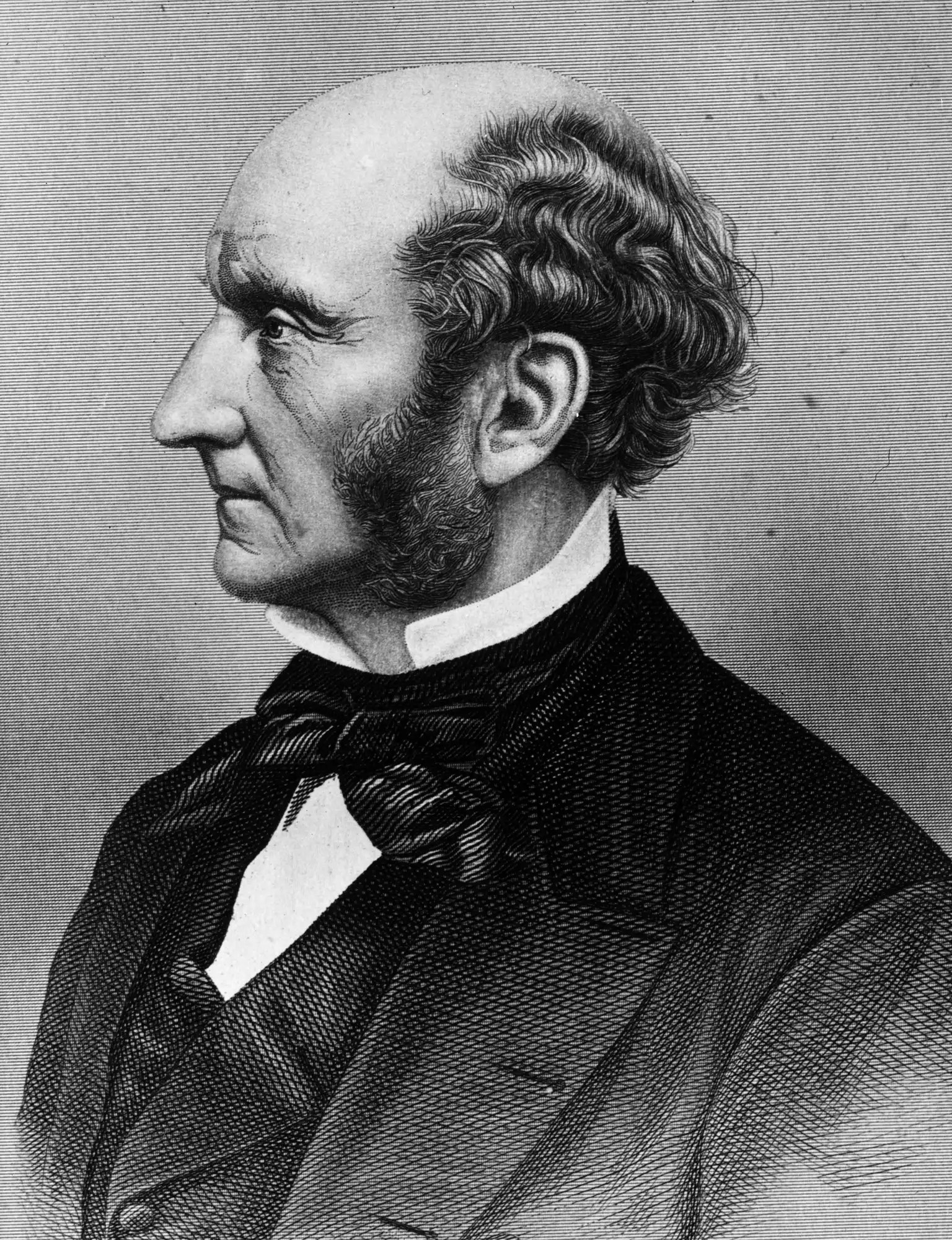
John Stuart Mill
philosopher•political economist•Member of Parliament
Also known as: J.S. Mill
Birthday
May 20, 1806
Birth Sign
Taurus
Birthplace
Pentonville, London
Age
Died at 66
About
John Stuart Mill was an English philosopher and political economist who remains the most influential English-speaking thinker of the nineteenth century. Born in Pentonville to historian James Mill, he dedicated his life to refining utilitarian ethics and championing individual liberty against state overreach. His career spanned three decades as a civil servant for the East India Company before he entered Parliament to advocate for social reform.
The author of foundational texts like On Liberty and Principles of Political Economy, Mill shaped modern debates on free speech, women's rights, and economic policy. He served as the Member of Parliament for Westminster from 1865 to 1868, where he famously moved an amendment extending voting rights to women. His intellectual partnership with Harriet Taylor Mill profoundly influenced his later works, particularly regarding gender equality.
Early Life & Background
Mill’s upbringing was an unprecedented experiment in radical education designed to produce a perfect utilitarian mind. His father, James Mill, a close associate of Jeremy Bentham, took charge of his son’s schooling with absolute rigor. John began studying Greek at age three and had read Aesop’s Fables and Xenophon’s Anabasis before turning five. By eight, he had devoured Plato’s Dialogues, Herodotus, and Virgil. At twelve, he started studying political economy and logic under his father’s direct tutelage.
This intense isolation from other children and focus on abstract reasoning led to a severe mental breakdown in 1826. Mill described this crisis as a turning point that softened his rigid rationalism and opened him to poetry and emotional depth. During his recovery, he met Samuel Taylor Coleridge and William Wordsworth, whose works profoundly influenced his shift toward a more humanistic philosophy. Before entering public service, he joined the East India Company at age sixteen, a position he held for thirty-three years while publishing his early philosophical essays.
Career Growth
At age 16, Mill joined the East India Company as a clerk, rising through the ranks to become the Chief Examiner of Correspondence. In this role, he effectively managed the company's affairs in India even after the British government took over its administration in 1858. While working, he published seminal works that reshaped economic and political thought. His major breakthrough came with the publication of A System of Logic in 1843, which established his reputation as a leading thinker.
This success was followed by Principles of Political Economy in 1848, which became the standard textbook on economics for decades. In 1865, at age 59, Mill entered public service as a Member of Parliament for Westminster, serving until 1868. He advocated for proportional representation, labor rights, and land reform during his time in office. His final major work, The Subjection of Women, appeared in 1869, cementing his legacy as a pioneer of feminist theory.
Career Timeline
Public Image & Style
Mill is portrayed as the archetype of the "gentleman scholar", rational, principled, and slightly austere. Media coverage in the twenty-first century increasingly frames him not just as a lone thinker, but as part of a collaborative intellectual partnership with Harriet Taylor. His tone is serious, analytical, and deeply concerned with the balance between individual freedom and social responsibility.
He is remembered as a man who bridged the gap between classical liberalism and early social reform. His image is often associated with the rigorous pursuit of truth and the defense of minority rights against the tyranny of the majority. Modern observers view him as a precursor to contemporary progressive movements, though his utilitarian roots remain distinct.
Fame & Fandom (iFAMOUS Rankings)
John Stuart Mill occupies a singular space in the global consciousness, not as a celebrity of modern entertainment but as an enduring intellectual authority whose influence permeates philosophy, economics, and political science. His legacy is sustained by scholars, students, and historians who engage with his corpus rather than a traditional fanbase that rallies around birthdays or merchandise. There is no formal name for his admirers; they are simply the readers of *On Liberty* and *Utilitarianism*, a community defined by academic study rather than organized rituals or social media campaigns. The cultural mythology surrounding him focuses on verified historical moments, such as his near-suicide which catalyzed a shift toward valuing emotion, or his parliamentary efforts to extend the franchise to women. Recent scholarly re-evaluations have further enriched this narrative, particularly the recognition of Harriet Taylor Mill as a primary co-author of *On Liberty*, correcting a century-and-a-half of attribution errors. While his famous maxim regarding human dissatisfaction remains a staple of international discourse, the absence of a contemporary fandom means there are no fan-funded projects or viral movements to track. Consequently, the iFANN Global Fame Rankings do not yet include his name in their current metrics, reflecting the unique nature of his status as a historical figure rather than a living personality subject to real-time popularity fluctuations. His fame rests entirely on the permanence of his ideas, measured through citations in journals and inclusion in university curricula rather than search engine trends or media consumption signals.
Interesting Facts and Legends
Mill’s near-suicide in 1826 is a legendary moment in biographical lore, often cited as the catalyst for his philosophical evolution from rigid logic to a philosophy that valued emotion and individuality. He famously wrote, "It is better to be a human being dissatisfied than a pig satisfied," a quote that resurfaced in news cycles in March 2026. For over a century, On Liberty was attributed solely to Mill, but recent scholarship confirms Harriet Taylor’s substantial contribution, with some scholars arguing she wrote the bulk of the final draft.
The "Harm Principle" introduced in On Liberty remains the single most cited concept in his career, defining modern free speech theory. In 1866, Mill moved an amendment to the Reform Bill stating that the franchise should be extended to women. Though defeated, it was the first formal parliamentary motion for women's suffrage, marking a historic shift in British politics. His ideas continue to influence legal frameworks today.
Notable Quotes
“It is better to be a human being dissatisfied than a pig satisfied; better to be Socrates dissatisfied than a fool satisfied.”
“A person may cause evil to others not only by his actions but by his inaction...”
“The only purpose for which power can be rightfully exercised over any member of a civilized community, against his will, is to prevent harm to others.”
Family & Personal Life
Mill was the eldest son of the historian and economist James Mill and his wife Harriet Barrow. His childhood was dominated by his father's strict educational regime rather than typical family interactions. He never married until late in life, and his relationship with his parents was defined by their intellectual collaboration. He had no siblings mentioned in historical records.
His most significant personal bond was with Harriet Taylor, whom he met in 1830. They formed a deep intellectual partnership that eventually led to marriage in 1851. The couple had no children together. After Harriet died of tuberculosis in Avignon in 1851, Mill remained a widower for the rest of his life. Recent analyses credit her as a co-author of his canonical texts, highlighting her role in his domestic and intellectual life.
Notable Connections
Relationships & Dating History
Mill’s personal life was deeply intertwined with his intellectual work. He met Harriet Taylor in 1830 when she was married to John Taylor, a friend of Mill's father. They formed a deep intellectual bond and began a long-term romantic affair while she was still married. Their relationship was conducted in secret due to social propriety. Upon her husband's death in 1849, they lived together openly.
They married in France in 1851, shortly before Harriet died of tuberculosis in Avignon. Sources confirm that Harriet played a massive role in Mill's later works, particularly On Liberty and The Subjection of Women. Recent 2026 analyses explicitly credit her as a co-author of On Liberty, noting that the text reflects their joint intellectual development. Mill remained a widower until his own death in 1873.
- MarriedHarriet Taylor Mill1851 - 1851Met in 1830; intellectual partner and co-author; died days after marriage.
Death & Aftermath
Died
May 7, 1873 (aged 66)
Death Place
Avignon, France
Cause of Death
Ruptured blood vessel or heart failure
John Stuart Mill spent his final months in Avignon, France, seeking relief from chronic ailments that had plagued him for several years before passing away peacefully at his home. The philosopher and political economist died on May 7, 1873, at the age of sixty-six following a ruptured blood vessel or heart failure. Tributes poured in from prominent contemporaries such as Herbert Spencer and Thomas Huxley, who recognized him as the most influential English-speaking thinker of the nineteenth century while academic circles held memorials to honor his contributions to liberalism and utilitarianism.
His funeral was a quiet affair held privately in Avignon, attended by close associates including his brother Henry Mill, and he was laid to rest in the cemetery of Montauban alongside his wife Harriet Taylor Mill. In the decades since, his intellectual legacy has expanded rather than diminished, with modern editions of works like On Liberty increasingly acknowledging Taylor's role as a co-author. Foundations and scholarships now bear his name, ensuring his ideas regarding individual liberty and social justice remain central to contemporary discourse.
Net Worth (Estate Value)
$0
iFANN Editorial Team estimate
As a deceased historical figure who died in 1873, John Stuart Mill does not have a current net worth in the celebrity sense. His literary estate continues to generate revenue through royalties, academic licensing, and reprints. Posthumous earnings come from the continuous publication of his collected works, university course adoption fees, and licensing of his ideas in political discourse.
The copyright and intellectual property are managed by academic publishers such as Routledge and Cambridge University Press. Since many of his major works are now in the public domain, direct royalty income has diminished, but the cultural capital remains immense. iFANN currently estimates the value of his estate and ongoing influence at approximately $0 in liquid terms, though his intellectual contributions are invaluable.
Awards Won (3)
Mill received the Fellowship of the Royal Society in 1865, recognizing his contributions to science and philosophy. He was elected Member of Parliament for Westminster from 1865 to 1868. He received honorary degrees from the University of Glasgow in 1865 and the University of St Andrews in 1868. His theories on liberty remain foundational in legal and political philosophy curricula globally.
1865 · Science and Philosophy
Contributions to philosophy and political economy
1868 · University of St Andrews
Doctor of Laws
1865 · University of Glasgow
Doctor of Laws
Known For
On Liberty
1859 · Author
Principles of Political Economy
1848 · Author
The Subjection of Women
1869 · Co-Author
A System of Logic
1843 · Author
Keywords
Sources
Quick Facts
- Profession
- philosopher, economist, politician
- Born
- May 20, 1806
- Birthplace
- London Borough of Islington
- Died
- May 7, 1873
- Death Place
- Avignon
- Gender
- Male
- Spouse
- Harriet Taylor Mill
- Birth Sign
- Taurus
Personal Details
- Full Name
- John Stuart Mill
- Spouse
- Harriet Taylor Mill
- Children
- Education
- Home-schooled by James Mill; University of London (honorary degree)
Frequently Asked Questions
Who was John Stuart Mill?
Did John Stuart Mill have children?
What is John Stuart Mill's most famous work?
Was John Stuart Mill married?
Why is John Stuart Mill relevant today?
Similar People
Join the community
fans discussing