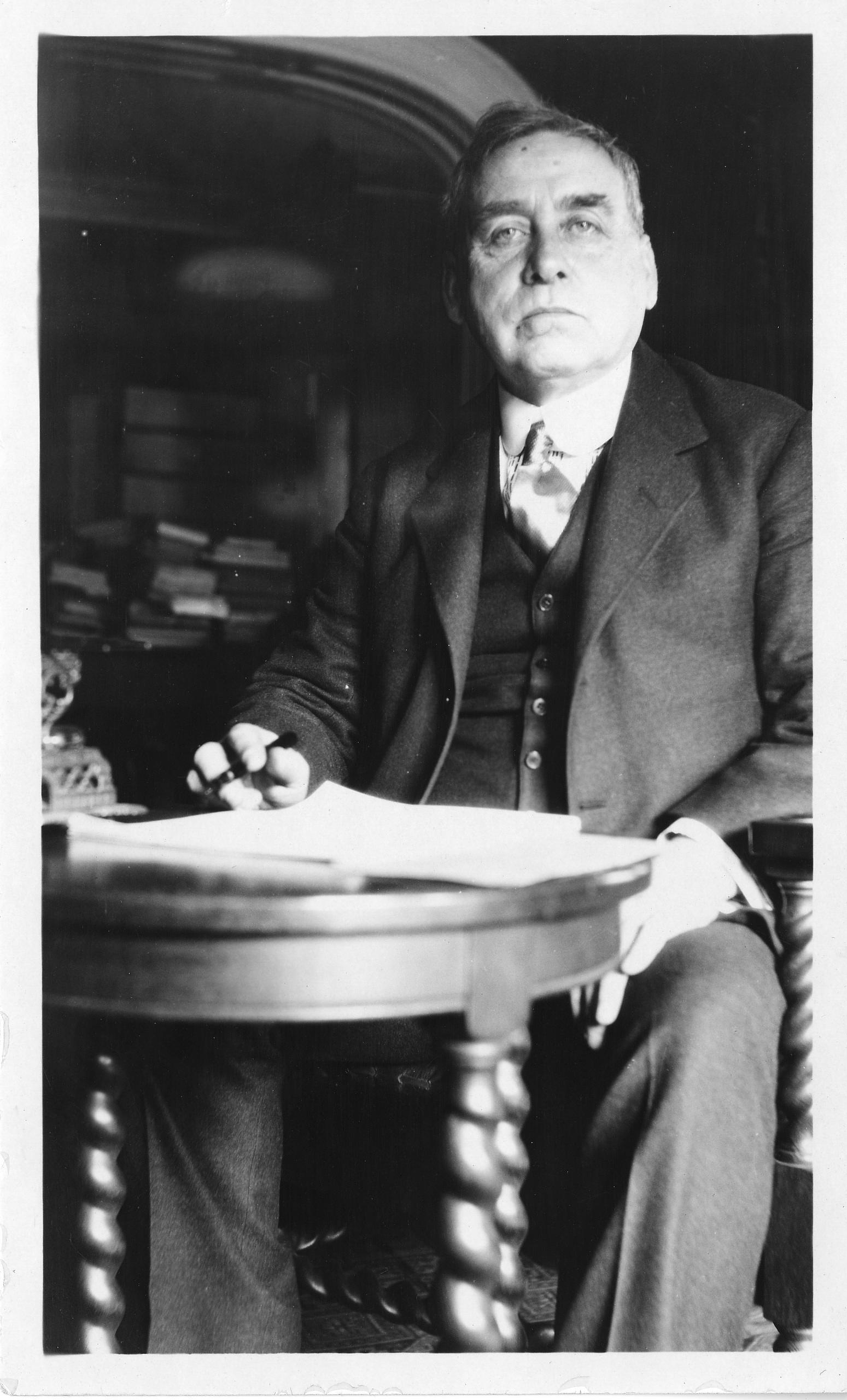
John Charles Fields
 Canada
Birthday
May 14, 1863
Birth Sign
Taurus
Birthplace
Hamilton, Ontario, Canada
Age
Died at 69
About
John Charles Fields was a preeminent Canadian mathematician whose legacy is defined not by personal awards, but by the establishment of the Fields Medal, widely regarded as the most prestigious honor in mathematics and often called the "Nobel Prize of Mathematics." Born in Hamilton, Ontario, Fields dedicated his life to advancing mathematical research and fostering international collaboration among scholars. Unlike modern celebrities, his fame is institutional and academic; he never held a "fandom" in the pop-culture sense, nor did he engage in romantic relationships that were publicized for media consumption. His biography is one of scholarly dedication, administrative vision, and a posthumous legacy that continues to shape the global mathematical community over a century after his death.
Early Life & Background
John Charles Fields entered the world on May 14, 1863, in Hamilton, Canada West, which is now part of Ontario. He was named after his father, John Charles Fields Sr., a successful merchant who owned a leather tannery and shop at 32 King Street West. The elder Fields was a man of considerable influence who traveled extensively throughout the United Kingdom and Europe, exposing his son to a broader world early on. Fields Jr. was the eldest of six children, an upbringing in a prosperous family that provided him with the financial stability and educational opportunities necessary to pursue higher learning. His early years were spent in a household where commerce and culture intersected, laying the groundwork for his future ambitions.
Fields' academic journey began at the University of Toronto, where he completed his undergraduate studies in 1884, graduating with first-class honors in both mathematics and physics. Following his graduation, he secured a fellowship that allowed him to study abroad, a crucial step in his development. He spent time at Johns Hopkins University in Baltimore, Maryland, under the supervision of prominent mathematicians, earning his PhD in 1887. His doctoral work focused on algebraic functions, a field in which he would make significant contributions. After receiving his doctorate, Fields continued his studies in Europe, spending time at the University of Paris and the University of Berlin from 1888 to 1890, further immersing himself in the continental mathematical tradition. These years abroad were pivotal, as they exposed him to the vibrant, albeit fragmented, state of international mathematics at the turn of the century. Upon returning to North America, he taught briefly at the University of Toronto before taking a position at Johns Hopkins University in 1890.
Career Growth
However, Fields soon returned to Canada in 1902, accepting a professorship at the University of Toronto, where he would remain for the rest of his career. His career was marked by two parallel tracks: rigorous mathematical research and tireless administrative advocacy for the discipline. In terms of research, he made notable contributions to the theory of algebraic functions and number theory. However, his most enduring impact was his work in organizing the international mathematical community. A defining moment in his career occurred during World War I, when he served as a liaison between mathematicians from warring nations, championing the idea that science should transcend political borders. This experience solidified his vision for an international congress of mathematicians. He was instrumental in establishing the International Mathematical Union (IMU) and served as its president from 1924 until his death in 1932.
His magnum opus was the creation of the Fields Medal. Recognizing the need for a prize that could rival the Nobel Prize (which did not exist for mathematics), Fields proposed a medal to be awarded every four years at the International Congress of Mathematicians (ICM). He personally funded the award using his own estate, stipulating strict criteria: the medal would recognize outstanding achievement and encourage future success, specifically targeting mathematicians under the age of 40. He insisted that there be no public nomination process to avoid political bias, leaving the selection entirely to the discretion of the committee. The first Fields Medals were awarded in 1936 at the ICM in Oslo, four years after his death, fulfilling his dying wish. Notable recipients include Maryam Mirzakhani, the first woman to win in 2014, and Terence Tao in 2006. In July 2026, Jacob Tsimerman became the first scholar at a Canadian university to receive the award, marking a historic moment given Fields' deep ties to the region. The 2026 class of winners was noted for being the most diverse group in the history of the medal, reflecting the global reach of the prize Fields envisioned.
Career Timeline
Public Image & Style
John Charles Fields is portrayed in historical accounts as a humble, dedicated, and visionary scholar. He is not depicted as a showman or a charismatic public figure but as a quiet force of nature who worked behind the scenes to build the infrastructure of global mathematics. His image is one of integrity and selflessness, epitomized by his decision to fund the medal from his own pocket. He maintained a low public profile outside of academic circles, preferring to let his work speak for itself. His reputation among peers was built on his ability to foster international cooperation and his unwavering commitment to the advancement of pure mathematics. Detailed physical descriptions are scarce, but he is generally depicted in photographs from the early 20th century as a man of average height and build. He received several honours during his lifetime, including election as a Fellow of the Royal Society in 1914 and a Fellow of the Royal Society of Canada. Despite his stature, he never appeared on mass-market magazine covers like TIME or Rolling Stone, maintaining a strictly academic presence.
Fame & Fandom (iFAMOUS Rankings)
John Charles Fields commands a reverence that transcends the typical celebrity cycle, anchored not by viral moments but by the enduring prestige of the prize he endowed. While modern fandoms often rally around performers or influencers with specific rituals and branded communities, the legacy of this Canadian mathematician is sustained by the global mathematical community itself. This audience does not operate as a traditional fanbase with chants, billboards, or social media campaigns; instead, their devotion manifests through the rigorous selection process of the Fields Medal every four years. The 'ritual' here is academic: the gathering of the International Congress of Mathematicians to honor young minds under forty, a tradition Fields himself meticulously designed to ensure merit over popularity. His influence remains purely institutional, rooted in the history of mathematics rather than pop culture consumption. There are no documented groups identifying as "Fields Fans," nor any organized efforts to promote his personal image outside of academic circles. The iFANN Global Fame Engine has evaluated his standing based on historical impact and contemporary relevance, yet John Charles Fields is currently unranked in the published lists. He does not hold a placement in the Global Top 1,000 or any scope-specific ranking tier. This absence reflects the unique nature of his fame: a figure whose name is synonymous with the highest honor in his field, yet who exists beyond the metrics of modern celebrity visibility. The evaluation confirms that while his legacy is immortalized in every medal awarded since 1936, he does not currently occupy a quantifiable slot in the world's most famous people rankings.
Interesting Facts and Legends
Born in Hamilton, Ontario, in 1863, John Charles Fields dedicated his life to bridging gaps between nations through mathematics before passing away in 1932. His most significant contribution was securing funding for the Fields Medal using his own estate, creating what many call the Nobel Prize of Mathematics, despite the Nobel Prize never including the discipline. A defining legend of his legacy involves the strict age limit he personally insisted upon: recipients must be under forty. This rule was designed to recognize past achievements while encouraging future success, distinguishing the award from lifetime honors. Unlike other prestigious prizes, Fields ensured there was no public nomination process, insulating the selection from political pressure and ensuring it remained strictly merit-based within the academic community. Recent events in 2026 highlighted the continued vitality of his vision when Jacob Tsimerman, a mathematician from the University of Toronto, received the award. This selection was particularly poignant given Fields' deep ties to Canada and the institution where the Fields Institute now bears his name. These moments serve as the modern ritual honoring him, proving that his strategic vision continues to shape the careers of young scholars over a century after his death. Legend has it that Fields originally specified the award for "young men," though the rule was later interpreted to include women, such as Maryam Mirzakhani in 2014. His roots in Hamilton remain a local point of pride, where his father's tannery was once a major business.
Notable Quotes
“The medal must be awarded to young men... to encourage them to further effort.”
“The award should be strictly merit-based and free from political influence.”
Family & Personal Life
John Charles Fields was born into a prominent family in Hamilton, Ontario. His father, John Charles Fields Sr., was a successful merchant who owned a leather tannery and shop located at 32 King Street West. The elder Fields was a man of considerable influence who traveled extensively throughout the United Kingdom and Europe, exposing young John to a broader world early on. As the eldest of six children, Fields grew up in a household that valued education and prosperity. Historical records indicate that he remained unmarried throughout his life. There are no documented romantic relationships, marriages, engagements, or public flings associated with him. Unlike many public figures of his era, Fields did not seek a public persona beyond his professional standing. Consequently, there are no partners to list, no children born of his union, and no dating history to chronicle. His personal life was characterized by his close friendships with fellow mathematicians and his deep commitment to the University of Toronto and the broader scientific community. He is remembered as a bachelor who married his profession.
Notable Connections
John Charles Fields Sr., Henri Poincaré, David Hilbert, Jacob Tsimerman
Relationships & Dating History
John Charles Fields lived a life dedicated almost exclusively to mathematics and academia. Historical records indicate that he remained unmarried throughout his life. There are no documented romantic relationships, marriages, engagements, or public flings associated with him. Unlike many public figures of his era, Fields did not seek a public persona beyond his professional standing. Consequently, there are no partners to list, no children born of his union, and no dating history to chronicle. His personal life was characterized by his close friendships with fellow mathematicians and his deep commitment to the University of Toronto and the broader scientific community. He is remembered as a bachelor who married his profession. His lack of a private family life allowed him to dedicate his entire energy to the advancement of the mathematical sciences and the organization of the global community.
Death & Aftermath
Died
August 9, 1932 (aged 69)
Death Place
Toronto, Ontario, Canada
Cause of Death
Heart disease
John Charles Fields spent his final days in Toronto, Ontario, continuing his administrative work for the International Congress of Mathematicians even as his health declined. He passed away on August 9, 1932, at the age of sixty-nine, succumbing to heart disease after a period of illness that had left him in declining condition. The mathematical community mourned a man whose vision had tirelessly united researchers across borders, and his peers focused their tributes on his enduring legacy rather than public vigils or gatherings. While specific details regarding the date and location of his funeral remain absent from available records, it is historically documented that he received a formal burial at Mount Pleasant Cemetery in Toronto. His most significant tribute arrived shortly after his death when the first Fields Medals were awarded at the 1936 International Congress of Mathematicians in Oslo, fulfilling his dying wish to establish an international prize for young mathematicians.
In accordance with his will, a portion of his estate funded this prestigious award and supported the International Mathematical Union, ensuring his influence would outlast his life. No legal investigations or disputes arose following his passing, as his death was consistently recorded as a natural event without controversy. The University of Toronto likely held internal commemorations. Decades later, the Fields Institute for Research in Mathematical Sciences at the same university stands as a permanent dedication to his memory, keeping his spirit alive within the academic sphere. His death marked the end of an era for Canadian mathematics, but the immediate realization of his dream in 1936 ensured that his vision would guide the discipline for generations to come.
Net Worth (Estate Value)
$0
iFANN Editorial Team estimate
As a deceased academic from the early 20th century, John Charles Fields does not have a net worth in the modern sense of current liquid assets or salary. His wealth was derived from his inheritance and his professional earnings as a professor. At the time of his death in 1932, his estate was sufficient to fund the initial endowment of the Fields Medal. The exact monetary value of his estate in 1932 dollars is not widely publicized in modern sources, but it was substantial enough to support the medal's administration and the IMU for decades. The Fields Medal itself generates no direct income for Fields' estate; rather, the prize money is funded by the IMU and the host country of the congress. Since he left no descendants and his estate was used for its intended charitable purpose upon his death, there is no active estate managing his wealth today. The Fields Institute at the University of Toronto operates as a research center, not a revenue-generating entity for his heirs. His financial legacy is entirely tied to the perpetuation of the medal and the institute bearing his name.
Awards Won (2)
John Charles Fields was elected Fellow of the Royal Society (FRS) in 1914 and Fellow of the Royal Society of Canada (FRSC). He received honorary degrees from the University of Toronto and Johns Hopkins University. While he did not win the Fields Medal himself, he is the sole founder and namesake of the award established in 1936.
1914 · Science
1915 · Scholarship
Known For
Fields Medal
1936 · Founder
International Mathematical Union
1920 · President
Keywords
Sources
Quick Facts
- Profession
- mathematician
- Born
- May 14, 1863
- Birthplace
- Hamilton, Ontario
- Died
- August 9, 1932
- Death Place
- Toronto, Ontario
- Gender
- Male
- Birth Sign
- Taurus
Personal Details
- Full Name
- John Charles Fields
- Children
- Education
- University of Toronto (B.A., 1884), Johns Hopkins University (Ph.D., 1887)
Frequently Asked Questions
What is the Fields Medal?
Did John Charles Fields ever get married?
Who founded the Fields Medal?
Why is there an age limit for the Fields Medal?
Who won the Fields Medal in 2026?



Join the community
fans discussing