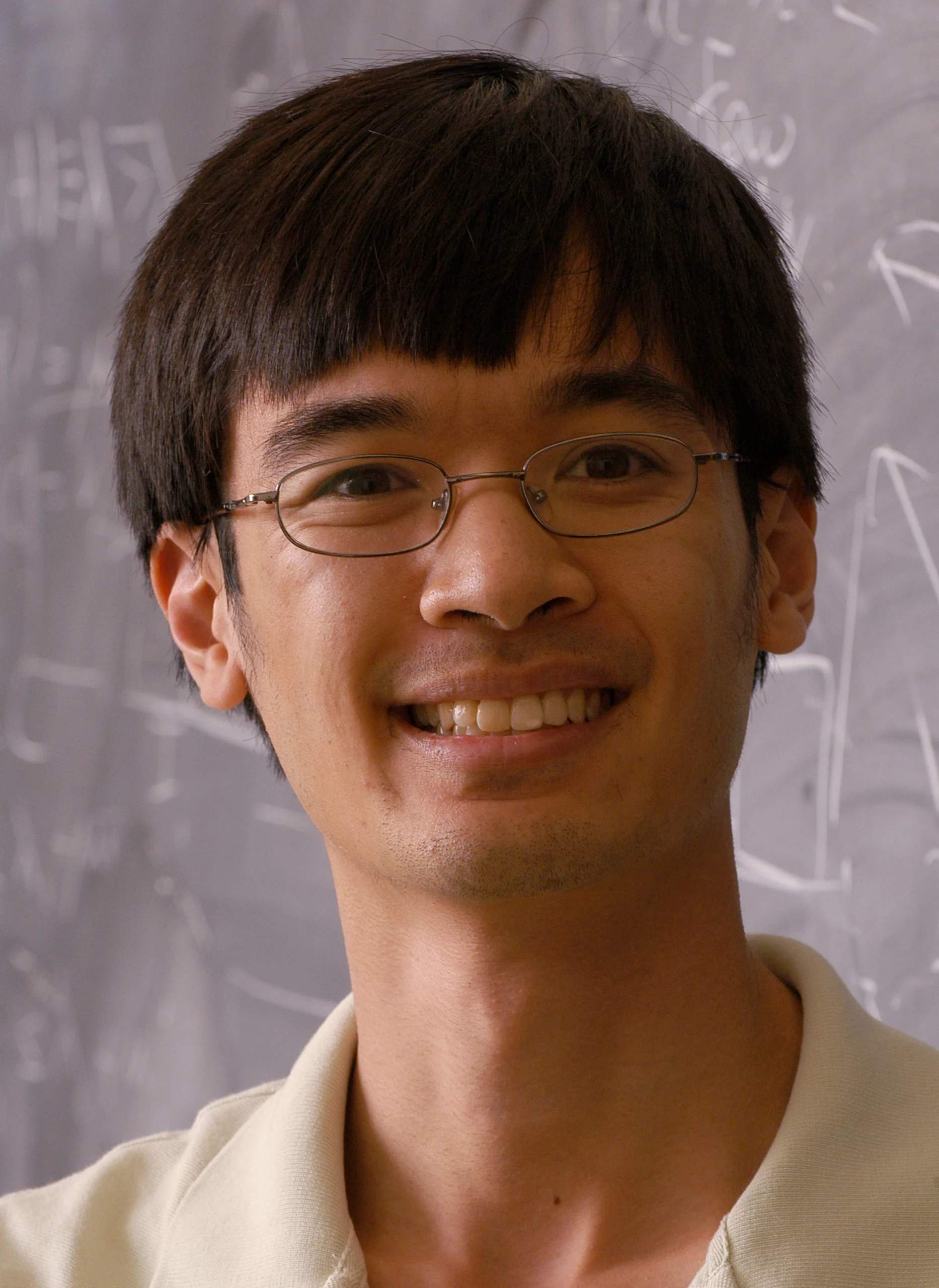
Terence Tao
 Australia
mathematician•university teacher
Also known as: Terence Chi-Shen Tao, Táo Zhéxuān
Birthday
July 17, 1975
Birth Sign
Cancer
Birthplace
Adelaide, South Australia, Australia
Age
51 years old
Height
5 ft 10 in (178 cm)
About
Terence Chi-Shen Tao is an Australian and American mathematician widely regarded as one of the greatest living mathematicians. He is a professor of mathematics at the University of California, Los Angeles, where he holds the James and Carol Collins Chair in the College of Letters and Sciences. Tao was awarded the Fields Medal in 2006 for his contributions to partial differential equations, combinatorics, harmonic analysis, and additive number theory. His work spans an extraordinary range of fields, including analytic number theory, compressed sensing, probability theory, and algebraic combinatorics. He has published over 400 research papers and several influential textbooks. He is also known for his prolific mathematics blog, which has become a central resource for the global mathematics community. Tao has received numerous major awards, including the Breakthrough Prize in Mathematics in 2014 and the Royal Medal. He was named a MacArthur Fellow in 2006. As of 2026, Tao continues to publish actively and remains a leading figure in mathematics. His ability to solve deep, long-standing problems across multiple disciplines sets him apart. Fans and colleagues admire his clarity, generosity in collaboration, and his gift for making complex ideas accessible through his blog and lectures.
Early Life & Background
Terence Tao was born on 17 July 1975 in Adelaide, South Australia, to Chinese immigrant parents from Hong Kong. His father, Dr. Billy Tao (Tao Xiangguo), was a pediatrician who earned his MBBS from the University of Hong Kong, and his mother, Grace Tao (Leung Bing Kwan), taught mathematics and physics in Hong Kong. Tao showed extraordinary mathematical abilities from age two, when he could perform basic arithmetic. By age five, he was teaching himself calculus and mastering high school-level mathematics. He attended St. Peter's College in Adelaide but simultaneously enrolled at Flinders University at age eight, becoming the youngest person ever to take university-level math courses in Australia. At age nine, he scored 760 out of 800 on the mathematics section of the SAT, a feat widely reported in Australian media. He earned his Bachelor of Science from Flinders University at 14 and his Master of Science at 16, making him the youngest master's graduate in Australian history. He then moved to the United States to pursue a Ph.D. at Princeton University under Elias M. Stein, earning his doctorate at age 20 with a dissertation titled "Three Regularity Results in Harmonic Analysis." His first research paper was published when he was 15, in the Journal of the Australian Mathematical Society. After Princeton, he was awarded a postdoctoral fellowship at UCLA.
Career Growth
Tao's breakthrough came in 2004 when he and Ben Green proved the Green–Tao theorem, solving a long-standing open problem about prime numbers containing arbitrarily long arithmetic progressions. This catapulted him to international fame in mathematics. In 2006, he was awarded the Fields Medal at the International Congress of Mathematicians in Madrid, and that same year he received a MacArthur Fellowship worth $500,000. In 2015, he solved the Erdős discrepancy problem, a major challenge in number theory, using a combination of analytic techniques and computer-assisted proofs. Since joining UCLA as a postdoctoral fellow in 1996, Tao has become the James and Carol Collins Chair. He has published over 400 research papers and several influential books, including the multi-volume Analysis series, Structure and Randomness, and Nonlinear Dispersive Equations. His blog, Terence Tao's WordPress blog, attracts millions of readers and has become a central hub for mathematical discussion. He has collaborated with more than 100 mathematicians across a vast range of fields. In 2014, he won the Breakthrough Prize in Mathematics, worth $3 million. Other major awards include the Salem Prize (2000), Clay Research Award (2003), Ostrowski Prize (2007), King Faisal International Prize (2010), Nemmers Prize (2010), Crafoord Prize (2012), Simons Investigator Award (2013), Bôcher Memorial Prize (2020), Princess of Asturias Award (2020), Cole Prize in Number Theory (2022), and Carl Friedrich Gauss Medal (2023). He was elected a Fellow of the Royal Society in 2007, the Australian Academy of Science in 2008, the American Academy of Arts and Sciences in 2009, the National Academy of Sciences in 2012, and the Chinese Academy of Sciences in 2015. He has received honorary doctorates from numerous universities including St Andrews, Edinburgh, Flinders, New South Wales, Sydney, Hong Kong, Australian National University, and Princeton. He was appointed an Officer of the Order of Australia in 2012 and designated an Australian Living Treasure in 2012.
Career Timeline
Public Image & Style
Terence Tao is known for his calm, approachable demeanor and his ability to explain complex mathematics with clarity. He maintains a prolific blog where he discusses open problems, new results, and mathematical techniques, often engaging directly with readers. His writing style is informal yet precise, making advanced topics accessible to a broader audience. The mathematics community sees him as a unifying figure, lauded for his generosity in collaboration and his willingness to mentor younger researchers. Tao's public persona is that of a humble genius — he rarely seeks media attention but is frequently profiled in outlets like The New York Times and Quanta Magazine. He was listed in TIME 100 Most Influential People in 2007 and in Nature's "Top 10 People Who Mattered in Science" in 2015. Fans admire his dedication to pure knowledge and his rare combination of depth and breadth across so many mathematical disciplines. He has no flamboyant style or signature look; his image is that of a thoughtful, serious scholar.
Fame & Fandom
Terence Tao commands a global audience defined by academic reverence rather than celebrity worship, with no formal fandom name or organized fanbase to claim his admirers. His supporters are primarily students, researchers, and mathematics enthusiasts who engage with his work through digital platforms like Mathstodon, where he maintains approximately 23,000 followers, rather than participating in ritualistic campaigns or commercial drives. The mathematical community views him as a unifying figure whose influence spans disciplines from harmonic analysis to artificial intelligence, yet this following lacks the theatrical elements of pop culture stardom. Despite the absence of a dedicated moniker for his fans, his reach is substantial and measured in citations and collaborative networks rather than merchandise sales or chart positions. Within the iFANN Global Fame Rankings, Terence Tao holds significant standing across multiple geographic scopes. He is ranked as the 58th most famous person in Australia, a position holding steady from the previous cycle. From his nation of origin, he stands as the 22nd most famous person from Australia, also maintaining his rank without fluctuation. On a broader regional scale, he is recognized as the 47th most famous person in Oceania. These placements reflect a sustained presence in global attention metrics that track media coverage, search activity, and consumption signals worldwide. His reputation extends beyond mere recognition into a legacy of intellectual authority, where his public image is built on clarity, generosity, and the ability to demystify complex theories for a broad audience.
Interesting Facts and Legends
Terence Tao is a naturalized U.S. citizen who retains his Australian citizenship, and his Chinese name is Táo Zhéxuān. A lifelong enthusiast, he plays chess and enjoys reading during his leisure time. His career is marked by solving problems across diverse fields, ranging from harmonic analysis to compressed sensing. Tao maintains one of the world's most widely read mathematics blogs, titled 'What's new', and has collaborated with over 100 different mathematicians throughout his career. He is a member of the American Mathematical Society and has served on the editorial boards of several prominent journals, while delivering plenary lectures at major conferences globally. His Erdős number is 2, reflecting his close collaborative ties within the field, and he is an avid user of social media for mathematical discussions. Among the legends surrounding his life is the widely retold story of his prodigious ascent; he entered the University of Adelaide at age nine and earned his PhD from Princeton University at just twenty. Another enduring narrative involves his recent pivot toward artificial intelligence, where he has become known as an advocate for AI tools in mathematics, famously describing them as vanilla extract rather than the cake itself. This perspective was highlighted in high-profile interviews and awards received in 2026, such as the James Madison Medal from Princeton University.
Notable Quotes
“The only way to learn mathematics is to do mathematics.”
“I think it's important to have a sense of humor about mathematics.”
“I'm not a genius; I'm just a hard worker.”
“Mathematics is not about numbers, equations, computations, or algorithms: it is about understanding.”
“The beauty of mathematics only shows itself to more patient followers.”
Family & Personal Life
Terence Tao was born to Chinese immigrant parents Billy and Grace Tao in Adelaide. His father, Dr. Billy Tao, was a pediatrician who earned his MBBS from the University of Hong Kong; his mother, Grace Tao, was a secondary school teacher of mathematics and physics in Hong Kong. Both parents were first-generation immigrants from Hong Kong, China. Tao has two younger brothers: Trevor, a computer scientist, and Nigel, a lawyer. The family lived in a supportive, academically-oriented household. Tao's father became a key advocate for his son's accelerated education. Tao has described his childhood as fairly normal outside of mathematics — he played chess, enjoyed reading, and had a close relationship with his brothers. Tao's parents remain active in his life. The family resides in the Westwood neighborhood of Los Angeles.
Notable Connections
Terence Tao is closely associated with Ben Green, with whom he proved the Green–Tao theorem. He was also a student of Elias M. Stein at Princeton. At UCLA, he has collaborated extensively with colleagues across departments. His blog has connected him with a global community of mathematicians and enthusiasts.
Relationships & Dating History
Terence Tao's romantic history is remarkably private and limited to a single publicly known relationship. He met Laura Thomas while both were at UCLA; she is an electrical engineer who works at NASA's Jet Propulsion Laboratory in Pasadena. The couple married around 2005 in a private ceremony. They have two children: a son, William (born about 2006), and a daughter, Madeleine (born about 2009). Tao has occasionally mentioned his family in interviews and blog posts, noting his pride in his wife's work at JPL. No other romantic relationships have been publicly reported. As of 2026, Tao remains married to Laura, and the family resides in Los Angeles.
- MarriedLaura Tao2005 - presentCurrentMet at UCLA; Laura is an electrical engineer at NASA's Jet Propulsion Laboratory. They have two children together.
Salary, Net Worth In 2026
$5 Million
iFANN Editorial Team estimate
Per iFANN's editorial analysis, the net worth of Terence Tao is estimated at $5 Million. This figure reflects a lifetime of academic achievement rather than commercial enterprise, as he does not pursue endorsements or business ventures. His wealth is derived primarily from his long-standing position as a professor at UCLA since 1996, where his annual base salary ranges between $250,000 and $350,000. Significant financial milestones include the $3 million Breakthrough Prize in Mathematics awarded in 2014, alongside a $500,000 MacArthur Fellowship grant in 2006. Additional prize winnings totaling approximately $1.5 to $2 million have been accumulated from honors such as the Crafoord Prize, King Faisal Prize, Nemmers Prize, and Simons Investigator Award. Book royalties from influential textbooks like Analysis I & II and Nonlinear Dispersive Equations contribute an estimated $50,000 to $100,000 annually. Speaking fees and consulting roles further add between $100,000 and $200,000 per year. Tao and his wife Laura reside in a home in the Westwood neighborhood of Los Angeles valued at $2 to $4 million, complemented by a diversified investment portfolio estimated at $1 to $2 million.
Awards Won (20)
Terence Tao has won many of the highest honors in mathematics. He received the Fields Medal in 2006, the Breakthrough Prize in Mathematics in 2014, and the Royal Medal in 2014. Other major awards include the Crafoord Prize (2012), the Bôcher Memorial Prize (2020), the Cole Prize in Number Theory (2022), and the Carl Friedrich Gauss Medal (2023). His awards span analysis, number theory, and applied mathematics.
2023 · Mathematics
Outstanding mathematical contributions with significant applications outside mathematics
2022 · Number Theory
Erdős discrepancy problem and other contributions to number theory
Known For
Green–Tao theorem
2004 · Co-author
Solution to Erdős discrepancy problem
2015 · Solver
Fields Medal
2006 · Recipient
Keywords
Quick Facts
- Profession
- mathematician, university teacher
- Born
- July 17, 1975
- Birthplace
- Adelaide, South Australia, Australia
- Gender
- Male
- Birth Sign
- Cancer
- Height
- 5 ft 10 in (178 cm)
- Spouse
- Laura Tao
- Children
- William Tao, Madeleine Tao
Personal Details
- Full Name
- Terence Chi-Shen Tao
- Height
- 5 ft 10 in (178 cm)
- Spouse
- Laura Tao
- Children
- William Tao, Madeleine Tao
- Education
- B.Sc. (Flinders University, age 14), M.Sc. (Flinders University, age 16), Ph.D. in Mathematics (Princeton University, age 20)
Frequently Asked Questions
How old is Terence Tao in 2026?
What is Terence Tao's net worth in 2026?
Is Terence Tao still active in mathematics in 2026?
What is Terence Tao best known for?
Is Terence Tao married?
Social Media
Similar People

Join the community
fans discussing