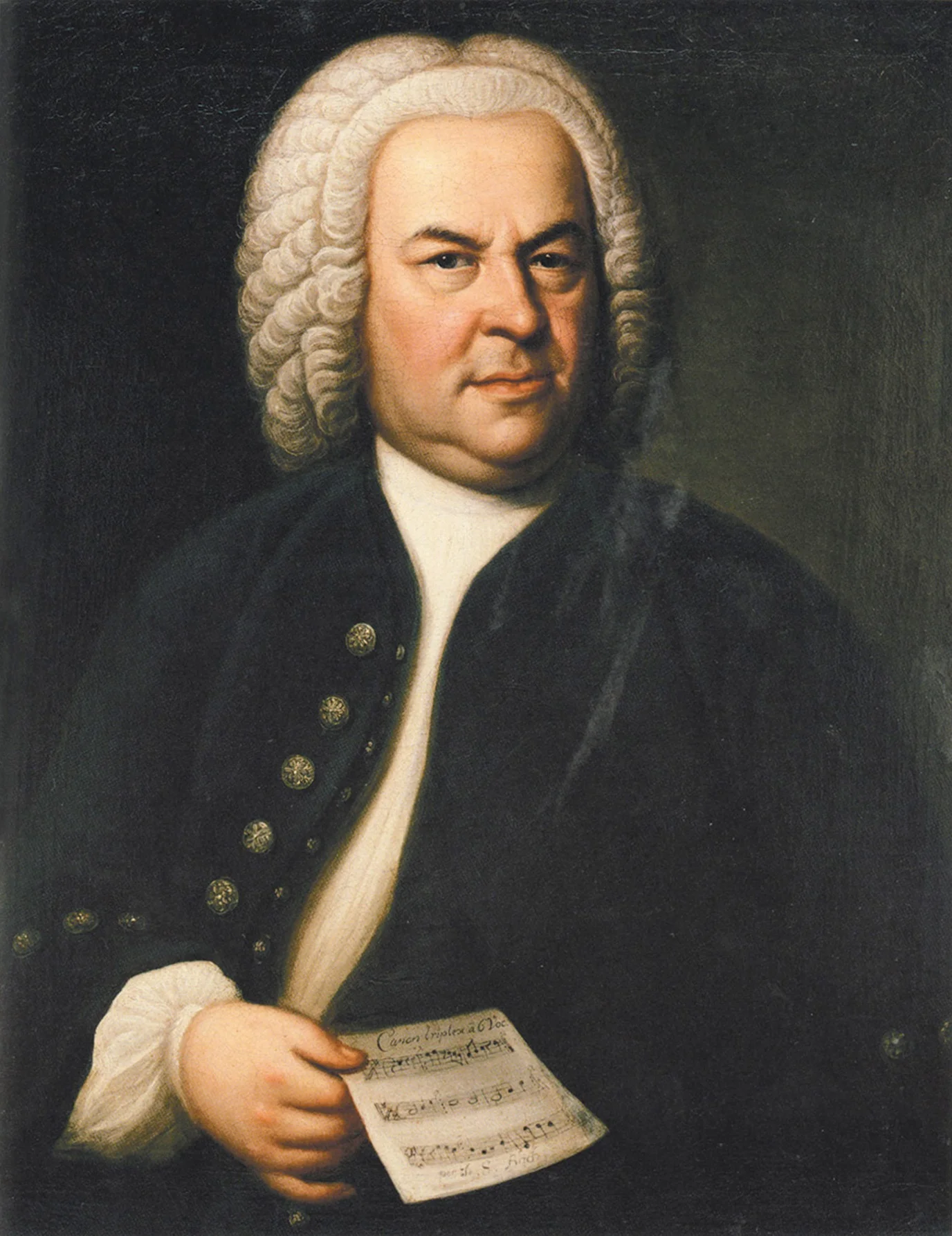
Johann Sebastian Bach
 Germany
composer•organist•harpsichordist
Birthday
March 21, 1685
Birth Sign
Aries
Birthplace
Eisenach, Saxe-Eisenach
Age
Died at 65
Height
5 ft 8 in (173 cm)
About
Johann Sebastian Bach was a German composer and keyboard virtuoso of the late Baroque, one of the most revered figures in Western music. He is admired above all for the rigor of his counterpoint, the craft by which independent melodic lines interlock without losing their individual voice. Within that discipline he wrote music of extraordinary range, from the intimate keyboard studies of The Well-Tempered Clavier to the vast devotional drama of the St. Matthew Passion and the Mass in B minor. Bach spent his life as a salaried church and court musician, producing cantatas week after week to a liturgical deadline; much of his output was treated as functional craft in his own day. His towering modern reputation came later, crystallized by the 1829 revival that Felix Mendelssohn helped lead. For musicians since, his work functions almost as a shared language: a body of writing studied by every serious composer, reinterpreted endlessly across genres, and held up as a benchmark for what musical structure can achieve. His influence on harmony and form is difficult to overstate.
Early Life & Background
Bach was born into a musical dynasty in Eisenach, the youngest of eight children. His father, Johann Ambrosius Bach, taught him violin and harpsichord basics. Both parents died by the time he was ten, and he moved to Ohrdruf to live with his older brother Johann Christoph, an organist who provided formal keyboard instruction. At fourteen, Bach won a scholarship to the Michaelisschule in Lüneburg, where he studied theology, Latin, and music, and likely encountered French and Italian composers. His first jobs came as a court musician in Weimar in 1703 and then as organist at the New Church in Arnstadt. A pivotal moment came in 1705 when he walked over 200 miles to Lübeck to hear the renowned organist Dieterich Buxtehude. He overstayed his leave by several months, causing conflict with his Arnstadt employers, but the trip deepened his compositional mastery. In 1707, he took a post as organist at St. Blasius Church in Mühlhausen, where he married his cousin Maria Barbara and wrote his first major cantata, Gott ist mein König.
Career Growth
Bach’s breakthrough was gradual. In 1708, he became court organist and chamber musician in Weimar, producing organ masterpieces like the Toccata and Fugue in D minor. From 1717 to 1723, he served as Kapellmeister in Köthen for Prince Leopold, a period that yielded the Brandenburg Concertos (1721), The Well-Tempered Clavier Book I (1722), and the six Cello Suites. In 1723, he became Cantor of the Thomasschule in Leipzig, a demanding post he held until his death. There he composed the St. John Passion (1724), the St. Matthew Passion (1727), the Mass in B minor (completed 1749), and over 200 church cantatas. In his late career, he wrote The Musical Offering (1747) after a visit to Frederick the Great and began The Art of Fugue, left unfinished. During his lifetime, Bach was known more as a virtuoso organist than a composer; his music was considered old-fashioned by the emerging Classical style. The posthumous Bach Revival, sparked by Mendelssohn’s 1829 performance of the St. Matthew Passion, elevated him to the pantheon of Western music.
Career Timeline
Public Image & Style
Bach’s public image is that of a solemn, towering genius, often portrayed in wigs and period dress, yet his music pulses with human energy. He is known for his fiery temper and stubbornness in life, but his art is revered for its mathematical precision and emotional depth. The fandom is global, with annual Bach festivals in Leipzig, Ansbach, and elsewhere, and academic societies like the American Bach Society. Fans often refer to themselves as Bach enthusiasts. His music streams billions of times annually on platforms like Spotify, with pieces like Air on the G String crossing over into popular culture. Social media accounts managed by the Bach Archive share educational content and performance clips, maintaining a reverent but accessible tone.
Fame & Fandom (iFAMOUS Rankings)
Walking the hallowed halls of music history, Johann Sebastian Bach stands as a titan whose influence transcends time. According to the iFANN Global Fame Rankings, he is currently the 333rd most famous person in the world, holding steady from the previous cycle. Within his homeland, his stature is even more pronounced, placing him as the 11th most famous person in Germany and the 13th most famous person from Germany. His reach extends across the continent where he ranks as the 64th most famous person in Europe, while within the classical sphere specifically, he commands the spotlight as the 4th most famous person in Classical. These placements reflect a global attention that spans centuries of media coverage and consumption signals worldwide. Unlike modern celebrities who rely on fleeting viral moments, Bach's audience consists of academic institutions, conservatories, and dedicated enthusiasts who engage with his work through rigorous performance and scholarship. There is no formal fandom name or organized grassroots movement bearing his specific brand; instead, the community functions as a collective stewardship of his legacy. Recent discoveries of lost pieces performed for the first time in over three centuries and new documents surfacing in Leipzig archives keep the scholarly flame burning bright. While fans do not gather to shout slogans or shut down streets, they participate in rituals of deep study, performing cantatas during church services and concert halls globally. The narrative surrounding him is one of enduring quality rather than sensationalism, marked by the dramatic revival sparked by Felix Mendelssohn in the 19th century that transformed him from a forgotten regional musician into a universally revered figure.
Interesting Facts and Legends
The legend of Bach's dedication to craft is legendary; he once trekked over 200 miles on foot just to hear the great Buxtehude play. His temper was as fiery as his talent, leading to a month-long imprisonment in 1717 when he attempted to leave Weimar without permission. A true virtuoso, he could improvise complex fugues on the spot, dazzling audiences with spontaneous counterpoint. Though his masterpiece The Art of Fugue remained unfinished at his death, his final note cleverly spelled out the musical signature BACH. He also revolutionized keyboard technique by being the first to utilize the thumb, a method that changed how musicians played forever. Following his passing, his music fell into near-total obscurity for eighty years until it was rediscovered. Beyond these verified facts, folklore often recounts how he was better known in his lifetime as an improvisational genius rather than a composer. A central story in his mythology involves the massive family dynasty he built with two wives, producing twenty children who carried the musical torch. Modern lore continues to grow with recent findings, such as lost pieces unearthed in late 2025 and organ documents discovered in Leipzig in early 2026, reinforcing the image of an unstoppable creative force.
Notable Quotes
“The aim and final end of all music should be none other than the glory of God and the refreshment of the soul.”
“I have had to work hard; anyone who works as hard as I do will achieve the same results.”
“Where there is devotional music, God is always at hand with His gracious presence.”
Family & Personal Life
Bach came from an extraordinary musical lineage: the Bach family produced over 70 known musicians across seven generations. His father, Johann Ambrosius Bach, was a town musician in Eisenach; his mother, Maria Elisabeth Lämmerhirt, died when he was nine. After his father’s death a year later, he lived with his elder brother Johann Christoph Bach, an organist. Bach married his second cousin Maria Barbara Bach in 1707; they had seven children, three of whom died in infancy. After her sudden death in 1720, he married Anna Magdalena Wilcke, a soprano sixteen years his junior, in 1721. She bore thirteen children, with only six surviving infancy. Bach’s sons Wilhelm Friedemann, Carl Philipp Emanuel, and Johann Christian became notable composers. Anna Magdalena assisted Bach by copying scores, and he composed the Notebook for Anna Magdalena Bach for her. After Bach’s death, she died in poverty in 1760. Today, the Bach Archive in Leipzig manages his legacy and manuscripts.
Notable Connections
Bach’s patrons included Prince Leopold of Anhalt-Köthen and Frederick the Great. He was deeply influenced by Dieterich Buxtehude, and his contemporaries included Georg Philipp Telemann. His sons Wilhelm Friedemann, Carl Philipp Emanuel, and Johann Christian Bach all became notable composers, extending the Bach dynasty’s musical legacy.
Relationships & Dating History
Bach married his second cousin Maria Barbara Bach on October 17, 1707, in Dornheim. They had seven children together; three died in infancy. Maria died suddenly on July 7, 1720, while Bach was traveling with Prince Leopold. In 1721, he married Anna Magdalena Wilcke, a soprano sixteen years his junior. They had thirteen children, with only six surviving infancy. Anna Magdalena assisted Bach by copying scores, and he composed the Notebook for Anna Magdalena Bach for her. Bach was a devoted husband, and no credible sources indicate extramarital affairs. After Bach’s death in 1750, Anna Magdalena lived in poverty until her death in 1760.
- MarriedMaria Barbara Bach1707 - 1720Bach's second cousin; they married in 1707 and had seven children; she died suddenly in 1720.
- MarriedAnna Magdalena Wilcke1721 - 1750Soprano, 16 years younger; they had 13 children; she assisted Bach by copying scores; after his death she died in poverty.
Death & Aftermath
Died
July 28, 1750 (aged 65)
Death Place
Leipzig, Saxony, Germany
Cause of Death
Stroke following failed eye surgery
The posthumous reverence that now defines Johann Sebastian Bach began quietly in the decades following his passing, long before Felix Mendelssohn's 1829 performance of the St. Matthew Passion resurrected his reputation as a towering figure of Western art music. Today, his legacy is honored through the Bachhaus museum in Eisenach, the Bach Archive in Leipzig, and annual festivals worldwide, while researchers recently reconstructed his facial features from a skull cast discovered in 2009. This enduring fame stands in stark contrast to the muted reaction at the time of his death, when he was primarily known as a virtuoso organist rather than a composer whose work would eventually outshine the emerging galant style.
His final days were marked by tragedy after failed eye surgeries performed by the English oculist John Taylor in late June 1750, which caused severe inflammation, total blindness, and intense pain. The last public appearance generally attributed to him was his work on the final fugue of The Art of Fugue, specifically Contrapunctus XIV, which he left unfinished due to his deteriorating health and inability to see the manuscript clearly. He died on July 28, 1750, in Leipzig, Germany, with the cause determined as a stroke following the surgical complications. A private funeral took place the next day at the Old St.
John's Cemetery, attended by his son Carl Philipp Emanuel Bach and close friends, though the specific location of his grave was lost when the churchyard became a park in the 19th century. Tributes from peers were limited during his lifetime; his pupil Johann Friedrich Agricola wrote a brief obituary, and friend Johann Nicolaus Forkel later compiled a biography based on interviews with Bach's sons.
Net Worth (Estate Value)
$10 Million
iFANN Editorial Team estimate
As of 2026, Bach's estate holds negligible monetary value since his works entered the public domain long ago. During his lifetime, he earned a modest salary as a cantor and court musician, never amassing significant wealth. The Bach Archive Leipzig manages his manuscripts and legacy, generating revenue from licensing sheet music, recordings, and tourism at St. Thomas Church. Per iFANN's editorial analysis, the archive's estimated value is around $10 Million, reflecting the cultural rather than financial worth. No major estate sales or posthumous earnings like those of modern artists exist.
Awards & Accolades
View 14 records, honours and achievementsKnown For
Brandenburg Concertos
1721 · Composer
The Well-Tempered Clavier
1722 · Composer
St. Matthew Passion
1727 · Composer
Mass in B minor
1749 · Composer
Toccata and Fugue in D minor
1703 · Composer
Keywords
Quick Facts
- Profession
- composer, organist, harpsichordist
- Born
- March 21, 1685
- Birthplace
- Eisenach, Saxe-Eisenach
- Died
- July 28, 1750
- Death Place
- Leipzig
- Gender
- Male
- Spouse
- Maria Barbara Bach, Anna Magdalena Wilcke
- Birth Sign
- Aries
Personal Details
- Full Name
- Johann Sebastian Bach
- Height
- 5 ft 8 in (173 cm)
- Spouse
- Maria Barbara Bach (1707–1720), Anna Magdalena Wilcke (1721–1750)
- Children
- 20 children (10 survived to adulthood), including Wilhelm Friedemann Bach, Carl Philipp Emanuel Bach, Johann Gottfried Bernhard Bach, Johann Christian Bach, Johann Christoph Friedrich Bach
- Education
- Michaelisschule, Lüneburg (1700–1702)
Frequently Asked Questions
How many children did Johann Sebastian Bach have?
Did Bach ever go deaf?
What is Bach's most famous piece?
Why is Bach so important?
How did Bach die?
Social Media
Similar People
Join the community
fans discussing