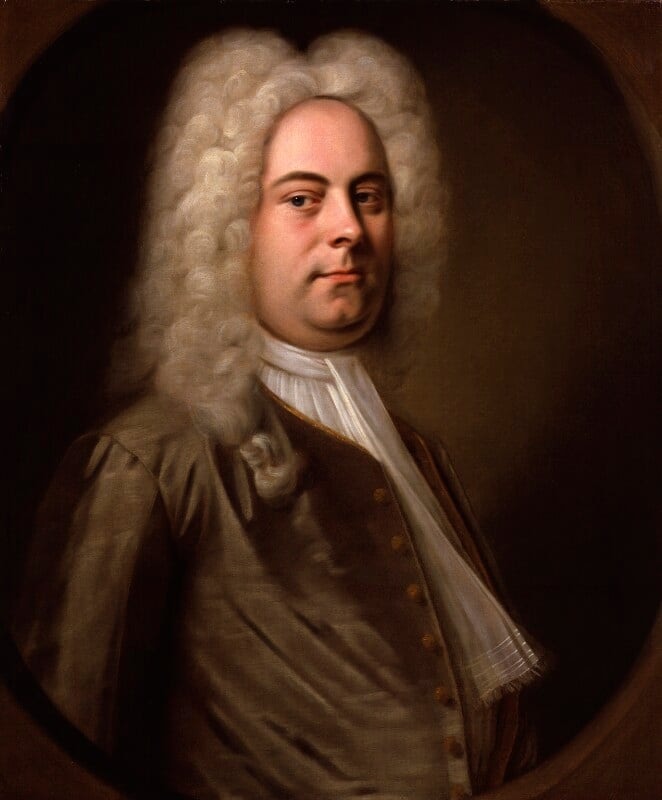
George Frideric Handel
composer•harpsichordist•organist
Also known as: Georg Friedrich Händel
Birthday
February 23, 1685
Birth Sign
Pisces
Birthplace
Halle, Duchy of Magdeburg, Brandenburg-Prussia (now Halle, Saxony-Anhalt, Germany)
Age
Died at 74
About
George Frideric Handel was a German-born British Baroque composer, harpsichordist, and organist who created some of the most enduring works in Western classical music. His music represents the peak of the high Baroque style, blending German polyphonic traditions with Italian melody and drama. Handel's career saw a significant shift towards English choral works, leading to his most famous composition, the oratorio Messiah (1742). His orchestral pieces Water Music and Music for the Royal Fireworks remain popular, and one of his coronation anthems, Zadok the Priest, has been performed at every British coronation since 1727. Handel died in 1759 a wealthy and respected figure, with an immense influence on later composers. Today, Handel is recognized as a dramatic genius and a cornerstone of classical music. Annual Messiah sing-alongs are a tradition in many cities, and his 'Hallelujah Chorus' is celebrated globally. His legacy is maintained by historical societies and music institutions, preserving an educational and reverential tone.
Early Life & Background
Georg Friedrich Händel, later known as George Frideric Handel, was born on February 23, 1685, in Halle, Duchy of Magdeburg, Brandenburg-Prussia (now Halle, Saxony-Anhalt, Germany). He was the son of Georg Händel, a distinguished barber-surgeon aged 63 who served the court of Saxe-Weissenfels, and Dorothea Taust, the daughter of a pastor. From an early age, Handel showed remarkable musical talent, a path his father strongly objected to, doubting it would provide a realistic income and not permitting him to own a musical instrument. His mother, however, was supportive and encouraged him to develop his talent secretly. By age 9, Handel was already a skilled keyboard player.
He received his only formal musical instruction from Friedrich W. Zachow, a local organist and composer in Halle, learning keyboard performance and composition principles. He also attended the Lateinschule in Halle, where headmaster Johann Praetorius was reportedly an ardent musician. After his father died when Handel was 11, his education had been provided for. At his father's insistence, he enrolled as a law student at the University of Halle in 1702. During this period, he also became organist of the Reformed Cathedral in Halle, a position he held for only one year. His undeniable passion for music could not be suppressed, and after studying law briefly, he left university to pursue music full-time. In 1703, at age 18, Handel committed himself completely to music, accepting a violinist's position at the Hamburg Opera's Goose Market Theater. He supplemented his income by teaching private music lessons. Though working primarily as a violinist, his exceptional skill on organ and harpsichord quickly earned him attention and more opportunities to perform in operas.
On January 8, 1705, he presided over the premiere of his first opera, Almira, at the Hamburg Opera, which achieved great success. He also composed Nero that same year. Having absorbed these initial experiences in Hamburg, Handel then traveled to Italy from 1707 to 1710, touring major cities over three opera seasons and introducing himself to most of Italy's major musicians. In Italy, he served patrons in Rome, Florence, and Venice, composing numerous cantatas, Roman Catholic church music, his first oratorios, and two new operas. His oratorio La resurrezione (1708) and the opera Agrippina (1709) proved his growing mastery of the Italian Baroque style. While in Venice, he met people who expressed interest in London's music scene .
Career Growth
Handel left Venice for London in 1710, where he met the manager of the King's Theatre, who commissioned an opera. Within just two weeks, he composed Rinaldo, which was released during the London opera season and became his breakthrough work, gaining him widespread recognition. In 1712, he settled permanently in London, where he spent the bulk of his career. He composed Water Music in 1717 for a royal barge party on the River Thames, one of his most famous orchestral works. In 1723, he was appointed Composer of the Chapel Royal. He became a naturalized British subject in 1727 and composed Zadok the Priest for the coronation of King George II; this anthem has been performed at every British coronation since. In 1727, he also formed the New Royal Academy of Music after producing several operas with the Royal Academy of Music.
After suffering a physical breakdown in 1737, possibly a stroke, he shifted from Italian opera to English choral works targeting the middle class. In 1741, he composed Messiah, his most famous oratorio, in just 24 days. It premiered in Dublin on April 13, 1742. During the 1740s and 1750s, he composed major oratorios including Samson (1743), Belshazzar (1745), Judas Maccabaeus (1747), Solomon (1749), and Theodora (1750). In 1749, he composed Music for the Royal Fireworks for a celebration in London's Green Park. He died on April 14, 1759, in London and received a state funeral at Westminster Abbey.
Career Timeline
Public Image & Style
Handel is remembered as a large, portly man with a sauntering gait and a mix of irascibility, humour, and good-heartedness. He was socially reserved and enjoyed a private circle. His music is considered the pinnacle of the high Baroque style, blending German polyphonic traditions with Italian melody and drama. Today, he is portrayed as a dramatic genius and a cornerstone of classical music. He was awarded an honorary Doctor of Music from the University of Oxford in the 1730s. His monument stands in Westminster Abbey, and a statue in Halle, Germany, commemorates him. His music has been performed continuously since his death, a rare distinction for any composer.
Fame & Fandom
The admirers of George Frideric Handel do not gather under a single branded banner like the Swifties or Beyhive. Instead, his legacy is sustained by Early Music enthusiasts, Baroque specialists, and members of formal institutions such as the San Francisco Early Music Society. This audience operates through opera houses and educational outreach rather than internet subcultures, yet their rituals are deeply ingrained in global culture. The most enduring tradition involves standing for the Hallelujah Chorus during Messiah performances, a custom born from an 18th-century royal reaction that persists in concert halls today. Handel democratized high art by shifting from aristocratic operas to English oratorios for the general public, creating a communal anthem that links modern listeners directly to British history and national ceremony. While no viral street shutdowns ever occurred, his work maintains a steady, institutional vitality through holiday traditions and community-focused revivals worldwide. His influence stretches across centuries, with recent productions reinterpreting his operas for new generations while digital archives preserve his voice for future discovery. According to the iFANN Global Fame Rankings, George Frideric Handel is currently the 38th most famous person in Classical, holding this position steadily from the previous cycle.
Interesting Facts and Legends
George Frideric Handel shares his birth year, 1685, with Johann Sebastian Bach and Domenico Scarlatti. He composed his masterpiece Messiah in a mere 24 days. Despite his father forbidding him from owning instruments, he practiced secretly, eventually abandoning his brief law studies to pursue music full-time. A stroke in 1737 temporarily paralyzed his right arm, yet he recovered to continue composing. Beethoven later hailed him as 'the greatest composer that ever lived.' A legendary story surrounds the premiere of Messiah where King George II stood up during the Hallelujah Chorus, prompting the entire court to rise; this tradition continues today. Historical records also confirm that despite suffering from blindness and strokes in his final years, Handel remained active until his death in 1759.
Notable Quotes
“I should be sorry if I only entertained them; I wished to make them better.”
“Whether I was in the body or out of the body when I wrote it I know not.”
Family & Personal Life
Handel's father, Georg Händel, was a distinguished barber-surgeon aged 63 at Handel's birth, who served the court of Saxe-Weissenfels and the Margraviate of Brandenburg. His mother, Dorothea Taust, was the daughter of pastor Georg Taust. His father died when Handel was 11. He had two younger sisters, but they died young. Handel never married and had no children. His will left his estate to servants, friends, and charitable organizations, including the Foundling Hospital. He was also a music teacher to the royal princesses.
Notable Connections
Relationships & Dating History
Handel never married and had no known romantic relationships documented in credible historical sources. He was a lifelong bachelor. Historical accounts describe him as socially reserved and enjoying a private circle. Some scholars have speculated about his sexuality given his bachelor status, but no credible contemporary evidence confirms any romantic relationships. His will left his estate to servants, friends, and charitable organizations, with no mention of romantic partners or children. As of 2026, he is deceased and never married.
Death & Aftermath
Died
April 14, 1759 (aged 74)
Death Place
London, England
Cause of Death
Reported stroke (apoplexy)
George Frideric Handel died on April 14, 1759, at his residence located at 25 Brook Street in London. His final days followed a decline after he fainted while conducting Judas Maccabaeus on April 6 and collapsed again during Messiah on April 10. Contemporary biographer John Mainwaring recorded that the composer lost the power of speech and sight before passing away from what was described as a stroke or apoplexy. The public reaction was immediate and profound, with King George II ordering a state funeral and declaring the nation had lost its most distinguished subject. Bells tolled at St. Paul's Cathedral, theaters observed moments of silence, and large crowds gathered outside Brook Street to pay their respects. The funeral procession on April 20 drew over 3,000 mourners along the route to Westminster Abbey, where Handel was interred in the north transept reserved for national heroes.
The service featured Let God Arise, an anthem composed specifically for the occasion, and was attended by royalty and the entire musical establishment of London. Tributes poured in from peers and institutions like the Royal Society and the University of Oxford, cementing his legacy through continued performance. His estate was handled privately by his nephew, John Christopher Smith, who oversaw the publication of unpublished works and inherited the bulk of the assets. In the decades following his death, Handel experienced a resurgence in popularity, particularly for Messiah, and is now frequently cited as one of the greatest composers in history. Beethoven famously called him the greatest that ever lived.
Net Worth (Estate Value)
$10 Million
iFANN Editorial Team estimate
Handel died a wealthy man in 1759, leaving an estate valued at approximately £20,000, equivalent to several million pounds today. He left substantial bequests to servants, the Foundling Hospital, and other charities. His music entered the public domain long ago, but his works continue to generate revenue through performances, recordings, sheet music sales, and licensing for film and television. The Handel House Museum in Halle and London preserves his legacy, while his manuscripts remain held by major libraries including the British Library. Per iFANN's editorial analysis, his estimated net worth stands at $10 Million. As of 2026, the ongoing use of his compositions in concerts, recordings, and media ensures his financial legacy remains significant, though no single estate valuation exists.
Awards Won (2)
Formal music awards did not exist during Handel's lifetime. However, he received royal patronage as Composer of the Chapel Royal (1723) and music teacher to the royal princesses. He was granted an honorary Doctor of Music from the University of Oxford in the 1730s. His burial at Westminster Abbey with a state funeral was a rare honor for a musician.
1730 · Honorary Degree
University of Oxford
1723 · Royal Appointment
Chapel Royal
Known For
Messiah
1741 · Composer
Water Music
1717 · Composer
Music for the Royal Fireworks
1749 · Composer
Zadok the Priest
1727 · Composer
Rinaldo
1711 · Composer
Keywords
Sources
Quick Facts
- Profession
- composer, harpsichordist, organist
- Born
- February 23, 1685
- Birthplace
- Halle, Duchy of Magdeburg, Brandenburg-Prussia
- Died
- April 14, 1759
- Death Place
- London, England
- Gender
- Male
- Birth Sign
- Pisces
Personal Details
- Full Name
- Georg Friedrich Händel
- Education
- Lateinschule Halle; University of Halle (law, 1702); musical training under Friedrich W. Zachow
Frequently Asked Questions
Was Handel ever married?
How did Handel die?
What is Handel's most famous piece?
How old was Handel when he died?
Did Handel have children?
Social Media
Similar People
Join the community
fans discussing