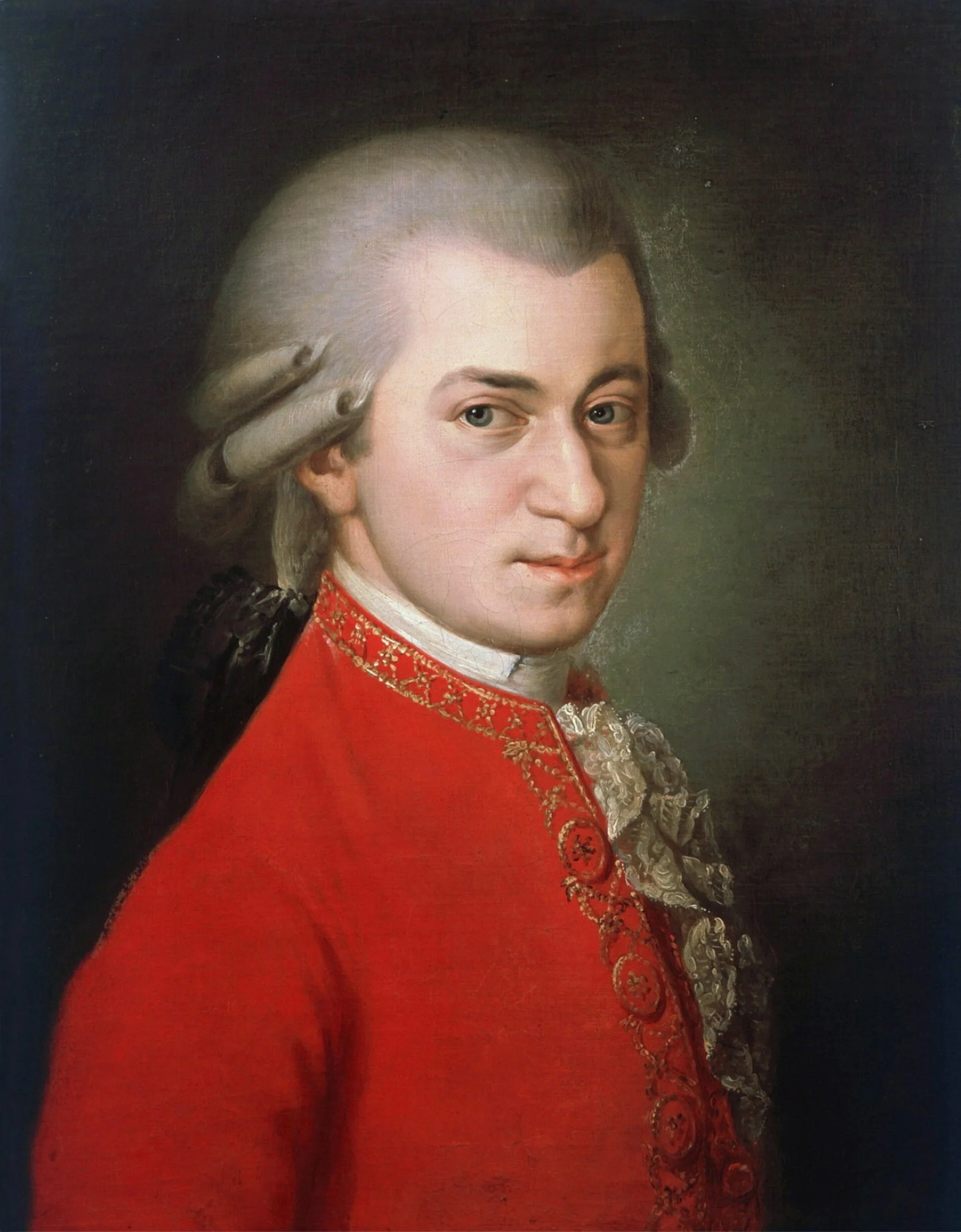
Wolfgang Amadeus Mozart
 Austria
composer•pianist•music educator
Also known as: Johannes Chrysostomus Wolfgangus Theophilus Mozart
Birthday
January 27, 1756
Birth Sign
Aquarius
Birthplace
Salzburg, Austria
Age
Died at 35
Height
5 ft 4 in (163 cm)
About
Wolfgang Amadeus Mozart was an Austrian composer and pianist whose output of over 800 works reshaped Western classical music. He is famous for his prolific and influential output, which includes some of the most celebrated works in the classical repertoire: the operas Le nozze di Figaro, Don Giovanni, Così fan tutte, and Die Zauberflöte; over a dozen piano concertos; the last three symphonies including the Jupiter; the serenade Eine kleine Nachtmusik; the Clarinet Concerto; and the unfinished Requiem. His music is defined by its melodic clarity, emotional depth, and structural sophistication. Though he died at 35, his works remain central to concert programs, film scores, and recordings worldwide. Fans relate to him through the enduring beauty and complexity of his compositions. The International Mozarteum Foundation manages his estate and promotes his legacy through festivals, research, and licensing.
Early Life & Background
Johannes Chrysostomus Wolfgangus Theophilus Mozart was born on January 27, 1756, in Salzburg, Austria, specifically in the Getreidegasse. He was the youngest of seven children, though only he and his older sister, Maria Anna, affectionately known as Nannerl, survived infancy. His father, Leopold Mozart, a respected violinist and composer at the Salzburg court, quickly recognized Wolfgang's extraordinary musical gifts. As a child prodigy, Wolfgang began composing at the tender age of five and by four, he could learn a complex musical piece in just 30 minutes. Leopold took on the rigorous task of homeschooling his son, not only in music but also in languages and academics, dedicating his own career to nurturing Wolfgang's immense talent.
At the age of six, and certainly before his tenth birthday, Leopold embarked on a grand European tour with Wolfgang and Nannerl, showcasing his children's abilities to royalty across the continent. They performed for Empress Maria Theresa in Vienna, King Louis XV in Paris, and King George III in London, where Wolfgang had the significant opportunity to meet Johann Christian Bach, who would become a major influence on his developing style. These tours were instrumental in shaping his early musical understanding. Between the ages of 14 and 16, Wolfgang made three formative trips to Italy. During these journeys, he deeply absorbed the Italian musical style, which profoundly influenced his compositions, and he wrote his first operas, Mitridate, re di Ponto and Lucio Silla, for Milan. A testament to his burgeoning genius, at just 14, he was inducted into the prestigious Accademia Filarmonica in Bologna, a rare honor for someone so young.
Upon his return to Salzburg, Mozart, by then 17 years old, took up a position as a court musician. However, he soon grew restless, finding himself at odds with his employer, Archbishop Colloredo, who treated him poorly. This dissatisfaction led him to seek better opportunities. In 1777, with his father Leopold's permission, Wolfgang traveled with his mother, embarking on a two-year search for a more suitable position. This period, from 1777 to 1779, saw him visit Mannheim, where he fell in love with Aloysia Weber, and then Paris, where tragedy struck with the sudden death of his mother. He returned to Salzburg in 1779, accepting a post as court organist. However, his discontent with the Salzburg court continued, culminating in a definitive break in 1781, when he moved to Vienna after a final falling out with his employer, marking the beginning of a new chapter in his life.
Career Growth
Mozart's breakthrough came in 1781 when he visited Vienna with the Archbishop and was dismissed after a heated argument. He chose to stay in Vienna as a freelance composer and performer, a risky move that paid off. His opera Die Entführung aus dem Serail premiered in 1782 to great success, establishing his reputation. That same year he married Constanze Weber. In Vienna, Mozart taught, performed, and composed prolifically, writing the Haydn Quartets (dedicated to his friend Joseph Haydn) and a series of piano concertos that blended virtuosity with symphonic depth.
His peak Vienna years saw the premieres of Le nozze di Figaro (1786) in Vienna and Don Giovanni (1787) in Prague, both operatic masterpieces. In 1787 he was appointed Imperial Chamber Composer by Emperor Joseph II, though the salary was modest. He composed his last three symphonies (Nos. 39, 40, and the Jupiter) in the summer of 1788. Così fan tutte premiered in 1790. In 1791, his final year, he wrote Die Zauberflöte, the Clarinet Concerto, and began the Requiem, commissioned anonymously by Count Walsegg. Mozart died on December 5, 1791, before completing the Requiem, which was finished by his student Franz Xaver Süssmayr.
Career Timeline
Public Image & Style
Mozart's public image is that of a genius composer, often depicted as a playful, irreverent child-man, a portrayal popularized by the 1984 film Amadeus. In reality, he was a serious professional who worked tirelessly, though he enjoyed socializing, dancing, and practical jokes. His signature style embodies the Classical period's elegance, clarity, and emotional depth, with a gift for melody that makes his music instantly recognizable. Fans, sometimes called Mozarteans, celebrate his birthday on January 27 with concerts worldwide. The Mozarteum Foundation maintains his image through educational content, social media posts sharing lesser-known works, and historical anecdotes. His music is frequently used in films, commercials, and even ringtones, keeping him a constant presence in popular culture. The fandom includes both serious classical enthusiasts and casual listeners drawn to his most famous pieces.
Fame & Fandom (iFAMOUS Rankings)
Wolfgang Amadeus Mozart remains a towering figure in global culture, holding the 326th most famous person in the world according to the iFANN Global Fame Rankings. This standing places him firmly as the 3rd most famous person from Austria and the 3rd most famous person in Classical music, metrics that have held steady through recent cycles. His legacy transcends mere historical interest; it thrives on a decentralized community of classical enthusiasts and opera lovers who drive streaming numbers and fill concert halls worldwide. While there is no formal moniker like 'Swifties' for his supporters, the devotion runs deep enough to spark intense reactions during major anniversaries. The cultural investment in his image reached a bizarre peak in 2026 when the theft of over 200 golden statuettes from Salzburg sent shockwaves through the international press, proving how fiercely this audience protects his memory. These fans operate through symphonies and educational institutions rather than grassroots clubs, yet their collective power ensures his works remain staples on digital platforms. The rankings reflect a sustained engagement with media coverage, search activity, and consumption patterns that span centuries, confirming that the composer's influence has not faded but evolved into a modern phenomenon.
Interesting Facts and Legends
Mozart left behind a unique collection of personal quirks and historical mysteries. He owned a pet starling capable of whistling a theme from his Piano Concerto No. 17 and was an avid billiards player who often composed between games. Though he died at 35, his output included the unfinished Requiem, commissioned by Count Walsegg, who intended to pass it off as his own work. Mozart wrote the opera Don Giovanni in just six weeks and composed Eine kleine Nachtmusik in 1787, though it remained unpublished until after his death. His full baptismal name, Johannes Chrysostomus Wolfgangus Theophilus Mozart, includes Theophilus, which he Latinized as Amadeus. Beyond these facts, legends swirl around his final days. A persistent story claims he was poisoned by his rival Antonio Salieri out of jealousy while composing the Requiem, a narrative popularized by Peter Shaffer's play Amadeus. Historical records verify his sudden illness and death while working on the commission, but scholars widely regard the poisoning tale as fiction. Another legend involves audiences fainting during his performances in Vienna, attributed to the overwhelming emotional power of his revolutionary scores.
Notable Quotes
“The music is not in the notes, but in the silence between them.”
“Neither a lofty degree of intelligence nor imagination nor both together go to the making of genius. Love, love, love, that is the soul of genius.”
“I pay no attention whatever to anybody's praise or blame. I simply follow my own feelings.”
“I write as a sow piddles.”
“To talk well and eloquently is a very great art, but that an equally great one is to know the right moment to stop.”
Family & Personal Life
Mozart's father Leopold was a composer and violinist who served as deputy Kapellmeister at the Salzburg court. His mother Anna Maria Pertl died in Paris in 1778 while accompanying Wolfgang on a job search. His only surviving sibling was his sister Maria Anna (Nannerl), a talented keyboardist who performed alongside him as a child but was discouraged from pursuing a career. Mozart married Constanze Weber on August 4, 1782. They had six children, but only two survived infancy: Karl Thomas (1784–1858), who became a civil servant and never married, and Franz Xaver Wolfgang (1791–1844), who became a composer and pianist. The family lived in various apartments in Vienna, often moving due to financial pressures. They kept a pet dog and a canary. Constanze outlived Mozart by 51 years and later managed his estate, securing his legacy.
Notable Connections
Mozart maintained close ties with his father Leopold, who served as his teacher and manager. Joseph Haydn was a friend and mentor; Mozart dedicated six string quartets to him. Antonio Salieri, often portrayed as a rival, was in reality a respectful colleague. Emanuel Schikaneder wrote the libretto for Die Zauberflöte and produced it. Constanze Mozart, his wife, later managed his estate and promoted his works.
Relationships & Dating History
Mozart's first known romantic attachment was to Aloysia Weber, a soprano he met in Mannheim in 1777. He fell deeply in love and hoped to marry her, but his father Leopold forbade the match, and Aloysia eventually married actor Joseph Lange in 1780. After this rejection, Mozart turned his attention to Aloysia's younger sister, Constanze. They married on August 4, 1782, in Vienna. Despite financial struggles, their marriage was loving and supportive. Constanze bore six children, though only two survived infancy. She was a capable partner who managed their household and later became the primary guardian of his legacy. Mozart died in 1791, and Constanze outlived him by 51 years, remarrying in 1809 to Georg Nissen, a Danish diplomat who co-wrote a biography of Mozart. As of 2026, Mozart is deceased; his marriage to Constanze ended with his death.
- DatedAloysia Weber1777 - 1778Mozart fell in love with Aloysia in Mannheim, but his father forbade the match; she later married Joseph Lange.
- MarriedConstanze Mozart1782 - 1791Married on August 4, 1782; had six children, two survived; she outlived him by 51 years.
Death & Aftermath
Died
December 5, 1791 (aged 35)
Death Place
Vienna, Austria
Cause of Death
Reported as sudden illness with swelling and pain; never confirmed
Wolfgang Amadeus Mozart died in the early hours of December 5, 1791, at his home in the Alsergrund suburb of Vienna. His final days were spent working on the Requiem until he fell bedridden and delirious in late November, having reportedly composed the piece with a sense of impending doom. Public reaction remained subdued rather than dramatic; Vienna moved on quickly, though his widow Constanze and friends like Emanuel Schikaneder mourned deeply. A modest funeral took place the following day at St. Stephen's Cathedral, followed by burial in a common grave at St. Marx Cemetery where no headstone marked his resting place. The service lacked a procession or elaborate music due to financial constraints and prevailing customs for non-nobility. Posthumous legacy grew exponentially as peers completed unfinished works, including the Requiem finished by student Franz Xaver Süssmayr for Count Walsegg.
Tributes emerged from figures like Franz Xaver Niemetschek, who delivered a eulogy describing Mozart's genius. His estate was handled by his widow, Constanze, who successfully petitioned Emperor Leopold II for a pension to support herself and their children, securing her financial future despite Mozart's debts. She also managed the publication of his works to generate income. Over the centuries, numerous films, books, and awards have been dedicated to him, including Peter Shaffer's play Amadeus and its film adaptation, which significantly influenced the public narrative of his life and death. Foundations, scholarships, and museums (such as the Mozarteum Foundation in Salzburg) continue to honor his legacy, and his birthplace in Salzburg is now a major landmark.
Net Worth (Estate Value)
$10 Million
iFANN Editorial Team estimate
Mozart passed away in 1791 with minimal personal wealth, yet his estate continues to generate substantial income decades later. The International Mozarteum Foundation, based in Salzburg, manages the intellectual property, collecting royalties from recordings, film licenses, and merchandise. Revenue streams include the Salzburg Mozart Week festival, licensing fees for films such as Amadeus and Out of Africa, and the publication of critical editions. Forbes listed Mozart as the second highest-earning deceased celebrity in 2020 with $3.5 million that year. Per iFANN's editorial analysis, the total estate value is estimated at approximately $10 million as of 2026, reflecting the ongoing commercial appeal of his music and the foundation's careful stewardship.
Awards Won (5)
Formal awards in the modern sense did not exist in the 18th century. Mozart received the Papal Order of the Golden Spur in 1770, was elected a member of the Accademia Filarmonica di Bologna at age 14, and was appointed Imperial Chamber Composer in Vienna in 1787. Posthumously, he has been inducted into the Classical Music Hall of Fame (1998) and the Gramophone Hall of Fame (2012).
1770 · Knighthood
1770 · Honorary Membership
Known For
The Marriage of Figaro
1786 · Composer
Don Giovanni
1787 · Composer
The Magic Flute
1791 · Composer
Requiem
1791 · Composer
Eine kleine Nachtmusik
1787 · Composer
Keywords
Quick Facts
- Profession
- composer, pianist, music educator
- Born
- +1756-01-27
- Birthplace
- Salzburg, Austria
- Died
- +1791-12-05
- Death Place
- Vienna, Austria
- Gender
- Male
- Spouse
- Constanze Mozart
- Birth Sign
- Aquarius
Personal Details
- Full Name
- Johannes Chrysostomus Wolfgangus Theophilus Mozart
- Height
- 5 ft 4 in (163 cm)
- Spouse
- Constanze Mozart
- Children
- Karl Thomas Mozart, Franz Xaver Wolfgang Mozart
- Education
- Homeschooled by his father, Leopold Mozart
Frequently Asked Questions
What did Mozart die of?
Did Mozart and Salieri hate each other?
How many works did Mozart compose?
Was Mozart deaf?
What is Mozart's most famous piece?
Join the community
fans discussing