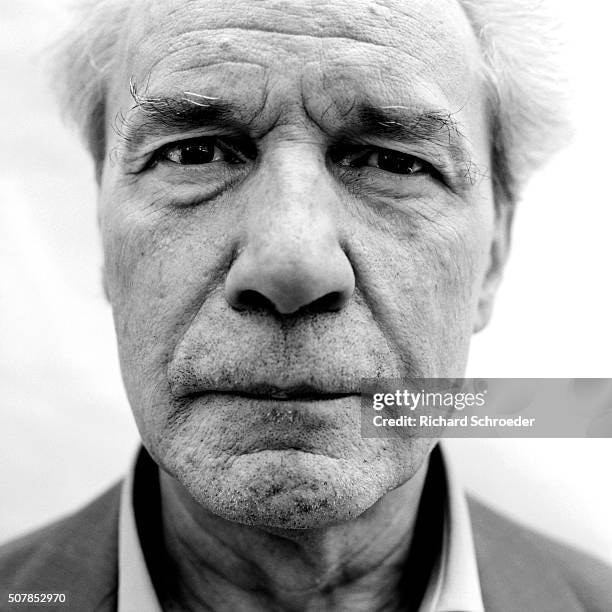
Jacques Rivette
 France
film director•screenwriter•film critic
Birthday
March 1, 1928
Birth Sign
Pisces
Birthplace
Rouen, Normandy, France
Age
Died at 87
Height
5 ft 10 in (178 cm)
About
Jacques Rivette was a French film director, screenwriter, and critic, a key architect of the French New Wave. Over 29 films, he pushed cinema toward improvisation, extreme length, and narrative freedom. His most celebrated works include Celine and Julie Go Boating (1974), the thirteen-hour Out 1 (1971), and La Belle Noiseuse (1991), which won the Grand Prix at Cannes. Rivette's films demand patience but reward with a unique, dreamlike logic.
Unlike his peers, Rivette never had a commercial hit. Instead, he built a reputation as a director's director, revered by cinephiles for his radical methods. He wrote for Cahiers du Cinéma and served as its editor, championing American genre cinema. His work continues to be studied and restored, with Celine and Julie Go Boating ranking among Sight & Sound's greatest films.
Early Life & Background
Rivette grew up in Rouen in a middle-class Catholic family. His father worked as a postal clerk; his mother stayed home. As a child, he discovered cinema through Jean Cocteau's films and started making his own at twenty with a 9.5mm camera. After finishing at Lycée Corneille, he moved to Paris in 1949.
In Paris, he became a regular at the Cinémathèque Française, where he met François Truffaut, Jean-Luc Godard, Éric Rohmer, and Claude Chabrol. He began writing for Cahiers du Cinéma in 1953, quickly known for his sharp, aggressive style. His 1956 short Le Coup de Berger is often called the first New Wave film. Rivette was the first of the group to start a feature, but Paris Belongs To Us took years to finish, releasing in 1961 after Chabrol, Truffaut, and Godard had all debuted.
Career Growth
Rivette's debut feature Paris Belongs To Us (1961) was a paranoid thriller shot on a tiny budget. He then served as editor of Cahiers du Cinéma from 1963 to 1965. His second film, The Nun (1966), sparked a censorship battle with the French government that he eventually won, but the experience pushed him toward a freer style.
After May 1968, Rivette embraced improvisation. L'Amour fou (1969) ran four hours. Then came Out 1 (1971), a thirteen-hour epic that was barely screened. Celine and Julie Go Boating (1974) marked his biggest success, winning the Sutherland Trophy. A nervous breakdown in the late 1970s slowed him, but producer Martine Marignac backed his later films, including La Belle Noiseuse (1991), which won the Cannes Grand Prix. He retired after Around a Small Mountain (2009).
Career Timeline
Public Image & Style
Rivette is remembered as the mysterious genius of the French New Wave, the most intellectually rigorous but least accessible. His films are known for extreme length, improvisation, and a blend of reality and fantasy. Critics call him a director's director. Fans, often called Rivette enthusiasts, host marathon screenings of Out 1. His social media presence is posthumous, maintained by film institutions like the Criterion Collection. He never sought fame, and his privacy only added to his legend.
Fame & Fandom (iFAMOUS Rankings)
Jacques Rivette cultivated a legacy defined by intellectual rigor rather than mass-market celebrity, resulting in an audience that consists primarily of cinephiles, film students, and critics who engage with his work through specialized archives and academic screenings. Unlike the organized movements surrounding pop icons, there is no official or widely recognized fandom name for his followers; fans do not refer to themselves as "Rivettians" or any other specific moniker. Instead, this community identifies through their participation in "true film" circles and specialty distributors like Radiance Films, where the interaction remains informal and focused on the preservation of complex, improvisational narratives. The most enduring stories surrounding his career are not tales of crowds fainting at premieres but myths of endurance, such as the legendary 13-hour cut of Out 1, which required decades of archival reconstruction to restore its full scope. While he remained reticent about public relations, preferring to let his films speak for themselves, his death marked the end of an era for differential cinema, cementing his status as an uncompromising master whose work demands active intellectual participation. Despite his towering influence on the art form and tributes from major publications like The New Yorker, Jacques Rivette is currently evaluated by iFANN's Global Fame Engine but does not hold a placement in the published Global Top 1,000 rankings or any Top-100 scope list as of August 2026.
Interesting Facts and Legends
Jacques Rivette was a passionate chess player who frequently integrated chess motifs into his cinematic narratives. He appeared on screen in only one movie, a brief cameo in Jean-Luc Godard's Band of Outsiders (1964). His magnum opus, Out 1, stands as one of the longest narrative films ever made, running approximately 13 hours in length. He refused interviews after the 1970s, securing his reputation as one of cinema's most private directors despite his Catholic upbringing, which he rejected in favor of lifelong atheism. His final project, Around a Small Mountain, was completed in an astonishingly short window of just 15 days. A central legend of his career involves the production of L'Amour fou (Love on the Ground, 1969), a film documenting the rehearsal of a stage adaptation of Balzac's La Duchesse de Langeais. This project became the subject of myth due to the tragic loss of original elements in a fire, sparking dedicated preservation campaigns by organizations like Film Independent and Radiance Films to restore the masterpiece. Another iconic story concerns the filming of Celine and Julie Go Boating (1974), where boundaries between personal lives and roles blurred so thoroughly with actress Bulle Ogier that the film achieved a unique dreamlike logic.
Notable Quotes
“Cinema is not a language, it is a machine.”
“The only thing that matters is the film. Everything else is just noise.”
“I make films to discover what I think.”
“The audience must work. I don't give them easy answers.”
“Alzheimer's is a strange thing. It takes your memory, but not your soul.”
Family & Personal Life
Rivette was intensely private about his family. He was born to a postal worker father and a homemaker mother. He had no known siblings. He married twice: first to Italian photographer and screenwriter Marilù Parolini in the early 1960s; the marriage ended in divorce. Later, he married Véronique Manniez, who was his wife at the time of his death. He had no children. His widow manages his estate.
Notable Connections
Rivette was part of the core French New Wave group: Éric Rohmer, François Truffaut, Jean-Luc Godard, and Claude Chabrol. He collaborated with producer Martine Marignac on all his films from 1981 onward. Frequent actors include Bulle Ogier, Michel Piccoli, and Jane Birkin.
Relationships & Dating History
Rivette was married twice. His first wife was Marilù Parolini, an Italian photographer and screenwriter whom he married in the early 1960s. The marriage was brief and ended in divorce; no children. He later married Véronique Manniez, a French woman with no public profession. The exact date of their marriage is unknown, but she was his wife at the time of his death in 2016. Rivette was intensely private and rarely discussed his personal life. He had no known romantic relationships after his second marriage. As of 2026, he is deceased; his widow survives him.
- MarriedMarilù Parolini1962 - 1965Italian photographer and screenwriter; marriage ended in divorce.
- MarriedVéronique Rivette1975 - 2016CurrentSecond wife; very private; was his spouse at death.
Death & Aftermath
Died
January 29, 2016 (aged 87)
Death Place
Unknown
Cause of Death
Unknown
Net Worth (Estate Value)
$5 Million
iFANN Editorial Team estimate
Per iFANN's editorial analysis, the estate of Jacques Rivette is valued at $5 Million as of 2026. Unlike mainstream directors, his income derived from art-house distribution, home video sales, and academic licensing rather than blockbuster box office returns. Key revenue streams include Criterion Collection releases of Celine and Julie Go Boating and La Belle Noiseuse, alongside theatrical re-releases of Out 1 . His widow Véronique Rivette and producer Martine Marignac manage the estate assets. Posthumous restorations and a 2025 Criterion box set have boosted revenue in recent years, ensuring the continued financial viability of his catalog.
Awards Won (7)
Rivette won the Grand Prix du Jury at Cannes for La Belle Noiseuse (1991), along with the Technical Grand Prize and FIPRESCI Prize at Cannes for earlier films. He also received the Prix Louis-Delluc and the Sutherland Trophy. His work earned critical acclaim but limited mainstream awards.
1991 · Cannes Film Festival
La Belle Noiseuse
1991 · Cannes Film Festival
La Belle Noiseuse
Known For
Celine and Julie Go Boating
1974 · Director
La Belle Noiseuse
1991 · Director
Out 1
1971 · Director
Paris Belongs To Us
1961 · Director
The Nun
1966 · Director
Keywords
Quick Facts
- Profession
- film director, screenwriter, film critic
- Born
- +1928-03-01
- Birthplace
- Rouen
- Died
- +2016-01-29
- Death Place
- 6th arrondissement of Paris
- Gender
- Male
- Spouse
- Marilù Parolini, Véronique Rivette
- Birth Sign
- Pisces
Personal Details
- Full Name
- Jacques Pierre Rivette
- Height
- 5 ft 10 in (178 cm)
- Spouse
- Marilù Parolini, Véronique Rivette
Filmography
29
Total
29
Film
0
TV
Frequently Asked Questions
Is Jacques Rivette still alive?
What is Jacques Rivette's most famous film?
How long is Jacques Rivette's Out 1?
Did Jacques Rivette have children?
Was Jacques Rivette married?

Join the community
fans discussing