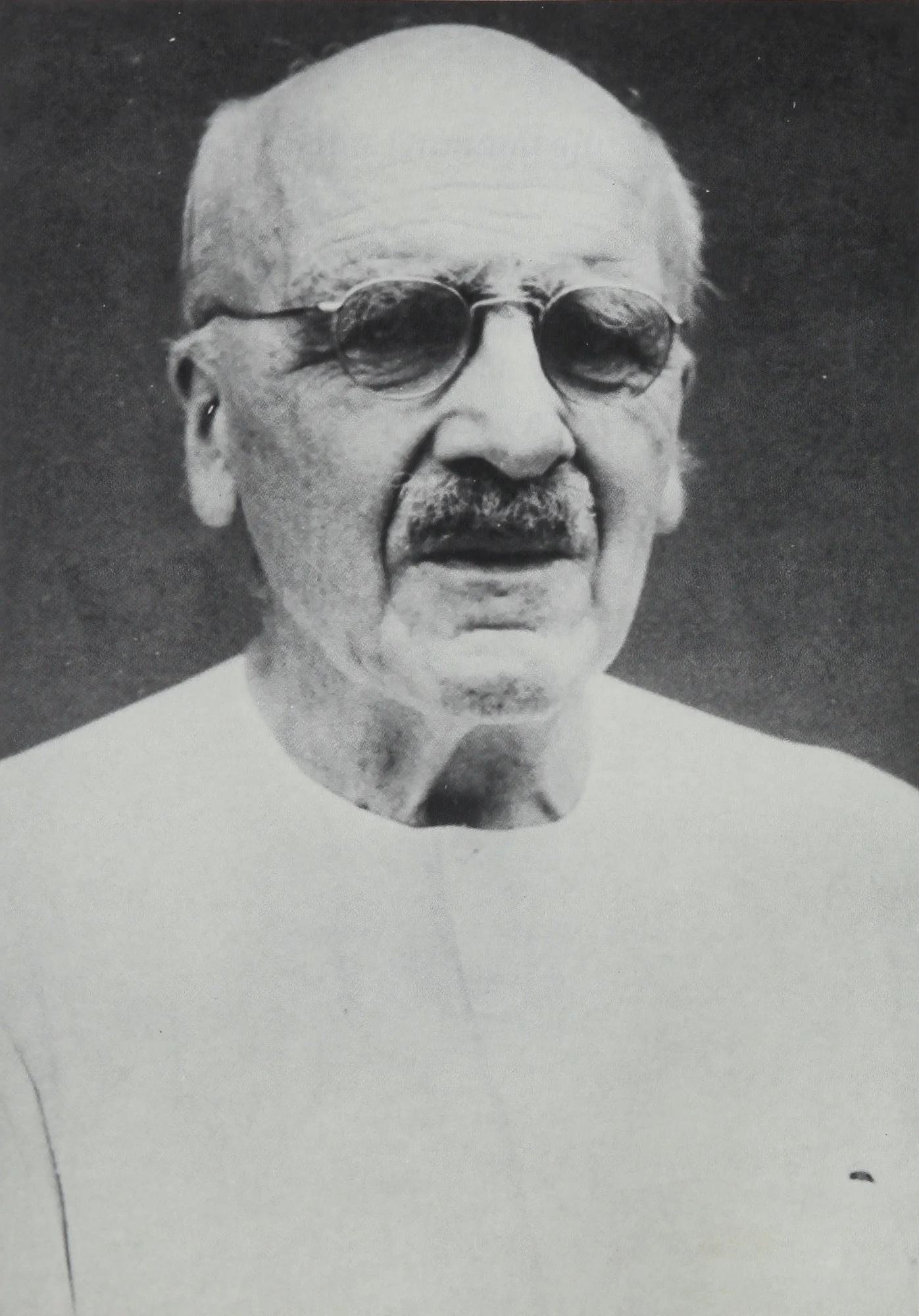
J.B.S. Haldane
 United Kingdom
biologist•geneticist•physiologist
Also known as: Jack Haldane, JBS
Birthday
November 5, 1892
Birth Sign
Scorpio
Birthplace
Oxford, England
Age
Died at 72
Height
5 ft 9 in (175 cm)
About
J.B.S. Haldane was a British-born biologist, geneticist, and physiologist who became an Indian citizen. He is one of the founders of population genetics and neo-Darwinism, using mathematics to unite Mendelian genetics with natural selection. He proposed the primordial soup theory for the origin of life, formulated Haldane's rule on hybrid sterility, and correctly linked sickle-cell disease to malaria resistance. He also coined the term "clone" and predicted in vitro fertilization decades before it happened.
Haldane never earned a formal degree in biology, yet he taught at Cambridge, University College London, and the Indian Statistical Institute. A committed Marxist and atheist, he renounced British citizenship in 1961 and spent his final years in India. His work continues to influence genetics, evolutionary biology, and physiology. Peter Medawar called him the cleverest man he ever knew.
Early Life & Background
Haldane grew up in Oxford surrounded by science. His father, John Scott Haldane, was a famous physiologist who studied respiration and mine safety. By age three, Jack was reading scientific texts, and at four he corrected his father's math. He often accompanied his father on mining expeditions, testing breathing equipment in dangerous conditions.
He attended Oxford Preparatory School and then Eton College, where he excelled in classics and math. In 1910, he entered New College, Oxford, to study Literae Humaniores, earning first-class honors in 1914. He never took a biology degree, but his family environment and self-directed reading gave him a deep scientific education.
During World War I, Haldane served as a captain in the Black Watch regiment. He was wounded in combat but continued conducting physiological experiments on himself and fellow soldiers, testing the effects of poison gas and extreme conditions. This wartime experience sharpened his commitment to applying science to real-world problems.
Career Growth
Haldane's breakthrough came in 1924 when he published statistical work showing that Mendelian genetics could be reconciled with Darwinian natural selection. This made him a founder of population genetics alongside Ronald Fisher and Sewall Wright. In 1929, his essay "The Origin of Life" proposed the primordial soup theory, suggesting life emerged from a chemical mixture energized by ultraviolet light.
In 1932, he published The Causes of Evolution, which mathematically established the relationship between mutation rates, selection pressure, and evolutionary change. That same year, he formulated Haldane's rule, stating that in hybrid species, the heterogametic sex is more likely to be sterile or inviable. He mapped human genes for hemophilia and color blindness to the X chromosome, and in 1949, he correctly proposed that sickle-cell disease persisted because it conferred malaria resistance.
Haldane coined the term "clone" in 1963 and envisioned ectogenesis, the hydrogen economy, and organismal cloning. He served as a scientific advisor to the British government during World War II, researching diving physiology and submarine escape. In 1956, he emigrated to India, accepting a professorship at the Indian Statistical Institute. He became an Indian citizen in 1961 and established the Genetics and Biometry Laboratory in Bhubaneswar, where he worked until his death.
Career Timeline
Public Image & Style
Haldane's public image is that of a brilliant, eccentric polymath. He was known for smoking a pipe, wearing rumpled suits, and delivering sharp wit. Media portrayals emphasize his role as a founder of modern evolutionary biology and a visionary who anticipated many 21st-century biotechnologies. His writing blended scientific rigor with literary flair, making him a popular science writer for outlets like the Daily Worker. There is no official fandom name, but he is revered in scientific communities, especially in India and the UK. Tribute accounts on social media keep his legacy alive with educational content.
Fame & Fandom
J.B.S. Haldane stands as a towering figure in the history of science, revered by historians and biologists for his foundational work in population genetics and his prophetic insights into modern biology. Despite his immense intellectual legacy, iFANN's Global Fame Engine has evaluated this person, but they do not currently hold a placement in the published rankings (Global Top 1,000 or a Top-100 scope list). This absence of a numeric rank reflects his status as an academic pioneer rather than a mass-market celebrity with a consumer following. His admirers are scholars and enthusiasts who preserve his memory through archival projects like jbshaldane.org rather than organized fan clubs or social media campaigns. There is no documented fandom name for his supporters; the community remains a loose network of researchers and readers drawn to his radical politics and scientific wit. While he predicted test-tube babies and cloning decades before they occurred, these achievements cemented his place in textbooks rather than generating viral moments or chart-topping popularity. The stories fans still retell focus on his eccentric self-experimentation and his principled exile to India, which define his character more than any pop culture phenomenon could. Unlike modern stars whose fame fluctuates with trending topics, Haldane's influence is steady and enduring, rooted in the very structure of evolutionary biology. He remains a symbol of the independent thinker who prioritized truth over career security, a narrative that resonates deeply within the scientific community without requiring the machinery of a formal fandom.
Interesting Facts and Legends
Haldane was famous for his daring self-experimentation, once drinking hydrochloric acid to study its effects on respiration and spending time in decompression chambers. He coined the word "clone" from the Greek for "twig" during a 1963 speech and correctly linked sickle-cell disease to malaria resistance. In 1923, he predicted test-tube babies more than fifty years before Louise Brown's birth. A committed atheist and Marxist, he left the Communist Party of Great Britain in 1950 over Lysenkoism. His body was dissected by medical students in India as he had requested. His sister, Naomi Mitchison, was a noted novelist; together they demonstrated genetic linkage in mammals. Legends surrounding him include the Oparin-Haldane hypothesis, where he independently proposed that life arose from organic compounds in a primordial atmosphere, a theory that later inspired the Miller-Urey experiment. Another enduring story involves the Infinite Monkey Theorem, which he popularized to illustrate statistical mechanics. His political dissent led to his departure from England in the late 1950s, settling in India to continue his research. Finally, his speculative essays on eugenics are widely credited with inspiring Aldous Huxley's dystopian novel Brave New World, though Haldane later expressed regret over the interpretation of his serious scientific predictions.
Notable Quotes
“The universe is not only queerer than we suppose, but queerer than we can suppose.”
“The scientist is not a person who gives the right answers; he is one who asks the right questions.”
“If I were to die, I would like my body to be used for medical research. I want to be useful even in death.”
Family & Personal Life
Haldane's father, John Scott Haldane, was a renowned physiologist known for work on respiration and mine safety. His mother, Louisa Kathleen Trotter, was a suffragist and community activist. His uncle, Richard Burdon Haldane, was a prominent statesman. His sister, Naomi Mitchison, was a novelist and collaborator. Haldane had no children from either of his two marriages. He lived modestly, especially after moving to India, and left his body to medical research.
Notable Connections
Haldane collaborated with Ronald Fisher and Sewall Wright as a co-founder of population genetics. He worked with his sister Naomi Mitchison on genetic linkage in mammals. He corresponded with Jawaharlal Nehru on science policy in India. Peter Medawar called him the cleverest man he ever knew, and Arthur C. Clarke admired his science popularization. His father, John Scott Haldane, was his early scientific mentor.
Relationships & Dating History
Haldane married twice. His first wife was Charlotte Franken, a German-British journalist and novelist. They married in 1926 and divorced in 1945 after nearly two decades. No children. In 1946, he married Helen Spurway, a geneticist who had been his student. They worked together at University College London and later in India. Helen survived him after his death in 1964. No children from either marriage.
- MarriedCharlotte Haldane1926 - 1945German-British journalist and novelist; met through literary circles; divorced after 19 years; no children.
- MarriedHelen Spurway1946 - 1964Geneticist and former student; worked together at UCL and in India; remained married until his death; no children.
Death & Aftermath
Died
December 1, 1964 (aged 72)
Death Place
Unknown
Cause of Death
Unknown
By the autumn of 1964, J.B.S. Haldane had settled into a quiet routine at his home in Bhubaneswar, India, where he continued to lead the Genetics and Biometry Laboratory despite advancing age. On December 1, 1964, the renowned scientist passed away at the age of seventy-two, bringing an end to a life that bridged British academia and Indian science with equal fervor. The specific medical cause of his passing was not publicly detailed by his family or local authorities, leaving the exact nature of his final hours undocumented in the public record. His body was donated to medical research as per his long-standing wishes, reflecting his lifelong commitment to science even beyond his own life.
The scientific community reacted with profound respect for a man who had fundamentally reshaped population genetics and predicted the molecular basis of heredity decades before the technology existed. Tributes from peers highlighted his unique ability to synthesize complex mathematical models with biological reality, noting how his work on sickle-cell disease and hybrid sterility remained foundational to modern evolutionary theory. While no grand state funeral was held, his passing marked the loss of a pivotal figure who had championed both scientific rigor and social justice throughout his career. His legacy endured through the institutions he built in India and the countless students he mentored, ensuring his intellectual contributions would guide future generations of biologists.
Net Worth (Estate Value)
$100 Thousand
iFANN Editorial Team estimate
Haldane's estate at his death in 1964 was modest, reflecting a life lived simply, particularly after his move to India. He left no significant wealth, relying instead on academic salaries, book royalties from works like The Causes of Evolution and Possible Worlds, and lecture fees. Posthumous republication rights generate some income, but per iFANN's editorial analysis, the total estate value is estimated at $100 Thousand. Haldane specified his body be used for medical research rather than a lavish funeral.
Awards Won (3)
Haldane received the Darwin Medal from the Royal Society in 1952 for his contributions to evolutionary biology. He also won the Darwin-Wallace Medal from the Linnean Society in 1958. He was elected a Fellow of the Royal Society in 1932 and received the Weldon Memorial Prize from Oxford University in 1953. Despite multiple nominations, he never won a Nobel Prize.
1952 · Biology
Contributions to evolutionary biology
1958 · Biology
Contributions to evolutionary theory
Known For
Population genetics
1924 · Founder
Primordial soup theory
1929 · Proposer
Haldane's rule
1932 · Formulator
Sickle-cell malaria resistance
1949 · Proposer
Coining the term 'clone'
1963 · Coiner
Keywords
Quick Facts
- Profession
- biologist, geneticist, physiologist
- Born
- +1892-11-05
- Birthplace
- Oxford
- Died
- +1964-12-01
- Death Place
- Bhubaneswar
- Gender
- Male
- Spouse
- Charlotte Haldane, Helen Spurway
- Birth Sign
- Scorpio
Personal Details
- Full Name
- John Burdon Sanderson Haldane
- Height
- 5 ft 9 in (175 cm)
- Spouse
- Charlotte Haldane, Helen Spurway
- Education
- New College, Oxford (Classics)
Frequently Asked Questions
What is J.B.S. Haldane famous for?
Did J.B.S. Haldane win a Nobel Prize?
Why did J.B.S. Haldane move to India?
What is Haldane's rule?
How did J.B.S. Haldane die?
Similar People
Join the community
fans discussing