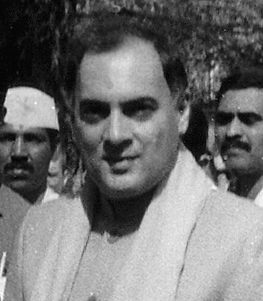
Rajiv Gandhi
 India
Indiapolitician•amateur radio operator
Birthday
+1944-08-20
Birth Sign
Leo
Birthplace
Mumbai
Age
Died at 46
About
Born in Mumbai on August 20, 1944, Rajiv Gandhi began his adult life far from the political arena. He trained as an aircraft pilot and flew for Indian Airlines. For much of the 1970s, while his mother Indira Gandhi served as Prime Minister, Rajiv remained focused on his family life with his wife Sonia and their children, Rahul and Priyanka. He was not initially drawn to politics, even after his younger brother Sanjay's tragic death in a plane crash in 1980. However, the political landscape shifted dramatically. Following his mother's assassination on October 31, 1984, Rajiv Gandhi was thrust into the role of Prime Minister. At just 40 years old, he became the youngest leader to hold the office. His tenure, which lasted until 1989, saw significant, though sometimes controversial, policy decisions. These included interventions in foreign affairs, such as the peacekeeping mission to Sri Lanka, and navigating the aftermath of domestic crises like the Bhopal disaster. His political party achieved a significant parliamentary majority in the elections following his mother's death, but his government was later defeated in 1989. After his term as Prime Minister, Gandhi continued to serve as Leader of the Opposition in the Lok Sabha until late 1990. His political career was tragically ended on May 21, 1991, when he was assassinated by a suicide bomber during an election campaign. Six months prior to his own death, he had resigned from his parliamentary position. Posthumously, he was awarded the Bharat Ratna, India's highest civilian honor, in 1991, recognizing his contributions to the nation.
Fame & Fandom
Global attention to Rajiv Gandhi remains anchored in his historical tenure as India's youngest prime minister and his tragic assassination, creating a legacy that persists across decades of political discourse. The iFANN Global Fame Rankings currently place him at specific points within global fame metrics, reflecting this enduring historical footprint. He is ranked the 57th most famous person from India, a position holding steady from the previous cycle. This standing reflects a broad, albeit static, level of recognition tied to his role as a national leader rather than fluctuating celebrity trends. Unlike modern entertainers whose fanbases are defined by informal names or organized digital campaigns, the audience surrounding Rajiv Gandhi consists of political supporters, party members, and the Indian electorate who view him through the lens of his state service. There is no formal or informal fandom name for his supporters; they do not identify as a collective noun like "Rajivites" nor engage in fan-funded chart pushes or birthday rituals. Instead, reverence for him manifests through institutionalized actions such as the operation of the "Rajiv Gandhi Bhawan" in Chandigarh and government initiatives bearing his name, such as the upgrade of schools to "Rajiv Gandhi Model Day-Boarding Schools." These are tributes from the state and the party rather than organic fan creations, indicating a relationship defined by political allegiance and martyrdom rather than pop-culture adoration.
Interesting Facts and Legends
Rajiv Gandhi was born on August 20, 1944, in Mumbai and initially pursued a career as an aircraft pilot for Indian Airlines before entering politics. Following the assassination of his mother, Indira Gandhi, on October 31, 1984, he assumed the office of Prime Minister at the age of 40, becoming the youngest elected head of government in the world at that time. His tenure concluded abruptly when he was assassinated by a suicide bomber on May 21, 1991, while campaigning in Sriperumbudur, Tamil Nadu. A widely retold narrative regarding his leadership focuses on his identity as a technocrat who launched major initiatives to modernize India's telecommunications and IT sectors, earning him posthumous references as a visionary for technology adoption. Political retrospectives often cite his 1986 declaration of a "twin war on terrorism," which emphasized tackling threats through political means and police action. While there are no stories of fans fainting or viral moments typical of celebrities, his life story is marked by the somber reactions to his own death and that of his mother, cementing his status as a martyr within the Congress party narrative. Recent commemorations continue to reference his vision for a skilled India, ensuring his political mythology remains active in contemporary discourse.
Death & Aftermath
Died
+1991-05-21 (aged 46)
Death Place
Sriperumbudur, Tamil Nadu, India
Cause of Death
Suicide bombing with RDX explosives
The assassination of Rajiv Gandhi triggered an unprecedented wave of national grief across India, prompting the immediate suspension of the election process and a moment of silence observed in Parliament. Leaders from across the political spectrum paid tribute, and massive crowds gathered at the site of the attack in Sriperumbudur and outside the family residence to mourn the former Prime Minister. The event cemented his legacy as a martyr and led to a significant shift in security protocols for all high-profile politicians in the country. On May 21, 1991, while campaigning for the Indian National Congress in Sriperumbudur, Tamil Nadu, Gandhi was killed by a suicide bomber named Dhanu who detonated a concealed belt containing approximately 5 kilograms of RDX explosives.
He suffered severe head and chest injuries during the blast and was rushed to the Government General Hospital in Madras, where he was declared dead shortly after arrival. The Tamil Nadu Police ruled the incident an assassination linked to the Liberation Tigers of Tamil Eelam, leading to a special court trial that convicted several conspirators, including Nalini and Perarivalan, whose sentences were later commuted to life imprisonment following legal proceedings over subsequent decades. A state funeral was held on May 24, 1991, in New Delhi, attended by thousands of mourners including the President and the Prime Minister.
Gandhi was cremated at Shakti Sthal, a memorial site adjacent to the Samadhi of his mother, Indira Gandhi. Posthumously, he was awarded the Bharat Ratna, India's highest civilian honor, and institutions such as the Rajiv Gandhi Foundation and the Rajiv Gandhi Institute of Petroleum Technology were established to preserve his memory.
Awards & Accolades
Keywords
Quick Facts
- Profession
- politician, amateur radio operator
- Born
- +1944-08-20
- Birthplace
- Mumbai
- Died
- +1991-05-21
- Death Place
- Sriperumbudur
- Gender
- Male
- Spouse
- Sonia Gandhi
- Birth Sign
- Leo
Personal Details
- Spouse
- Sonia Gandhi
Join the community
fans discussing