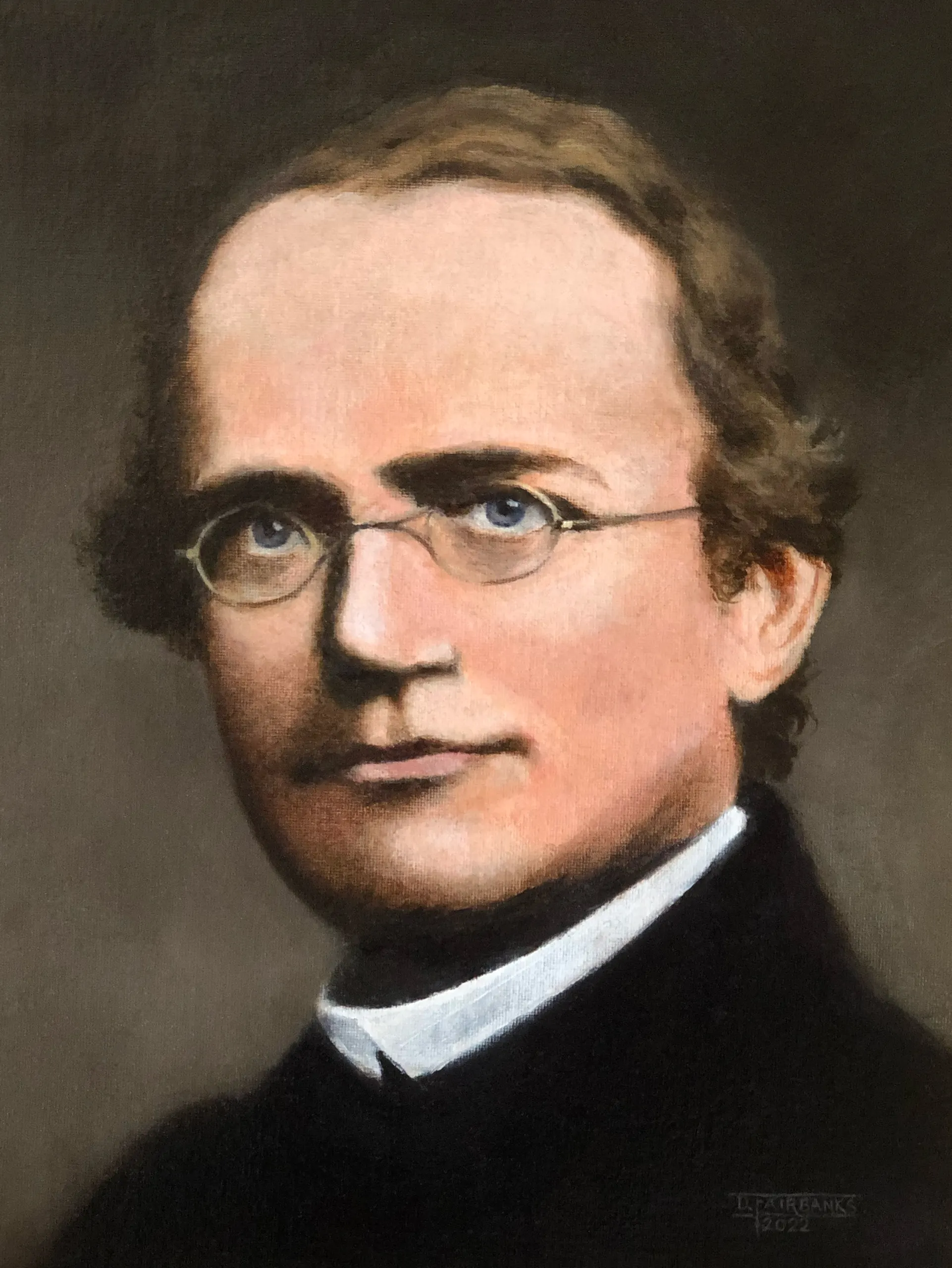
Gregor Mendel
 Czechia
biologist•geneticist•beekeeper
Also known as: Řehoř Jan Mendel, Gregor Johann Mendel
Birthday
July 20, 1822
Birth Sign
Cancer
Birthplace
Hynčice bei Odrau, Margraviate of Moravia, Austrian Empire (now Czech Republic)
Age
Died at 61
About
Gregor Johann Mendel was an Austrian biologist, mathematician, and Augustinian friar who became known as the father of modern genetics. Born in 1822 in a German-speaking family in the Margraviate of Moravia, he entered the Abbey of St. Thomas in Brno in 1843. While serving as a priest and later as the abbot of the monastery, he conducted groundbreaking experiments on inheritance using pea plants. His work established the fundamental laws of heredity that govern how traits pass from parents to offspring.
Mendel spent eight years between 1856 and 1863 cultivating over 28,000 pea plants in the monastery garden. By tracking seven distinct traits like seed shape and flower color, he discovered that inheritance follows specific mathematical ratios rather than blending together. He formulated the Laws of Segregation and Independent Assortment, introducing terms like dominant and recessive to describe these patterns. Although he published his findings in 1866, the scientific community largely ignored them for decades.
His insights remained dormant until 1900 when three researchers independently rediscovered his papers. This verification launched the field of genetics and cemented Mendel's place in history. Even today, his work forms the foundation of biological science. Scientists finally identified the specific genes corresponding to his seven traits as recently as 2025, proving his accuracy long before DNA was understood.
Early Life & Background
Gregor Johann Mendel was born on July 20, 1822, in Heinzendorf bei Odrau, a small village in the Margraviate of Moravia. He was the eldest son of Anton and Rosine Mendel, a German-speaking farming family of modest means. From a young age, Gregor helped his parents work their small farm, an experience that gave him a deep familiarity with plant cultivation and breeding. This early exposure to agriculture laid the groundwork for his future scientific inquiries.
In 1833, at age eleven, he enrolled in elementary school in Heinzendorf. He moved on to secondary education in Opava from 1840 to 1843, where he excelled in mathematics and physics. Despite his academic success, he faced significant financial hardship during this period. He often relied on support from his sister to complete his studies. These struggles likely influenced his decision to seek a more stable career path.
Facing economic uncertainty and seeking a secure profession, Mendel entered the Augustinian Abbey of St. Thomas in Brno in 1843. He took the name Gregor upon joining the order. While studying philosophy and theology, he also pursued natural sciences under the mentorship of Friedrich Franz, a physicist who encouraged his interest in experimentation. In 1851, he was sent to the University of Vienna to study mathematics, physics, and natural history. There, he studied under Christian Doppler and Franz Unger, further developing the statistical methods that would later revolutionize biology. Upon returning to Brno in 1854, he was ordained as a priest and began teaching at the abbey school.
Career Growth
Mendel's career is defined almost entirely by his pioneering work on inheritance conducted between 1856 and 1863 in the monastery garden. Focusing on the common pea plant Pisum sativum, he meticulously tracked seven distinct traits: seed shape, seed color, flower color, pod shape, pod color, flower position, and stem length. Over eight years, he cultivated and cross-bred over 28,000 pea plants. His pivotal breakthrough occurred when he observed that traits did not blend but were inherited as discrete units.
For instance, crossing true-breeding yellow peas with green ones yielded only yellow offspring in the first generation, but the green trait reappeared in the second generation in a precise ratio of approximately 3:1. This led him to formulate the Laws of Segregation and Independent Assortment, coining terms like dominant and recessive to describe these factors. He published his findings, Experiments on Plant Hybridization, in 1866 in the proceedings of the Natural History Society of Brno.
Mendel's career took a significant administrative turn after 1868 when he became the Abbot of St. Thomas' Abbey. As abbot, he focused on the administration of the monastery, meteorology, and beekeeping, publishing works on weather patterns and improving honeybee strains. His scientific experiments ceased during this period due to the demands of his office. He died on January 6, 1884, in Brno at the age of 61. The cause of death was chronic kidney disease, which had caused him severe pain and swelling in his final months.
Career Timeline
Public Image & Style
Mendel is portrayed as a humble, meticulous, and devout man who bridged the gap between faith and science. He is often depicted wearing his Augustinian habit, symbolizing the intersection of monastic discipline and rigorous scientific inquiry. Media portrays him as the archetype of the quiet genius who worked in solitude yet changed the world. His reputation rests on his patience and attention to detail, qualities that allowed him to uncover hidden patterns in nature.
Fame & Fandom (iFAMOUS Rankings)
iFANN has not yet collected fame data for this person. He does not appear on the September 2026 iFAMOUS Rankings flagship list. While there is no organized fanbase in the pop-culture sense, Mendel is revered by students of biology, geneticists, and historians of science. Fan-like campaigns include the annual Mendel Medal award ceremonies and student-led initiatives to promote genetics education in his name. The scientific community treats his work with the same reverence that fans show to cultural icons.
Interesting Facts and Legends
Before dedicating himself to genetics, Mendel was a prolific meteorologist. He kept detailed weather records for 25 years and published several papers on climate patterns in Moravia. He was also an expert beekeeper who experimented with hybridizing different bee species to improve honey production. His book on beekeeping remains a notable contribution to apiculture.
Although born in a German-speaking family, Mendel wrote his seminal paper in German despite living in a region with a growing Czech national movement. This choice sometimes complicated the reception of his work among local Czech scientists. Another fascinating detail is that it was not until 2025 that scientists fully identified the specific genes corresponding to all seven traits Mendel studied. This confirmed his accuracy even though he could not see the DNA.
The most iconic moment in his story is his eight-year experiment in the monastery garden. The story of him counting thousands of peas to find the 3:1 ratio is a foundational legend in biology. It represents the birth of quantitative genetics and the shift toward mathematical rigor in biological research.
Notable Quotes
“The present is the father of the future.”
“I have always believed that the truth is hidden in the details.”
“The laws of nature are simple, but their application requires patience.”
Family & Personal Life
Gregor Mendel was the eldest son of Anton and Rosine Mendel. His family lived in a German-speaking household in the village of Heinzendorf bei Odrau. He had a sister who supported him financially during his schooling years. As an Augustinian friar, Mendel took vows of celibacy and dedicated his life to his religious order. He never married or had children. His entire personal life revolved around the monastery community and his scientific pursuits. He is historically documented as having no romantic relationships.
Notable Connections
Relationships & Dating History
Gregor Mendel was an Augustinian friar who took vows of celibacy. Consequently, he had no romantic relationships, marriages, or children. His entire life was dedicated to his religious order and his scientific pursuits. He is historically documented as having no partner, and any speculation regarding a dating history is factually incorrect given his status as a monk.
Death & Aftermath
Died
January 6, 1884 (aged 61)
Death Place
Brno, Austrian Empire (now Czech Republic)
Cause of Death
Chronic kidney disease (renal failure)
Gregor Mendel died on January 6, 1884, in Brno at the Abbey of St. Thomas where he served as abbot. He was 61 years old and had suffered from chronic kidney disease that progressed to renal failure. The condition caused severe pain and swelling in his final months, confining him to his quarters while he continued managing monastery affairs until his health failed completely. His death occurred without public fanfare because his scientific work remained obscure to the broader community.
The immediate reaction to his passing was quiet and localized. Tributes came primarily from fellow monks and local clergy who attended his private funeral at the Abbey Church of St. Thomas. Peers like Carl Nägeli acknowledged his contributions privately, but the wider scientific world did not yet grasp the magnitude of his discoveries. Public acclaim would not arrive until after 1900 when Hugo de Vries, Carl Correns, and Erich von Tschermak independently rediscovered his papers.
Following the service, Mendel was buried within the abbey grounds. His estate was managed by the Augustinian order according to monastic rules. Posthumously, his legacy grew into something monumental. In 1900, the rediscovery of his work sparked the modern era of genetics. Institutions worldwide have honored him since then, including the annual Mendel Medal awarded by Villanova University and the establishment of the Mendel Museum in Brno. Recent scientific developments continue to validate his findings, with the molecular identity of all seven pea genes confirmed as recently as 2025.
Net Worth (Estate Value)
$0
iFANN Editorial Team estimate
As a deceased historical figure who lived in the 19th century and was a monk, Gregor Mendel did not accumulate personal wealth in the modern sense. He owned no real estate, business ventures, or investments outside of the abbey's holdings, which belonged to the order. Therefore, there is no net worth to report in 2026. His estate value is non-existent in financial terms, though his intellectual property generates immense value for the global scientific community, pharmaceutical industry, and agricultural sector.
Awards Won (1)
Mendel received no major awards during his lifetime as his work was unrecognized until after his death. Posthumously, he has been honored extensively including the Mendel Medal awarded annually by Villanova University since 1979. He is universally enshrined in the halls of scientific history and named in numerous institutions including the Mendel University in Brno.
1979 · Genetics
Posthumous Recognition
Known For
Experiments on Plant Hybridization
1866 · Author
Keywords
Sources
Quick Facts
- Profession
- biologist, geneticist, beekeeper
- Born
- July 20, 1822
- Birthplace
- Hynčice
- Died
- January 6, 1884
- Death Place
- Brno
- Gender
- Male
- Birth Sign
- Cancer
Personal Details
- Full Name
- Gregor Johann Mendel
- Children
- Education
- Augustinian Abbey of St. Thomas, University of Vienna
Frequently Asked Questions
What is Gregor Mendel famous for?
How many children did Gregor Mendel have?
When did Gregor Mendel die?
Why was Mendel's work ignored for so long?
What is the Mendel Museum?
Social Media
Similar People

Join the community
fans discussing