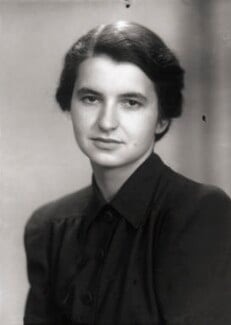
Rosalind Franklin
 United Kingdom
chemist•molecular biologist•physicist
Birthday
July 25, 1920
Birth Sign
Leo
Birthplace
Notting Hill, London, England
Age
Died at 37
Height
5 ft 6 in (168 cm)
About
Rosalind Elsie Franklin was an English chemist and X-ray crystallographer. Her X-ray diffraction images of DNA, especially Photo 51, were essential to the discovery of the double helix structure. She also made seminal contributions to the understanding of coal, graphite, and viruses. Though her work was used without her consent by Watson and Crick, she remains a towering figure in molecular biology, celebrated posthumously as a symbol of scientific integrity and the overlooked contributions of women in science.
Early Life & Background
Franklin was born on July 25, 1920, in Notting Hill, London, into an affluent Anglo-Jewish family. Her father, Ellis Arthur Franklin, was a merchant banker, and her mother, Muriel Frances Waley, was a homemaker. She attended St. Paul's Girls' School, where she excelled in science, Latin, and sports. At 15, she decided to become a scientist and passed the entrance exam for Cambridge University in 1938. She studied the Natural Sciences Tripos at Newnham College, graduating in 1941.
During World War II, instead of pursuing a PhD immediately, she worked for the British Coal Utilisation Research Association from 1942. Her research on the porosity of coal and the density of carbon was highly practical and earned her a PhD in physical chemistry from Cambridge in 1945. A pivotal moment came in 1947 when she moved to Paris to work at the Laboratoire Central des Services Chimiques de l'État under crystallographer Jacques Mering. There, she mastered X-ray crystallography, learning to work with high-resolution, fine-focus X-ray tubes, a skill few scientists possessed.
Career Growth
In 1951, Franklin joined King's College London as a research associate in the MRC Biophysics Unit, tasked with studying DNA structure. She and her graduate student Raymond Gosling produced increasingly sharp X-ray diffraction images of DNA. In May 1952, she captured Photo 51, a high-resolution image of the B form of DNA that clearly showed a helical cross pattern. Due to conflicts with colleague Maurice Wilkins and director John Randall, she transferred to Birkbeck College in 1953.
Without her knowledge or consent, Wilkins showed Photo 51 to James Watson. Watson and Francis Crick used this data to build their correct double-helix model, published in April 1953. Franklin's own data on DNA was published in the same issue of Nature as a supporting article. At Birkbeck, under J.D. Bernal, she led a pioneering group studying the tobacco mosaic virus and other plant viruses. She discovered that TMV's RNA was a single strand embedded within a hollow protein helix, a landmark finding in structural virology.
Career Timeline
Public Image & Style
Franklin is often portrayed as a tragic, brilliant, and underappreciated genius. She is a feminist icon and a symbol of scientific integrity. Her direct, sometimes confrontational manner alienated some male colleagues. Media portrayals emphasize the wronged heroine narrative. She has no official fandom name but is celebrated by science enthusiasts and feminists. Her online presence is educational and reverent, often correcting historical injustice.
Fame & Fandom (iFAMOUS Rankings)
Rosalind Franklin currently holds no placement in the iFANN Global Top 1,000 or any scope-specific ranking list. The iFANN Global Fame Engine evaluated her standing in August 2026 and determined she remains unranked among the world's most famous figures. She is a towering historical figure rather than a contemporary celebrity. Her admirers do not organize under a single moniker like a pop star fanbase; there is no formal name for those who revere her legacy. Instead, her audience consists of scientists, historians, and advocates for gender equity in STEM who view her as a symbol of integrity. Institutional recognition drives her modern presence more than grassroots fandom. Major entities like Rosalind Franklin University of Medicine and Science continue to award grants and incubate research in her name. The ExoMars Rosalind Franklin rover represents a massive global collaboration honoring her work, with engineering milestones reached in 2026 serving as contemporary tributes. These projects are scientific missions rather than fan campaigns. No birthday billboards or subway ads funded by fans exist because she passed away in 1958 before such rituals could form. Her story is retold through academic publications and educational efforts correcting historical narratives. While she lacks the viral moments of entertainers, her influence permeates molecular biology and space exploration. The community surrounding her focuses on preserving her contributions to DNA structure and coal chemistry. This dedication manifests in annual awards and the ongoing preparation of planetary rovers bearing her name.
Interesting Facts and Legends
Franklin was a passionate mountaineer and hiker who trekked extensively in the Alps and Norway. A skilled photographer, she took many of her own X-ray diffraction images herself. Her work on coal during World War II was critical to improving gas masks. The term Photo 51 was simply the 51st photograph in a series; she did not name it. She spoke fluent French and German and was a lifelong agnostic despite her family's Jewish background. A central legend surrounds the 'raw deal' she received regarding the double helix. The widely retold story claims that James Watson and Francis Crick viewed her X-ray image without permission, allowing them to finalize their model while she was denied credit for the crucial evidence. Verified facts confirm she died at age 37 from ovarian cancer, likely caused by radiation exposure during her crystallography work. In modern times, the naming of the ExoMars Rosalind Franklin rover has become an iconic moment for her legacy. Scheduled to launch in 2028, this mission marks the first major planetary probe dedicated to searching for signs of life under the Martian surface.
Notable Quotes
“Science and everyday life cannot and should not be separated.”
“I have no doubt that the facts of the structure of DNA are going to be known very soon.”
“I was told that my data was being used by Watson and Crick without my knowledge. I was furious.”
“There is no such thing as a 'female scientist.' You are a scientist, or you are not.”
Family & Personal Life
Franklin was the second of five children of Ellis Arthur Franklin, a merchant banker, and Muriel Frances Waley. Her family was deeply involved in charitable work. She never married and had no children. Her estate is managed by the Franklin Family Trust, which supports scientific and educational charities.
Notable Connections
Maurice Wilkins was a colleague at King's College who showed her Photo 51 to Watson. James Watson and Francis Crick used her data without permission to discover the DNA double helix. Raymond Gosling was her PhD student who took Photo 51 under her direction. John Desmond Bernal was her supportive boss at Birkbeck. Aaron Klug continued her virus work and won a Nobel Prize. Jacques Mering was her mentor in Paris who taught her X-ray crystallography.
Relationships & Dating History
Franklin never married and had no publicly known romantic relationships. Her personal life was intensely dedicated to her research. Biographers and letters indicate close friendships with colleagues but no evidence of romantic partnerships. She was known to be private and reserved.
Death & Aftermath
Died
April 16, 1958 (aged 37)
Death Place
London, England
Cause of Death
Ovarian cancer
The official medical certification recorded Rosalind Franklin's death as ovarian cancer, a diagnosis she had received in 1956. She passed away on April 16, 1958, at the age of 37 in London, England, while managing her illness alongside an active research schedule during her final two years. While historical accounts have occasionally speculated about radiation exposure from her X-ray crystallography work contributing to her condition, this remains a disputed and largely unconfirmed theory; medical consensus attributes her passing to the progression of the cancer itself. Her funeral was a private affair held shortly after her death in April 1958.
She was cremated, and her ashes were interred at Golders Green Crematorium in London. Initial tributes from peers within the scientific community recognized her expertise in X-ray crystallography and biophysics, though widespread public acclaim and the modern narrative of her as a marginalized pioneer emerged decades later. The primary controversy surrounding her legacy relates not to her death, but to the unauthorized use of her Photo 51 by Maurice Wilkins and James Watson prior to her passing. This issue resulted in significant academic criticism and later recognition of her contribution rather than any posthumous litigation regarding her estate or cause of death.
Posthumously, Franklin has received extensive honors, including induction into the National Women's Hall of Fame and the naming of the Rosalind Franklin University of Medicine and Science in North Chicago. A Mars rover named Rosalind Franklin is scheduled for launch in 2028 as part of the European Space Agency's ExoMars mission, and her estate was handled privately by her family without public details on its administration.
Net Worth (Estate Value)
$100,000
iFANN Editorial Team estimate
Franklin died in 1958 with a modest estate valued at less than £10,000. She came from a wealthy family and lived frugally. Her estate, managed by the Franklin Family Trust, supports scientific and educational charities. Posthumous income from book royalties, documentary licensing, and image rights is minimal and donated. Per iFANN's editorial analysis, the estate's net worth as of 2026 is estimated at $100,000, consisting of residual royalties and image rights.
Awards & Accolades
View 16 records, honours and achievementsKnown For
Photo 51
1952 · X-ray crystallographer
Discovery of DNA double helix structure
1953 · Contributor (data used without consent)
Tobacco mosaic virus structure
1955 · Lead researcher
Keywords
Quick Facts
- Profession
- chemist, molecular biologist, physicist
- Born
- +1920-07-25
- Birthplace
- Notting Hill, London, England
- Died
- +1958-04-16
- Death Place
- Chelsea, London, England
- Gender
- Female
- Birth Sign
- Leo
Personal Details
- Full Name
- Rosalind Elsie Franklin
- Height
- 5 ft 6 in (168 cm)
- Education
- Newnham College, Cambridge (BA, 1941); University of Cambridge (PhD, 1945)
Frequently Asked Questions
Why didn't Rosalind Franklin win a Nobel Prize?
Did Watson and Crick steal Rosalind Franklin's data?
Did Rosalind Franklin have kids?
What is Rosalind Franklin's most famous discovery?
Is Rosalind Franklin a feminist icon?
Similar People
Join the community
fans discussing