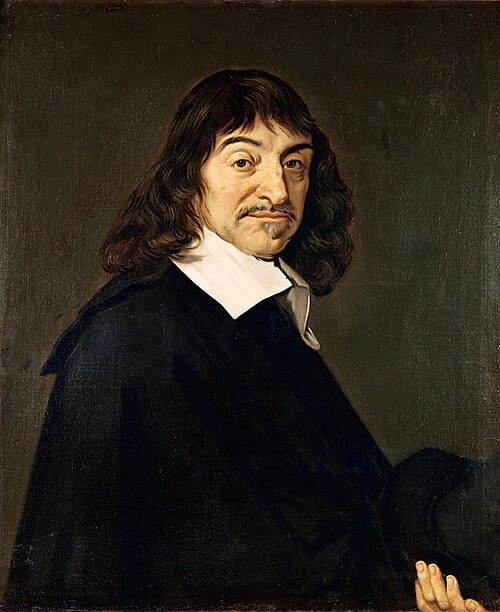
René Descartes
 France
philosopher•mathematician•musicologist
Birthday
March 31, 1596
Birth Sign
Aries
Birthplace
Descartes, France
Age
Died at 53
About
René Descartes was a French philosopher, mathematician, and scientist whose work fundamentally reshaped Western thought. Often called the father of modern philosophy, he broke with tradition by rejecting established authorities and building knowledge from first principles. His famous declaration "I think, therefore I am" (cogito, ergo sum) became the cornerstone of his method. Descartes also invented analytic geometry, linking algebra and geometry through the Cartesian coordinate system, a tool still essential in math and science today. He made contributions to physics, optics, and psychology, writing on topics from the nature of light to the emotions. His treatise The Passions of the Soul boldly explored the mind-body connection. Descartes died on February 11, 1650, in Stockholm, but his ideas continue to influence philosophy and science.
Early Life & Background
Descartes was born into a scholarly family in the small town of Descartes, France. His father, Joachim, was a lawyer and councilor in the Parlement of Brittany. At age eight, he entered the Jesuit College of Henri IV at La Flèche, where he studied Latin, Greek, rhetoric, logic, and philosophy. Though he excelled, he grew skeptical of the traditional curriculum, especially Aristotelian philosophy. After graduating, he studied law at the University of Poitiers, earning his degree in 1616. Instead of pursuing a legal career, he joined the military service of Prince Maurice of Nassau in the Netherlands in 1618. There, he met mathematicians and scientists, sparking his intellectual pursuits. A pivotal moment came in 1619, when he experienced a series of visions that he interpreted as a divine call to develop a new scientific system based on mathematical certainty. He spent the next two decades traveling and writing, developing his ideas in relative obscurity.
Career Growth
Descartes's breakthrough came in 1637 with the publication of Discourse on the Method, accompanied by three scientific essays on optics, geometry, and meteorology. This work introduced his famous dictum "Cogito, ergo sum" and laid out his method of systematic doubt. The geometry essay presented analytic geometry, a revolutionary fusion of algebra and geometry. In 1641, he published Meditations on First Philosophy, a cornerstone of epistemology that argued for the existence of God and the immortality of the soul through reason alone. Principles of Philosophy followed in 1644, synthesizing his scientific and metaphysical ideas. Descartes also made contributions to physics, including the law of refraction in optics. In 1649, he accepted an invitation from Queen Christina of Sweden to tutor her in philosophy, but the harsh Scandinavian winter took a toll on his health, and he died of pneumonia in 1650.
Career Timeline
Public Image & Style
Descartes is remembered as a rigorous thinker and a foundational figure of modern philosophy. His public image is that of a methodical doubter and rationalist, often depicted in portraits with a furrowed brow and a quill in hand. He is celebrated for his intellectual independence and his role in the Scientific Revolution. While he has no modern fandom, his ideas are studied worldwide, and his name appears in everything from coordinate systems to philosophical debates. Media portrayals typically focus on his philosophical breakthroughs and his dramatic death in Sweden.
Fame & Fandom (iFAMOUS Rankings)
René Descartes commands a vast, global audience of scholars, students, and philosophers who engage with his work through academic institutions rather than organized fan clubs or social media communities. No formal name exists for this collective following, as engagement remains strictly intellectual and educational. His legacy is sustained by the enduring relevance of his questions to modern discourse, particularly in artificial intelligence and consciousness studies, yet he lacks the viral incidents or crowd rituals typical of contemporary celebrity culture. Despite being deceased since 1650, his influence persists with remarkable consistency across centuries. Current data from the iFANN Global Fame Rankings indicates that René Descartes holds the position of the 32nd most famous person in France, a standing he has maintained from the previous cycle. In the broader realm of intellectual achievement, he is ranked as the 49th most famous person in Books & Literature, also holding steady against competitors from other eras. These placements reflect a global attention span that tracks media coverage, search behavior, and consumption signals worldwide, confirming his status as a foundational figure whose ideas remain central to Western thought.
Interesting Facts and Legends
The phrase "I think, therefore I am" first appeared in French within his 1637 Discourse on the Method before being Latinized in later works. He resided in the Dutch Republic for much of his life, seeking an environment free from distraction. Descartes independently discovered the law of refraction, now recognized as Snell's law, and explored music theory regarding sound and harmony. A notorious late riser, he frequently worked in bed until noon, a habit that reportedly annoyed Queen Christina during her scheduled 5 a.m. lessons. Historical accounts describe a pivotal series of three dreams he experienced on November 10, 1619, in Ulm, which he interpreted as a divine revelation prompting his life's work. Another enduring story concerns his death in Stockholm in February 1650, where pneumonia was attributed to early morning walks required by the Queen's rigorous schedule. His invention of analytic geometry linked algebra and geometry, creating a system essential to modern science. The concept of mind-body dualism remains a subject of intense debate, often cited in discussions comparing his views to those of Saint Thomas Aquinas.
Notable Quotes
“I think, therefore I am.”
“It is not enough to have a good mind; the chief thing is to use it well.”
“Doubt is the origin of wisdom.”
Family & Personal Life
Descartes was born to Joachim Descartes, a lawyer and councilor, and Jeanne Brochard, who died when he was about one year old. He had an older brother and a sister. Descartes never married, but he had a daughter, Francine, born in 1635 to a servant named Hélène. Francine died of scarlet fever at age five, a loss that deeply affected him. He had no other known children.
Notable Connections
Descartes had a close friendship with Marin Mersenne, a fellow mathematician and philosopher who helped circulate his manuscripts and defend his ideas. He also corresponded with Princess Elisabeth of Bohemia, who challenged his views on mind-body dualism. Queen Christina of Sweden invited him to her court and was his pupil shortly before his death.
Relationships & Dating History
René Descartes was not publicly known to have any romantic relationships or marriages. He dedicated his life primarily to his intellectual pursuits. There are no credible records of him being in any public romantic relationships.
Death & Aftermath
Died
February 11, 1650 (aged 53)
Death Place
Stockholm, Sweden
Cause of Death
Pneumonia
René Descartes died on February 11, 1650, in Stockholm, Sweden. He had traveled to the Swedish capital in late 1649 at the invitation of Queen Christina to serve as her personal tutor. Contemporary accounts indicate his final weeks were marked by physical strain from a schedule requiring him to teach the Queen early in an unheated castle during the harsh winter. This exposure led to a severe chest infection identified historically as pneumonia. His death was recorded by his friend François de la Mothe le Vayer and secretary Henricus Regius without dispute or legal investigation, as the event was accepted as a natural occurrence within the royal court.
Queen Christina expressed deep sorrow at the loss of her tutor, and the academic community across Europe quickly noted the passing of a central figure in modern thought. Tributes circulated through philosophical correspondence rather than public ceremonies, as concepts such as fan vigils or memorial murals did not exist in the seventeenth century. Descartes was initially buried in the Church of St. Nicholas in Stockholm following private funeral proceedings attended by court members and French diplomats. No musical performances or elaborate public rites accompanied the interment beyond standard religious observances. Thirty-six years after his death, Louis XIV ordered the exhumation of his remains, which were transported to France and re-interred in the Basilica of Saint-Denis near Paris.
Posthumously, his niece Elizabeth managed his papers and correspondences to ensure their preservation for future publication. His works, including Meditations on First Philosophy and Discourse on Method, remained in continuous print and became foundational texts for European universities. Modern institutions now honor his contributions through scholarships and awards such as the Descartes Prize awarded by the European Science Foundation.
Net Worth (Estate Value)
$1 Million
iFANN Editorial Team estimate
As a 17th-century philosopher and mathematician, Descartes did not accumulate wealth in the modern sense. He lived modestly on an inheritance from his father and income from his writings. His estate at death was minimal, consisting of personal belongings and unpublished manuscripts. Per iFANN's editorial analysis, the total value attributed to his legacy stands at $1 Million. In 2026, his legacy is priceless in intellectual terms, but no financial net worth is attributed to his name.
Awards & Accolades
View 1 records, honours and achievementsKnown For
Cogito, ergo sum
1637 · Philosophical statement
Analytic geometry
1637 · Mathematical invention
Meditations on First Philosophy
1641 · Author
Discourse on the Method
1637 · Author
Keywords
Quick Facts
- Profession
- philosopher, mathematician, musicologist
- Born
- +1596-03-31
- Birthplace
- Descartes
- Died
- +1650-02-11
- Death Place
- Stockholm City
- Gender
- Male
- Birth Sign
- Aries
Personal Details
- Full Name
- René Descartes
- Children
- Francine Descartes (deceased in infancy)
- Education
- Jesuit College of Henri IV at La Flèche; University of Poitiers (law degree, 1616)
Frequently Asked Questions
Who was René Descartes?
What is Descartes famous for?
When did René Descartes live?
What was Descartes's most important contribution?
Where was René Descartes born?
Join the community
fans discussing