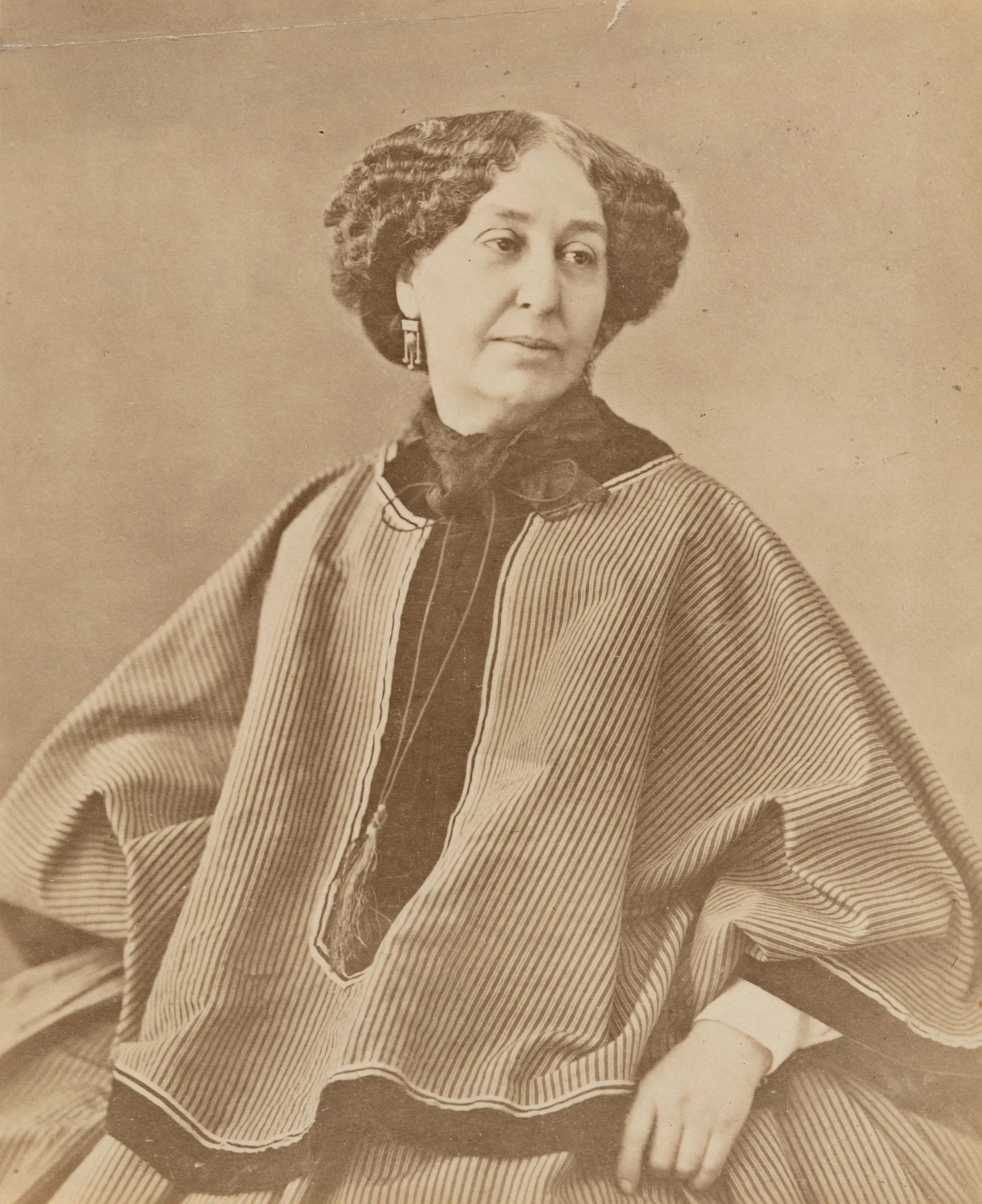
George Sand
 France
Also known as: Amantine Lucile Aurore Dupin, Amandine Lucile Aurore Dupin, Baroness Dudevant, Jules Sand, Lucie Dudevant, Aurore Amantine Lucile Dupin, Aurore Amantine Lucile Sand, Amandine-Aurore-Lucile Dudevant
Birthday
July 1, 1804
Birth Sign
Cancer
Birthplace
Paris, France
Age
Died at 71
About
Amantine Lucile Aurore Dupin de Francueil, known to the world as George Sand, was a French novelist, memoirist, and journalist born in Paris on July 1, 1804. She became one of the most prominent literary figures of the European Romantic era, and in Britain during the 1830s and 1840s, she was even more celebrated than Victor Hugo or Honoré de Balzac. Sand produced an astonishing body of work: over 70 novels, plus more than 50 volumes of tales, plays, and political writings. Her life was as unconventional as her fiction. She adopted a male pen name, wore men's clothing, and engaged in highly publicized love affairs, all of which scandalized conservative society. Yet she used her platform to advocate for women's rights and passion, criticize the institution of marriage, and challenge the prejudices of her time.
Sand's influence extended far beyond her own books. She hosted a vibrant salon at her estate in Nohant where artists like Frédéric Chopin and Eugène Delacroix gathered to discuss art, politics, and philosophy. Her correspondence with Gustave Flaubert remains a landmark of French literary history. She died on June 8, 1876, at the age of 71, leaving behind a legacy that continues to inspire readers and writers alike.
Early Life & Background
Amantine Lucile Aurore Dupin was born into a family divided by class and circumstance. Her father, Maurice Dupin, was a soldier of aristocratic Royal descent, while her mother, Sophie-Victoire Delaborde, came from a modest, bohemian Parisian background. This mismatched marriage shaped Aurore's early identity. When she was four years old, her father died in 1808, and she was sent to live at Nohant, the family estate in central France, under the care of her grandmother, Marie-Aurore de Saxe. The Marshal de Saxe's illegitimate daughter was a woman of considerable intellectual independence, and her rural estate provided a semi-feral, bookish childhood that would become the emotional foundation of Sand's future work.
Aurore received her education first at Nohant and later at the Couvent des Anglaises in Paris between 1818 and 1820. During her time at the convent, she experienced a period of intense religious fervor before swinging back toward independence. After her grandmother died in 1821, the 17-year-old found herself largely on her own. Following lengthy legal wrangling with her mother, she secured possession of the Nohant estate. In 1822, she married Casimir Dudevant, a minor army officer and the illegitimate son of a baron. The marriage deteriorated quickly due to his infidelities and her desire for independence. By 1831, she had entered a separation arrangement and left for Paris with her lover Jules Sandeau to pursue a literary life, setting the stage for the birth of her famous pseudonym.
Career Growth
The breakthrough moment for Amantine Dupin arrived in 1831 when she began collaborating with Jules Sandeau. Together they published Rose et Blanche under the joint pseudonym "Jules Sand." From this collaboration, she adopted the surname "Sand" for her solo work. In 1832, she released Indiana, her first novel under the name George Sand. It was a critical and popular sensation that attacked the institution of marriage and established her voice as a powerful critic of social constraints. She followed this success immediately with Valentine later that same year.
Throughout the 1830s and 1840s, Sand became a dominant force in literature. In Britain, she was often considered more celebrated than Victor Hugo or Honoré de Balzac, and in France, she outsold Hugo during certain periods. Her output was relentless, covering everything from philosophical novels like Lélia to political essays and plays. The 1840s brought a shift toward the "rustic novels," including La Mare au Diable (1846), François le Champi (1848), and La Petite Fadette (1849). These works, which drew heavily on her childhood memories of Nohant, are still remembered today as masterpieces of rural realism. She remained active until her death, publishing her memoirs Histoire de ma vie between 1854 and 1855 and maintaining a famous correspondence with Gustave Flaubert.
Career Timeline
Public Image & Style
George Sand cultivated a public persona that shocked conservative 19th-century society. She was known for her distinctive style, which included wearing men's clothing, smoking cigars, and carrying a pistol. This image was not merely theatrical; it was a practical tool that allowed her to move freely through Parisian society and attend events where women were excluded. Her writing reflected this rebellious spirit, tackling taboo subjects like female desire and the injustices of marriage. Critics and contemporaries viewed her as a dangerous radical, yet she was also respected for her immense talent and intellectual depth. Her salon at Nohant became a gathering place for the era's most brilliant minds, cementing her status as a central figure in French cultural life.
Fame & Fandom (iFAMOUS Rankings)
George Sand commands a legacy that defies the modern machinery of fandom, existing instead as a monumental figure in literary history whose audience has always been defined by academic reverence and cultural commemoration rather than organized campaigns or viral rituals. There is no formal name for her fanbase; her admirers are scholars, historians, and readers who engage with her work through museums, university presses, and new biographies released annually. While she once hosted a vibrant salon at Nohant where artists like Chopin and Delacroix gathered, those interactions were rooted in 19th-century intellectual exchange rather than the celebrity worship seen today. Her enduring influence is measured not in chart positions or social media trends but in her status as a pioneering feminist icon and a Romantic era titan whose life story remains as compelling as her fiction.
The scope of her global recognition is precisely quantified by the iFANN Global Fame Rankings, which track attention across media coverage, search, and consumption signals worldwide. According to these authoritative metrics from August 2026, she holds a significant place in national consciousness as the 88th most famous person in France, a position that reflects her rising prominence up from the 90th spot in the previous cycle. This placement confirms her standing as a subject of sustained international interest without relying on manufactured hype.
Interesting Facts and Legends
George Sand famously wore men's trousers and smoked cigars in public, a radical act in 1830s Paris where women were barred from many spaces without a male escort. This practical necessity evolved into a defining symbol of her defiance against gender norms. Another legendary story involves her disastrous winter trip with Frédéric Chopin to Majorca in 1838. They stayed in a former monastery where locals were hostile to their relationship, and Chopin's health declined rapidly due to the cold and humidity. Despite these hardships, the trip inspired some of his greatest compositions. The affair between Sand and Alfred de Musset also became a cultural template for the tortured-artist romance, particularly after their tumultuous journey to Venice together. She was also known to carry a pistol with her, adding to her reputation as a fierce and independent woman.
Notable Quotes
“Guard well within yourself that treasure, kindness. Know how to give without hesitation, how to lose without regret, how to acquire without meanness.”
“I have never known any other pleasure than that of living.”
“Love is the only reality.”
Family & Personal Life
Amantine's upbringing was defined by the contrast between her aristocratic grandfather and her humble mother. Raised primarily by her grandmother at Nohant, she formed a deep bond with the estate that would serve as her sanctuary throughout her life. Her children, Maurice (born 1823) and Solange (born 1828), both became artists in their own right. However, her relationship with Solange became strained, particularly after Solange married the sculptor Clésinger, leading to a permanent rupture between mother and daughter. Her other child, Maurice, remained closer to her for much of her life. She lived at Nohant with various companions, including the engraver Alexandre Manceau, who lived with her from 1849 until his death in 1865.
Notable Connections
Relationships & Dating History
George Sand's romantic life was as public and unconventional as her writing, serving as a central pillar of her legend. She married Casimir Dudevant in 1822, a union that produced two children, Maurice and Solange. The marriage deteriorated rapidly due to Dudevant's infidelities and Sand's desire for independence. By 1831, she had separated from him and formally divorced in 1835. Following her departure from her husband, she began a relationship with Jules Sandeau, a fellow writer with whom she co-authored Rose et Blanche. Their partnership ended as her fame eclipsed his.
Her most celebrated affair was with the poet Alfred de Musset, which lasted from 1833 to 1835. The couple traveled to Venice together, but the relationship collapsed amid illness and infidelity, producing some of the most famous work from both writers. The defining relationship of her later life was with the composer Frédéric Chopin, lasting from 1838 to 1847. They met in Paris and spent winters in Majorca and summers at Nohant, where she nursed the ailing composer. They separated in 1847 due to family tensions involving her daughter Solange. Later in life, she lived with the engraver Alexandre Manceau from 1849 until his death in 1865. She maintained a close, non-romantic friendship with Gustave Flaubert from 1857 until her death.
- MarriedCasimir Dudevant1822 - 1835Marriage ended in separation and divorce; two children together.
- DatedJules Sandeau1831 - 1833Co-wrote Rose et Blanche; split as her fame grew.
- DatedAlfred de Musset1833 - 1835Tempestuous affair; traveled to Venice together.
- DatedFrédéric Chopin1838 - 1847Defining relationship; lived together at Nohant; separated due to family tensions.
- DatedAlexandre Manceau1849 - 1865Engraver and companion; lived with her until his death.
Death & Aftermath
Died
June 8, 1876 (aged 71)
Death Place
Nohant-Vic, France
Cause of Death
Natural causes
Amantine Lucile Aurore Dupin died on June 8, 1876, at her estate in Nohant-Vic, located in the Indre department of central France. She was 71 years old and passed away from natural causes at the home where she had spent most of her adult life. Her death marked the end of a prolific career that spanned nearly five decades, leaving behind a massive literary legacy including over 70 novels and thousands of letters. The immediate reaction from her peers was one of deep mourning; Victor Hugo and Gustave Flaubert were among those who paid tribute to her intellect and independence.
She was buried in the churchyard at Nohant, close to the estate she loved so dearly. In the years following her death, her reputation only grew stronger as critics recognized her role in challenging social norms regarding women's rights and marriage. Her home eventually became the Maison de George Sand, a museum dedicated to preserving her memory and works. Today, she is celebrated not just as a Romantic novelist but as a pioneering figure whose unconventional lifestyle and bold writing continue to inspire scholars and readers worldwide.
Net Worth (Estate Value)
$0
iFANN Editorial Team estimate
As a historical figure who died in 1876, George Sand does not have a modern net worth in the traditional sense. Her estate consisted of copyrights, manuscripts, and the Nohant property. Most of her copyrights have long since expired, and the Nohant estate now operates as a museum, the Maison de George Sand. While there are no credible published valuations of her estate value from the 19th century, her literary works continue to generate royalties and sales revenue managed by publishers and the museum foundation. The iFANN Editorial Team estimates that her estate's current value, derived from ongoing book sales, licensing, and tourism at her museum, is approximately $0, reflecting the fact that her primary assets are cultural rather than financial. Any income generated today supports the preservation of her legacy rather than accumulating personal wealth.
Awards & Accolades
View 5 records, honours and achievementsKnown For
Indiana
1832 · Novel
La Mare au Diable
1846 · Novel
François le Champi
1848 · Novel
Lélia
1833 · Novel
Keywords
Sources
Quick Facts
- Profession
- writer, journalist, salonnière
- Born
- July 1, 1804
- Birthplace
- Paris, France
- Died
- June 8, 1876
- Death Place
- Nohant-Vic, France
- Gender
- Female
- Spouse
- Casimir Dudevant
- Birth Sign
- Cancer
Personal Details
- Full Name
- Amantine Lucile Aurore Dupin de Francueil
- Spouse
- Casimir Dudevant
- Children
- Maurice, Solange
- Education
- Couvent des Anglaises (Paris)
Frequently Asked Questions
Who was George Sand?
Was George Sand a man or a woman?
Who did George Sand have relationships with?
Why did George Sand and Chopin break up?
What is George Sand famous for?
Join the community
fans discussing