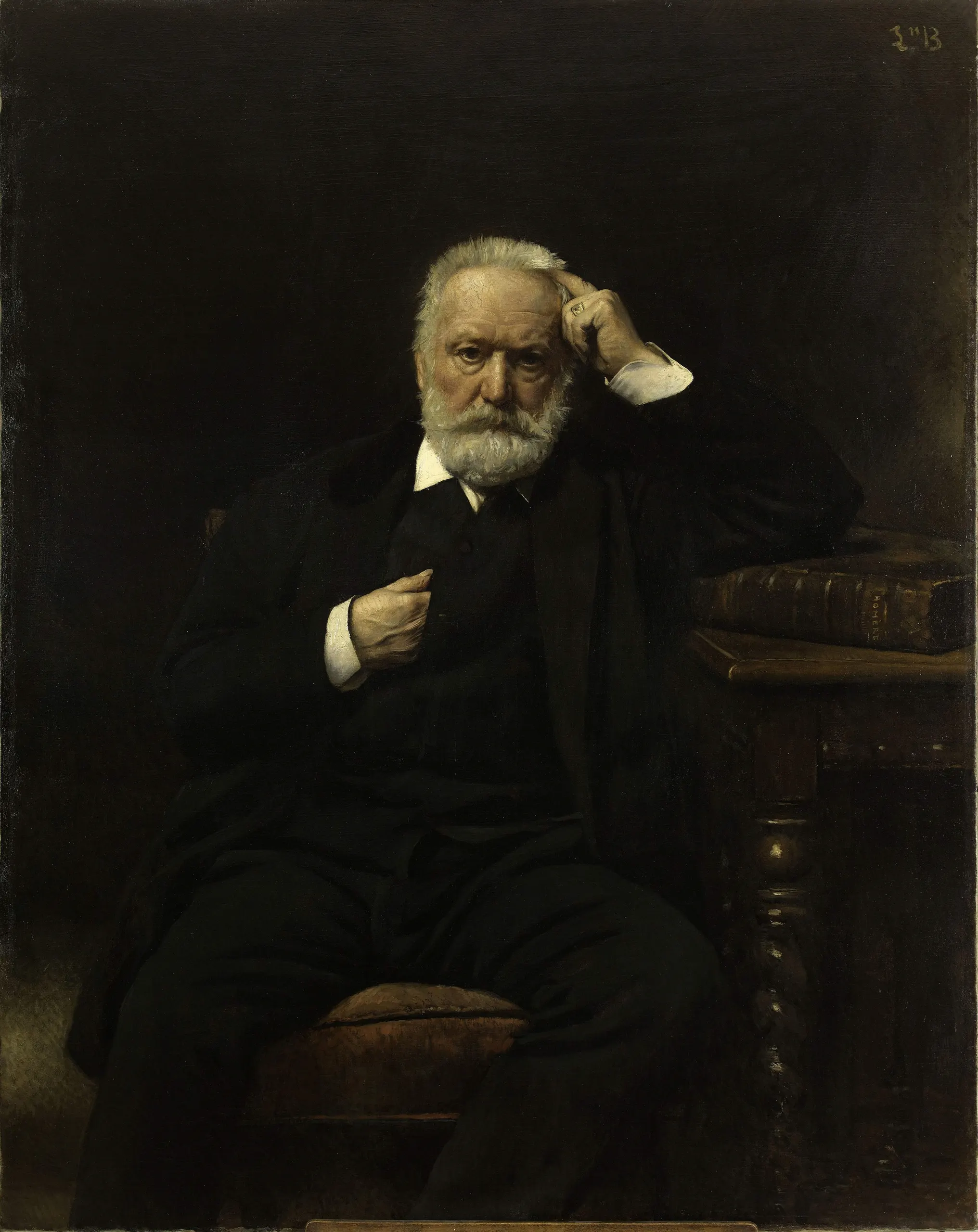
Victor Hugo
 France
novelist•poet•playwright•politician
Also known as: Homme océan, Ocean Man
Birthday
February 26, 1802
Birth Sign
Sagittarius
Birthplace
Besançon, France
Age
Died at 83
Height
5 ft 8 in (1.73 m)
About
Victor-Marie Hugo was a towering figure of the French Romantic movement and one of the most influential writers in history. He worked as a novelist, poet, playwright, essayist, journalist, and politician for over six decades, becoming a national symbol of liberty and human rights in France. His works continue to define the canon of Western literature.
Hugo remains the most read author in French literary history, with his epic novels and plays translated into hundreds of languages. The global cultural footprint of his stories is immense, driving countless adaptations in theater, film, and opera that generate billions in revenue annually. He is remembered not just for his artistic output but for his fierce political activism against social injustice and the death penalty.
Early Life & Background
Victor Hugo entered the world on February 26, 1802, in Besançon, France, into a family divided by the turbulent politics of the era. His father, Joseph Léopold Sigisbert Hugo, served as a general under Napoleon Bonaparte, while his mother, Sophie Trébuchet, held royalist sympathies. This conflict shaped his early childhood, which involved frequent moves across Europe as his father's military career took them to Spain and Italy. These travels exposed the young Victor to diverse cultures and languages long before he established himself in Paris.
His education was rigorous yet interrupted by political instability. He attended the Collège des Nobles in Madrid and later the prestigious Lycée Louis-le-Grand in Paris, where he began writing poetry before the age of ten. By his teens, he was already winning academic prizes for his verse, signaling a prodigious talent. In 1817, at just fifteen years old, he won a prize from the Académie Française for a poem, marking his first official recognition in the literary world.
Before achieving global fame, Hugo navigated the conservative literary circles of Restoration France, often clashing with critics who favored rigid classical forms. His marriage to Adèle Foucher in 1822 provided domestic stability during his early struggles. He published his first major collection, Odes et Poèmes, in 1822, establishing his voice within the emerging Romantic movement. His early plays like Cromwell contained a preface that became a manifesto for French Romanticism, challenging the established rules of drama. The pivotal moment arrived in 1830 with the premiere of Hernani. The play sparked the legendary "Battle of Hernani," where supporters and detractors clashed in the audience, ultimately cementing the triumph of Romanticism over Classicism in French theater.
Career Growth
Hugo's career is defined by monumental works that redefined European literature and politics. Following the success of Hernani, he published The Hunchback of Notre-Dame in 1831, a historical novel that revitalized public interest in Gothic architecture and medieval history. In 1841, he was elected to the Académie Française, securing his place in the highest echelons of French intellectual life.
A personal tragedy struck in 1843 when his beloved daughter Léopoldine drowned in the Seine. This event deeply influenced his later poetry, particularly the collection Les Contemplations. His political stance led to exile in 1851 after he opposed Louis-Napoléon Bonaparte's coup d'état. During his nineteen years in Brussels, Jersey, and Guernsey, he wrote powerful satirical poems against Napoleon III and completed Les Travailleurs de la mer.
In 1862, he published Les Misérables, an epic social novel addressing poverty, justice, and redemption. It became an instant international bestseller and remains one of the most adapted works in history. Hugo returned to France in 1870 following the fall of the Second Empire and was greeted as a national hero. He continued to write prolifically until his final years, producing Ninety-Three in 1874 and various poetry collections. In 1881, the state officially celebrated him as the "Grand Old Man" of French letters.
Career Timeline
Public Image & Style
Victor Hugo is portrayed as the "Grand Old Man" of French literature, a visionary, and a humanitarian. His image is one of wisdom, moral authority, and unwavering commitment to justice. Media and scholars depict him as a tragic figure who suffered profound personal loss but found redemption in his work. His style was distinctive, often featuring a large beard and formal black suits with white cravats.
His public persona was that of a revolutionary spirit who used his pen as a weapon against tyranny. He was seen as a man who transcended his era to become a national symbol of liberty. Even today, his likeness evokes a sense of solemnity and intellectual depth, representing the height of 19th-century French culture.
Fame & Fandom (iFAMOUS Rankings)
The scope of Victor Hugo's cultural footprint is quantified by the iFANN Global Fame Rankings, which track attention across media coverage, search activity, and consumption signals worldwide. As of September 2026, he stands as the 16th most famous person in France, holding steady from the previous cycle. He ranks as the 18th most famous person from France, maintaining his standing since the last update. Across the continent, he is recognized as the 31st most famous person in Books & Literature, holding firm against new entrants.
While there is no formal fandom name for such a historical figure, his admirers are highly organized through academic institutions and literary societies dedicated to preserving his legacy. Fans engage in deep study of his works and participate in discussions about his political philosophy. Notable fan projects include the restoration of his homes, such as the Victor Hugo House in Paris and his residence in Guernsey, as well as annual commemorations of his birthday and death. Their devotion is measured in the sustained relevance of his ideas across centuries rather than chart pushes or viral campaigns.
Interesting Facts and Legends
One of the most enduring legends about Victor Hugo is that he wrote The Hunchback of Notre-Dame specifically to save the actual cathedral from demolition. While historians note the building was already slated for restoration, the novel certainly accelerated the effort and sparked a massive revival of interest in Gothic architecture. Another fascinating fact involves his writing speed; Hugo was known to compose entire chapters in a single sitting, often working late into the night.
Hugo was a fierce advocate for the abolition of the death penalty, a cause he championed throughout his political career. He spoke several languages fluently, including English and Spanish, thanks to his childhood travels. His funeral procession in 1885 remains one of the largest public gatherings in French history, with an estimated two million people lining the streets of Paris to pay their respects. A modern legend suggests that his estate continues to generate hundreds of millions of dollars annually through licensing and adaptations, making him one of the wealthiest authors posthumously.
Notable Quotes
“He who opens a school door, closes a prison.”
“Life is the flower for which love is the honey.”
“Even the darkest night will end and the sun will rise.”
“To love another person is to see the face of God.”
Family & Personal Life
Hugo married Adèle Foucher in 1822, and they remained together until her death in 1868. They had five children: Léopold, who died in infancy; Charles, who lived to adulthood; François-Victor; Léopoldine, whose drowning in 1843 devastated Hugo; and Adèle. The loss of Léopoldine profoundly shaped his emotional and spiritual output in his later years.
Beyond his marriage, Hugo had a significant long-term relationship with Juliette Drouet, whom he met in 1833. Their bond lasted nearly fifty years, though they never married. Drouet abandoned her own acting career to follow Hugo into exile, managing his correspondence and household in poverty. She died shortly before him in 1883. Hugo also maintained friendships with other prominent figures, including Alexandre Dumas and Charles Baudelaire, who admired his work.
Notable Connections
Relationships & Dating History
Victor Hugo's romantic life was complex, marked by a long marriage and a defining extramarital partnership. He married Adèle Foucher on October 12, 1822. Their relationship began in their youth, and they remained together until her death in 1868. They raised five children together, though the marriage was strained by Hugo's infidelities and Adèle's declining health. She died of tuberculosis, ending their union.
In 1833, Hugo met Juliette Drouet, an actress, on stage. Their relationship lasted nearly 50 years until his death, though they never married. Drouet was a devoted companion who abandoned her own career to follow him into exile, living in poverty in Guernsey while managing his correspondence. She died shortly after him in 1883. While Hugo had other brief affairs with actresses and muses, Drouet remains the most significant long-term partner after his wife. As of the time of his death in 1885, he was widowed by Adèle Foucher.
- MarriedAdèle Foucher1822 - 1868Met through family connections; raised five children together; she died of tuberculosis.
- DatedJuliette Drouet1833 - 1885Lifelong companion who followed him into exile; never legally married.
Death & Aftermath
Died
May 22, 1885 (aged 83)
Death Place
Paris, France
Cause of Death
heart attack (myocardial infarction)
The death of Victor Hugo triggered a moment of national grief that transformed Paris into a single, weeping entity. When the French government declared a period of mourning, millions lined the streets to witness a procession that remains one of the largest funerals in history. The body traveled from his residence at number 6 Place des Vosges to the Arc de Triomphe before resting finally in the Panthéon, where he was interred on June 1, 1885. This ceremony united political factions and citizens alike, cementing his status as the Grand Old Man of French letters. Hugo passed away on May 22, 1885, at the age of 83 within his own home in the Marais district.
He had returned to France decades earlier after exile in 1870, spending his final years as a celebrated figure who continued to write prolifically until shortly before his passing. Tributes poured in immediately from peers, politicians, and the general public, solidifying his legacy as a titan of literature and human rights activism. Posthumously, his estate has been managed by the Centre des Monuments Nationaux, which maintains his former residences as museums including the Maison Victor Hugo in Besançon and his Paris home. His works, particularly Les Misérables and The Hunchback of Notre Dame, continue to generate enduring global popularity through countless adaptations and cultural institutions dedicated to his memory.
Net Worth (Estate Value)
$2 Billion
iFANN Editorial Team estimate
As a deceased historical figure, Victor Hugo does not possess a personal net worth in the traditional sense, but his estate continues to generate substantial revenue. Research by the iFANN Editorial Team puts his fortune at around $2 Billion as of 2026. This valuation reflects the ongoing commercial success of his intellectual property, managed by his descendants and the Fondation Victor Hugo.
Revenue streams are driven primarily by royalties from book sales, particularly Les Misérables and The Hunchback of Notre-Dame, which remain bestsellers globally. Licensing fees for films, stage musicals, and operas contribute significantly to the estate's value. The Les Misérables franchise alone generates hundreds of millions in box office and ticket sales every few years. Additionally, merchandise, educational materials, and digital adaptations add to the financial trajectory. The estate has seen consistent growth due to the timeless nature of his themes and the continuous demand for his works in new media formats.
Awards & Accolades
View 11 records, honours and achievementsKnown For
Les Misérables
1862 · Author
The Hunchback of Notre-Dame
1831 · Author
Hernani
1830 · Playwright
Keywords
Sources
Quick Facts
- Profession
- politician, playwright, novelist
- Born
- February 26, 1802
- Birthplace
- Besançon
- Died
- May 22, 1885
- Death Place
- Paris
- Gender
- Male
- Spouse
- Adèle Foucher
- Birth Sign
- Sagittarius
Personal Details
- Full Name
- Victor-Marie Hugo
- Height
- 5 ft 8 in (1.73 m)
- Spouse
- Adèle Foucher
- Children
- Charles, François-Victor, Léopoldine, Adèle, and Léopold (deceased as an infant)
- Education
- Collège des Nobles in Madrid; Lycée Louis-le-Grand in Paris
Frequently Asked Questions
What is Victor Hugo famous for?
How did Victor Hugo die?
Where is Victor Hugo buried?
Who was Victor Hugo's wife?
Is Victor Hugo still relevant today?
Similar People
Join the community
fans discussing