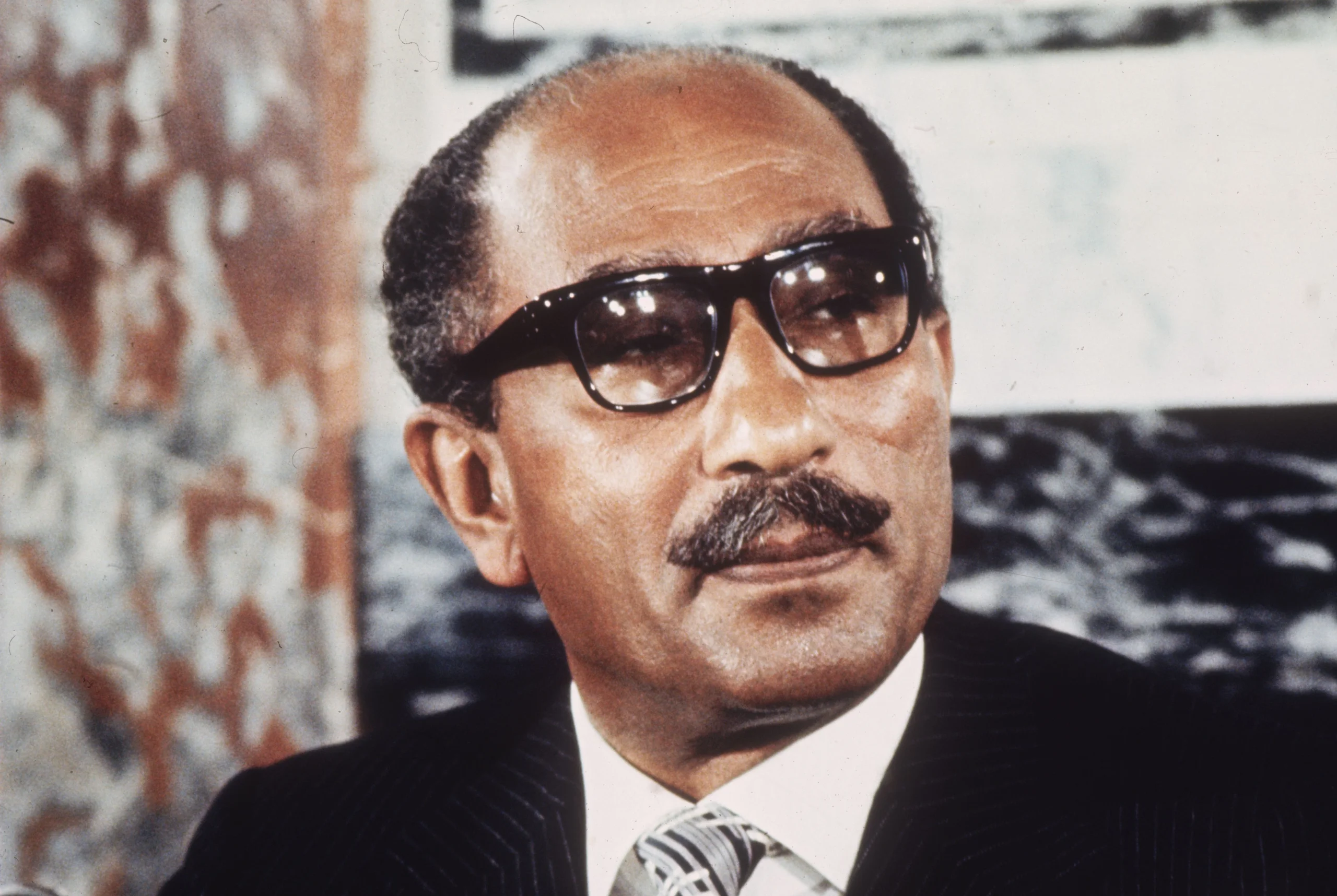
Anwar Sadat
 Egypt
Egyptpolitician•military officer•statesperson
Also known as: Muhammad Anwar el-Sadat, Anwar el-Sadat, Sadat, Muhammad Anwar es-Sadat
Birthday
December 25, 1918
Birth Sign
Sagittarius
Birthplace
Mit Abu al-Kum, Monufia Governorate, Egypt
Age
Died at 62
Height
5 ft 9 in (175 cm)
About
Muhammad Anwar el-Sadat was the third President of Egypt, serving from 1970 until his assassination in 1981. A career military officer who rose from a modest rural upbringing in the Nile Delta, he played a pivotal role in the 1952 revolution that overthrew King Farouk I. Following the death of Gamal Abdel Nasser, Sadat assumed the presidency and steered Egypt through a dramatic transformation of its foreign policy and domestic economy.
His tenure is defined by the 1973 October War, which reclaimed Egyptian honor, and the subsequent Camp David Accords, which secured a historic peace treaty with Israel. For these efforts, he shared the 1978 Nobel Peace Prize with Israeli Prime Minister Menachem Begin and U.S. President Jimmy Carter. His legacy remains one of the most complex in modern history, marked by bold diplomatic courage and fierce political opposition.
Early Life & Background
Muhammad Anwar el-Sadat was born on December 25, 1918, in Mit Abu al-Kum, a small village in the Monufia Governorate of the Nile Delta. He was the son of El-Sadat Mohamed, a post office clerk, and Fatma Mahran. The family lived in poverty, often struggling to make ends meet. Due to financial hardships, Sadat spent much of his childhood living with relatives in Upper Egypt, far from his birthplace. This early exposure to economic struggle and the nationalist sentiments rising against British colonial rule deeply influenced his worldview.
His formal education began in a traditional Quranic school before he moved to Cairo to attend the Rashid Secondary School. He was known for his quiet demeanor and dedication to study during these formative years. In 1936, at the age of 18, he enrolled in the Royal Military Academy. He graduated in 1938 as a Second Lieutenant, marking the start of a life dedicated to military service and national liberation. His early career saw him stationed in Manqabad and later in Sudan, where he honed his skills as an officer.
During World War II, Sadat became involved in secret anti-British activities. These actions led to his arrest and imprisonment by British authorities in 1942. Although he was released after a few months, the experience solidified his resolve to end foreign influence in Egypt. In the late 1940s, he emerged as a key member of the Free Officers Movement, a group of junior officers dedicated to overthrowing the monarchy. This movement culminated in the successful July 23, 1952 revolution, elevating him from a junior officer to a prominent figure in the new republic.
Career Growth
Sadat's ascent continued rapidly after the 1952 revolution. He was elected to the Revolutionary Command Council in 1954 and served as Secretary-General of the Arab Socialist Union. Throughout the 1960s, he held high-ranking government positions, including Minister of Information and Speaker of the National Assembly. In 1969, Gamal Abdel Nasser appointed him Vice President of Egypt.
Upon Nasser's death on September 28, 1970, Sadat assumed the presidency. He immediately began to shift Egypt's trajectory, launching the Yom Kippur War (October War) on October 6, 1973. The initial military successes against Israel restored national pride and broke the psychological barrier of defeat from the 1967 Six-Day War. Following this, he pursued a bold path of diplomacy, visiting Jerusalem in November 1977 to address the Israeli Knesset. This unprecedented act led to the Camp David Accords in September 1978, signed with Menachem Begin and Jimmy Carter.
The peace process culminated in the Egypt-Israel Peace Treaty signed in March 1979, formally ending the state of war between the two nations. These achievements earned Sadat the Nobel Peace Prize in December 1978. Domestically, he introduced the Infitah economic opening policies in 1980 to liberalize Egypt's economy. His tenure ended abruptly on October 6, 1981, when he was assassinated during a military parade in Cairo.
Career Timeline
Public Image & Style
Anwar Sadat is portrayed as a complex figure: a visionary peacemaker and a controversial leader. To supporters, he is a hero who dared to make peace with Israel and modernized Egypt. To critics, particularly in the Arab world, he is seen as a traitor who compromised Arab unity. His signature style was that of a military leader, pragmatic, decisive, and often theatrical in his public appearances. He cultivated an image of a man of the people despite his high office, often wearing simple military uniforms and speaking directly to citizens.
Fame & Fandom
Anwar Sadat never had a fandom in the modern sense of billboards, fan clubs, or streaming campaigns. His legacy is not driven by grassroots enthusiasm but by state-sponsored commemoration and the deep, often fractured memory of a nation. Supporters include scholars at the Anwar Sadat Chair for Peace and Development, diplomats analyzing his treaties, and Egyptians who lay wreaths at his tomb on Sinai Liberation Day. The public sentiment remains polarized; he is simultaneously revered as a prophet of peace and cursed as a traitor by those who view his 1977 Jerusalem visit as a betrayal. This duality defines his enduring presence: a figure whose assassination during a military parade in 1981 transformed him into a martyr for some and a cautionary tale for others.
While no formal group calls themselves his fans, the rituals surrounding his death remain potent annual events where historians and news outlets reflect on the irony of a leader killed by extremists while celebrating a war victory. His story is told through high-stakes history rather than pop culture lore, yet his global reach remains undeniable. According to the latest data from the iFANN Global Fame Rankings, Anwar Sadat holds significant standing across multiple geographic scopes. He is currently ranked as the 10th most famous person in Egypt, a position holding steady from the previous cycle. From his birthplace perspective, he is listed as the 6th most famous person from Egypt. On a broader regional stage, he secures the spot of the 41st most famous person in Middle East.
Interesting Facts and Legends
Anwar Sadat grew up in extreme poverty, often going hungry. He once recalled eating a single meal a day during his childhood in Mit Abu al-Kum. His time in British prison in 1942 was not just a period of confinement but also one of intellectual growth, where he wrote poetry and studied law. His visit to Jerusalem in 1977 remains a defining moment in Middle Eastern history, as he was the first Arab leader to officially recognize Israel. He often quoted the Quran in his speeches, emphasizing the importance of faith in his political decisions. After his death, his wife Jehan Sadat became a prominent author and activist, continuing to advocate for human rights and peace.
Notable Quotes
“I am not a prophet, but I believe that peace is possible.”
“We will not accept any solution that does not restore our dignity.”
“Peace is not just a dream; it is a necessity.”
Family & Personal Life
Anwar Sadat was married twice. His first wife was Eqbal Madi, whom he married in 1949. They had two children, Mohamed and Hoda, before divorcing in 1953. His second wife was Jehan Raouf, whom he married around 1949 or 1950. She was an artist and writer who accompanied him on many diplomatic missions. Together they had four children: Magdi, Alaa, Mona, and Ahmed. Jehan Sadat remained a vocal advocate for peace and women's rights after her husband's death, publishing memoirs and continuing public service until her own passing in 2021.
Notable Connections
Gamal Abdel Nasser, Menachem Begin, Jimmy Carter, Jehan Sadat, Hosni Mubarak.
Relationships & Dating History
Anwar Sadat was married twice. His first marriage was to Eqbal Madi in 1949. They had two children, Mohamed and Hoda, before the couple divorced in 1953. The split occurred reportedly due to incompatibility and the demands of his growing political career. Eqbal Madi lived a relatively private life after the divorce.
His second and most famous marriage was to Jehan Raouf, whom he wed around 1949 or 1950. Jehan was an artist and writer from a prominent family. Their relationship blossomed into a deep partnership, and she became his trusted confidante and First Lady. They had four children together: Magdi, Alaa, Mona, and Ahmed. Jehan supported his political ambitions and was instrumental in his later years. She survived him and continued to be a public figure until her own death in 2021. As of 2026, Sadat is widowed, having been separated from his wife by his assassination in 1981.
- MarriedEqbal Madi1949 - 1953Divorced after four years; had two children together.
- MarriedJehan Sadat1949 - 1981Married until his assassination; had four children together.
Death & Aftermath
Died
October 6, 1981 (aged 62)
Death Place
Cairo, Egypt
Cause of Death
Gunshot wounds and massive blood loss
Anwar Sadat stood on a specially constructed viewing stand in Cairo, reviewing a military parade to mark the eighth anniversary of the October War. As he watched the columns pass, six Islamist extremists embedded within the unit opened fire, striking him in the neck and chest. He was rushed to the nearby Military Hospital but was pronounced dead shortly after arrival from massive blood loss caused by multiple gunshot wounds. The immediate investigation revealed a plot planned over several months, leading to a rapid military tribunal that executed six main conspirators, including Lieutenant Khalid Islambouli, while others received prison sentences.
The public reaction was deeply polarized across the Arab world and beyond. While Western leaders and Israeli officials mourned the loss of a key peace architect, many in Egypt and neighboring nations viewed him as a traitor for signing the Camp David Accords. Spontaneous gatherings saw citizens weeping openly in some areas, while others expressed anger or relief depending on their political alignment. United Nations Secretary-General Javier Pérez de Cuéllar declared a moment of silence, and heads of state issued strong statements honoring his legacy as newspaper sales surged globally. A state funeral held one day later drew hundreds of thousands of Egyptians who lined the streets of Cairo for the procession from the hospital to the Al-Hussein Mosque.
Dignitaries attended despite some Arab leaders boycotting the event, and prayers were led by Grand Imam Sheikh Ahmed el-Tayeb before Sadat was interred in a grand mausoleum adjacent to the mosque. Posthumously, his 1978 Nobel Peace Prize remained central to his legacy, and the Anwar Sadat Chair for Peace and Development was established at the University of Maryland to promote conflict resolution. His wife Jehan Sadat founded the Jehan Sadat Foundation to support education and healthcare initiatives in Egypt.
Net Worth (Estate Value)
$0
iFANN Editorial Team estimate
As Anwar Sadat died in 1981, there is no current net worth in the modern sense of liquid assets held by the individual. However, his estate and legacy continue to generate value. Specific figures for his personal estate at death are not publicly detailed in modern financial reports, as state assets and personal wealth were often intertwined in the context of the Egyptian presidency. Posthumous earnings include royalties from books written by his wife, Jehan Sadat, and licensing of his image.
The primary revenue streams associated with his name today are academic endowments like the Anwar Sadat Chair, museum exhibitions, and documentary licensing. No credible 2026 net worth estimates exist for the deceased individual, as such calculations apply only to living entities or estates with active commercial management. The value of his legacy is measured in geopolitical impact rather than currency. iFANN Editorial Team analysis confirms that while his estate generates nominal income through historical preservation, it does not hold a liquid net worth comparable to modern billionaires.
Awards Won (3)
Anwar Sadat received the Nobel Peace Prize in 1978 alongside Menachem Begin and Jimmy Carter for their roles in negotiating the Camp David Accords. He was also awarded the Legion of Merit by the United States in 1978 and the Order of the Golden Fleece by Spain. Additionally, he received the Order of the Nile, one of Egypt's highest honors, multiple times throughout his presidency.
1978 · Peace
Camp David Accords
1978 · Military Service
Diplomatic Achievements
Known For
Camp David Accords
1978 · Signatory
Egypt-Israel Peace Treaty
1979 · Signatory
Nobel Peace Prize
1978 · Recipient
Keywords
Sources
Quick Facts
- Profession
- politician, military officer, statesperson
- Born
- December 25, 1918
- Birthplace
- Mit Abu al-Kum, Egypt
- Died
- October 6, 1981
- Death Place
- Cairo, Egypt
- Gender
- Male
- Spouse
- Eqbal Madi, Jehan Sadat
- Birth Sign
- Sagittarius
Personal Details
- Full Name
- Muhammad Anwar el-Sadat
- Height
- 5 ft 9 in (175 cm)
- Spouse
- Eqbal Madi, Jehan Sadat
- Children
- Mohamed · Hoda · Magdi · Alaa · Mona · Ahmed
- Education
- Rashid Secondary School; Royal Military Academy
Frequently Asked Questions
Who was Anwar Sadat?
How did Anwar Sadat die?
Why did Anwar Sadat go to Jerusalem?
Did Anwar Sadat win a Nobel Prize?
What is Anwar Sadat's legacy?
Similar People
Join the community
fans discussing