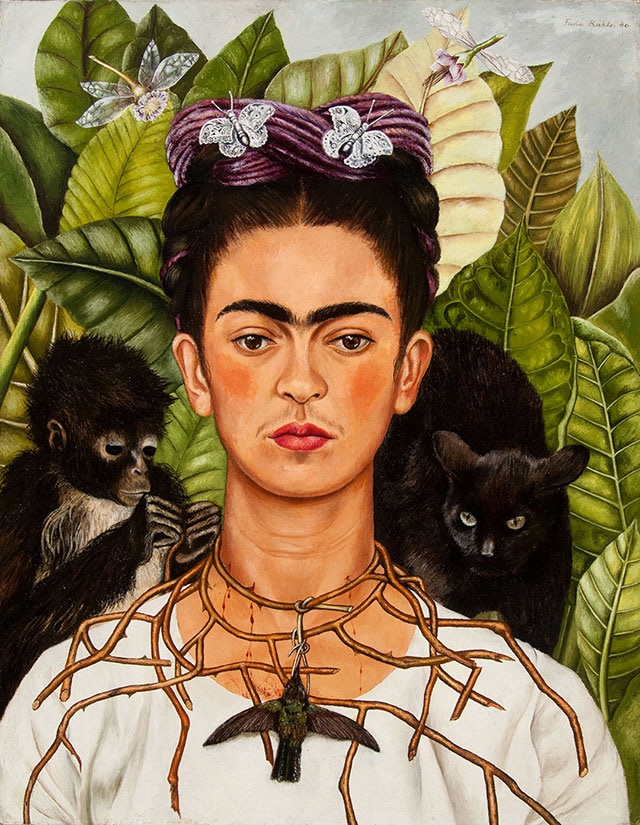
Frida Kahlo
 Mexico
Also known as: Magdalena Carmen Frida Kahlo y Calderón
Birthday
July 6, 1907
Birth Sign
Cancer
Birthplace
Coyoacán, Mexico City, Mexico
Age
Died at 47
Height
5 ft 3 in (160 cm)
About
Frida Kahlo, born Magdalena Carmen Frida Kahlo y Calderón on July 6, 1907, in Coyoacán, Mexico City, was a Mexican painter whose work has become synonymous with bold self-expression and cultural pride. Known for her many self-portraits, she used a naïve folk art style to explore identity, postcolonialism, gender, class, and race. Her paintings mix realism with fantasy, often drawing from her own life, including her chronic pain. She is celebrated as an icon for Chicanos, feminists, and the LGBTQ+ community, her uncompromising depictions of the female experience making her a global symbol of resilience and cultural identity. Her image has been featured on Mexican banknotes, and her home, La Casa Azul, is now the Frida Kahlo Museum, one of the most visited museums in Mexico City. The 2002 biopic Frida, starring Salma Hayek, won two Academy Awards and introduced her to a new generation. In 2018, she was ranked #1 on Rolling Stone's list of "10 Best Visual Artists of All Time," and in 2020, she was named one of TIME's "100 Women of the Year" as a proxy for 1937. The intense global cult of personality around her is sometimes called "Fridamania." Fans often dress as her for Halloween or "Frida Fest" events, and her image is a staple of Day of the Dead celebrations. The official social media accounts post a mix of art history, political statements aligned with her Communist past, and inspirational quotes. As of 2026, her estate is estimated to be worth $60–$80 million, managed by the Frida Kahlo Museum and the Diego Rivera and Frida Kahlo Trust.
Early Life & Background
Kahlo grew up in the family home known as La Casa Azul in Coyoacán. At age six, polio left her right leg thinner than the left, and she walked with a limp for the rest of her life. Her father, a photographer, encouraged her to play soccer and swim to strengthen the leg. She was a bright, rebellious student and one of only 35 girls at the National Preparatory School in Mexico City. It was there she first saw Diego Rivera painting a mural on campus. A pivotal moment came on September 17, 1925, when the bus she was riding collided with a trolley car. The accident impaled her through the pelvis, fractured her spine, collarbone, ribs, pelvis, and right leg. During her long, painful recovery, immobile in a body cast, she began to paint. Her mother had a special easel made so she could paint in bed, and a mirror placed above her so she could paint self-portraits. That bus accident redirected her life entirely, turning a pre-med student into an artist. She often gave her birth year as 1910, the start of the Mexican Revolution, to align her life with modern Mexico.
Career Growth
Kahlo's breakthrough came in 1938 when surrealist André Breton organized her first solo exhibition at the Julien Levy Gallery in New York. The show sold about half of the 25 paintings, a commercial success. In 1939, she traveled to Paris for an exhibition at the Renou & Colle Gallery, where the Louvre purchased The Frame, making her the first 20th-century Mexican artist collected by the museum. Throughout the 1940s, she taught at the Escuela Nacional de Pintura, Escultura y Grabado "La Esmeralda" and became a founding member of the Seminario de Cultura Mexicana. In 1953, her first solo exhibition in Mexico was held at the Galería Arte Contemporáneo. She attended the opening in an ambulance and was carried to her bed, which was placed in the gallery. She continued to paint until her death in 1954. Posthumously, her work gained enormous traction. In 2021, her painting Diego y yo sold for $34.9 million, a record for a Latin American artist at auction. In 1954, she received the Premio Nacional de Pintura from the Mexican government. A major exhibition, "Frida Kahlo: The Life of an Icon," has been touring globally, featuring immersive digital experiences. In 2024, the Frida Kahlo Museum announced a new permanent exhibition focusing on her political activism.
Career Timeline
Public Image & Style
Kahlo's signature style includes her unibrow, flower crowns, colorful Tehuana dresses, and a direct, unflinching gaze in her self-portraits. She is portrayed as a tragic but resilient feminist icon, a symbol of pain transformed into art, and a figure of cultural pride for Mexicans and Chicanos. She appeared on the cover of Vogue in 1937, photographed by Toni Frissell, introducing her to an American fashion audience. TIME featured an illustration of her on its cover in 2002, and Vanity Fair had a cover story for the film Frida that same year. The official Instagram account @museofridakahlo has over 1.1 million followers, and the Facebook page has over 500,000 followers. The Twitter/X account @FridaKahlo has over 300,000 followers. Fans are often called "Frida followers" or "Frida fans," and there is a strong subculture of "Frida-themed" weddings. The estate continues to launch new licensed product lines, including a recent collaboration with a high-end fashion house.
Fame & Fandom (iFAMOUS Rankings)
Frida Kahlo remains the 1st most famous person from Mexico, a position she holds with quiet authority. Her standing extends far beyond her borders, ranking as the 3rd most famous person in Latin America and securing the 4th spot globally for her country of origin at the 4th most famous person in Mexico. Within the global pantheon of creativity, she is recognized as the 3rd most famous person in Art & Design, while her overall cultural footprint places her at the 185th most famous person in the world. These placements, consistent across recent cycles within the iFANN Global Fame Rankings, reflect an enduring devotion that transcends generations. The scale of this attention tracks how her image permeates media coverage, search behaviors, and consumption signals worldwide, cementing her status not merely as a historical figure but as a living presence in contemporary culture.
There is no formal name for her fanbase, though the term "Fridas" has emerged in cultural discourse to describe women who emulate her style or identify with her legacy rather than a structured organization. Unlike modern celebrities whose followers drive campaigns or fund billboards, Kahlo's devotees express their admiration through the preservation of her mythos. This mythology rests on verified biographical events amplified into folklore, such as her survival of a near-fatal bus accident which transformed physical suffering into the pain and passion evident in her self-portraits. Her tumultuous marriage to Diego Rivera and her distinct visual persona, elaborate Tehuana clothing and floral hairstyles adopted to assert Mexican identity, have become symbols of resistance. Recent institutional reactions underscore this devotion; a major exhibition broke pre-sale ticket records at the Tate, while activists filed lawsuits to prevent her paintings from leaving Mexico, arguing they are too culturally vital to be exported. These events highlight a fierce protection of her legacy by a global audience that treats her life story as high drama and her art as a national treasure.
Interesting Facts and Legends
Born Magdalena Carmen Frida Kahlo y Calderón on July 6, 1907, in Coyoacán, she became a painter whose work defined bold self-expression and cultural pride. Known for her many self-portraits, she utilized a naïve folk art style to explore identity, postcolonialism, gender, class, and race. Her paintings mixed realism with fantasy, often drawing from her own life and chronic pain. She was celebrated as an icon for Chicanos, feminists, and the LGBTQ+ community, with her uncompromising depictions of the female experience making her a global symbol of resilience. Her image appeared on Mexican banknotes, and her home, La Casa Azul, served as a museum. Her signature style included her unibrow, flower crowns, colorful Tehuana dresses, and a direct gaze. She appeared on the cover of Vogue in 1937, photographed by Toni Frissell, introducing her to an American fashion audience. TIME featured an illustration of her on its cover in 2002, and Vanity Fair had a spread. She was bisexual and had affairs with both men and women, including the singer Chavela Vargas. She was an avid political activist and joined the Mexican Communist Party in 1928. She loved wearing traditional Tehuana dresses to highlight her Indigenous heritage and hide her scarred leg. She often incorporated her unibrow and facial hair into her self-portraits as a deliberate statement against conventional beauty standards. Her height was 5 feet 3 inches (160 cm). She was honored with a Google Doodle on July 6, 2010, for her 103rd birthday. Notable quotes include: "I paint self-portraits because I am so often alone, because I am the person I know best" (from her diary, circa 1940s); "They thought I was a Surrealist, but I wasn't. I never painted dreams. I painted my own reality" (interview, 1953); "Feet, what do I need you for when I have wings to fly?" (from her diary, 1953, after her leg amputation); and "I hope the exit is joyful, and I hope never to return" (final diary entry, 1954). A story fans still retell involves her near-fatal bus accident in 1925, which sparked her artistic career during recovery. Another legend centers on her relationship with Diego Rivera, marked by volatility and infidelities, including rumors of an affair with Leon Trotsky. Her deliberate rejection of beauty norms, growing a mustache and unibrow, became a core part of her lore.
Notable Quotes
“I paint self-portraits because I am so often alone, because I am the person I know best.”
“They thought I was a Surrealist, but I wasn't. I never painted dreams. I painted my own reality.”
“Feet, what do I need you for when I have wings to fly?”
“I hope the exit is joyful — and I hope never to return.”
Family & Personal Life
Kahlo's father, Guillermo Kahlo, was a German immigrant and photographer. Her mother, Matilde Calderón y González, was of Indigenous and Spanish descent. She had three sisters: Matilde, Adriana, and Cristina. Kahlo never had children; a pregnancy in 1930 was terminated for medical reasons, and subsequent miscarriages left her deeply depressed. She and Rivera lived at La Casa Azul, which later became the Frida Kahlo Museum. The house was filled with animals, including monkeys, parrots, and a Xoloitzcuintli dog. She also owned a pet deer named Granizo.
Notable Connections
Diego Rivera, her husband and fellow muralist, was a lifelong influence. André Breton, the surrealist writer, championed her work and organized her first major exhibition. Photographer Nickolas Muray, her lover, captured iconic images of her. Salma Hayek portrayed her in the 2002 biopic and helped bring her story to a global audience.
Relationships & Dating History
Kahlo's first serious relationship was with Alejandro Gómez Arias, a charismatic student leader at the National Preparatory School. They dated from 1922 to 1927, and he was with her during the 1925 bus accident. The relationship ended due to his family's disapproval and his infidelity. In 1929, she married Diego Rivera, a notorious womanizer. Their marriage was passionate but tumultuous, marked by affairs on both sides. Kahlo had affairs with both men and women, including the photographer Nickolas Muray (on and off from 1931 to 1941), the sculptor Isamu Noguchi (1936–1937), the German art dealer Heinz Berggruen (1938), and the Catalan artist José Bartolí (1946–1950). A rumored affair with exiled Russian revolutionary Leon Trotsky in 1937 caused a rift between Kahlo and Rivera. They divorced in 1939 but remarried a year later on December 8, 1940, maintaining a platonic companionship until her death. As of 2026, Frida Kahlo is deceased.
- DatedAlejandro Gómez Arias1922 - 1927Her first serious boyfriend; they were together during the bus accident.
- MarriedDiego Rivera1929 - 1939First marriage, tumultuous with infidelities.
- DatedNickolas Muray1931 - 1941On-and-off affair; Muray took iconic photographs of Kahlo.
- DatedIsamu Noguchi1936 - 1937Affair while Rivera was with her sister Cristina.
- RumouredLeon Trotsky1937 - 1939Widely believed affair while Trotsky lived at the Blue House.
- DatedHeinz Berggruen1938 - 1938Brief relationship with the German art dealer.
- MarriedDiego Rivera1940 - 1954Second marriage, platonic companionship until her death.
- DatedJosé Bartolí1946 - 1950Long-distance relationship with the Catalan artist.
Death & Aftermath
Died
July 13, 1954 (aged 47)
Death Place
Coyoacán, Mexico City, Mexico
Cause of Death
Pulmonary embolism
The announcement of Frida Kahlo's passing came from her family at La Casa Azul in Coyoacán, confirming the end of a life marked by intense physical struggle and artistic brilliance. On July 13, 1954, she died at the age of 47 within the very home where she had spent so much of her creative life, bedridden and isolated by the severe complications of gangrene that had necessitated the amputation of her right leg earlier that year. Her final diary entry reading "I hope the exit is joyful, and I hope never to return" was widely interpreted by historians as relief from chronic suffering rather than an act of suicide, effectively refuting rumors that had circulated about her intent. Public reaction at the time remained subdued, confined largely to close peers and the Mexican art community since she had not yet achieved global fame.
Her husband, Diego Rivera, was devastated by the loss and fell into a deep depression, dying just over a year later in 1957. The funeral was a private affair attended by Rivera, their daughter Matilde Kahlo, and friends like photographer Lola Álvarez Bravo before she was cremated at the Panteón Civil de Dolores. Her ashes were eventually interred at La Casa Azul, which Rivera converted into a museum dedicated to her memory. In the decades that followed, her legacy surged through feminist art history and the publication of her diaries, leading to major exhibitions, the 2002 film Frida, and enduring recognition as a global icon of resilience.
Net Worth (Estate Value)
$80 Million
iFANN Editorial Team estimate
As Frida Kahlo is deceased, her net worth refers to the value of her estate, which is estimated at $80 Million per iFANN's editorial analysis as of 2026. The estate generates income through licensing her image, which is one of the most licensed in the world, appearing on everything from T-shirts to sneakers to Barbie dolls. Merchandise sales, royalties from book and art print sales, and admissions to the Frida Kahlo Museum in Mexico City also contribute. The estate is managed by the Frida Kahlo Museum and the Diego Rivera and Frida Kahlo Trust, which aggressively protects her intellectual property. The trust has sued companies for unauthorized use of her likeness, maintaining the estate's value. Some fan sites project an estate value as high as $200 million, but this is considered a forward-looking projection based on potential future licensing deals.
Awards Won (1)
Kahlo received the Premio Nacional de Pintura from the Mexican government in 1954, just before her death. Her work has been posthumously honored through museum exhibitions and cultural recognition, including being featured on Mexican banknotes and in Google Doodles.
1954 · National Prize of Painting
Lifetime achievement
Known For
Self-Portrait with Thorn Necklace and Hummingbird
1940 · painter
The Two Fridas
1939 · painter
The Broken Column
1944 · painter
Diego y yo
1949 · painter
The Frame
1938 · painter
Keywords
Quick Facts
- Profession
- painter, artist
- Born
- July 6, 1907
- Birthplace
- Coyoacán, Mexico City, Mexico
- Died
- July 13, 1954
- Death Place
- Coyoacán, Mexico City, Mexico
- Gender
- Female
- Spouse
- Diego Rivera
- Birth Sign
- Cancer
Personal Details
- Full Name
- Magdalena Carmen Frida Kahlo y Calderón
- Height
- 5 ft 3 in (160 cm)
- Spouse
- Diego Rivera
- Education
- National Preparatory School, Mexico City
Frequently Asked Questions
What is Frida Kahlo most famous for?
How did Frida Kahlo die?
Did Frida Kahlo have children?
Why did Frida Kahlo paint so many self-portraits?
Was Frida Kahlo a surrealist?
Similar People
Join the community
fans discussing