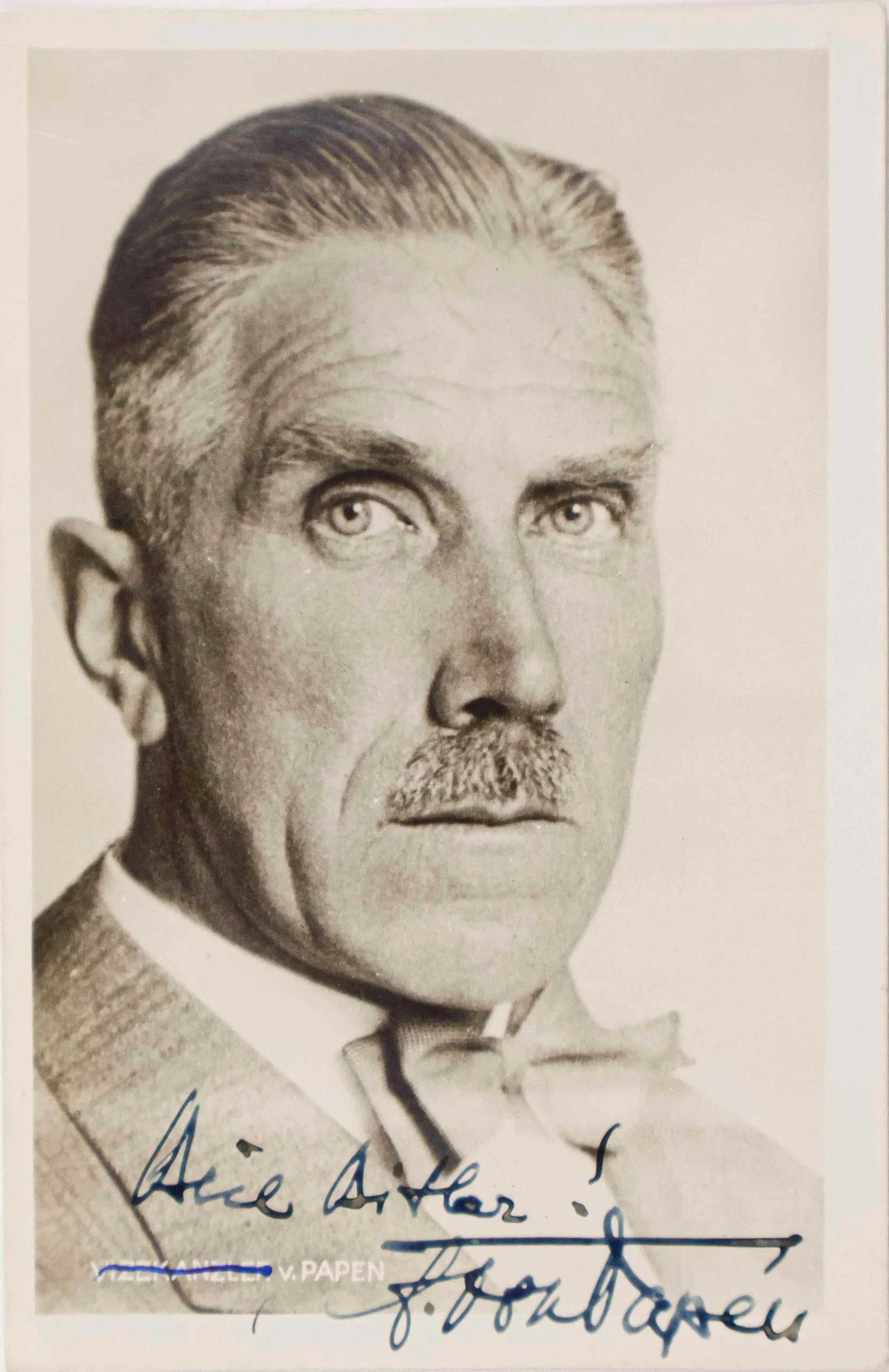
Franz von Papen
 Germany
politician•diplomat•military personnel
Also known as: von Papen, Papen, Franz Joseph Hermann Michael Maria von Papen, Erbsälzer zu Werl und Neuwerk
Birthday
October 29, 1879
Birth Sign
Sagittarius
Birthplace
Werl, Westphalia, German Empire
Age
Died at 89
About
Franz von Papen was a German national conservative politician, diplomat, and Prussian nobleman whose career left a dark and enduring imprint on the twentieth century. Born into a wealthy aristocratic family in Werl, Westphalia, he pursued a military career before entering the volatile politics of the Weimar Republic. He is chiefly remembered for his pivotal role in facilitating Adolf Hitler's rise to power, serving as Chancellor of Germany in 1932 and Vice-Chancellor under Hitler from 1933 to 1934. His legacy is defined not by personal fame or artistic achievement, but by his status as an "establishment enabler" who believed traditional elites could control extremists while maintaining their own power.
His political ascent came during the waning years of the Weimar Republic, where he utilized presidential decrees to bypass parliamentary opposition. As Chancellor, he orchestrated the Preußenschlag, a constitutional crisis that ousted the Social Democratic government of Prussia, demonstrating his willingness to undermine democratic institutions. Although he failed to build a stable parliamentary base and was replaced by General Kurt von Schleicher, his determination to regain influence led him to convince President Paul von Hindenburg to appoint Hitler as Chancellor in January 1933. Von Papen assumed the role of Vice-Chancellor, believing he could box in the Nazi leader, but was quickly marginalized. His effective removal from power followed the Night of the Long Knives in 1934, after which he served as Ambassador to Austria and Turkey until the end of the war. Post-war, he was acquitted at Nuremberg but remained a symbol of the conservative betrayal that allowed the Third Reich to flourish.
Early Life & Background
Franz von Papen entered the world on October 29, 1879, in Werl, Westphalia, as the eldest son of Franz von Papen, a wealthy landowner, and Martha von Loë. His upbringing was steeped in the traditions of the Prussian military and Catholic aristocracy. From an early age, he was groomed for a life of service to the state and the monarchy. He attended the Cadet School in Berlin, where he received his initial military training, before moving on to study law and political science at the University of Bonn and the University of Freiburg. Despite his academic pursuits, his primary focus remained firmly on military affairs.
In 1898, at the age of 18, von Papen joined the Prussian Army as a second lieutenant in the 3rd Guard Uhlan Regiment. He quickly distinguished himself as a capable officer, completing General Staff training and rising through the ranks with the expectation of a high-profile military career. These formative years solidified his monarchist views and convinced him that the German Empire's survival depended on aggressive realpolitik and the preservation of aristocratic authority. Before entering the volatile politics of the Weimar Republic, von Papen established a reputation as a skilled, albeit controversial, diplomat and intelligence operative.
During World War I, he served as a military attaché in Mexico from 1913 to 1915 and later in the United States. In Mexico, he acted as a secret agent for the German Empire, attempting to incite a revolution against the United States and organizing sabotage operations against American supply lines to the Allies. This espionage work led to his expulsion from the U.S. as persona non grata in 1915. He returned to Europe to serve on the Western Front, commanding a battalion and later serving in the Middle East, finishing the war as a lieutenant colonel. These experiences hardened his political outlook and prepared him for the challenges of the post-war era.
Career Growth
Von Papen's political career began in earnest after the collapse of the German Empire in 1918. A staunch monarchist, he refused to accept the Weimar Republic initially but eventually sought to use its mechanisms to restore conservative influence. In June 1932, President Paul von Hindenburg appointed von Papen as Chancellor. His government was short-lived and deeply unpopular, relying heavily on presidential decrees rather than parliamentary support. He orchestrated the Preußenschlag (Prussian Coup), a constitutional crisis where he ousted the Social Democratic government of Prussia. After failing to secure a stable majority, he resigned in November 1932.
Determined to regain power, von Papen played a crucial role in convincing Hindenburg to appoint Adolf Hitler as Chancellor in January 1933. Von Papen negotiated the terms of the coalition, believing he could box in Hitler and serve as Vice-Chancellor. However, Hitler quickly marginalized him. On June 17, 1934, in a defiant move, von Papen delivered a speech at the University of Marburg criticizing the Nazi regime's excesses, calling for the restoration of press freedom and the rule of law. The speech was suppressed by Joseph Goebbels, and the event marked the beginning of his effective removal from power.
Following the purge of the SA leadership and other political opponents known as the Night of the Long Knives in 1934, von Papen's associates were murdered. Von Papen himself was placed under house arrest but was spared execution due to the intervention of Hermann Göring. He resigned his post shortly thereafter. He then served as Ambassador to Austria from 1934 to 1938, where he helped engineer the Anschluss by pressuring Chancellor Kurt Schuschnigg. He later served as Ambassador to Turkey from 1939 to 1944, when he was recalled to Germany. After the war, he was indicted at Nuremberg in 1946 but acquitted of all charges in 1947. Despite his acquittal, a denazification court sentenced him to eight years of hard labor in 1947, though this sentence was overturned on appeal in 1949.
Career Timeline
Public Image & Style
Franz von Papen cultivated an image of the dashing, sophisticated aristocrat, often referred to as 'the charming Franzele.' His smooth demeanor and polished manners masked a willingness to engage in Machiavellian politics. Media perception of him shifted dramatically over time. Initially viewed as a stabilizing force by conservative elites, he became a symbol of the 'conservative betrayal' following the collapse of the Weimar Republic. Modern scholarship views him not as a resistance figure, despite his Marburg Speech, but as an unscrupulous opportunist whose miscalculations led to the Holocaust and World War II.
Historians universally regard him as a cautionary tale of how traditional elites, desperate to maintain their power, could inadvertently destroy democracy by allying with extremists they believed they could control. His nickname, "the charming Franzele," reflected his ability to charm powerful figures while engaging in dangerous political maneuvering. Quotes attributed to him, such as "I have done my duty... I am not responsible for what happens now," highlight his defense of his actions in his memoirs. He remains a figure of intense academic scrutiny rather than admiration, with his public image strictly negative and used as a warning against the dangers of political compromise with authoritarian movements.
Fame & Fandom
Franz von Papen does not currently hold a placement in the iFANN Global Top 1,000 or any Top-100 scope list. The Global Fame Engine has evaluated his legacy, and as of September 2026, he remains unranked, a status that reflects the overwhelmingly negative and cautionary nature of his public remembrance. Unlike cultural figures who inspire dedicated fan communities, von Papen's historical footprint is the subject of academic scrutiny rather than admiration, and no formal or informal fandom name exists for those who study his role in the collapse of the Weimar Republic.
Public engagement with von Papen is almost exclusively framed as a warning. Online discussions, such as those on Reddit's r/todayilearned, center on his part in facilitating Hitler's chancellorship and his illegal 1932 coup against Prussia. A 2016 opinion piece in the Statesman Journal compared him to then-Speaker Paul Ryan, and a 2024 JTA essay used his example to illustrate how elites enabled Hitler. Even his 1953 memoirs were reviewed under the headline 'A Notorious Failure in the Larger Affairs of Men.' No fan clubs, conventions, or coordinated campaigns exist in his honor; the only 'fans' are historians who dissect his miscalculations. Recent news items from 2024 to 2026 primarily discuss his historical role in the context of modern political comparisons, with no new biographical discoveries altering the established narrative of his life.
Interesting Facts and Legends
One of the most enduring pieces of von Papen lore is his nickname, 'the charming Franzele,' a moniker that captured his smooth aristocratic demeanor even as his political actions proved destructive. The 1945 New Yorker article titled 'The Charming Franzele' cemented this image, and it remains a shorthand for the dangerous blend of charisma and recklessness. The Marburg Speech of June 17, 1934, stands as his most defiant moment. As Vice-Chancellor, he publicly criticized the Nazi regime's excesses, calling for the restoration of press freedom and the rule of law. The speech was suppressed by Goebbels, and its significance is still debated; some view it as genuine right-wing resistance, others as a belated attempt to distance himself from a regime he had helped create.
His survival during the Night of the Long Knives is another legendary near-miss. His associates Edgar Jung and Herbert von Bose were murdered, and von Papen was placed under house arrest, reportedly spared only by Hermann Göring's intervention. The event marked the end of his political influence, reducing him to a powerless figure in the Nazi hierarchy. He was one of the few high-ranking Nazis to be acquitted at Nuremberg, a fact that fueled controversy and accusations that the tribunal was too lenient on conservatives. Additionally, the full text of his 1934 speech was banned in Germany until after the war, making it a rare example of internal dissent within the Nazi hierarchy that was actively erased from public record. He famously stated regarding his survival during the purge, "I was saved by Göring."
Notable Quotes
“I have done my duty... I am not responsible for what happens now.”
“We must not allow the National Socialist movement to become a movement of violence and terror... The rule of law must be restored.”
“I was saved by Göring.”
Family & Personal Life
Franz von Papen married Martha von Loë in 1905. Martha was the daughter of a Prussian general, fitting the pattern of aristocratic alliances common among the German elite. They had one child together, a daughter named Gisela von Papen, born in 1906, who predeceased her father. There are no records of other romantic relationships or marriages; von Papen remained monogamous throughout his life, adhering to the strict social conventions of his class. Martha survived him, dying in 1974. Their marriage was described as a conventional union of convenience and status rather than a public romance, typical of the era's aristocracy. As of his death in 1969, he was widowed, having been married only once. No children survive him today.
Upon his death on May 2, 1969, at his estate in Bruckberg near Munich, Bavaria, at the age of 89, von Papen was buried in the St. Georg Cemetery in Bruckberg, on the grounds of his family estate. The funeral was a private affair attended by family members and a few former associates. No major public memorial services were held, and his estate was handled privately by his heirs. Unlike many of his contemporaries, his death did not provoke widespread public mourning or tribute; his legacy was too tainted by his role in enabling the Nazi regime. Posthumously, his memoirs, *Der Wahrheit eine Gasse* (A Lane to Truth), published in 1952, were critically received as a self-serving attempt to rewrite history, portraying himself as a tragic patriot rather than an opportunist.
Notable Connections
Relationships & Dating History
Franz von Papen's personal life was marked by a single, long-term marriage that aligned with the social expectations of his aristocratic background. He married Martha von Loë in 1905. Martha was the daughter of a Prussian general, making their union a strategic alliance between two prominent families within the German elite. They had one child together, a daughter named Gisela von Papen, who was born in 1906. Gisela predeceased her father, leaving no direct descendants to carry on the family line.
There are no records of other romantic relationships or marriages; von Papen remained monogamous throughout his life, adhering to the strict social conventions of his class. Martha survived him, dying in 1974, five years after his own death. Their marriage was described as a conventional union of convenience and status rather than a public romance, typical of the era's aristocracy. As of his death in 1969, he was widowed, having been married only once. No other partners are documented in historical records. His relationship with the Nazi leadership was purely transactional and political; he never joined the Nazi Party despite serving in high office under Hitler, maintaining his identity as a conservative nationalist who believed he could manipulate the regime.
- MarriedMartha von Loë1905 - 1969Married until his death; she died in 1974.
Death & Aftermath
Died
May 2, 1969 (aged 89)
Death Place
Bruckberg, Bavaria, West Germany
Cause of Death
Natural causes associated with old age
Franz Joseph Hermann Michael Maria von Papen died on May 2, 1969, at the age of 89 in Bruckberg, Bavaria, West Germany. The event occurred under circumstances described as natural causes associated with old age. His final days proceeded without notable public spectacle or immediate controversy surrounding the biological end of his life.
Public reaction to his death remained muted, reflecting a legacy defined by his role as an enabler of the Nazi regime rather than a universally celebrated figure. Contemporary discourse focused on re-evaluating his complex political failures and moral ambiguities, particularly his position as a conservative monarchist who facilitated Hitler's rise and his subsequent Marburg Speech criticizing the Nazis. Scholarly reviews and historical analyses published decades later continue to examine his political conduct rather than commemorating him with mass vigils or dedicated landmarks erected immediately following his passing.
His only significant legal proceedings took place decades earlier when he was tried by the International Military Tribunal at Nuremberg starting in November 1945, where he was acquitted of all charges related to conspiracy to wage aggressive war and crimes against peace. Following this acquittal, he lived out the remainder of his life without further legal entanglement regarding his death. While a modern biography titled Rebel Patriot: A Biography of Franz Von Papen appeared in 2022, this work represents a later scholarly re-evaluation rather than an immediate posthumous dedication established upon his death.
Net Worth (Estate Value)
$0
iFANN Editorial Team estimate
The estate of Franz von Papen holds no significant monetary value in the modern financial landscape, as he died in 1969 without leaving behind a vast fortune comparable to modern celebrities. His wealth was tied to his family's aristocratic estates and properties, which were managed privately by his heirs after his death. The estate did not generate substantial posthumous revenue streams beyond standard inheritance settlements. Unlike living individuals whose net worth fluctuates with new ventures, von Papen's financial standing remains static, defined by the assets he held at the time of his passing. The iFANN Editorial Team estimates the current value of his estate at approximately $0, reflecting the lack of active commercial interests or ongoing royalties associated with his name in the contemporary market. His memoirs, published in 1952, generated some income but were critically received as self-serving, limiting their long-term commercial impact.
Awards & Accolades
Known For
Chancellor of Germany
1932 · Politician
Vice-Chancellor of Germany
1933 · Politician
Ambassador to Turkey
1939 · Diplomat
Keywords
Sources
Quick Facts
- Profession
- politician, diplomat, military personnel
- Born
- October 29, 1879
- Birthplace
- Werl, Westphalia
- Died
- May 2, 1969
- Death Place
- Bruckberg, Bavaria
- Gender
- Male
- Spouse
- Martha von Loë
- Birth Sign
- Sagittarius
Personal Details
- Full Name
- Franz Joseph Hermann Michael Maria von Papen, Erbsälzer zu Werl und Neuwerk
- Spouse
- Martha von Loë
- Children
- Gisela von Papen
- Education
- Cadet School in Berlin; University of Bonn; University of Freiburg
Frequently Asked Questions
Who was Franz von Papen?
Why is Franz von Papen famous?
Did Franz von Papen go to jail?
What happened to Franz von Papen after the war?
Was Franz von Papen a Nazi?
Join the community
fans discussing