 France
About
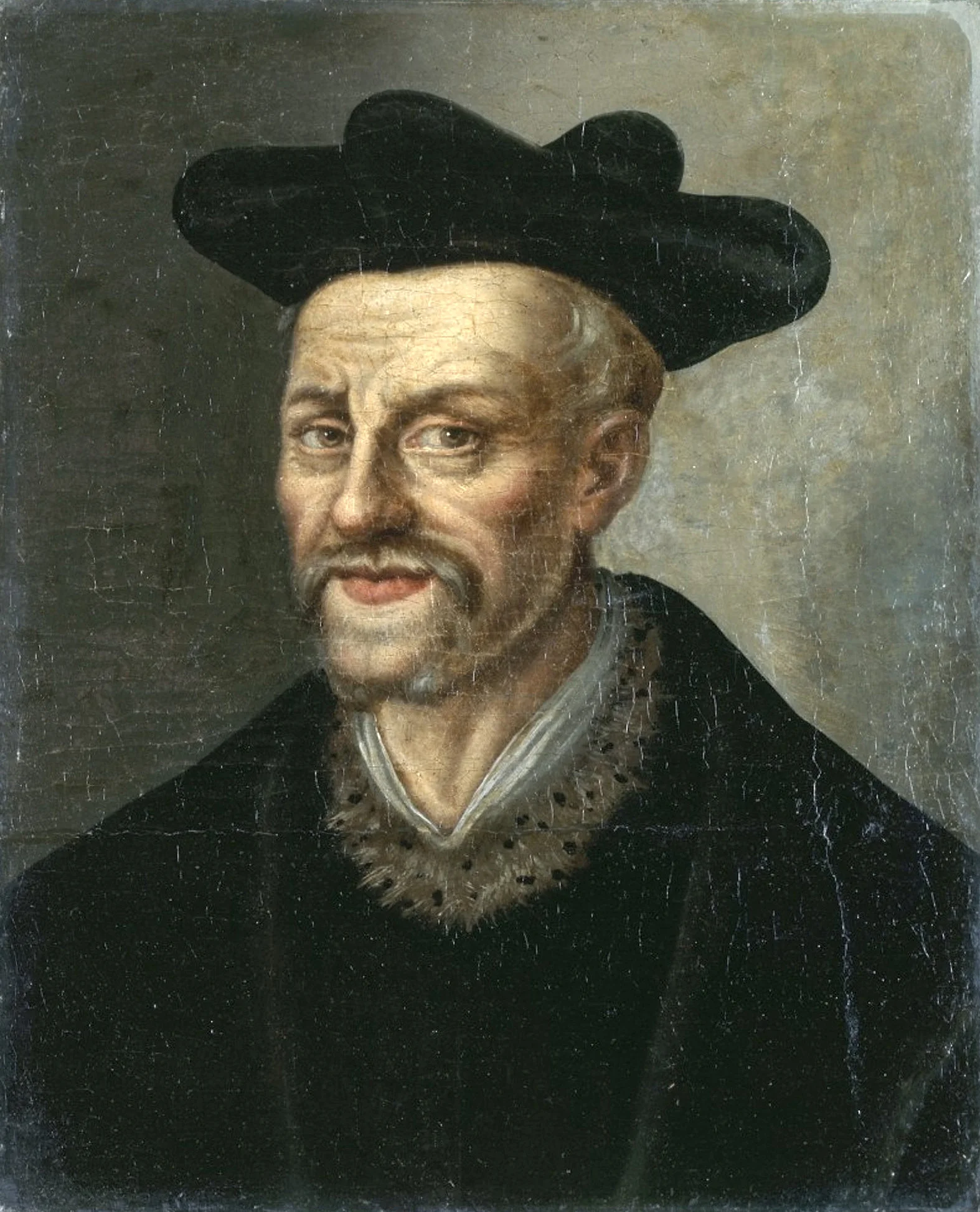
François Rabelais was a French Renaissance writer, physician, and humanist born around 1494 in Seuilly. He is universally celebrated as the first great author of French prose literature, best known for his satirical novels featuring the giants Gargantua and Pantagruel. His work blended erudition with earthy comedy, challenging the dogmas of both the Catholic Church and Protestant reformers like John Calvin. While he served as a physician to prominent figures including Pope Leo X and King Francis I, his enduring legacy rests on his literary masterpieces that defined a new style of grotesque humor.
Rabelais lived through the religious and political upheaval of the Reformation, and his novels tackled the big questions of his era. He admired Erasmus and embraced Christian humanism while mocking medieval scholasticism. His first two books followed the bildungsroman tradition, while later works shifted toward philosophical debates. The term "Rabelaisian" entered the lexicon to describe anything marked by gross robust humor or bold naturalism. He died in 1553 at age 59, leaving behind a body of work that continues to influence writers and satirists globally.
Early Life & Background
Born François Rabelais around 1494 in the village of Seuilly near Chinon in the Touraine region of France, he came from a family of modest means but sufficient standing. His father, Guillaume Rabelais, worked as a local lawyer and landowner, providing the resources necessary for François to receive an education uncommon for someone of his background. From a young age, François displayed a sharp aptitude for languages and classical learning, traits that would define his future career as a scholar. The exact year of his birth remains a subject of historical debate due to scarce parish records, with some sources suggesting dates as early as 1483, but 1494 is the most widely accepted estimate.
His path to secular fame began within the cloister. Around 1510, he entered the Franciscan order at the Abbey of Fontenay-le-Comte, seeking spiritual guidance and scholarly training. However, his interests soon led him to transfer to the Benedictine order at the Abbey of Maillezais. It was during this monastic period that he immersed himself in the classics, mastering Latin and Greek, a rare skill among French writers of the time. Despite his religious vows, Rabelais grew increasingly drawn to the humanist movement and secular studies. In 1530, he made the pivotal decision to abandon the cloister, formally leaving the monastery to pursue medicine and law. This departure marked the end of his life as a monk and the beginning of his journey as a physician and writer.
After leaving the religious orders, Rabelais moved to Paris to study medicine, eventually earning a doctorate. His medical training provided him with a deep understanding of anatomy and physiology, which he would later weave into his satirical narratives. He practiced in Lyon, a major center of printing and humanism where he began to develop his literary voice. Before his breakthrough as an author, he established himself as a respected physician, serving high-profile clients and gaining access to the highest levels of European power. This medical career laid the groundwork for his eventual transition into the world of letters, where he would revolutionize French prose.
Career Growth
François Rabelais's literary career launched with a bang in 1532 when he published Les Horribles et Épouvantables Faits et Prouesses du Très Renommé Pantagruel, Roy des Dipsodes. This comic novel immediately caused a sensation and controversy, establishing his voice as a subversive genius. The book introduced the character of Pantagruel, a giant king whose adventures allowed Rabelais to lampoon social norms and religious hypocrisy. Two years later, in 1534, he released Gargantua, a sequel that expanded the world and deepened the satire against educational systems, war, and religion. These first two volumes became instant classics despite facing bans from the Sorbonne and the Catholic hierarchy.
His subsequent works continued to push boundaries. In 1546, he published Le Tiers Livre de Pantagruel, which shifted toward more philosophical and theological debates, reflecting his own struggles with censorship and the complexities of faith. The following decade brought Le Quart Livre de Pantagruel in 1552, an adventure narrative filled with allegory and travelogue elements that showcased his mastery of language and imagination. Although he died before completing the series, the fifth book, Les Antiquités de Pantagruel, was published posthumously in 1565, likely based on his notes or completed by a follower.
Throughout his career, Rabelais served as a physician to Pope Leo X and King Francis I, leveraging his medical expertise to gain patronage and protection for his writing. His works were commercially successful despite the risks of publishing controversial material. The term "Rabelaisian" entered the lexicon to describe anything marked by gross robust humor, extravagance, or bold naturalism. He remained a key figure in the Humanist movement, admired by Erasmus, and used his writing to advocate for free will and critical thinking. His influence extended far beyond his lifetime, shaping the development of the novel and inspiring generations of writers who valued wit and intellectual freedom.
Career Timeline
Public Image & Style
Rabelais is portrayed in media and academia as the archetypal Renaissance humanist, a man of wit, wisdom, and rebellion. His image is often associated with the grotesque, the carnivalesque, and the celebration of the body and the senses. He is seen as a champion of free speech and critical inquiry, willing to challenge authority in the face of persecution. His writing style, characterized by bawdy caricature and sharp social critique, earned him a reputation as a subversive genius who refused to conform to the rigid expectations of his time. Even today, he is remembered not just as a writer but as a symbol of intellectual courage and the power of laughter to dismantle dogma.
Fame & Fandom
François Rabelais commands a global attention defined by enduring literary influence rather than contemporary celebrity metrics. As a Renaissance humanist and physician whose satirical novels established the foundations of French prose, his legacy persists within academic circles and historical discourse. iFANN's Global Fame Engine has evaluated this person, but they do not currently hold a placement in the published rankings (Global Top 1,000 or a Top-100 scope list). This absence of a numeric rank reflects his status as a historical figure whose fame is measured by scholarly citation and cultural permeation rather than current consumer consumption signals. The fanbase associated with his work possesses no formal name; followers are scholars, literary critics, and students who engage with his texts within university settings rather than a mass consumer movement characterized by organized campaigns or social media rituals. While modern celebrities often generate specific fandom identities, Rabelais remains an object of intellectual study where the term "Rabelaisian" serves as a linguistic descriptor for earthy, grotesque, or exuberant works instead of a tribal identifier. His influence is sustained through the analysis of his attacks on medieval scholasticism and his contributions to bioethical discussions in the modern era, confirming that his renown is rooted in the permanence of his written word rather than the volatility of public opinion.
Interesting Facts and Legends
François Rabelais was one of the few Frenchmen of his time who could read and write fluent Greek, allowing him to translate ancient texts and incorporate them directly into his own work. He served as a physician to Pope Leo X and later to King Francis I, giving him unprecedented access to the highest levels of European power and politics. Several of his books were placed on the Index Librorum Prohibitorum (List of Prohibited Books) by the Catholic Church due to their perceived heresy and obscenity, yet they remained wildly popular among readers. James Joyce, the modernist writer, was heavily influenced by Rabelais, particularly in his use of language and stream-of-consciousness techniques. The adjective "Rabelaisian" is now a standard part of the English language, used to describe anything exuberantly humorous or grotesque. A story fans still retell claims his last words were "I go to seek a great perhaps," a phrase that defines his philosophical persona as a seeker of truth rather than dogma. His conflict with John Calvin over religious tolerance remains a legendary episode in the history of ideas.
Notable Quotes
“Knowledge is the only good.”
“Je vais quérir un grand peut-être" (I go to seek a great perhaps)”
“Science without conscience is the ruin of the soul.”
Family & Personal Life
François Rabelais was born to Guillaume Rabelais, a local lawyer and landowner in Seuilly, and his mother whose name is not recorded in surviving documents. The family enjoyed a relatively comfortable upbringing that allowed François to access quality education. Historical records provide sparse details about siblings or extended family, focusing primarily on his professional achievements. He remained unmarried throughout his life, dedicating his energies to his medical practice, scholarly pursuits, and literary output. There are no verified accounts of children or long-term public relationships, though some biographical traditions suggest he may have had a companion or mistress, these remain speculative. He lived in various locations throughout France, including Seuilly, Poitiers, Lyon, and Paris, often moving to be closer to patrons or medical opportunities.
Notable Connections
Erasmus, John Calvin, Marguerite de Navarre, King Francis I, Pope Leo X
Relationships & Dating History
Historical records provide sparse details about François Rabelais's personal romantic life compared to modern celebrities. It is generally accepted that he remained unmarried throughout his life, focusing his energies on his medical practice, scholarly pursuits, and literary output. There are no verified accounts of children or long-term public relationships. Some biographical traditions suggest he may have had a companion or mistress, but these remain speculative and lack concrete evidence. Consequently, there is no chronological dating history to report. As of his death in 1553, he was single. His primary relationships were professional and intellectual, centered around his patrons like King Francis I and his peers in the humanist movement. His life was dedicated to the pursuit of knowledge and the creation of art, leaving little room for documented romantic entanglements.
Death & Aftermath
Died
April 9, 1553 (aged 59)
Death Place
Paris, France
Cause of Death
Unconfirmed severe illness
François Rabelais passed away on April 9, 1553, in Paris after a period of declining health. The specific medical cause remains unconfirmed by historical records, though accounts describe a severe final illness. His death was marked by a famous anecdote that has become central to his legend: the claim that his last words were Je vais quérir un grand peut-être, translating to "I go to seek a great perhaps." This phrase captures his humanist skepticism regarding the afterlife and dogmatic certainty, even if modern historians view it as apocryphal rather than a medically verified statement.
The immediate public reaction among his peers was one of intellectual mourning rather than mass public spectacle. As a figure who navigated dangerous waters between Catholic orthodoxy and Protestant reform, his funeral was a private affair held at the church of Saint-Paul in Paris, attended by friends and colleagues who appreciated his defense of free thought. Tributes poured in from fellow humanists who recognized his unique contribution to literature and critical inquiry.
Following his death, his unfinished fifth volume, Les Antiquités de Pantagruel, appeared in print in 1565, likely completed by followers using his notes. This posthumous release solidified the narrative arc of his giants and cemented his status as a seminal figure in Western literature. Over the centuries, his legacy has been preserved through the continuous republication of his works, which remain a cornerstone of academic study. Memorials include the Rabelais Museum in Seuilly and various statues across France, ensuring his influence as a pioneer of satire and humanism endures.
Net Worth (Estate Value)
$0
iFANN Editorial Team estimate
As a historical figure who lived in the 16th century, François Rabelais did not accumulate a net worth in the modern sense of liquid assets or real estate holdings tracked by celebrity finance sites. His wealth was measured in land, manuscripts, and the patronage of kings and popes. Upon his death in 1553, his estate was modest, consisting primarily of his library, medical instruments, and perhaps some property. The value of his estate today is not quantifiable in dollars but is reflected in the billions of dollars generated by the licensing, publishing, and adaptation of his intellectual property over the last five centuries. His works continue to generate revenue through global publishing rights, theatrical adaptations, and educational materials. The "Rabelais Estate" is managed by publishers and academic institutions rather than a family trust. No credible 2026 financial reports exist for his personal net worth as he is deceased and his wealth is historical. Any figures citing a specific dollar amount for his personal net worth would be speculative or erroneous.
Awards & Accolades
View 8 records, honours and achievementsKnown For
Gargantua and Pantagruel
1532 · Author
Keywords
Sources
Quick Facts
- Profession
- writer, physician, humanist
- Born
- c. 1494
- Birthplace
- Seuilly, France
- Died
- April 9, 1553
- Death Place
- Paris, France
- Gender
- Male
- Birth Sign
- Capricorn
Personal Details
- Full Name
- François Rabelais
- Children
- Education
- University of Poitiers (Medicine), University of Montpellier (Medicine)
Frequently Asked Questions
What is François Rabelais famous for?
When did François Rabelais die?
What is the meaning of 'Rabelaisian'?
Did François Rabelais get married?
What was François Rabelais' last words?
Join the community
fans discussing