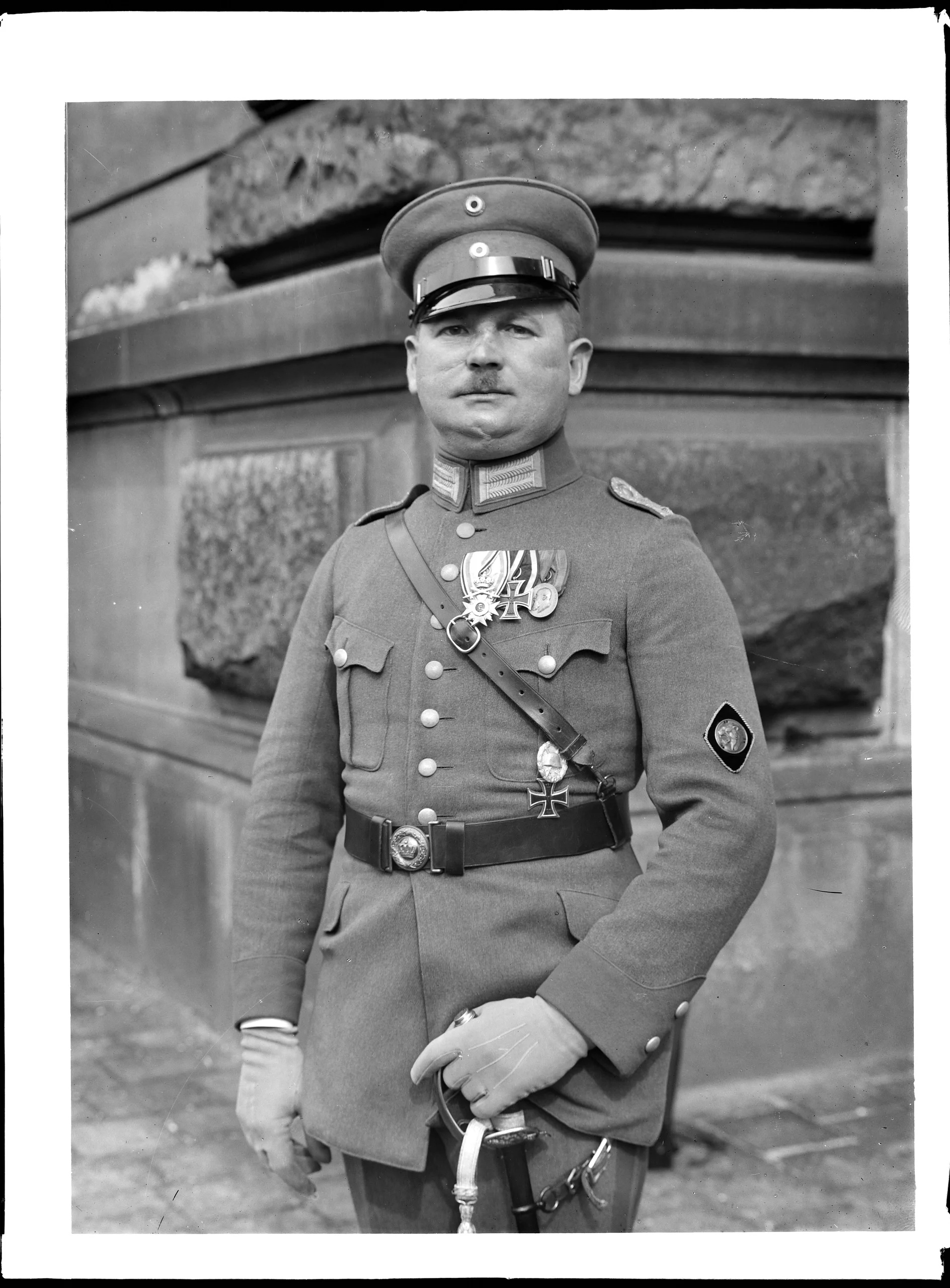
Ernst Röhm
 Germany
Also known as: Ernst Julius Günther Röhm, Stabschef Röhm
Birthday
November 28, 1887
Birth Sign
Sagittarius
Birthplace
Munich, Kingdom of Bavaria
Age
Died at 46
About
Ernst Röhm was a German military officer and Nazi politician who served as the co-founder and long-time leader of the Sturmabteilung (SA), the paramilitary wing of the Nazi Party. Born in Munich in 1887, he rose through the ranks of the Royal Bavarian Army during World War I, earning the Iron Cross for his service despite suffering severe facial wounds that left him with a distinctive scarred appearance. His early political activism led him to join the German Workers' Party in 1919, where he first met Adolf Hitler.
Röhm became one of Hitler's earliest and closest allies, organizing the party's street-fighting squads and expanding them into a massive force of over a million men by the early 1930s. Despite his loyalty, his ambition to merge the SA with the regular German army and his calls for a "second revolution" created irreconcilable conflicts with Hitler, the traditional military leadership, and other Nazi figures like Hermann Göring and Heinrich Himmler. This power struggle culminated in his arrest and execution during the Night of the Long Knives in 1934.
Early Life & Background
Ernst Röhm entered the world on November 28, 1887, in Munich, the son of Emil Röhm, a railway official, and Sofie Röhm. He grew up in a modest household with two brothers and a sister, but his path diverged sharply from civilian life when he joined the Royal Bavarian Army in 1906 as an officer cadet. Commissioned as a lieutenant in 1908, he served with the 10th Bavarian Infantry Regiment and quickly distinguished himself as a capable soldier.
His military career took a brutal turn during World War I when he fought on the Western Front. Röhm was wounded three times, including a devastating injury in 1914 that destroyed part of his nose and left him with a permanently scarred face. Despite these injuries, he continued to serve and was awarded the Iron Cross First Class. By the end of the war, he had reached the rank of captain, though his physical condition made further front-line duty impossible.
In the chaotic aftermath of the war, Röhm joined the Freikorps, a nationalist paramilitary group, before finding his way into politics. In 1919, he joined the German Workers' Party, the precursor to the Nazi Party. It was here that he crossed paths with Adolf Hitler, a connection that would define the next phase of his life. Using his military background, he began organizing the party's early strong-arm squads, laying the groundwork for what would become the infamous SA.
Career Growth
Röhm's political ascent began in earnest in 1920 when he helped establish the Ordnertruppen, the nucleus of the Sturmabteilung. By 1921, he formally organized the SA, transforming it from a disorganized brawler group into a disciplined paramilitary force. His role was pivotal during the 1923 Beer Hall Putsch in Munich, an attempted coup that ended in failure. Röhm was arrested, convicted of treason, and imprisoned, though he was released on probation in 1924.
Following a period of estrangement from Hitler, Röhm emigrated to Bolivia in 1928 to work as a military adviser. He returned to Germany in 1930 at Hitler's specific request to take over the SA as Stabschef, or Chief of Staff. Under his command, the organization exploded in size, growing from roughly 100,000 members to over a million by 1933-1934. This expansion gave the Nazi Party significant muscle on the streets of Germany, intimidating opponents and securing votes through violence.
After Hitler became Chancellor in 1933, Röhm's influence peaked. He was appointed a Reichsleiter and named a Minister without Portfolio in the Reich Cabinet in December 1933. However, his vision for a "second revolution" and his desire to subordinate the regular army to the SA alienated key power brokers. The resulting friction with the army leadership, Göring, and Himmler set the stage for his downfall. On June 30, 1934, the purge known as the Night of the Long Knives began, ending Röhm's career and his life.
Career Timeline
Public Image & Style
Röhm projected an image of the rugged, battle-hardened soldier. His scarred face and stocky build were constant reminders of his service in World War I, traits that commanded respect among veterans and paramilitary members. Within the Nazi movement, he was seen as a loyalist and a man of action, someone who understood the necessity of violence in achieving political goals. His public persona was one of unyielding dedication to the party's cause, even as his ambitions grew larger than his allies could tolerate.
Media portrayals of Röhm shifted dramatically after his death. Propaganda efforts painted him as a traitor and a degenerate, using his homosexuality as a weapon to discredit him and justify his execution. This narrative dominated historical accounts for decades, obscuring the complex reality of his role in the rise of the Third Reich until modern historians began to re-examine the evidence.
Fame & Fandom
The iFANN Global Fame Engine evaluated Ernst Röhm as of September 2026 but determined that he does not currently hold a placement in the published rankings, whether in the Global Top 1,000 or any Top-100 scope list. This absence reflects a legacy defined by infamy rather than celebrity; his name is recognized not for admiration but for his central role in one of history's darkest periods. There is no documented fandom name, no organized fanbase, and no community rituals associated with him.
His fame exists almost entirely within the realm of historical study and morbid curiosity. Scholars, students, and those interested in the mechanics of totalitarian regimes encounter Röhm primarily through academic texts, documentaries, and films. The "gay Nazi" narrative adds a layer of complexity to his story, drawing attention in discussions of LGBTQ+ history, though often in a contentious context. His audience is not a group of devoted followers but a diverse collection of people seeking to understand the forces that led to the Holocaust and World War II.
Interesting Facts and Legends
Ernst Röhm's most striking physical feature was a severe facial wound from World War I that cost him part of his nose. Contemporary descriptions often noted his "fat, stocky, red-faced" appearance and the prominent scars that marked his face. This distinctive look made him instantly recognizable in photographs and portraits from the era.
The hotel where Röhm was arrested, the Pension Hanselbauer in Bad Wiessee, has since gained its own notoriety. Known colloquially as the "Hitler hotel," the site of his capture was slated for demolition in 2018, marking a modern effort to erase the physical traces of this dark chapter in history.
Historians frequently debate Röhm's sexuality, noting that he was openly homosexual within Nazi circles. This fact has been the subject of intense scholarly analysis and political manipulation, particularly regarding the so-called "myth of the gay Nazi." While he is often cited as the highest-ranking gay figure in the regime, experts caution against using this detail to sanitize or explain away the broader ideology of Nazism.
Notable Quotes
“If I am to be killed, let Adolf do it himself.”
“The SA must be the sword of the National Socialist movement.”
Family & Personal Life
Ernst Röhm was born to Emil Röhm, a railway official, and his wife Sofie. He had two brothers and a sister who remained part of his extended family throughout his life. Unlike many public figures of his time, Röhm never married and had no known children. He lived a relatively private domestic life compared to the public intensity of his political career, keeping his personal relationships largely confined to close male friends and associates within the SA and military circles.
Notable Connections
Relationships & Dating History
Ernst Röhm never married and had no recorded children. Historical records indicate he was openly homosexual within his social and political circles, making him one of the few high-ranking officials in the Nazi regime with a known same-sex orientation. His personal life was characterized by close friendships and romantic associations with men in the SA and military, though no single long-term partner is documented in the way modern biographies might record a spouse or fiancé.
His most significant relationship was with Adolf Hitler, whom he met in 1919. They developed a deep bond based on shared political views and mutual loyalty, with Röhm serving as one of Hitler's earliest and most trusted allies. This friendship lasted until the end, when political rivalry and ideological differences turned Röhm into a target. The relationship ended violently with Röhm's execution on Hitler's orders in 1934. At the time of his death, he remained unmarried and without a surviving partner of record.
- DatedAdolf Hitler1919 - 1934Close political ally and friend until Röhm's execution on Hitler's orders.
Death & Aftermath
Died
July 1, 1934 (aged 46)
Death Place
Stadelheim Prison, Munich, Germany
Cause of Death
Execution by gunshot after refusal to commit suicide
The Nazi regime officially declared the death of Ernst Röhm a state-sanctioned judicial act, retroactively legitimizing the killings through a law passed by the Reichstag on July 3, 1934. Following his arrest during the Night of the Long Knives purge at Bad Wiessee, Röhm was transported to Stadelheim Prison in Munich where he spent his final hours under SS guard. Accounts vary regarding whether he was offered a pistol to end his own life or shot directly by a firing squad ordered by Adolf Hitler, but the outcome remained an execution by gunshot that ended his life on June 30, 1934.
The public reaction was characterized by silence and official propaganda rather than tributes, as the state portrayed him as a traitor who required elimination to save the nation. No funeral services were held for the public, and his body was interred in the Waldfriedhof cemetery in Munich without ceremony, with the exact grave location lost to time due to subsequent destruction of records. Posthumously, Röhm has appeared in documentaries and books such as the 2026 work by Professor Derek Hastings, honors, or foundations have been established in his name given his association with the Third Reich.
Awards Won (1)
Ernst Röhm received the Iron Cross First Class during World War I for his bravery on the Western Front. He also held various high-ranking positions within the Nazi Party structure, including SA-Stabschef and Reichsleiter, though these were political appointments rather than formal awards.
1915 · Military Decoration
World War I Service
Known For
Night of the Long Knives
1934 · Victim
Sturmabteilung (SA)
1921 · Leader
Keywords
Sources
Quick Facts
- Profession
- politician, military personnel, military officer
- Born
- November 28, 1887
- Birthplace
- Munich, Kingdom of Bavaria
- Died
- July 1, 1934
- Death Place
- Stadelheim Prison, Munich, Germany
- Gender
- Male
- Birth Sign
- Sagittarius
Personal Details
- Full Name
- Ernst Julius Günther Röhm
- Children
- Education
- Royal Bavarian Army Officer Cadet School
Frequently Asked Questions
Who was Ernst Röhm?
How did Ernst Röhm die?
Was Ernst Röhm gay?
Why did Hitler kill Ernst Röhm?
What was the Night of the Long Knives?
Join the community
fans discussing