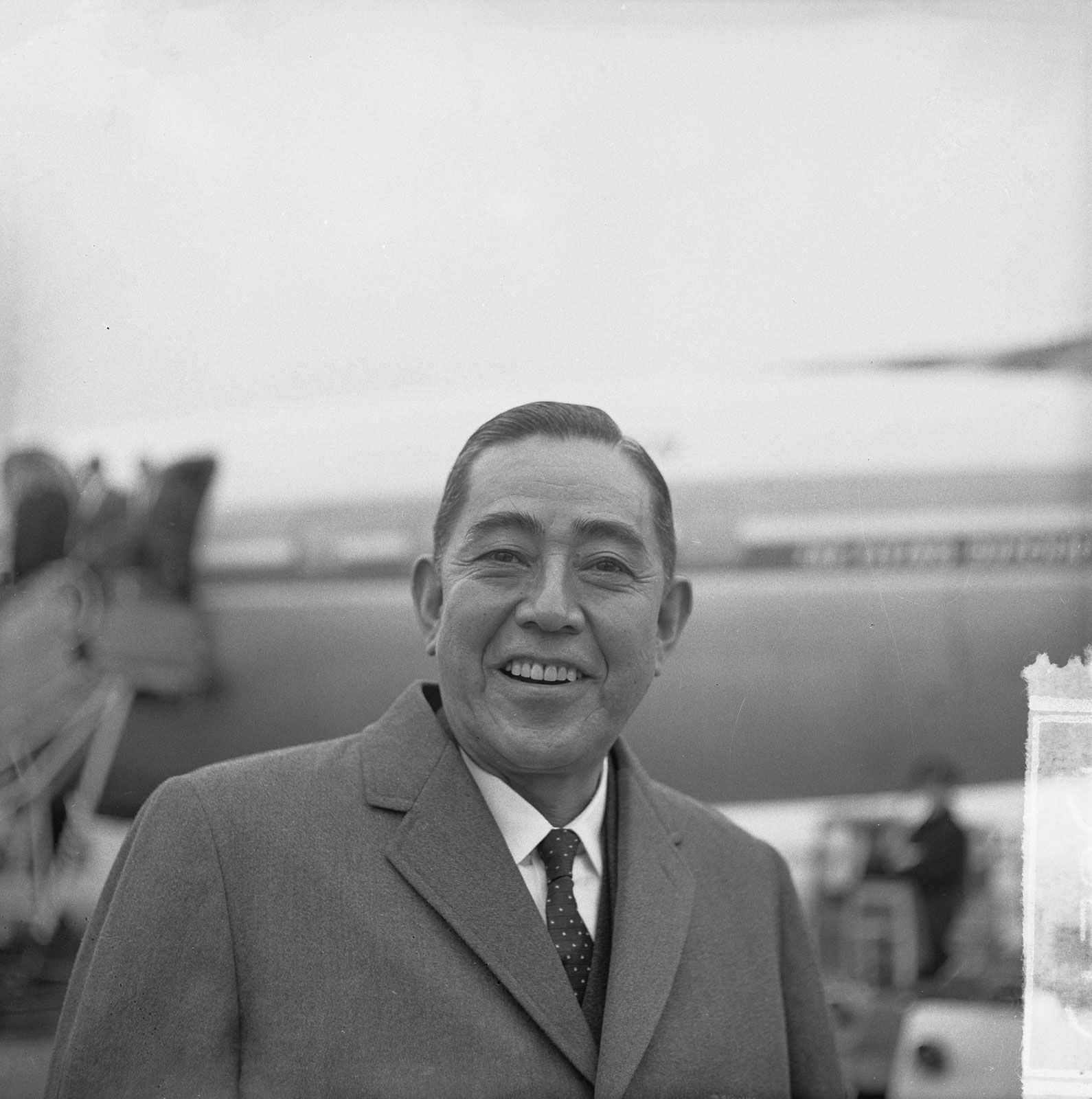
Eisaku Satō
 Japan
JapanBirthday
+1901-03-27
Birth Sign
Sagittarius
Birthplace
Tabuse
Age
Died at 74
About
Eisaku Satō, born on March 27, 1901, in the small town of Tabuse in Yamaguchi Prefecture, was a Japanese politician who served as prime minister from 1964 to 1972. He remains the third longest-serving prime minister in Japan's history, and his tenure was the longest uninterrupted, a record that still stands. Satō came from a prominent political family; his older brother, Nobusuke Kishi, also served as prime minister, and his grandson, Shinzo Abe, would later hold the office. After graduating from Tokyo Imperial University in 1924, Satō joined the Ministry of Railways, beginning a career as an elite bureaucrat that mirrored his brother's path. He entered the National Diet in 1949 as a member of the Liberal Party, and under Prime Minister Shigeru Yoshida, he held several cabinet posts, including posts and telecommunications minister, construction minister, and chief cabinet secretary. Later, as a member of the Liberal Democratic Party, he served as finance minister under his brother and as minister of international trade and industry under Hayato Ikeda. In 1964, Satō succeeded Ikeda as party president and prime minister, backed by Japan's business and financial elites. His time in office coincided with a period of rapid economic growth, and he supported Keynesian policies that helped sustain the boom. On the foreign policy front, Satō normalized diplomatic relations with South Korea in 1965, maintained close ties with the United States, and oversaw the renewal of the U.S.-Japan Security Treaty in 1970. His most celebrated achievement came in 1972 when he secured the return of Okinawa to Japanese administration, a move that had been a long-standing national aspiration. That same year, he introduced the Three Non-Nuclear Principles, which declared that Japan would not produce, possess, or allow the introduction of nuclear weapons. In 1968, he signed the Nuclear Non-Proliferation Treaty, and in 1974, he was awarded the Nobel Peace Prize for his efforts. However, the prize stirred controversy when it later emerged that Satō had made secret agreements with the U.S. that allowed violations of the non-nuclear principles. Despite his successes, Satō's later years in office were marked by mounting economic problems and falling approval ratings. He resigned in 1972, and his chosen successor, Takeo Fukuda, failed to win the party leadership, leaving Satō without a strong political heir. His influence quickly waned, and he died on June 3, 1975, at the age of 74. Satō's legacy is a mix of diplomatic triumphs and policy contradictions, but his role in shaping postwar Japan's security and economic trajectory remains significant.
Fame & Fandom
Eisaku Satō, a titan of postwar Japanese politics, has been evaluated by iFANN's Global Fame Engine but currently holds no placement in the published rankings. This means that while his historical significance is undeniable, his contemporary fame footprint does not place him among the world's top 1,000 most famous figures or within any top-100 scope list. His renown, such as it is, rests on his record-breaking tenure as prime minister and his Nobel Peace Prize, rather than on any sustained global media presence in the digital age.
His fanbase, if it can be called that, has no formal name. There is no documented fandom community, no fan clubs, no conventions, and no organized rituals. Instead, his admirers are primarily conservative voters, historians, and students of Japanese diplomacy who respect his statesmanship. The closest thing to a devoted following exists among political science enthusiasts who debate his legacy, particularly the tension between his public anti-nuclear principles and the secret agreements revealed decades later. This is a scholarly fascination, not a fan culture, and it remains unnamed.
Interesting Facts and Legends
Satō's premiership was marked by several legendary moments that continue to define his legacy. His articulation of the Three Non-Nuclear Principles in 1967, not to possess, produce, or permit the introduction of nuclear weapons into Japan, became a cornerstone of postwar Japanese identity and was formally adopted by the Diet in 1971. This policy, for which he won the Nobel Peace Prize in 1974, remains his most celebrated achievement.
Yet the most intriguing story surrounding Satō is the secret nuclear pacts controversy. Declassified documents have revealed that, despite his public stance, he entered into secret agreements with the United States allowing nuclear weapons to transit through Okinawa. This gap between his public peace platform and private diplomatic maneuvering has become the defining interpretive debate about his career, a story that historians and journalists continue to dissect.
Another iconic moment was the successful reversion of Okinawa to Japanese control in 1972, a crowning diplomatic achievement. His record-breaking tenure of nearly eight years, uninterrupted, was itself part of his legend, symbolizing a steady hand during Japan's postwar resurgence. That record stood until Shinzo Abe surpassed it in 2020, adding a familial echo to his story.
Death & Aftermath
Died
+1975-06-03 (aged 74)
Death Place
Tokyo, Japan
Cause of Death
Stroke
The family of Eisaku Satō announced the passing of the former Prime Minister and Nobel Peace Prize laureate at a Tokyo hospital, confirming that he had died after a prolonged period of illness. The circumstances surrounding his final days began on May 19, 1975, when Satō suffered a stroke while dining at a restaurant in Tokyo, an event that caused him to lapse into a coma. His condition remained precarious following this initial health crisis until he ultimately passed away, with the date of death recorded as June 3, 1975, according to contemporaneous reporting from major news outlets like The New York Times. The cause was established as a stroke, a conclusion drawn from hospital and family statements. Public reaction to his death reflected his stature as a key figure in post-war Japanese diplomacy and the first Asian recipient of the Nobel Peace Prize.
Government officials and international bodies offered high-level tributes, focusing heavily on his tenure as the longest-serving prime minister in Japan's history up to that point and his role in signing the Nuclear Non-Proliferation Treaty. While specific details of public vigils or memorial services are not documented in the immediate records, his legacy was instantly recognized through the continued citation of his Nobel Lecture and the historical significance of his three non-nuclear principles. The state protocol for such a figure naturally included honors befitting his rank, though the specifics of the funeral arrangements remain within the realm of standard procedure rather than detailed public record. In the decades following his death, Satō's reputation underwent significant re-evaluation by historians and academic institutions like the University of Tokyo.
Later revelations regarding secret nuclear agreements between Satō and the United States concerning Okinawa added complex layers to his historical standing, with documents confirmed in 2023 acknowledging a pact to place US nuclear weapons in Okinawa, a fact previously denied. These disclosures, along with the opening of a suicide note by a former negotiator in 2025, shed light on the immense pressures Satō faced during negotiations, yet these developments occurred long after the mourning period and did not alter the immediate respect accorded to his memory.
Awards & Accolades
Keywords
Quick Facts
- Profession
- politician
- Born
- +1901-03-27
- Birthplace
- Tabuse
- Died
- +1975-06-03
- Death Place
- The Jikei University Hospital
- Gender
- Male
- Spouse
- Hiroko Satō
- Birth Sign
- Sagittarius
Personal Details
- Spouse
- Hiroko Satō
Join the community
fans discussing