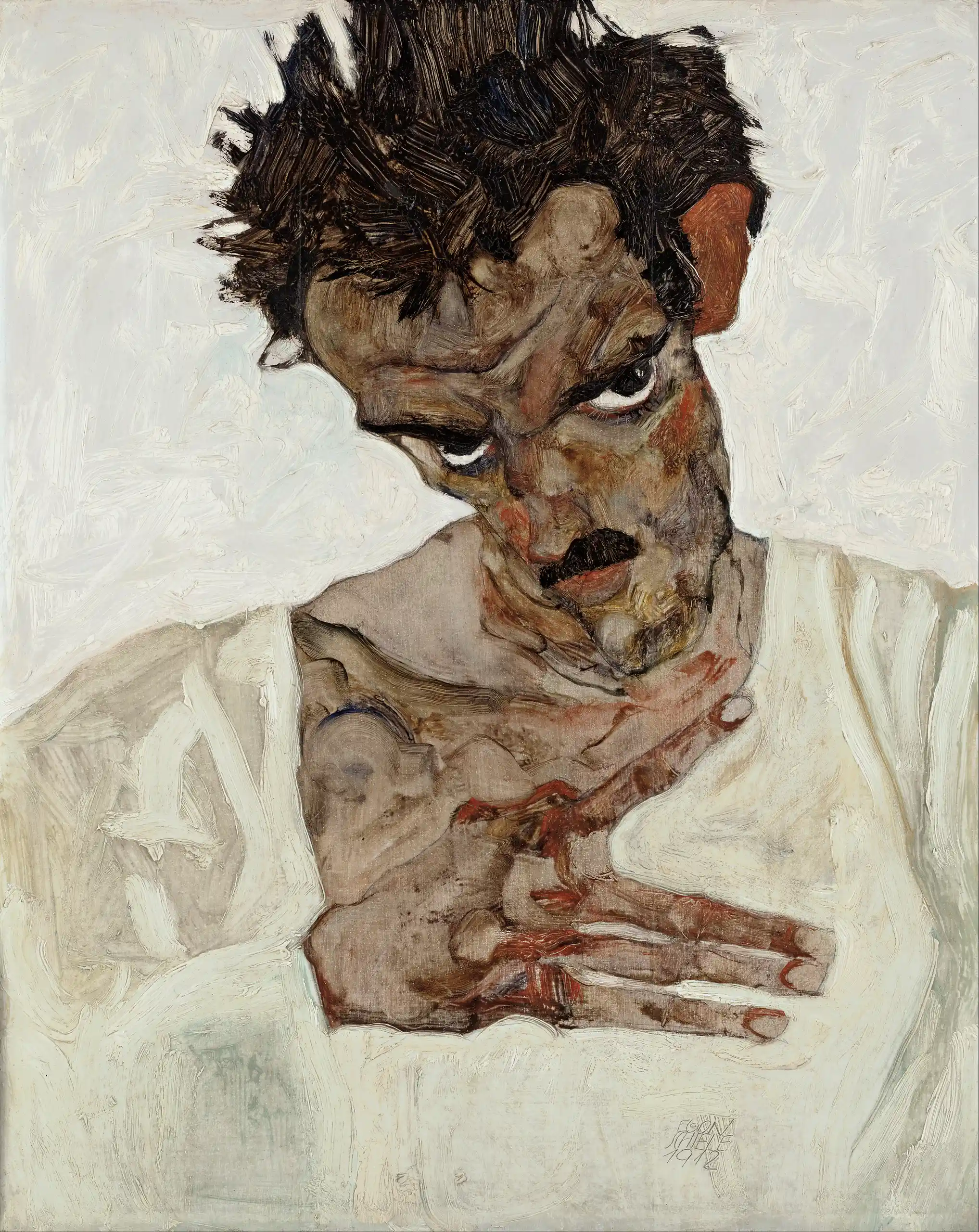
Egon Schiele
 Austria
painter•printmaker•draftsperson
Also known as: Egon L. A. L. Schiele, Egon Schiele
Birthday
June 12, 1890
Birth Sign
Gemini
Birthplace
Tulln an der Donau, Austria
Age
Died at 28
Height
5 ft 9 in (175 cm)
About
Egon Leo Adolf Ludwig Schiele was an Austrian Expressionist painter whose career burned with intense energy before ending at age 28. Born in Tulln an der Donau, he revolutionized early 20th-century art through raw depictions of the human body, sexuality, and psychological depth. His work rejected traditional beauty standards in favor of jagged lines, contorted poses, and unfiltered emotional exposure.
Though his life was tragically short, Schiele produced over 300 paintings and 3,000 drawings that continue to define the Expressionist movement. He is best known for his hundreds of self-portraits, which served as a mirror for his own physical and mental state. Today, his estate remains one of the most valuable in the art world, managed by major institutions like the Leopold Museum in Vienna and the Neue Galerie in New York.
Early Life & Background
Egon Schiele spent his early childhood in Tulln an der Donau before moving to Krems an der Donau at age six. It was in this small town where his artistic talent first emerged; he attended elementary school there and began drawing obsessively. By fifteen, his skill was so advanced that he gained admission to the School of Arts and Crafts in Vienna. The following year, at just sixteen, he enrolled at the Academy of Fine Arts Vienna under Christian Griepenkerl.
Schiele quickly chafed against the conservative academic curriculum, finding it stifling compared to the avant-garde styles he admired. Gustav Klimt became his mentor and patron during this period, introducing him to influential circles and patrons. In 1909, Schiele left the Academy to establish his own studio, marking the start of his independent career. He joined the 'Neue Kunstgenossenschaft' and held his first solo exhibition in Prague, signaling his arrival as a serious artist ready to challenge conventions.
Career Growth
Schiele's professional breakthrough arrived swiftly after leaving the Academy. In 1909, he held his first solo exhibition in Prague, followed by a major showing in Vienna the next year where he painted Portrait of Dr. Erwin von Graff. His work gained international traction through exhibitions in Berlin, Paris, and London, though it also drew controversy. In 1911, he faced legal troubles when arrested and imprisoned for 24 days on charges of public indecency related to his art and behavior. This scandal only galvanized his supporters and increased his notoriety among the avant-garde community.
By 1912, he moved to Krumau (now Český Krumlov) and established a permanent studio there. He published The World, a portfolio of 24 lithographs, in 1913, further cementing his reputation. During World War I, he served briefly in the military but was exempted due to poor health. Despite the war and worsening personal circumstances, he maintained a prolific output until his final months. In October 1918, while suffering from the Spanish Flu, he painted his last self-portrait just days before his death.
Career Timeline
Public Image & Style
Schiele is remembered as a tragic genius who defied the conventions of his time. Media and critics emphasize his vulnerability, his struggle with poverty, and his untimely death. His public persona was that of a rebel against the establishment, a man who refused to compromise his vision for commercial success. His work is characterized by jagged lines, contorted bodies, and a raw, unfiltered view of humanity. Modern audiences often associate him with the darker aspects of the human condition, viewing his art as a window into his own psyche.
Fame & Fandom (iFAMOUS Rankings)
Egon Schiele commands a global audience of art historians, collectors, and admirers of Expressionism who engage with his work through museum exhibitions and high-profile auctions rather than modern fan rituals. The cultural mythology surrounding him is rooted in verified historical events concerning his life, legal troubles, and artistic style, including the intense eroticism of his figurative works that challenged early 20th-century Vienna and the 1912 arrest for corrupting youth which remains a central piece of his lore. His legacy is further cemented by the tragic narrative of his untimely death at age 28 from the Spanish flu pandemic alongside his wife Edith, an event often cited to illustrate the potential cut short by the global crisis. Specific anecdotes frequently referenced include the portrait painted as repayment to Dr. Erwin von Graff and the description of his subjects feeling like a "skinned hare" attributed to model Liliana Amon. While recent exhibitions at institutions like the Neue Galerie in New York have renewed interest in his oeuvre, there are no organized fan groups, unofficial nicknames for fans, or fan-funded projects dedicated to him. The iFANN Global Fame Rankings do not yet include Egon Schiele in their current evaluations. Consequently, no specific ranking position can be assigned to his global fame metrics at this time. The fanbase has no formal name. The audience for his work consists entirely of professionals and enthusiasts who appreciate his raw depictions of the human body and psychological depth without the structured community behaviors seen in contemporary celebrity culture.
Interesting Facts and Legends
Schiele created nearly 100 self-portraits, a number unmatched by any other artist of his time. He used these works to explore his identity, often painting himself nude or in states of vulnerability. Another striking fact is his sheer productivity; in less than a decade, he produced approximately 300 paintings and over 3,000 drawings on paper. His 1911 arrest for public indecency remains a defining moment in his biography, often cited as a testament to his rebellious nature. He was accused of seducing minors and drawing nudes in public spaces, though he was eventually acquitted. Recent discussions highlight how his depiction of the naked form challenged societal norms, creating what some call a 'sacred space' for the human body in art.
Notable Quotes
“To restrict the artist is a crime. It is to murder germinating life.”
“I am my own best subject.”
Family & Personal Life
Egon was born to Adolf Carl Schiele, a railway station master, and Marie Gutmann. He had a close relationship with his family during his youth before moving out to pursue art. His sister, Gerti, lived with him and Edith in their final years. There are no records of children surviving to adulthood; Edith suffered a miscarriage shortly before her death. The couple lived in poverty for much of their marriage, relying on the sale of artworks and occasional patronage to survive. Their home in Krumau became a hub for artists and intellectuals, though financial struggles were constant.
Notable Connections
Gustav Klimt, Edith Schiele, Wally Neuzil, Dr. Erwin von Graff, Oskar Kokoschka.
Relationships & Dating History
Egon Schiele's personal life was as turbulent and intense as his art. He met Edith Harms in 1915, and they were engaged later that year. They married on October 17, 1915, in a ceremony marked by deep emotional connection and shared artistic interests. Edith was pregnant with their first child at the time of their marriage, though she suffered a miscarriage or lost the pregnancy shortly before her death. Their relationship was strained by financial hardship and Schiele's infidelities, yet they remained devoted to each other until the end.
Before marrying Edith, Schiele had several documented relationships, including with Valerie Neuzil and her sister Wally Neuzil, who served as his primary model for years. These relationships were often short-lived and complicated by his intense emotional needs. Tragically, both Egon and Edith died just weeks apart in October 1918 from the Spanish Flu pandemic. Edith passed on October 28, and Egon followed three days later on October 31, leaving no surviving children.
- MarriedEdith Schiele1915 - 1918Married in 1915; both died of Spanish Flu in October 1918.
- DatedWally Neuzil1911 - 1915Primary model for years; relationship ended before marriage to Edith.
- DatedValerie Neuzil1910 - 1911Short-lived relationship; sister of Wally Neuzil.
Death & Aftermath
Died
October 31, 1918 (aged 28)
Death Place
Vienna, Austria
Cause of Death
Acute influenza (Spanish Flu)
Egon Schiele died on October 31, 1918, in Vienna, Austria, at the age of 28. He succumbed to acute influenza complicated by malnutrition and physical collapse following a rapid decline alongside his pregnant wife, Edith Harms-Schiele, who had passed three days prior. While historical speculation occasionally suggested a suicide pact or mental distress, medical consensus attributes the fatalities to the Spanish Flu pandemic that swept through Vienna during the final months of World War I. The immediate reaction within the Viennese art community was marked by private tributes rather than public vigils, with peers like Oskar Kokoschka expressing grief in letters while the world remained embroiled in war and disease.
Schiele was buried on November 5, 1918, in the Protestant section of Hietzing Cemetery, where he rests beside his wife in a quiet affair attended only by family and close friends. Posthumous management of his estate fell to his stepmother and later the Leopold Museum, which now holds the largest collection of his works. His legacy expanded significantly in subsequent decades through catalogues raisonnés and major exhibitions.
Net Worth (Estate Value)
$2.5 Billion
iFANN Editorial Team estimate
The iFANN Editorial Team estimates the value of Egon Schiele's estate at approximately $2.5 Billion. As of 2026, individual paintings regularly sell for between $20 million and $50 million at auction, with some pieces exceeding $30 million. The estate generates substantial revenue through licensing deals, book publications, exhibition fees, and the sale of original works and prints. Major institutions like the Leopold Foundation manage the collection, ensuring its preservation and continued financial growth. Recent sales, such as Bettina Morska selling for over $19 million in 2013 and Self-Portrait with Striped Shirt fetching $28.2 million in 2015.
Awards Won (2)
Schiele received no formal state awards during his lifetime due to his controversial nature. Posthumously, he has been honored extensively through museum dedications and recognition as a master of Austrian Expressionism. The Leopold Museum, established in 1998, houses the world's largest collection of his works. The Egon Schiele Art Centrum in Český Krumlov opened in 2004 to celebrate his legacy. His works consistently rank among the highest-priced paintings sold at auction, with Self-Portrait with Striped Shirt selling for $28.2 million in 2015.
1998 · Museum Establishment
World's largest collection of Schiele's works
2004 · Museum Dedication
Museum dedicated to his work
Known For
Portrait of Dr. Erwin von Graff
1910 · painting
Self-Portrait with Striped Shirt
1912 · painting
The Family
1918 · painting
Death and the Maiden
1915 · painting
Keywords
Sources
Quick Facts
- Profession
- painter, printmaker, draftsperson
- Born
- June 12, 1890
- Birthplace
- Tulln an der Donau
- Died
- October 31, 1918
- Death Place
- Vienna
- Gender
- Male
- Spouse
- Edith Schiele
- Birth Sign
- Gemini
Personal Details
- Full Name
- Egon Leo Adolf Ludwig Schiele
- Height
- 5 ft 9 in (175 cm)
- Spouse
- Edith Schiele
- Children
- Education
- Academy of Fine Arts Vienna; School of Arts and Crafts Vienna
Frequently Asked Questions
How old was Egon Schiele when he died?
Who was Egon Schiele's wife?
Why is Egon Schiele famous?
Did Egon Schiele have any children?
Where can I see Egon Schiele's art?
Join the community
fans discussing