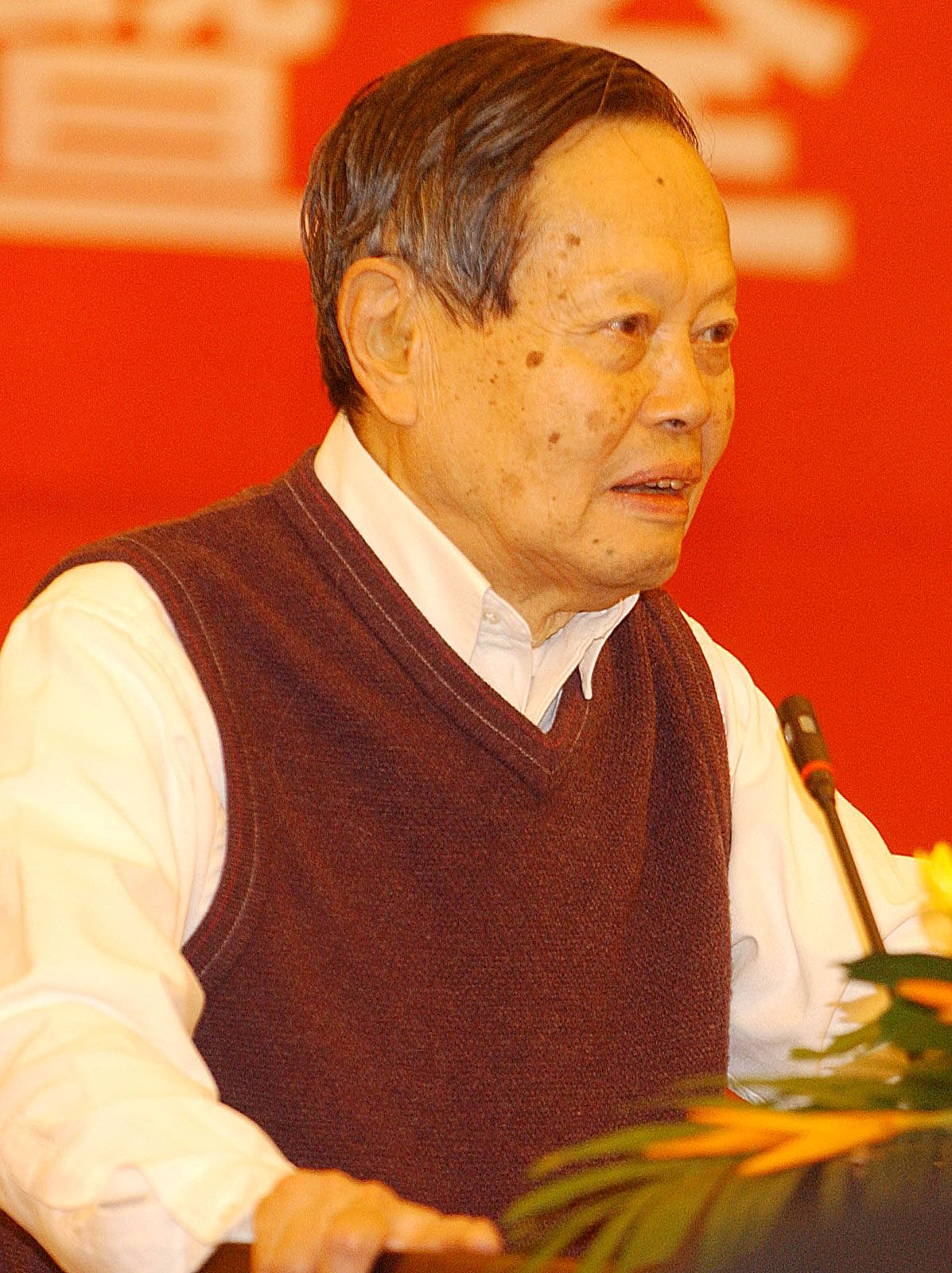
Chen-ning Yang
 China
ChinaAlso known as: Frank Yang, Franklin Yang, 杨振宁
Birthday
October 1, 1922
Birth Sign
Libra
Birthplace
Hefei, Anhui, China
Age
Died at 103
About
Chen-ning Yang was a Chinese-American theoretical physicist whose work reshaped modern physics. Born in Hefei, China, he became one of the most influential scientists of the 20th century, known for the Yang–Mills theory and his Nobel Prize-winning insight into parity violation. He spent his career bridging Eastern and Western scientific traditions, with appointments at Princeton's Institute for Advanced Study, Stony Brook University, and finally Tsinghua University in Beijing.
Yang's legacy rests on two monumental achievements. With Robert Mills in 1954, he developed the Yang–Mills gauge theory, now a cornerstone of the Standard Model of particle physics. Three years later, he shared the 1957 Nobel Prize in Physics with Tsung-Dao Lee for proposing that parity conservation is violated in weak nuclear interactions, a bold idea confirmed by the Wu experiment. These discoveries fundamentally altered how physicists understand the forces governing the universe.
Beyond his research, Yang devoted himself to rebuilding Chinese physics after the Cultural Revolution, becoming the first prominent Chinese-American scientist to visit China in 1971. He continued teaching and mentoring until his death on October 18, 2025, in Beijing, at the age of 103. His quiet, modest demeanor belied a mind that repeatedly found order in the chaos of subatomic reality.
Early Life & Background
Yang Chen-ning was born on October 1, 1922, in Hefei, Anhui Province, the eldest of five children. His father, Ko-Chuen Yang, was a mathematician who had earned his PhD at the University of Chicago under Leonard Dickson, and the family lived on the Tsinghua University campus outside Beijing, where his father taught. Growing up in that scholarly atmosphere, young Yang absorbed a love of learning early.
He attended Chung Te Middle School in Beijing before transferring to a provincial school in Hefei. When the family moved to Kunming during the Sino-Japanese War, he continued his studies at Kun Hua Middle School. A biography of Benjamin Franklin inspired him to adopt Franklin as a nickname, later shortened to Frank. His father introduced him to representation theory, sparking a lifelong fascination with symmetry and group theory.
In 1938, Yang enrolled at the National Southwest Associated University in Kunming, earning his B.Sc. in 1942, followed by an M.Sc. from Tsinghua University in 1944. After teaching briefly, he won a Tsinghua fellowship to study in the United States, arriving at the University of Chicago in January 1946. There, Enrico Fermi became his mentor, teaching him that physics must be built from the ground up. Yang completed his PhD in 1948 and stayed on as an instructor for a year before moving to Princeton's Institute for Advanced Study.
Career Growth
Yang's breakthrough came in 1954 when he and Robert Mills formulated the Yang–Mills theory, a non-abelian gauge theory that would become essential to the Standard Model. The theory generalizes Maxwell's equations and provides the framework for the strong and weak nuclear forces. Three years later, he and Tsung-Dao Lee proposed that parity, a symmetry long assumed to hold, is violated in weak interactions. The Wu experiment confirmed this, and they received the 1957 Nobel Prize in Physics, becoming the first Chinese Nobel laureates.
Yang remained at Princeton's Institute for Advanced Study until 1966, when he moved to Stony Brook University as the Albert Einstein Professor and founding director of the Institute for Theoretical Physics, now named the C.N. Yang Institute for Theoretical Physics. In 1967, he discovered the Yang–Baxter equation, a pivotal relation in statistical mechanics and integrable systems that opened new fields in mathematics and physics.
After the thaw in US–China relations, Yang visited China in 1971, the first prominent Chinese-American scientist to do so. He worked to rebuild Chinese physics, helping establish the Committee on Educational Exchange with China and later serving as honorary director of the Center for Advanced Study at Tsinghua University. He retired from Stony Brook in 1999 and returned to Tsinghua as a professor, where he continued to teach and mentor until his death in 2025.
Career Timeline
Public Image & Style
Yang was known as a quiet, modest, and affable physicist, a hard worker who allowed himself little leisure. He embodied a bridge between Eastern and Western scientific traditions, having grown up in China and trained in the United States. The media often portrayed him as having the best of two worlds. His scientific legacy was monumental, but he remained personally unassuming, preferring deep thought to public spectacle. Colleagues remembered his precise lectures and his dedication to mentoring young physicists, both in the US and China. His name adorns the C.N. Yang Institute for Theoretical Physics, a lasting tribute to his influence.
Fame & Fandom (iFAMOUS Rankings)
The scientific community and the general public maintain a legacy of respect for Chen-ning Yang, yet no formal fan organization, club, or named fandom exists to organize collective rituals or campaigns around his memory. His audience consists primarily of historians of science, students of physics, and admirers of his intellectual endurance rather than a demographic engaging in modern celebrity culture. Despite this lack of organized fandom, his standing in global historical prominence remains significant according to the iFANN Global Fame Rankings. As of August 2026, he is recognized as the 81st most famous person in China, a position holding steady from the previous cycle. He also ranks as the 85th most famous person from China, having shifted down from the 83rd spot in the prior assessment. These placements reflect enduring attention across media coverage, search activity, and cultural consumption signals worldwide. The rankings confirm that while he lacks the viral machinery of contemporary entertainment figures, his name retains substantial weight in historical records and academic discourse.
Interesting Facts and Legends
Chen-ning Yang's official birth date appeared as September 22, 1922, on his 1945 passport due to an administrative error, a date he subsequently used on all documents. He adopted the nickname Frank after reading a biography of Benjamin Franklin during his childhood. Yang played a pivotal role in establishing the Committee on Educational Exchange with China, which facilitated nearly 100 Chinese scholars studying in the United States. He was one of two founding members of the Shaw Prize, a prestigious international science award. His father had previously studied at the University of Chicago, creating a two-generation connection between the family and the institution. In an interview with The New Yorker, Yang recalled that Enrico Fermi taught him abstractions must follow detailed foundation work rather than precede it. A central narrative in his legend involves his discovery of parity violation alongside Tsung-Dao Lee, an event that led to their 1957 Nobel Prize and revolutionized the understanding of fundamental symmetries. His longevity further cemented his status; living to 103 years old, he remained scientifically active until his death in Beijing on October 18, 2025, marking the end of an era for 20th-century theoretical physics.
Notable Quotes
“Physics should not be a specialist's subject; physics is to be built from the ground up, brick by brick, layer by layer.”
“Life can be said to form a circle.”
Family & Personal Life
Yang was the eldest of five children born to Ko-Chuen Yang, a mathematician, and Luo Meng-hua Yang. His father's academic career at Tsinghua University shaped Yang's early years on the campus. Yang married Du Zhili (Chih Li Tu) in 1950, and they had three children: Franklin (born 1951), Gilbert (born 1958), and Eulee (born 1961). Du Zhili passed away before Yang's return to China in 2003. In his later years, he married Fan Weng, who survived him at his death in 2025. Yang described his return to Tsinghua as his life forming a circle, returning to his childhood home.
Notable Connections
Yang's closest collaborators included Robert Mills, with whom he developed the Yang–Mills theory, and Tsung-Dao Lee, his Nobel co-recipient. His doctoral advisor Enrico Fermi profoundly influenced his approach to physics. His father, Ko-Chuen Yang, was a mathematician who shaped his early interest in symmetry. His first wife, Du Zhili, and second wife, Fan Weng, were central to his personal life.
Relationships & Dating History
Yang met his first wife, Du Zhili (Chih Li Tu), while teaching mathematics at her high school in China. They married in 1950 and had three children together: Franklin, Gilbert, and Eulee. Their marriage lasted until Du Zhili's death, which occurred before Yang's return to China in 2003. After moving back to Tsinghua University, Yang married Fan Weng in his later years, a union that CERN Courier noted was part of his life forming a circle. He remained married to Fan Weng until his death on October 18, 2025.
- MarriedDu Zhili1950 - presentFirst wife, mother of their three children; she passed away before Yang's return to China in 2003.
- MarriedFan Weng2003 - 2025CurrentSecond wife, married in his later years after returning to China.
Death & Aftermath
Died
October 18, 2025 (aged 103)
Death Place
Beijing, China
Cause of Death
Natural causes associated with advanced age
The scientific community and global media reacted with immediate tributes upon the announcement of his death, with Stony Brook University honoring him as a towering figure who defined the institution's scientific excellence. Nature published an obituary describing him as an intuitive physicist whose work was inspired by the beauty of symmetry, while major outlets like The New York Times and Associated Press emphasized his shared 1957 Nobel Prize for the discovery of parity non-conservation. Chen-ning Yang passed away on October 18, 2025, in Beijing, China, shortly after celebrating his 103rd birthday. Official reports from multiple sources stated he died at the age of 103 without specifying a particular pathological cause, implying natural causes associated with advanced age.
Specific details regarding the date, time, and location of a funeral or memorial service were not included in available news coverage, with reports indicating that the family likely held private ceremonies given the cultural context. Following his death, retrospective publications such as a feature in Nuclear Science Review titled Giant of physics, in memory of Chen-Ning Yang were announced, and the C.N. Yang Institute for Theoretical Physics at Stony Brook continued its existing scholarship programs in his name.
Net Worth (Estate Value)
$10 Million
iFANN Editorial Team estimate
Chen-ning Yang's financial standing reflected the typical profile of a distinguished theoretical physicist rather than a commercial entrepreneur. His income derived primarily from academic salaries held at Princeton, Stony Brook, and Tsinghua University, supplemented by the Nobel Prize money awarded in 1957. There were no documented business ventures or endorsement deals associated with his career. Per iFANN's editorial analysis, his estate is estimated at $10 Million as of 2026, a figure reflecting his academic earnings and prudent savings over a long life. The Nobel Prize award, shared with Tsung-Dao Lee, amounted to approximately $250,000 in 1957, a substantial sum at that time. His later tenure at Tsinghua included an honorary professorship with a modest salary. No major posthumous revenue streams such as book royalties or licensing agreements have been reported. The estate remains under family management, with his wife Fan Weng identified as a likely beneficiary.
Awards Won (6)
Chen-ning Yang received the 1957 Nobel Prize in Physics, shared with Tsung-Dao Lee, for their work on parity non-conservation. He also won the Albert Einstein Commemorative Award in 1957, the Rumford Premium in 1980, the U.S. National Medal of Science in 1986, the Benjamin Franklin Medal in 1993, and the Lars Onsager Prize, among others.
1999 · Physics
Statistical mechanics
1957 · Physics
Parity non-conservation in weak interactions
Known For
Yang–Mills theory
1954 · Co-developer with Robert Mills
Parity non-conservation
1956 · Proposed with Tsung-Dao Lee
Nobel Prize in Physics
1957 · Co-recipient
Yang–Baxter equation
1967 · Discoverer
Keywords
Sources
Quick Facts
- Profession
- Theoretical physicist
- Born
- October 1, 1922
- Birthplace
- Hefei, Anhui, China
- Died
- October 18, 2025
- Death Place
- Beijing, China
- Gender
- Male
- Spouse
- Du Zhili (1950–?), Fan Weng (?–2025)
- Birth Sign
- Libra
Personal Details
- Full Name
- 杨振宁 (Yáng Zhènníng)
- Spouse
- Fan Weng
- Children
- Franklin Yang, Gilbert Yang, Eulee Yang
- Education
- B.Sc. National Southwest Associated University (1942), M.Sc. Tsinghua University (1944), Ph.D. University of Chicago (1948)
Frequently Asked Questions
How old was Chen-ning Yang when he died?
What did Chen-ning Yang win the Nobel Prize for?
Who was Chen-ning Yang's wife?
What is the Yang-Mills theory?
What was Chen-ning Yang's net worth?
Similar People
Join the community
fans discussing