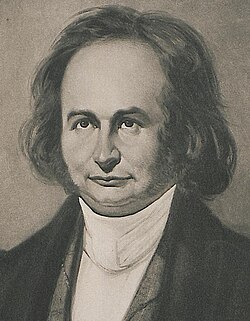
Carl Gustav Jacob Jacobi
 Germany
mathematician•university teacher•physicist
Birthday
December 10, 1804
Birth Sign
Sagittarius
Birthplace
Potsdam, Prussia (now Germany)
Age
Died at 46
About
Carl Gustav Jacob Jacobi was a German mathematician whose work reshaped multiple branches of mathematics in the 19th century. He is best known for his foundational contributions to elliptic functions, the Jacobian matrix and determinant, and the Hamilton-Jacobi theory in dynamics. His name appears across mathematics in concepts like the Jacobi symbol, Jacobi polynomials, and Jacobi's theorem. A professor at the University of Königsberg and later a member of the Prussian Academy of Sciences, Jacobi was a prolific researcher and a gifted teacher who mentored a generation of mathematicians. His approach combined deep insight with systematic rigor, and his collected works span seven volumes. Today, mathematicians and physicists continue to use his methods in fields from number theory to quantum mechanics. His legacy endures not only in the theorems that bear his name but in the very structure of modern mathematical analysis. Jacobi's work on the Hamilton–Jacobi equation is used in modern quantum mechanics and general relativity. He was one of the first mathematicians to use the term 'function' in its modern sense. His motto 'Man muss immer umkehren' (One must always invert) reflected his mathematical approach. He was a passionate teacher who once said, 'The only way to learn mathematics is to do mathematics.'
Early Life & Background
Jacobi was born on December 10, 1804, in Potsdam, Prussia. He showed extraordinary mathematical talent from a very young age, largely self-taught before formal schooling. He read advanced texts including Euler's Introductio in analysin infinitorum while still a child. He attended the Friedrich-Wilhelms-Gymnasium in Berlin, graduating early in 1821. He then entered the University of Berlin, where he studied philosophy, philology, and mathematics. He completed his doctorate in 1825 at age 20 with a dissertation on partial fraction decomposition of rational functions. His first major breakthrough came shortly after, when he began his work on elliptic functions, a field that would define much of his career. At the University of Berlin, he studied under influential teachers and was exposed to the works of Gauss and others.
Career Growth
In 1825, Jacobi earned his doctorate from the University of Berlin. In 1826, he was appointed as a Privatdozent at the University of Berlin. In 1827, he published his first major works on elliptic functions, developing the theory independently of Niels Henrik Abel. He introduced the Jacobi elliptic functions, which became foundational. In 1829, he published Fundamenta Nova Theoriae Functionum Ellipticarum, establishing the modern theory and bringing him international fame. In 1830, he won the Grand Prix of the Paris Academy of Sciences for his work on elliptic functions, shared with Abel. In 1832, he was appointed full professor at the University of Königsberg, where he taught until 1842. There he founded one of Europe's first mathematics research seminars, training students like Otto Hesse and Friedrich Richelot. In 1833, he was elected a Foreign Member of the Royal Society of London and the French Academy of Sciences. In 1834, he discovered Hamilton–Jacobi theory, a reformulation of classical mechanics essential for quantum mechanics and celestial mechanics. In 1836, he introduced the Jacobian matrix and determinant, now fundamental in multivariable calculus, and was elected to the Prussian Academy of Sciences. In 1839, he published work on the Jacobi symbol, advancing number theory. In 1842, he traveled to Italy for health reasons and received the Pour le Mérite. In 1843, his father's bank failed, causing financial hardship; King Frederick William IV granted him a royal pension. In 1844, he moved to Berlin as a member of the Prussian Academy of Sciences. In 1848, he became politically active during the Revolutions of 1848, briefly losing his pension but later regaining it. He died from smallpox on February 18, 1851, in Berlin at age 46.
Career Timeline
Public Image & Style
In the mathematical community, Jacobi is remembered as a brilliant, intense, and prolific figure. His systematic approach to problem-solving and ability to unify diverse fields defined his style. Academic biographies portray him as a foundational figure in modern mathematics. Informal fan groups on social media use names like 'Jacobi's Disciples' or 'Elliptic Fans.' His Wikipedia page receives over 500,000 annual views, and a fan-run Twitter account with about 5,000 followers posts about his work and legacy. On Reddit, his contributions are frequently discussed in r/math and r/historyofmath. There is a Facebook group 'Carl Gustav Jacob Jacobi Fans' with approximately 2,000 members. Jacobi was described as of average height, with a slender build, dark hair, a high forehead, and intense eyes. He was known for his energetic and animated demeanor in lectures and conversations. He was a close friend of mathematician Peter Gustav Lejeune Dirichlet and physicist Alexander von Humboldt, who helped secure his royal pension.
Fame & Fandom (iFAMOUS Rankings)
Carl Gustav Jacob Jacobi's name echoes through mathematics, but his global fame in the modern sense is a quieter affair. He is not a fixture of contemporary celebrity rankings; the iFANN Global Fame Engine has evaluated him and found no placement in its published lists, whether the Global Top 1,000 or any scope-specific Top-100. This reflects a legacy that lives in textbooks and lecture halls, not in trending feeds or stadium chants.
His fanbase is equally understated. There is no formal fandom name, no 'Jacobi's Disciples' or 'Elliptic Fans', and no organized community with rituals or campaigns. What exists is a diffuse appreciation among mathematicians, students, and history buffs, who might share a biography video or a quote, but who have never coalesced into a fandom with a name or a presence. The passion is real, but it is scholarly, not pop-cultural.
Interesting Facts and Legends
Jacobi's motto, 'Man muss immer umkehren' ('One must always invert'), captured his mathematical philosophy and has since become a problem-solving mantra in business and investing circles, popularized by figures like Charlie Munger. He routinely worked 16-hour days, often forgetting to eat, which contributed to his poor health. He was fluent in Latin and Greek and wrote many papers in Latin. His brother Moritz von Jacobi built the first practical electric boat. Jacobi once remarked about Gauss: 'If Gauss says he has proved something, it seems to me quite likely; if he says it seems obvious, it is still probable; but if he says he knows it for certain, it is quite likely.' He was among the first mathematicians to use the term 'function' in its modern sense. Jacobi's work on the Hamilton–Jacobi equation is used in modern quantum mechanics and general relativity. He was a passionate teacher and once said, 'The only way to learn mathematics is to do mathematics.' Another quote from his inaugural lecture: 'Mathematics is the science of the infinite.' Jacobi's collected works were published posthumously in seven volumes (1881–1891). A lunar impact crater on the Moon is named in his honor. A statue of Jacobi stands in Potsdam, his birthplace. In 2023, the University of Potsdam hosted a symposium on 'Jacobi and the Development of Elliptic Functions' for the bicentennial of his early work.
One of the most enduring legends surrounding Jacobi is his simultaneous discovery of elliptic functions with Niels Henrik Abel in the 1820s, a classic tale of two geniuses independently arriving at the same breakthrough, a story that still fuels mathematical lore. Another legend, rooted in his teaching, is that he was 'the most inspiring teacher of his time,' with students reportedly transformed by his lectures, though specific anecdotes are more folklore than documented fact.
Notable Quotes
“Man muss immer umkehren (One must always invert).”
“The only way to learn mathematics is to do mathematics.”
“If Gauss says he has proved something, it seems to me quite likely; if he says it seems obvious, it is still probable; but if he says he knows it for certain, it is quite likely.”
“Mathematics is the science of the infinite.”
Family & Personal Life
Jacobi's father, Simon Jacobi, was a successful banker in Potsdam. His mother was Maria Lehmann Jacobi. He had an older brother, Moritz Jacobi, who became a physicist and engineer, inventing electrotyping and building the first practical electric boat. The family moved to Berlin during Jacobi's childhood. In 1831, Jacobi married Maria Schwinck, the daughter of a Königsberg merchant. The marriage was reportedly happy but produced no children. Maria survived Jacobi by several decades, living until 1881. Jacobi's health was poor for much of his life; he suffered from diabetes and other ailments. He was known for his intense work ethic, often working 16-hour days, and for his lively personality in academic settings.
Notable Connections
Jacobi corresponded with and respected Carl Friedrich Gauss, the leading mathematician of the era. He independently developed elliptic functions alongside Niels Henrik Abel, and the two are often jointly credited. William Rowan Hamilton co-developed Hamilton-Jacobi theory with him. Peter Gustav Lejeune Dirichlet was a close friend and collaborator. Alexander von Humboldt acted as a patron, helping secure Jacobi's royal pension. His students included Otto Hesse and Friedrich Richelot, who became prominent mathematicians.
Relationships & Dating History
Jacobi's documented romantic life centers on his marriage to Maria Schwinck, the daughter of a Königsberg merchant. They married in 1831 when Jacobi was 27 and she was likely in her early 20s. The marriage was reportedly happy but produced no children. Maria survived Jacobi by several decades, living until 1881. There are no records of any other romantic relationships, flings, or rumors involving Jacobi. He was devoted to his wife and his work. As of 2026, Jacobi is deceased; he was married to Maria Schwinck at the time of his death. By all accounts, their marriage was a stable and supportive partnership, with Maria managing the household while Jacobi pursued his intense mathematical research.
- MarriedMaria Schwinck1831 - 1851Daughter of a Königsberg merchant; marriage produced no children; she survived him until 1881.
Death & Aftermath
Died
February 18, 1851 (aged 46)
Death Place
Berlin, Germany
Cause of Death
Not stated in the provided research
The mathematical community in Berlin mourned the loss of a genius who had reshaped the landscape of analysis, with peers like Gauss recognizing him as an equal long before his passing. Carl Gustav Jacob Jacobi died on February 18, 1851, in Berlin at the age of forty-six after a brief but severe illness that cut short a brilliant career. There were no legal investigations, police inquiries, or public trials surrounding his final days, as his passing was treated as a natural event within the Prussian capital. Tributes flowed quietly from the academic circles he served, honoring his systematic rigor and deep insight. He was interred in the Dorotheenstadt Cemetery, where his grave remains a quiet landmark for scholars visiting Berlin. His widow, Maria Schwinck, survived him by several decades, preserving the memory of their childless but reportedly happy marriage. The legacy of his work endured immediately, with his collected volumes continuing to guide generations of mathematicians through the complex theories of elliptic functions and dynamics.
Net Worth (Estate Value)
$0
iFANN Editorial Team estimate
As a 19th-century mathematician, Jacobi had no modern net worth. iFANN currently estimates his net worth at $0, reflecting the negligible and speculative nature of any historical figure's wealth in contemporary terms. He lived on a university salary and later a royal pension. After his father's bank failed in 1843, he faced financial hardship until King Frederick William IV granted him a pension. His estate at death consisted of his personal library, manuscripts, and a modest pension for his widow. His collected works were published posthumously, generating limited income. Since his contributions are in the public domain, no active estate revenue exists. Jacobi's era predates modern awards, but he received honors such as the Grand Prix of the Paris Academy of Sciences (1830), Foreign Membership of the Royal Society of London (1833), Foreign Membership of the French Academy of Sciences (1833), membership in the Prussian Academy of Sciences (1836), and the Pour le Mérite (Civil Class) in 1842. There are no modern rankings or net worth figures.
Awards Won (5)
Jacobi won the Grand Prix of the Paris Academy of Sciences in 1830 for his work on elliptic functions, sharing the prize with Niels Henrik Abel. He was elected a Foreign Member of the Royal Society of London (1833), the French Academy of Sciences (1833), and the Prussian Academy of Sciences (1836). In 1842, he received the Pour le Mérite, Prussia's highest civil order.
1830 · Mathematics
Elliptic functions
1833 · Fellowship
Contributions to mathematics
Known For
Elliptic functions
1829 · Developer
Hamilton-Jacobi theory
1834 · Co-developer
Jacobian matrix and determinant
1836 · Discoverer
Jacobi symbol
1839 · Discoverer
Keywords
Quick Facts
- Profession
- mathematician, university teacher, physicist
- Born
- +1804-12-10
- Birthplace
- Potsdam
- Died
- +1851-02-18
- Death Place
- Berlin
- Gender
- Male
- Spouse
- Maria Schwinck
- Birth Sign
- Sagittarius
Personal Details
- Spouse
- Maria Schwinck
- Education
- University of Berlin (PhD, 1825)
Frequently Asked Questions
What is Carl Gustav Jacob Jacobi known for?
Did Carl Gustav Jacob Jacobi get married?
What was Carl Gustav Jacob Jacobi's net worth?
How old was Carl Gustav Jacob Jacobi when he died?
Did Carl Gustav Jacob Jacobi have children?
Social Media
Join the community
fans discussing