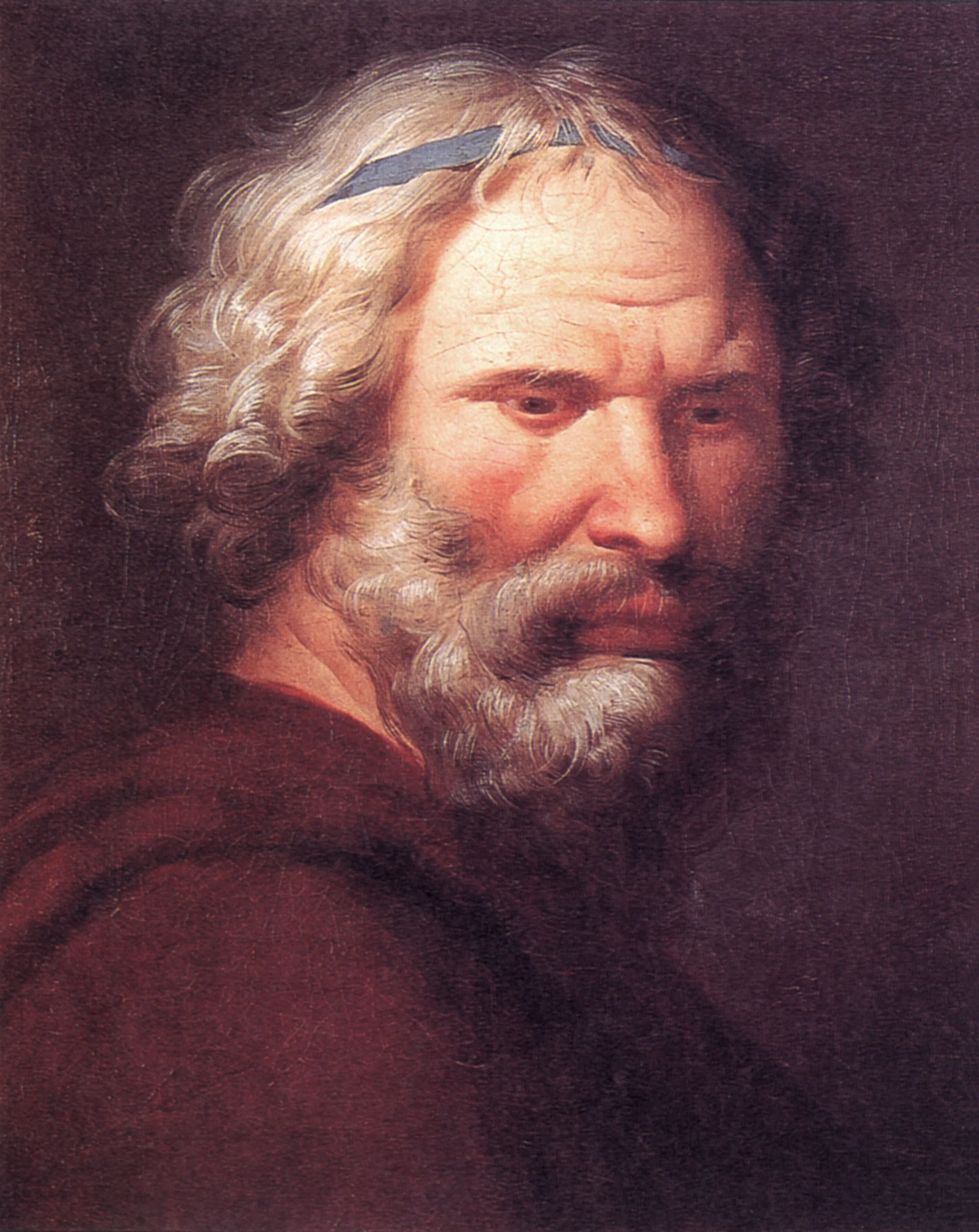
Archimedes
mathematician•physicist•engineer•astronomer•inventor
Also known as: Archimedes of Syracuse, The Father of Mathematics
Birthday
-287
Birth Sign
Capricorn
Birthplace
Syracuse, Sicily
Age
Unknown
About
Born in Syracuse around 287 BC, Archimedes spent his life bridging the gap between abstract thought and physical reality. He worked as a mathematician, physicist, engineer, astronomer, and inventor during the height of classical antiquity. While records of his daily life remain sparse, his surviving work proves he stood alongside the greatest scientific minds history has ever produced. His career flourished under the patronage of King Hiero II, allowing him to dedicate decades to studying geometry and mechanics before his death during the Roman siege of Syracuse in 212 BC.
Archimedes revolutionized mathematics by anticipating calculus centuries before Newton or Leibniz. He applied the method of exhaustion to calculate areas and volumes for shapes like circles, spheres, and parabolas with incredible precision. His most famous mathematical contributions include deriving an accurate approximation of pi (π) and creating a system to express extremely large numbers. In The Sand Reckoner, he devised a notation capable of counting grains of sand filling the known universe, challenging contemporary limits on scale. He also defined the Archimedean spiral and proved geometric theorems regarding ellipses and hyperboloids that remain foundational today.
Beyond pure math, Archimedes brought rigorous logic to physics. He formulated the law of the lever and established the concept of center of gravity, proving that even heavy objects could move with minimal force. His study of fluids led to the enunciation of the law of buoyancy, now known as Archimedes' principle, which explains why objects float. He applied these theories to build practical devices, including the Archimedes screw for lifting water and compound pulleys for moving massive ships. During the First Punic War, he designed defensive war machines that held off the Roman fleet at Syracuse for years until the city finally fell.
His legacy extended far beyond his lifetime. Cicero later visited Archimedes' tomb in Syracuse, noting it was marked by a sphere and cylinder representing his favorite discovery. Although his writings were rare in antiquity, they survived through translations into Arabic and Latin during the Middle Ages. These texts fueled the Renaissance and the Scientific Revolution. The 1906 discovery of the Archimedes Palimpsest revealed hidden calculations about how he derived his results, offering new insights into his brilliant mind.
Early Life & Background
Archimedes entered the world in Syracuse, a Greek colony on the island of Sicily, around 287 BC. His father, Phidias, served as an astronomer, a role that likely shaped the young boy's fascination with celestial movements and the patterns of the cosmos. While the historical record offers few intimate details about his childhood play or family dynamics, scholars agree that his upbringing provided a solid foundation in the liberal arts and early mathematics. It is widely believed that Archimedes traveled to Alexandria, the intellectual capital of the Hellenistic world, to pursue advanced studies. There, he studied under the successors of Euclid, immersing himself in the Great Library's vast collection of scrolls.
During his time in Alexandria, Archimedes formed lasting friendships with prominent scholars like Conon of Samos and Eratosthenes. These connections were vital, fostering a network of thinkers who would exchange ideas across generations. After completing his education, he returned to Syracuse to live under the protection and patronage of King Hiero II. The king granted Archimedes the unique freedom to pursue research without the pressure of commercial demands or political interference. This environment allowed him to focus entirely on theoretical problems and practical inventions, setting the stage for a career that would redefine human understanding of the physical world.
Career Growth
Archimedes' professional life is defined by a striking duality: he viewed pure mathematics as his primary passion while treating engineering and practical inventions as necessary duties for the defense of his city. Around 260 BC, he developed the method of exhaustion, a precursor to integral calculus, to calculate the areas and volumes of complex shapes like spheres and paraboloids. By 250 BC, he had formulated the Law of the Lever, proving that the ratio of weights equals the inverse ratio of their distances from the fulcrum. He famously declared, "Give me a place to stand, and I shall move the Earth," illustrating his profound grasp of mechanical advantage.
In 240 BC, he discovered the principle of buoyancy while investigating whether a crown commissioned by King Hiero was made of pure gold or adulterated with silver. This moment became legendary as the "Eureka!" incident. Around 230 BC, he authored The Sand Reckoner, devising a system of notation capable of expressing numbers as large as 8 x 10^63, challenging the ancient belief that the number of grains of sand in the universe was infinite. During the Second Punic War, from 215 to 212 BC, he designed massive defensive war machines for Syracuse, including the Claw of Archimedes and potentially heat rays to set enemy vessels ablaze.
Posthumously, his works laid the groundwork for the development of calculus by Newton and Leibniz. His manuscripts were preserved through Arabic translations and the discovery of the Archimedes Palimpsest in 1906, ensuring his methods influenced the Scientific Revolution centuries after his death.
Career Timeline
Public Image & Style
Archimedes is portrayed as the archetype of the "mad scientist" or "genius hermit", a man so absorbed in thought that he neglects basic human needs. Media portrays him as the ultimate rationalist, a man of logic who could manipulate the physical world through mathematics. His tone in historical texts is one of quiet confidence and intellectual superiority. He is universally recognized as the "Father of Mathematical Physics" and the "Father of Mechanics," titles that reflect his dual mastery of theory and application.
Fame & Fandom (iFAMOUS Rankings)
iFANN has not yet collected fame data for this person. He does not appear on the September 2026 iFAMOUS Rankings flagship list. Archimedes does not have a formal fandom name in the modern pop-culture sense. He is revered by historians, mathematicians, engineers, and students worldwide. There are no fan clubs, campaigns, or rituals, but his name is invoked in academic contexts globally. Fans of his work are essentially the global community of STEM professionals and enthusiasts who continue to study his methods and celebrate his contributions to science.
Interesting Facts and Legends
The story of Archimedes running naked through the streets of Syracuse shouting "Eureka!" after discovering the principle of displacement in his bathtub is one of the most famous anecdotes in history. While likely apocryphal in its dramatic details, it symbolizes the moment of scientific insight. Another enduring legend involves the "burning mirror," where polished bronze shields focused sunlight to burn Roman ships, a feat recently demonstrated by modern researchers using arrays of mirrors. The Archimedes screw, used for irrigation and lifting water, is still used today in parts of the Middle East and Africa.
In 1906, Danish scholar Johan Ludvig Heiberg discovered the Archimedes Palimpsest, a manuscript where Archimedes' original text had been scraped off and overwritten with religious prayers. X-ray imaging in the 21st century has allowed scholars to recover the hidden text, revealing previously unknown works. He invented a system to count grains of sand, effectively creating the first scientific notation for extremely large numbers. His statement about moving the Earth with a lever remains a testament to his understanding of mechanical advantage.
Notable Quotes
“Give me a place to stand, and I shall move the Earth.”
“Eureka! Eureka! I have found it!”
“Do not disturb my circles.”
Family & Personal Life
Archimedes was born into a family with connections to the Syracusan court, specifically related to King Hiero II. His father, Phidias, was an astronomer, which likely influenced Archimedes' early interests in celestial mechanics and geometry. As a figure from antiquity, there are no recorded details about siblings, wives, or children. Historical records from the 3rd century BC do not document personal romantic relationships for men of his status unless they were part of royal dynasties. He appears to have lived a life dedicated entirely to his work and the service of his city, with no mention of a domestic life in surviving biographies by Plutarch, Cicero, or Livy.
Notable Connections
Relationships & Dating History
As a figure from antiquity, Archimedes has no recorded dating history, marriages, or children. Historical records from the 3rd century BC do not document personal romantic relationships for men of his status unless they were part of royal dynasties. There are no credible sources mentioning a wife, fiancée, or partner. Consequently, there are no public statements, breakups, or offspring associated with him. He appears to have lived a life dedicated entirely to his work and the service of his city, with no mention of a domestic life in surviving biographies by Plutarch, Cicero, or Livy. As of any modern retrospective analysis, his relationship status remains historically single and childless.
Death & Aftermath
Died
-212-01-01
Death Place
Syracuse, Sicily
Cause of Death
Killed by a Roman soldier during the siege
Archimedes died in Syracuse during the Roman capture of the city in 212 BC, an event that concluded the Second Punic War. Historical accounts describe his final moments as occurring while he was engaged with a geometric diagram in the sand, where he reportedly refused a Roman soldier's command to appear before General Marcellus until he had finished his work. This defiance led to his death by sword, though later biographical traditions by Plutarch and Valerius Maximus embellish the specific dialogue and circumstances rather than providing verified eyewitness testimony. A secondary version suggests the soldier mistook Archimedes' mathematical instruments for gold, resulting in immediate execution. The general Marcus Claudius Marcellus reportedly felt deep remorse for the loss of the genius and sought out Archimedes' relatives to ensure they were treated well, offering them gifts instead of imposing penalties on the soldier responsible.
Specific details regarding the funeral service remain unrecorded due to the chaos of the siege, but he was buried within Syracuse. Centuries later, Cicero described a tomb erected in his honor featuring a sphere and cylinder, symbols of his favorite mathematical discoveries, which had fallen into disrepair by the time he visited. His works survived through the Byzantine era and were later rediscovered, revolutionizing calculus and physics, while modern dedications include the Archimedes crater on the Moon and various scientific prizes.
Net Worth (Estate Value)
$0
iFANN Editorial Team estimate
Archimedes died in 212 BC, and the concept of "net worth" in dollars does not apply to him. He lived in a barter-based economy and had no salary, stock options, or endorsement deals. His "wealth" consisted of land, property, and perhaps gifts from King Hiero II, but these were consumed or lost following his death and the subsequent sacking of Syracuse. No estate value can be calculated as his material possessions were largely lost during the Roman siege.
Any revenue generated from his name today, such as books, merchandise, or patents on the Archimedes screw, belongs to publishers and manufacturers, not his heirs. As a deceased individual from antiquity, he has no current financial standing. The iFANN Editorial Team estimates his net worth at $0, reflecting the absence of monetary assets in the modern sense.
Awards & Accolades
View 7 records, honours and achievementsKnown For
The Sand Reckoner
-230 · Author
On Spirals
-250 · Author
On the Sphere and Cylinder
-250 · Author
Archimedes Principle
-240 · Discoverer
Keywords
Sources
Quick Facts
- Profession
- mathematician, physicist, astronomer, engineer, inventor
- Born
- -287
- Birthplace
- Syracuse, Sicily
- Died
- -212
- Death Place
- Syracuse, Sicily
- Gender
- Male
Personal Details
- Full Name
- Archimedes of Syracuse
- Children
- Education
- Studied under successors of Euclid in Alexandria, Egypt
Frequently Asked Questions
What is Archimedes most famous for?
What did Archimedes say before he died?
What did Archimedes discover in his bathtub?
Why is Archimedes called the father of mathematics?
How did Archimedes die?
Similar People
Join the community
fans discussing