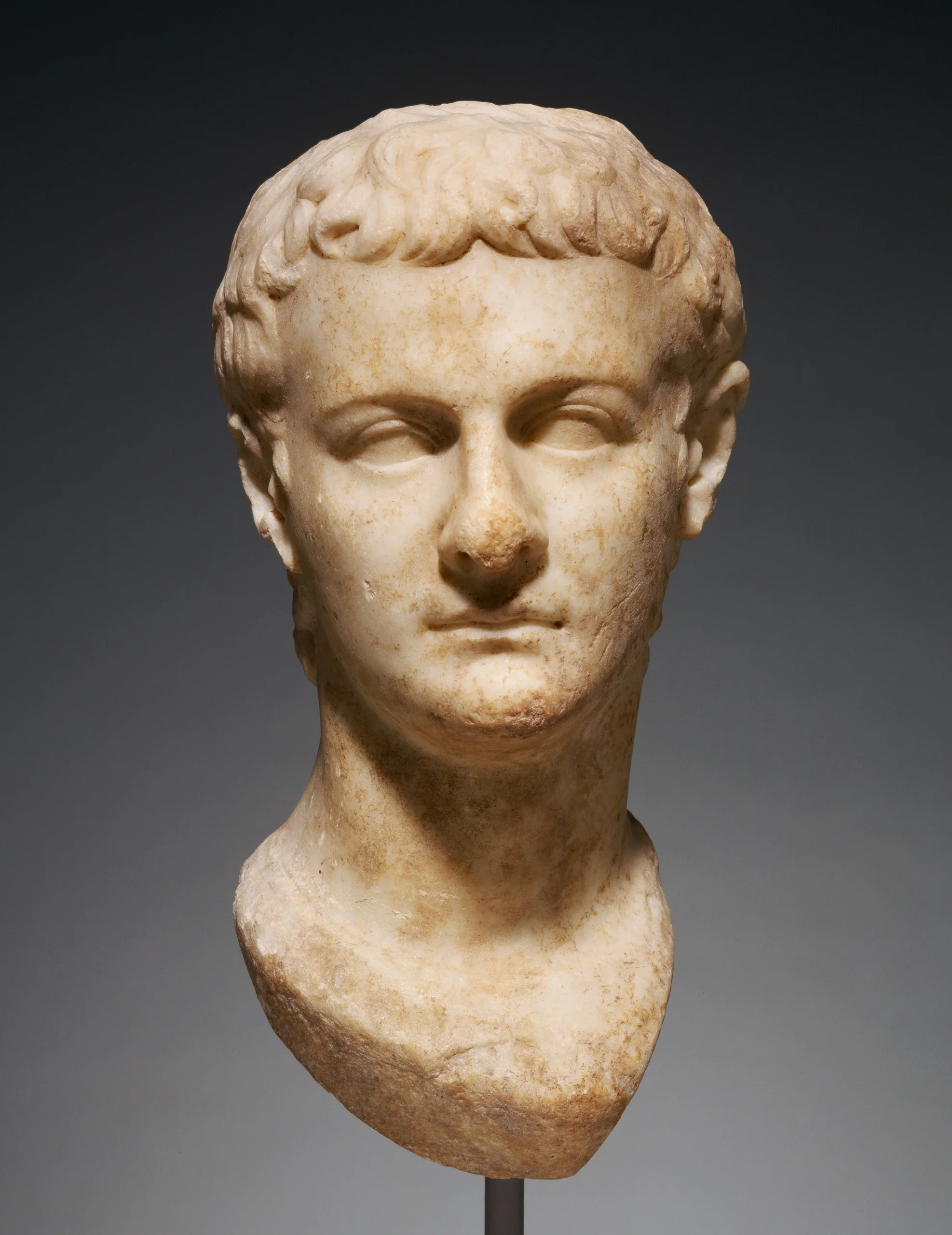
Caligula
 Italy
Also known as: Gaius, Little Boot, Gaius Julius Caesar Augustus Germanicus
Birthday
August 31, 12 AD
Birth Sign
Virgo
Birthplace
Antium (modern Anzio), Italy
Age
Died at 28
About
Caligula was a Roman emperor, the third to hold the office, who ruled from AD 37 until his assassination on 24 January AD 41. Born Gaius Julius Caesar Augustus Germanicus into the Julio-Claudian dynasty, he is remembered today less for what he built than for what his enemies wrote about him: a four-year reign that ancient authors painted as a descent from generous young ruler to capricious tyrant. The stories are vivid and widely repeated, but they come from senators and biographers writing decades after his death, and historians still argue over how much of the portrait is fact.
What is not in dispute is the scale of his power and the speed of his fall. He controlled the Roman Empire at 24, launched ambitious building projects including two aqueducts and a sprawling program of roads, harbours and amphitheatres, and was dead at 28, cut down by his own Praetorian Guard in a palace corridor. The name Caligula has outlived the man by two thousand years and now functions as shorthand for arbitrary cruelty, a linguistic afterlife that says as much about how Rome remembered him as it does about the emperor himself.
Early Life & Background
Gaius was born on 31 August AD 12 at Antium, a coastal town south of Rome now called Anzio. His father was Germanicus, the most popular general of his generation and a man the troops adored. His mother was Agrippina the Elder, a granddaughter of Augustus, which placed the boy near the center of the imperial family from the moment he drew breath. He was not raised in a quiet household. Germanicus spent years on campaign in Germania, and Gaius, then four or five, went along, dressed in a miniature soldier's uniform and boots. The legions found this hilarious and touching in equal measure, and the nickname stuck: Caligula, little boot. It followed him to the grave.
Then the family fell apart. Germanicus died at Antioch in AD 19, aged 33, under circumstances that have never been settled; ancient writers suspected poisoning and pointed fingers at Tiberius. Agrippina brought her children back to Rome and immediately went to war with the emperor, a feud that consumed her, her sons and eventually herself. Caligula was the only male of the line to survive it. Tiberius withdrew to Capri in AD 26, and five years later summoned the boy to join him there. The old emperor had a habit of testing his heirs, and Caligula learned to survive by hiding his feelings, a skill the sources note with a mixture of admiration and unease. When Tiberius died in March AD 37, the 24-year-old was the last Julio-Claudian male standing.
Career Growth
The accession was a triumph. Rome had endured the sour final years of Tiberius, and the arrival of Germanicus's son felt like the return of something good. The sources describe a young emperor who freed prisoners, recalled exiles, paid out legacies, and governed with a generosity that seemed almost reckless. Coins and inscriptions from the first months carry the language of liberty and restoration. Then, in AD 37 or 38, he fell seriously ill. Nobody knows what the illness was. What matters is that the accounts mark it as the turning point, the moment the generous young ruler was replaced by something harder.
What followed was a reign of building, annexation and provocation. He annexed Mauretania as a province, brought its king Ptolemy to Rome and had him executed. He marched an army to the Channel and then, according to the sources, ordered the troops to collect seashells instead of invading Britain, a story historians still debate. He began the Aqua Claudia and Anio Novus aqueducts, both of which carried water into Rome for centuries, and commissioned racetracks, theatres, amphitheatres, roads and harbours. He also ordered a statue of himself placed in the Temple in Jerusalem, a demand that nearly sparked a revolt and was quietly shelved. The Lake Nemi ships, two vast pleasure vessels recovered from the lakebed in the 1920s and destroyed in 1944, remain the most tangible physical evidence of his extravagance.
Career Timeline
Public Image & Style
The Caligula of the popular imagination is a monster with a crown: a man who made his horse a consul, slept with his sisters, and demanded to be worshipped as a god. That image was built by his enemies. Suetonius, writing eighty years after his death, collected every rumor he could find. Cassius Dio and Josephus added their own. The senators who killed him had every reason to justify the deed, and the emperors who followed had every reason to let the stories stand.
Modern historians have spent decades chipping away at the caricature. They point out that the early reign was praised, that the building program was real, that the cruelty stories cluster around the illness and the political crises, and that Roman biography was a genre with its own rules, not a modern fact-checking operation. None of this makes him a good man. It makes him a complicated one, and the gap between the historical figure and the cartoon is where most of the argument now lives.
Fame & Fandom (iFAMOUS Rankings)
Caligula is one of those figures whose fame has detached from his life. He is not on the September 2026 iFAMOUS Rankings flagship list, and iFANN has not yet collected fame data for him, which is perhaps the least surprising sentence in this profile. His name is better known than his reign, and it circulates mostly as a byword for tyranny. The 2026 political commentary that uses Caligula as shorthand for a modern leader is the latest installment in a two-thousand-year habit.
There is no fandom in the modern sense. No one calls themselves a Caligula stan. But there is a persistent audience: classicists, novelists, filmmakers, and the occasional emperor-adjacent tourist who wants to see the Nemi ships or the aqueducts. The 1979 film, with its notorious production history, gave him a second life in cult cinema, and the 2023 Ultimate Cut re-release brought him back to the art-house circuit. Fans of Roman history tend to encounter him first as a punchline and then, if they keep reading, as a puzzle. The puzzle is the appeal.
Interesting Facts and Legends
The horse Incitatus is the story everyone knows and the one historians trust least. According to Suetonius, Caligula planned to make the horse a consul, the highest elected office in Rome. It appears only in hostile late sources, and many scholars read it as a deliberate insult to the Senate rather than a sign of madness. The bridge of boats across the Bay of Naples, built so he could ride across the water, is another Suetonius set piece with no independent confirmation.
He was tall and pale and balding, with a thin neck and hollow eyes, according to the same sources. He reportedly had a phobia of thunderstorms and would hide under his bed during one, and he was said to have spoken to statues of the gods and to have demanded that he be worshipped as a living god, a demand that created real tension in Judaea and in the Senate.
His name is now an insult. When a modern column calls a politician a Caligula, it means capricious and cruel, a shorthand that has outlived every building he ever put up.
Notable Quotes
“Oderint dum metuant. (Let them hate me, so long as they fear me.)”
“Utinam populus Romanus unam cervicem haberet. (If only the Roman people had a single neck.)”
Family & Personal Life
Caligula's family was the Julio-Claudian dynasty, a household so tangled that the family tree looks like a conspiracy diagram. His father, Germanicus, was a beloved general and the adopted son of Tiberius. His mother, Agrippina the Elder, was a granddaughter of Augustus and a woman of ferocious ambition. He had five siblings: Nero Caesar, Drusus Caesar, Agrippina the Younger, Julia Drusilla and Julia Livilla. Most of them died badly. Nero and Drusus were killed or starved in prison during Tiberius's reign, and Agrippina the Elder was exiled and died in AD 33. Caligula's sister Julia Drusilla was his favorite, and after her death in AD 38 he had her deified, a decision that shocked contemporaries and fueled later rumors of an incestuous relationship, a charge modern scholars treat with caution.
His own marriages were brief and turbulent. Junia Claudilla, his first wife, died in childbirth before he became emperor. Livia Orestilla was taken from her husband at her wedding and divorced within days. Lollia Paulina was recalled from her marriage to Memmius Regulus and divorced within months. Milonia Caesonia, his last wife, gave him a daughter, Julia Drusilla, and was killed alongside him in AD 41.
Notable Connections
Relationships & Dating History
Caligula married four times, and none of the marriages lasted. His first wife, Junia Claudilla, married him around AD 33 and died in childbirth before he became emperor. His second, Livia Orestilla, was taken from her husband at their wedding in AD 38 and divorced within days. His third, Lollia Paulina, was recalled from her marriage to Memmius Regulus the same year and divorced within about six months. His fourth, Milonia Caesonia, married him in AD 39 or 40 and gave him a daughter, Julia Drusilla. She was killed alongside him on 24 January AD 41.
The sources also report a long affair with his sister Julia Drusilla, a charge that comes from the hostile literary tradition and is treated with caution by modern scholars. He had no surviving male heir of his own; Tiberius Gemellus was adopted as heir and then executed in AD 37. At the time of his death he was married to Caesonia.
- MarriedJunia Claudilla33 - 36First wife; died in childbirth before Caligula became emperor.
- MarriedLivia Orestilla38 - 38Taken from her husband at their wedding; divorced within days.
- MarriedLollia Paulina38 - 38Recalled from her marriage to Memmius Regulus; divorced within about six months.
- MarriedMilonia Caesonia39 - 41Fourth wife and mother of his daughter Julia Drusilla; killed alongside him in AD 41.
- RumouredJulia Drusilla37 - 38Sister; an alleged affair reported only in hostile sources and treated with caution by historians.
Death & Aftermath
Died
January 24, 41 AD (aged 28)
Death Place
Rome, Italy
Cause of Death
Assassination
The reaction in Rome was not grief so much as vertigo. The Senate, according to the ancient accounts, swung within hours from terror to something close to elation, with some members said to have argued for restoring the Republic outright before the Praetorian Guard settled the question by proclaiming Claudius. The sources for all of this are literary rather than official: Suetonius, Dio and Josephus, writing decades later, shape the narrative of the plot and the panic that followed it.
What is fixed is the date and the deed. Gaius was killed at Rome on 24 January AD 41, aged 28, less than four years into a reign that had begun in AD 37. The conspiracy involved members of the Praetorian Guard and senators, among them the guard officer Cassius Chaerea, whose name the tradition preserves as the leading hand. The accounts place the killing in a passage of the palace complex on the Palatine as the emperor left the games, and the lurid anecdotes attached to his final days belong to that same literary tradition, which is to say they are told rather than documented.
The body was handled quietly. Tradition holds that it was taken away and hastily cremated, with the ashes later interred, and that the imperial property and titles passed to Claudius on his accession. His name was subjected to damnatio memoriae in some contexts, his images and inscriptions subject to erasure. The death has been remembered ever since as the hinge between the Julio-Claudian experiment and the settled Principate, and it has drawn writers and filmmakers repeatedly, from the 1979 film Caligula to the 1982 The Emperor Caligula: The Untold Story, works of imagination rather than commemoration.
Net Worth (Estate Value)
$0
iFANN Editorial Team estimate
Caligula had no personal net worth in any modern sense. The Roman imperial treasury was not his private fortune, and the ancient figures for state revenues are fragmentary and unreliable. What can be said is that he spent money at a rate that alarmed contemporaries. He built aqueducts, racetracks, amphitheatres and harbours, staged lavish games, and reportedly drained the treasury Tiberius had left behind. The sources claim he resorted to confiscations and treason trials to refill it, a charge that is hard to separate from senatorial hostility. The Lake Nemi ships alone, with their bronze fittings and imported marble, represent an extraordinary outlay on a pleasure project. No credible modern estimate of his personal wealth exists, and any dollar figure attached to him online is invented.
Awards & Accolades
View 3 records, honours and achievementsKnown For
Emperor of Rome
AD 37-41 · Third Roman emperor
Aqua Claudia and Anio Novus aqueducts
AD 40 · Commissioned the aqueducts
The horse Incitatus
AD 40 · Legendary plan to make his horse a consul
Lake Nemi ships
AD 40 · Commissioned the giant pleasure ships
Keywords
Sources
Quick Facts
- Profession
- Roman emperor
- Born
- August 31, 12 AD
- Birthplace
- Antium (modern Anzio), Italy
- Died
- January 24, 41 AD
- Death Place
- Rome, Italy
- Gender
- Male
- Spouse
- Junia Claudilla, Livia Orestilla, Lollia Paulina, Milonia Caesonia
- Birth Sign
- Virgo
- Cause of Death
- Assassination
Personal Details
- Full Name
- Gaius Julius Caesar Augustus Germanicus
- Spouse
- Junia Claudilla, Livia Orestilla, Lollia Paulina, Milonia Caesonia
- Children
- Julia Drusilla (daughter); Tiberius Gemellus (adopted son)
Frequently Asked Questions
What is Caligula most famous for?
Why was Caligula assassinated?
What does it mean when someone calls you Caligula?
Who were Caligula's sisters?
What are the controversial scenes in Caligula?
Similar People
Join the community
fans discussing