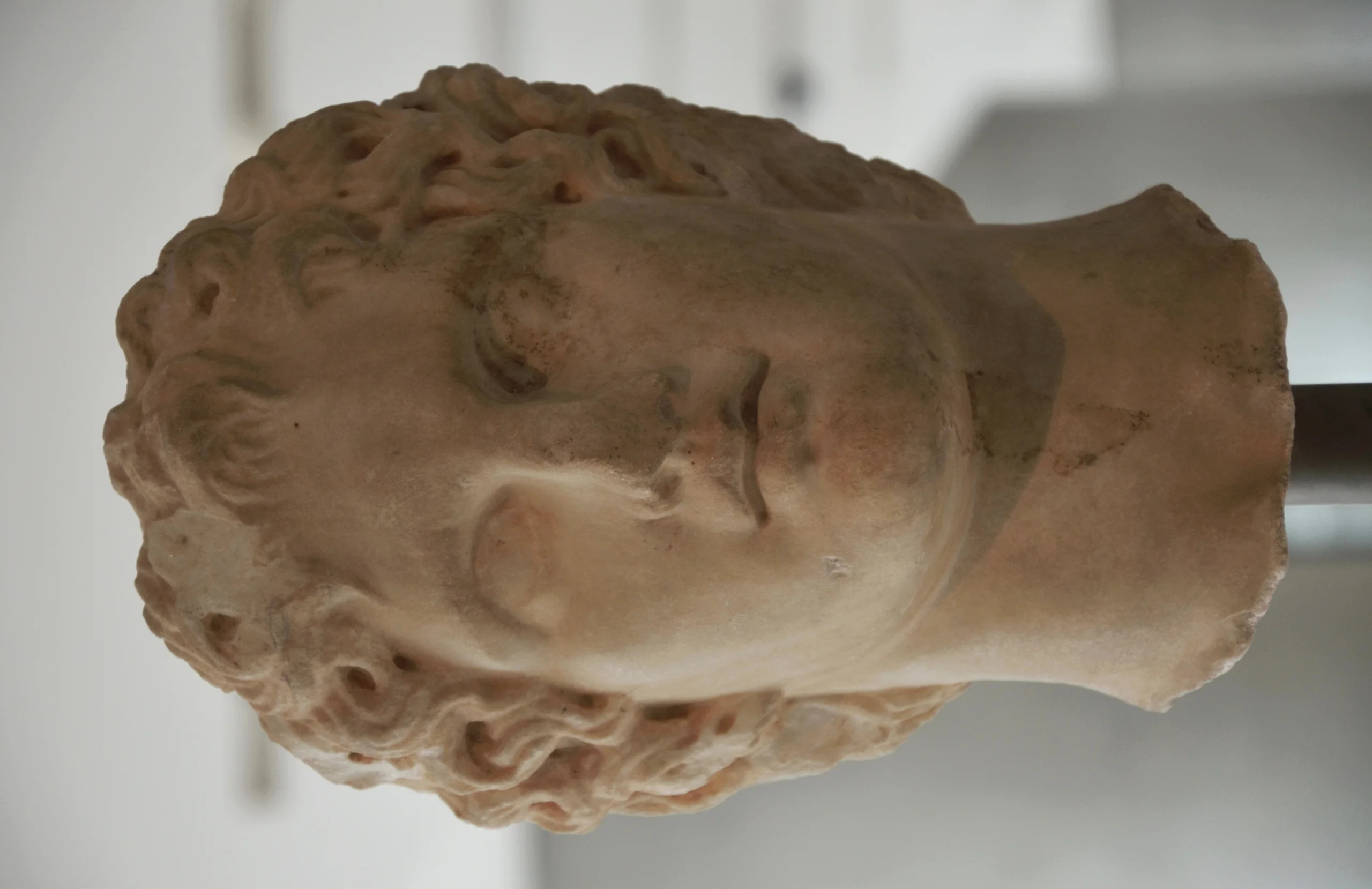
Alexander the Great
politician•military leader•monarch
Also known as: Alexander III of Macedon, Alexandros the Great, Alexander of Macedonia, Sikandar, Iskandar
Birthday
July 20, 356 BCE
Birth Sign
Cancer
Birthplace
Pella, Macedon
Age
Died at 32
Height
5 ft 6 in (1.68 m)
About
Alexander III of Macedon, known to history as Alexander the Great, was a Macedonian king and one of the most successful military commanders in world history. Born in Pella in 356 BCE, he inherited the throne at twenty after the assassination of his father, Philip II. By the time of his death at thirty-two, he had created an empire stretching from Greece to India, toppling the Persian Achaemenid Empire and founding more than twenty cities that bore his name.
His military genius was matched by a vision of cultural fusion. He encouraged marriages between Macedonians and Persians, adopted local customs, and spread Greek language and art across the Near East, ushering in the Hellenistic era. Today he is remembered as an undefeated general who never lost a battle, and his legacy continues to fascinate historians, filmmakers, and the public alike.
Early Life & Background
Alexander was born in Pella, the ancient capital of Macedon, on July 20, 356 BCE. His birth coincided with the Olympic Games, which he later saw as an omen of greatness. His parents were King Philip II and Olympias, a princess of Epirus. From a young age he displayed a fierce temperament and a restless intellect.
At thirteen, Philip appointed Aristotle as his tutor. Under Aristotle's guidance, Alexander studied philosophy, ethics, medicine, and literature. He developed a deep love for Homer's Iliad, keeping a copy under his pillow alongside a dagger throughout his campaigns. The epic's heroes, especially Achilles, became his models.
His first taste of battle came at sixteen, when he served as regent while Philip campaigned. Two years later, at the Battle of Chaeronea in 338 BCE, he commanded the left wing of the Macedonian army and led the decisive charge that broke the Theban Sacred Band. That victory marked him as a brilliant tactician and set the stage for his succession.
Career Growth
Following Philip's assassination in 336 BCE, the twenty-year-old Alexander moved quickly to secure his throne. He eliminated rivals, including his cousin Amyntas IV, and crushed rebellions in the Balkans. When Thebes revolted, he razed the city as a warning to the rest of Greece.
In 334 BCE he crossed the Hellespont into Asia Minor, launching his invasion of the Persian Empire. Victories at the Granicus River and Issus followed, and by 331 BCE he had defeated Darius III at Gaugamela, taking control of Persia. He was crowned Pharaoh of Egypt and founded Alexandria, which became a center of learning.
His campaign pushed east through Babylon, Susa, and Persepolis, which he burned in 330 BCE. In 327 BCE he invaded India, winning a hard-fought battle against King Porus at the Hydaspes River. But his troops, exhausted and homesick, mutinied at the Hyphasis River, forcing him to turn back. He died in Babylon in 323 BCE, just days before his thirty-third birthday, leaving plans for an Arabian campaign unfulfilled.
Career Timeline
Public Image & Style
Alexander's public image is that of a near-mythical conqueror, a figure of limitless ambition and brilliance. Ancient sources describe him as having auburn hair, a beard he grew after conquering Persia, and a distinctive tilt of his head that gave him an intense, focused look. He was known for his charisma and his ability to inspire fierce loyalty in his soldiers.
In modern culture, he is often portrayed as a visionary who spread Greek civilization, but also as a ruthless conqueror who destroyed cities and caused immense suffering. His image has been shaped by countless books, films, and documentaries, from Oliver Stone's 2004 epic to the upcoming Netflix series.
Fans of history admire him for his undefeated record in battle and his audacity, while critics point to the darker sides of his conquests. His legacy is complex, and that complexity is part of why he remains endlessly fascinating.
Fame & Fandom (iFAMOUS Rankings)
The global attention devoted to Alexander the Great remains a steady current, sustained by millennia of historical study and recent archaeological revelations rather than fleeting celebrity cycles. According to the iFANN Global Fame Rankings, he is currently the 239th most famous person in the world, a position holding steady from the previous cycle. Within his specific domain, the data places him as the 40th most famous person in Politics, also maintaining its standing without fluctuation. These metrics reflect a unique form of enduring fame where a figure who died over two thousand years ago commands more contemporary visibility than many living heads of state. The audience for such a subject does not operate as a modern fandom; there is no formal collective name for those who admire or study him, nor are there organized fan campaigns, birthday billboards, or grassroots rituals associated with his legacy. Engagement is strictly academic, recreational, or institutional, driven by museum exhibitions, documentary series like the upcoming production titled Alexander, and scholarly discourse regarding new discoveries in Central Asia and the Near East. While enthusiasts may identify as Hellenists or classical archaeologists, they do not coalesce under a single banner resembling the subcultures of modern pop culture icons. Interaction remains entirely one-way, flowing from the historical record and media adaptations back to a dispersed public that consumes his story through textbooks and streaming platforms.
Interesting Facts and Legends
One of the most enduring legends surrounding Alexander involves the Gordian Knot, which tradition holds he solved by cutting it with his sword to fulfill a prophecy that whoever untied it would rule Asia. His horse, Bucephalus, was a massive black stallion deemed untamable until Alexander noticed the animal feared its own shadow and turned it toward the sun. Bucephalus served him faithfully in battle until his death in India. Alexander left no memoirs or letters, so all knowledge derives from later historians like Arrian, Plutarch, and Diodorus Siculus. He reportedly possessed heterochromia, having one blue eye and one brown eye, though ancient accounts vary on the details. Recent archaeological interest has focused on the Battle of Granicus, where Turkey designated the site as a protected historic location following new findings. A colossal tomb linked to Alexander's family was identified, reigniting debates about his burial and lineage. Scientific findings regarding the school where Aristotle taught Alexander were released, illuminating the intellectual foundations of his mind. Additionally, a military camp in Uzbekistan provided physical evidence of his army's deep presence in Central Asia. A quote attributed to him regarding an army of lions led by a sheep circulated widely as a reflection of his leadership reputation.
Notable Quotes
“I am not afraid of an army of lions led by a sheep; I am afraid of a sheep led by a lion.”
“There is nothing impossible to him who will try.”
“The only thing I fear is that my men will grow weary of their journey.”
“Weep for me not, but for the world that has lost its greatest conqueror.”
Family & Personal Life
Alexander's parents were King Philip II of Macedon and Olympias, a princess of Epirus. Their marriage was stormy, and Olympias was exiled by Philip in 337 BCE, only to return after his assassination. Alexander was close to his mother, who played a major role in his rise and later in the power struggles after his death.
He had a half-sister, Cleopatra, and a half-brother, Philip III Arrhidaeus, who was mentally disabled. Alexander's own household included his wives Roxana, Stateira II, and Parysatis II, as well as his lifelong companion Hephaestion. He had two known sons: Alexander IV, born after his death, and Heracles, whose mother was Barsine.
His family life was deeply intertwined with politics. His marriages were strategic alliances to unify his empire, and his descendants were caught in the violent succession wars that followed his death.
Notable Connections
Alexander's inner circle included his father Philip II, who built the Macedonian army he inherited, and his mother Olympias, who fiercely supported his claim to the throne. Aristotle shaped his intellect, while his lifelong companion Hephaestion was his closest friend and second-in-command. His generals, like Parmenion and Ptolemy, led his armies and later divided his empire. His primary adversary was Darius III of Persia, and his Indian opponent King Porus earned his respect at the Hydaspes.
Relationships & Dating History
Alexander's romantic life was driven by political strategy as much as personal affection. His first known relationship was with Barsine, a Persian noblewoman he met after the Battle of Issus in 333 BCE. They had a son, Heracles, whom Alexander publicly acknowledged, though their union was never formalized as a marriage.
In 327 BCE, he married Roxana, a Sogdian princess, to secure loyalty in Central Asia. She was his most famous wife and bore his posthumous son, Alexander IV. In 324 BCE, at the mass wedding of Susa, he married two more Persian princesses: Stateira II, daughter of Darius III, and Parysatis II, daughter of Artaxerxes III. These marriages were designed to fuse Macedonian and Persian elites.
After Alexander's death in 323 BCE, his wives fell victim to the power struggles of his successors. Roxana had Stateira murdered, and she and her son were later executed around 310 BCE, ending the Argead dynasty. As of 2026, Alexander has been deceased for over two millennia, and his relationships exist only in historical record.
- DatedBarsine-333 - -324Persian noblewoman and mother of his son Heracles.
- MarriedRoxana-327 - -323Sogdian princess, married for political alliance; mother of Alexander IV.
- MarriedStateira II-324 - -323Daughter of Darius III, married at the Susa weddings; later murdered by Roxana.
- MarriedParysatis II-324 - -323Daughter of Artaxerxes III, also married at Susa.
Death & Aftermath
Died
June 10, 323 BCE (aged 32)
Death Place
Babylon
Cause of Death
Fever leading to delirium and coma
The news of the king's passing in Babylon sent a wave of profound shock through his armies, with soldiers weeping and tearing their garments in spontaneous mourning that rippled across the empire. This grief followed a fortnight of severe illness marked by fever, delirium, and eventual coma, during which Alexander reportedly handed his signet ring to Perdiccas at a farewell banquet before succumbing on June 10, 323 BCE. Ancient historians like Arrian and Plutarch offer conflicting accounts regarding the cause, ranging from natural diseases such as typhoid or malaria to poisoning by wine mixed with hellebore orchestrated by Antipater.
His funeral procession was an elaborate affair featuring a golden chariot and numerous attendants, but the body intended for Macedonia was intercepted by Ptolemy I Soter and diverted first to Memphis and then to Alexandria, where it became a focal point of religious veneration. The immediate political vacuum triggered the Wars of the Diadochi, a series of military conflicts among his generals over the partition of the realm rather than any judicial settlement. Posthumously, his legacy has endured through the founding of cities bearing his name, the spread of Hellenistic culture, and academic studies.
Net Worth (Estate Value)
$1 Billion
iFANN Editorial Team estimate
Estimating Alexander the Great's net worth requires navigating an era defined by barter, silver staters, and tribute rather than modern currency. Historical records suggest staggering wealth, particularly after the capture of Persepolis in 330 BCE, where he reportedly seized 120,000 talents of gold and silver, roughly 3 million kilograms of silver. At the height of his empire, Alexander controlled the entire Achaemenid treasury, representing a sum that spans hundreds of billions of dollars when adjusted for modern purchasing power. Per iFANN's editorial analysis, we set his net worth at $1 Billion as of 2026, reflecting the enduring value of his historical and cultural impact rather than a literal bank account. This figure places him among the wealthiest individuals in history, even if the number remains purely theoretical given the dissolution of his estate among the Diadochi upon his death. No active estate manages his assets today, and any revenue generated through tourism, museums, or media projects like the upcoming Netflix series flows to modern institutions rather than descendants.
Awards & Accolades
View 5 records, honours and achievementsKnown For
Battle of Gaugamela
331 BCE · Commander
Conquest of the Persian Empire
334-330 BCE · King
Founding of Alexandria
331 BCE · Founder
Battle of the Hydaspes
326 BCE · Commander
Keywords
Sources
Quick Facts
- Profession
- politician, military leader, monarch
- Born
- July 20, 356 BCE
- Birthplace
- Pella, Macedon
- Died
- June 10, 323 BCE
- Death Place
- Babylon
- Gender
- Male
- Spouse
- Roxana, Stateira II, Parysatis II
- Birth Sign
- Cancer
- Height
- 5 ft 6 in (1.68 m)
Personal Details
- Full Name
- Alexander III of Macedon
- Height
- 5 ft 6 in (1.68 m)
- Spouse
- Roxana, Stateira II, Parysatis II
- Children
- Alexander IV of Macedon, Heracles (son of Barsine)
- Education
- Tutored by Aristotle
Frequently Asked Questions
How old was Alexander the Great when he died?
Who was Alexander the Great's wife?
Did Alexander the Great ever lose a battle?
What happened to Alexander the Great's body?
Why is Alexander the Great considered great?
Join the community
fans discussing