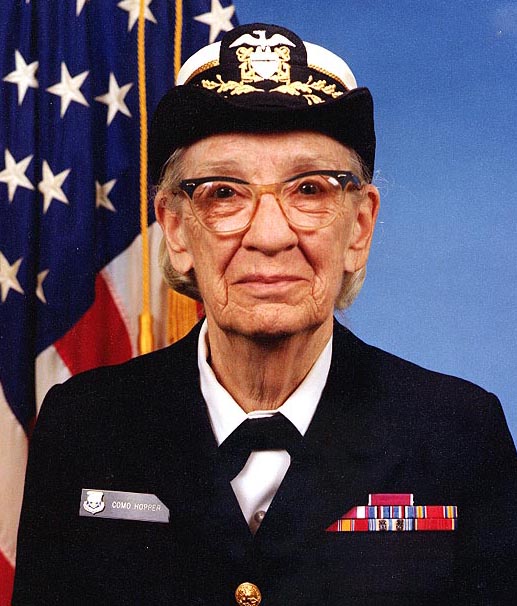
Grace Hopper
 United States
mathematician•naval officer•computer scientist
Also known as: Amazing Grace, Queen of Software, Mother of Computer Science
Birthday
December 9, 1906
Birth Sign
Sagittarius
Birthplace
New York City, New York, United States
Age
Died at 85
Height
5 ft 4 in (163 cm)
About
Grace Brewster Hopper was an American computer scientist, mathematician, and United States Navy rear admiral. She pioneered machine-independent programming languages and developed FLOW-MATIC and COBOL, still in use today. Hopper was among the first programmers of the Harvard Mark I computer and wrote the first computer manual. She earned a PhD in mathematics from Yale University and taught at Vassar College before joining the Navy Reserve during World War II. After the war, she worked on the UNIVAC I and invented the first compiler. In 1991, she received the National Medal of Technology, and in 2016, the Presidential Medal of Freedom posthumously. The USS Hopper, the Cray XE6 supercomputer, and the Nvidia GPU architecture bear her name. The annual Grace Hopper Celebration of Women in Computing continues her legacy.
Early Life & Background
Grace Brewster Murray was born in New York City to Walter Fletcher Murray, an insurance broker, and Mary Campbell Van Horne Murray. She was the oldest of three children. Her father believed his daughters should have the same educational opportunities as his son, a progressive view for the time. Her mother loved geometry and mathematics, sparking Grace's early interest. Summers were spent at a cottage on Lake Wentworth in New Hampshire, where she played games and enjoyed needlepoint, reading, and piano. At age seven, she dismantled her alarm clock to understand its mechanics; when she could not reassemble it, she took apart seven other clocks in the house. She attended private girls' schools in New York City. After failing a Latin exam required for Vassar College, she spent an extra year at Hartridge School in Plainfield, New Jersey. She entered Vassar in 1924, graduating Phi Beta Kappa in 1928 with a BA in mathematics and physics. She earned a master's degree in 1930 and a PhD in 1934 from Yale University. During a sabbatical, she studied with mathematician Richard Courant at New York University. After her master's, she began teaching mathematics at Vassar College while pursuing her doctorate.
Career Growth
In 1943, Hopper left Vassar to join the U.S. Navy Reserve. After training, she was assigned to the Bureau of Ordnance Computation Project at Harvard's Crufts Laboratory in 1944. She became part of the Harvard Mark I team led by Howard Aiken, one of the first programmers of the Mark I. In 1947, while working on the Mark II, a moth was found in a relay; she taped it in the logbook, popularizing the term "debugging." In 1949, she joined the Eckert-Mauchly Computer Corporation, working on the UNIVAC I. In 1952, she completed the first compiler, the A-0 System, which translated English terms into machine code. In 1954, she led the department for automatic programming, releasing FLOW-MATIC. In 1959, she participated in the CODASYL consortium, helping create COBOL. She promoted COBOL throughout the 1960s. After retiring from the Navy in 1966, she was recalled in 1967 and again in 1972, eventually promoted to captain and then rear admiral by a special act of Congress in 1985. She retired from the Navy in 1986 at age 79, the oldest active-duty commissioned officer in the Navy. She then joined Digital Equipment Corporation as a consultant and goodwill ambassador, giving up to 300 lectures per year until her death in 1992.
Career Timeline
Public Image & Style
Hopper was known for her naval uniform, which she wore proudly even after retirement. She had a no-nonsense demeanor combined with warmth and enthusiasm for teaching. Media portrayed her as "Amazing Grace," a pioneering trailblazer who broke barriers in computer science and the military. She is celebrated as a role model for women in STEM. The Grace Hopper Celebration of Women in Computing, founded in 1994, is the primary gathering for her fans, who share stories and wear "Amazing Grace" merchandise. Her quotes are widely shared on social media, especially on International Women's Day and Ada Lovelace Day. She is often called the "Queen of Software" and the "Mother of Computer Science."
Fame & Fandom
Grace Hopper's legacy is celebrated not by a traditional fandom with a name, but through the institutions and conferences that carry her spirit. The Grace Hopper Celebration, organized by AnitaB.org, stands as the world's largest gathering of women in technology, drawing tens of thousands each year. Universities across the United States sponsor student attendance, and major corporations send technologists to speak, making it a pilgrimage for women in computing. Yale University renamed Calhoun College to Grace Hopper College in 2017, and the U.S. Navy continues to honor her contributions. The National Security Agency's archival footage of her 1982 lecture has amassed over 171,000 views on YouTube, showing enduring public interest. Her birthday is occasionally noted in tech communities, but no coordinated fan campaigns exist.
As of August 2026, iFANN's Global Fame Engine has evaluated Grace Hopper, but she does not currently hold a placement in the published rankings, either in the Global Top 1,000 or any Top-100 scope list. Her fanbase has no formal name, and her admirers are characterized by professional reverence rather than fan rituals.
Interesting Facts and Legends
Grace Hopper's office clock ran counterclockwise, a symbol of her challenge to conventional thinking. She famously said, 'Humans are allergic to change. They love to say, "We've always done it this way." I try to fight that.' She predicted desktop computers and that non-programmers would use them. After retiring from the Navy, she continued to wear her full dress uniform to lectures, contrary to policy. She wrote the first computer manual, 'A Manual of Operation for the Automatic Sequence Controlled Calculator.' At age eight, her father had both legs amputated; his bravery inspired her to face challenges. She failed a Latin exam required for Vassar, delaying enrollment by a year.
Among the legends that persist, Hopper's nanosecond wire is verified: she handed out 11.8-inch pieces of wire to illustrate the distance light travels in a nanosecond. The story of the first computer bug is partially true: a moth was found in a relay of the Harvard Mark II in 1947, and Hopper popularized the tale, though she did not coin the term. Her quote 'It's easier to ask forgiveness than it is to get permission' is documented from her speeches. Her nickname 'Amazing Grace' was earned during her naval career, and her promotion to Rear Admiral in 1985 remains a celebrated milestone.
Notable Quotes
“Humans are allergic to change. They love to say, 'We've always done it this way.' I try to fight that. That's why I have a clock on my wall that runs counterclockwise.”
“It's easier to apologize than it is to get permission.”
“A ship in port is safe, but that's not what ships are built for.”
“The most dangerous phrase in the language is: 'We've always done it this way.'”
“I've always been more interested in the future than in the past.”
“The greatest contribution I've made to society is all the young people I trained.”
Family & Personal Life
Grace was the oldest of three children born to Walter Fletcher Murray, an insurance broker and Yale graduate, and Mary Campbell Van Horne Murray. Her mother studied geometry and loved mathematics. Her father believed in equal education for his daughters. She had a younger sister and brother. Grace married Vincent Foster Hopper in 1930; they divorced in 1945 with no children. She had no other known romantic relationships. She lived in Arlington County, Virginia, where she died. She is buried at Arlington National Cemetery.
Notable Connections
Howard Aiken led the Harvard Mark I team where Hopper was a key programmer. John Mauchly and J. Presper Eckert founded the Eckert-Mauchly Computer Corporation, which Hopper joined in 1949. She studied with mathematician Richard Courant at NYU. Morley Safer interviewed her on 60 Minutes in 1983, leading to her promotion. Congressman Philip Crane sponsored the resolution for her promotion to rear admiral.
Relationships & Dating History
Grace Murray married Vincent Foster Hopper, an English teacher, in 1930. The couple divorced in 1945. She retained his surname professionally for the rest of her life. No children came from this marriage. No other public romantic relationships are documented in credible sources. Hopper's life was devoted to her work, the Navy, and mentoring young people. As of 2026, she is deceased with no surviving spouse or partner.
- MarriedVincent Foster Hopper1930 - 1945Married an English teacher; divorced in 1945; no children.
Death & Aftermath
Died
January 1, 1992 (aged 85)
Death Place
Bethesda, Maryland, USA
Cause of Death
Natural causes associated with old age
Grace Hopper spent her final days in the quiet of Walter Reed National Military Medical Center, then known as Bethesda Naval Hospital, where she had been receiving care for her advanced years. The official cause was recorded as natural causes associated with old age, a determination made through standard medical certification procedures within the military hospital system rather than an autopsy or coroner's ruling. Public reaction to her passing involved widespread tributes from the U.S. government, the Navy, and the scientific community, who honored her as one of the most influential figures in computing history. Her funeral and memorial services were held privately consistent with the wishes of many high-ranking naval officers during that era, and she was cremated with her ashes interred at Arlington National Cemetery in Section 3, Site 2040-A alongside other distinguished veterans.
Posthumous recognition included induction into the National Women's Hall of Fame and the Computer History Museum's Hall of Fellows, while the U.S. Navy destroyer USS Hopper (DDG-70) was named in her honor and launched in 1997. Educational institutions later dedicated facilities to her legacy, including the renaming of Calhoun College at Yale University to Grace Hopper College in 2026, and the annual Grace Hopper Celebration continues to advance women in technology.
Net Worth (Estate Value)
$500 Thousand
iFANN Editorial Team estimate
Heading into 2026, iFANN currently estimates Grace Hopper's estate at $500 Thousand. She died in 1992 and did not accumulate significant personal wealth compared to modern tech figures. Her income during her lifetime came from her salary as a Vassar College professor, U.S. Navy pay and pension, compensation from Eckert-Mauchly/Sperry Rand, and a consultant salary from Digital Equipment Corporation. She also earned speaking fees from up to 300 lectures per year and book royalties from computing manuals. The estate is managed by family representatives. Revenue sources include posthumous licensing of her name and image, book royalties, and continued use of her name on the Grace Hopper Celebration conference. The estate has grown modestly over the years due to ongoing educational and memorial merchandising.
Awards Won (3)
Hopper received the National Medal of Technology in 1991, the first individual woman to do so. In 2016, she was posthumously awarded the Presidential Medal of Freedom, the nation's highest civilian honor. She earned 40 honorary degrees from universities worldwide. The IEEE dedicated a plaque in 2024 honoring her invention of the A-0 compiler.
2016 · Civilian Honor
Lifetime achievement
1991 · Technology
Pioneering computer programming
Known For
Harvard Mark I
1944 · Programmer
First Compiler (A-0 System)
1952 · Inventor
COBOL
1959 · Co-creator
FLOW-MATIC
1955 · Lead Developer
UNIVAC I
1951 · Contributor
Keywords
Sources
Quick Facts
- Profession
- mathematician, naval officer, computer scientist
- Born
- +1906-12-09
- Birthplace
- New York City
- Died
- +1992-01-01
- Death Place
- Arlington County
- Gender
- Female
- Spouse
- Vincent Foster Hopper
- Birth Sign
- Sagittarius
Personal Details
- Full Name
- Grace Brewster Murray
- Height
- 5 ft 4 in (163 cm)
- Spouse
- Vincent Foster Hopper
- Education
- Vassar College (BA, 1928); Yale University (MA, 1930; PhD, 1934); New York University (postgraduate study)
Frequently Asked Questions
How old was Grace Hopper when she died?
What is Grace Hopper's net worth in 2026?
What is Grace Hopper best known for?
Was Grace Hopper ever married?
Why is Grace Hopper called the 'Mother of Computer Science'?
Social Media
Similar People
Join the community
fans discussing