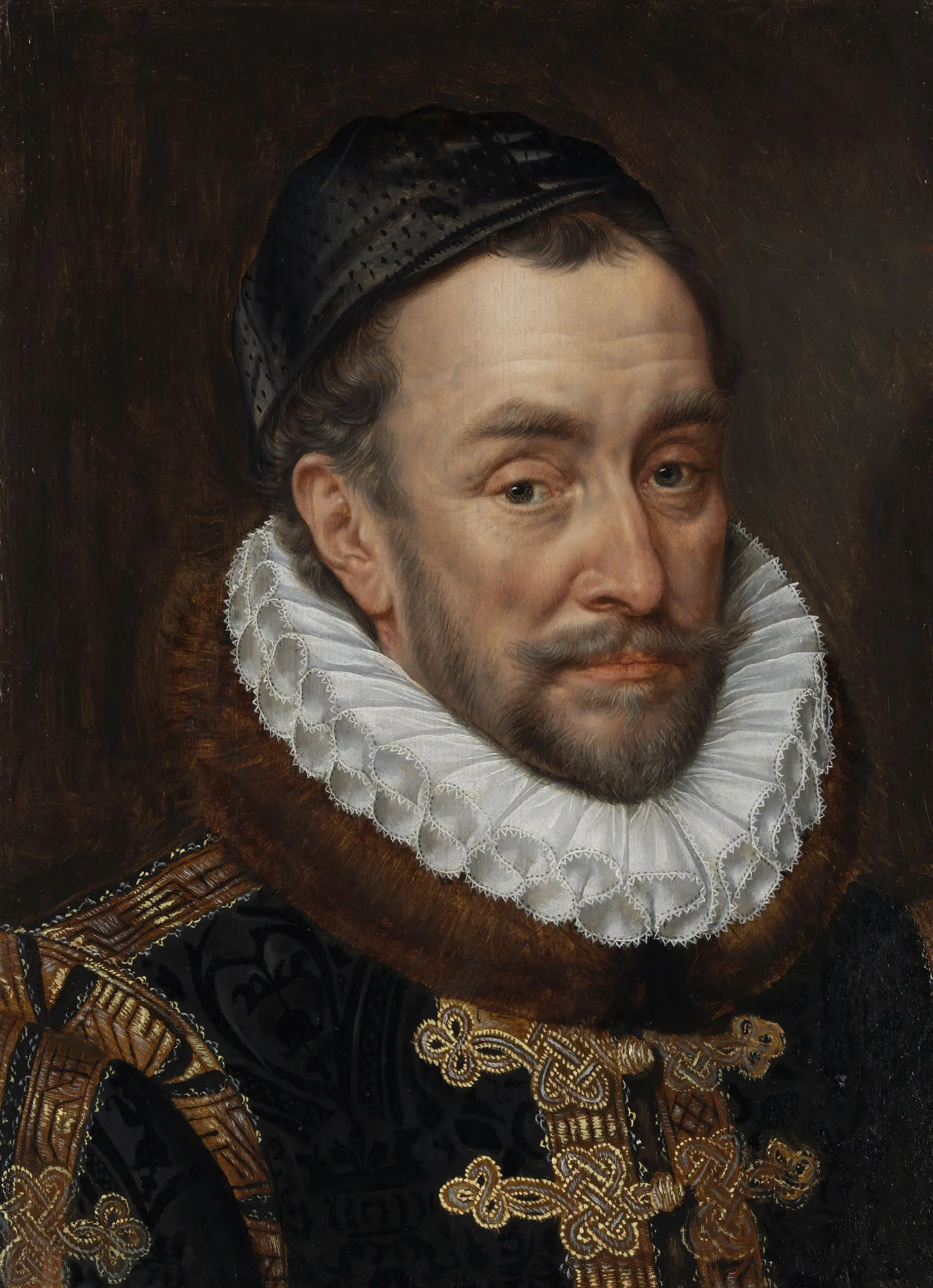
William the Silent
Also known as: William of Orange, Willem van Oranje, Willem de Zwijger, William the Taciturn, William I of Orange-Nassau, Prince of Orange
Birthday
April 24, 1533
Birth Sign
Taurus
Birthplace
Dillenburg, County of Nassau-Dillenburg, Holy Roman Empire
Age
Died at 51
About
William the Silent was a Dutch nobleman, Prince of Orange and the principal leader of the Dutch Revolt against Spanish rule. Born Willem van Nassau-Dillenburg, he is known in English by the epithet the Silent and in Dutch as Willem de Zwijger or simply Willem van Oranje. He holds the honorific Pater Patriae, Father of the Fatherland, and appears in the Dutch national anthem, the Wilhelmus, as William of Nassau.
His standing rests on the revolt he led from 1568 until his death in 1584, a campaign that became the Eighty Years' War and ended with formal independence of the United Provinces in 1648. He served as Stadtholder of Holland, Zeeland and Utrecht from 1572, and the house he founded, Orange-Nassau, later produced the Dutch monarchy. He was declared an outlaw by the Spanish king in 1580 and was shot dead at the Prinsenhof in Delft on 10 July 1584 by Balthasar Gérard. He was 51.
In the Netherlands he is treated as the country's founding statesman. Outside it, he is remembered chiefly as the first head of state killed by a firearm and as the namesake of the royal house whose colour, orange, still marks Dutch national teams.
Early Life & Background
William was born on 24 April 1533 at Dillenburg Castle in the County of Nassau-Dillenburg, part of the Holy Roman Empire and now in Hesse, Germany. He was the eldest son of William the Rich, Count of Nassau-Dillenburg, and Juliana of Stolberg, and he grew up a wealthy nobleman of the House of Nassau.
The decisive turn came in 1544, when his childless cousin René of Chalon died and left him the principality of Orange. The inheritance carried a condition: William was to be raised as a Catholic. He accepted, became Prince of Orange, and founded the Orange-Nassau branch that centuries later produced the Dutch monarchy.
He was then sent to the Habsburg court in Brussels, where he was educated and became a favoured courtier of Emperor Charles V. The association was close enough that at the emperor's abdication ceremony in 1555, Charles reportedly leaned on William's shoulder. That detail is the usual origin given for the nickname the Silent, though the epithet more likely referred to discretion at court than to any literal muteness.
Under the Spanish Habsburgs he served at the court of Margaret of Parma, governor of the Spanish Netherlands. Two developments turned him toward opposition: the centralisation of power away from the local estates, and the Spanish persecution of Dutch Protestants. By 1568 he had broken with his former masters.
Career Growth
The break came in 1568, when William turned against the Spanish Habsburgs and set off the Eighty Years' War. The conflict ran until 1648 and ended with the formal independence of the United Provinces, though he did not live to see it.
He proved the most politically capable of the rebel leaders, guiding Dutch forces through mixed military fortunes. In 1572 the capture of Brill was followed by his appointment as Stadtholder of Holland, Zeeland and Utrecht, an office he held until his death and the first hereditary stadtholderate of the United Provinces. The Pacification of Ghent followed in 1576, the Union of Utrecht in 1579, and the Act of Abjuration renouncing Philip II in 1581.
In 1580 the Spanish king declared him an outlaw and put a price on his head. He continued to lead the revolt until he was shot in Delft in 1584. His political work across the revolt's civil and military fronts laid the ground for the Dutch Republic, and the house he founded supplied the stadtholders and later monarchs of the Netherlands.
Career Timeline
Public Image & Style
In Dutch memory William is the Father of the Fatherland, a phrase that has stuck since the revolt and is used without irony in official and popular settings. He is the subject of the Wilhelmus, the national anthem, which names him as William of Nassau and frames the revolt as a defence of honour and conscience.
Outside the Netherlands the image is narrower and darker. English-language accounts tend to introduce him through the assassination: the prince shot on a staircase, the first head of state killed by a gun. The Prinsenhof, with its alleged bullet holes, is a physical relic of that reputation. In Protestant historiography he appears as a champion of toleration, though his record on religious matters was that of a politician rather than a theologian.
Fame & Fandom (iFAMOUS Rankings)
William the Silent has been evaluated by iFANN's Global Fame Engine but does not currently hold a placement in the published rankings, whether the Global Top 1,000 or a Top-100 scope list. The engine measures worldwide attention across public signals such as Wikipedia readership and global search interest, and on that measure he sits outside the current standings. He is not on the September 2026 iFAMOUS Rankings flagship list.
The audience around him has no formal name and no organised fan culture in the modern sense. What exists is national rather than fandom-based: Dutch readers and students encounter him through the Wilhelmus, school history and the Nieuwe Kerk in Delft, where his tomb draws visitors. English-language interest clusters around the assassination and the Prinsenhof staircase. His Wikipedia article records roughly 29,500 English views and 16,500 Dutch views over a recent thirty-day window, with German, Russian and Spanish editions contributing several thousand each, which gives some sense of where curiosity about him is concentrated.
Interesting Facts and Legends
William is generally counted as the first head of state to be assassinated with a firearm. The nickname the Silent is widely misunderstood: it referred to his discretion at court, not to any inability or refusal to speak, and the Dutch form de Zwijger carries the same sense of taciturnity.
A story fans of the period still retell concerns the French king's plans, disclosed to William in confidence, which he kept to himself at considerable risk. Whether the tale is exact or embroidered, it is the anecdote most often attached to the name.
His deathbed words, a plea for God to have mercy on him and on this poor people, are traditional rather than documented. The line I cannot approve of monarchs who want to rule over the conscience of the people circulates widely as his, again by popular attribution rather than by a verified record.
The Netherlands' orange sporting identity, worn by its football team among others, traces to the House of Orange he founded.
Notable Quotes
“I cannot approve of monarchs who want to rule over the conscience of the people.”
“My God, have mercy on me and on this poor people.”
Family & Personal Life
William was the eldest son of William the Rich, Count of Nassau-Dillenburg, and Juliana of Stolberg, and he grew up in a large noble household at Dillenburg. His four marriages produced a numerous family. With Anna van Egmont, heiress of Buren, he had three children, including Philip William and Maurice, who succeeded him as stadtholder. Anna of Saxony bore Maurice among others before the marriage collapsed. Charlotte of Bourbon, a former abbess who converted to Calvinism, gave him six daughters, among them Elizabeth and Charlotte Brabantina. His last wife, Louise de Coligny, daughter of the Huguenot admiral Gaspard de Coligny, bore his son Frederick Henry, who became stadtholder and father of William II. The Orange-Nassau line descended from these marriages still occupies the Dutch throne.
Notable Connections
Charles V, Holy Roman Emperor, under whom he served as a courtier; Margaret of Parma, governor of the Spanish Netherlands; Philip II of Spain, against whom he revolted; and the House of Orange-Nassau, which he founded.
Relationships & Dating History
William married four times, and each match carried political as well as personal weight.
His first wife was Anna van Egmont, heiress of Buren, whom he married in 1551. She died in 1558, leaving three children, among them Philip William and Maurice, his eventual successor as stadtholder.
In 1561 he married Anna of Saxony. The union produced Maurice, but it collapsed amid her affair with Jan Rubens and her subsequent mental instability, and the marriage was dissolved by divorce in 1571.
Charlotte of Bourbon became his third wife in 1575. A former abbess who had converted to Calvinism, she bore him six daughters, including Elizabeth and Charlotte Brabantina, and died in 1582.
His last marriage, in 1583, was to Louise de Coligny, daughter of the Huguenot admiral Gaspard de Coligny. Their son Frederick Henry became stadtholder and father of William II. William was killed in 1584, and Louise was widowed at the time of his death.
- MarriedAnna van Egmont1551 - 1558Heiress of Buren; died in 1558 after bearing three children, including Philip William and Maurice.
- MarriedAnna of Saxony1561 - 1571Marriage ended in divorce after her affair with Jan Rubens and her mental instability; mother of Maurice of Nassau.
- MarriedCharlotte of Bourbon1575 - 1582A former abbess who converted to Calvinism; bore six daughters and died in 1582.
- MarriedLouise de Coligny1583 - 1584Daughter of Huguenot admiral Gaspard de Coligny; widowed by his assassination in 1584. Their son Frederick Henry became stadtholder.
Death & Aftermath
Died
July 10, 1584 (aged 51)
Death Place
Delft, Netherlands
Cause of Death
Gunshot wounds
William of Orange was shot at close range on the staircase of the Prinsenhof in Delft on 10 July 1584. He was 51. The assassin, Balthasar Gérard, had gained entry by posing as a supplicant and fired as the prince descended the stairs. Contemporary accounts attribute the death directly to the gunshot wounds, and witnesses were present. The alleged bullet holes in the staircase wall are still shown at the Prinsenhof today.
The killing had a documented legal background. In 1580 the Spanish crown had declared William an outlaw and offered a reward for his life, and Gérard acted in that context. He was pursued, captured and executed for the murder.
Reaction to the death is recorded mainly through later commemoration rather than contemporary tributes. Frederick Douglass delivered a major address on William the Silent in Cincinnati on 8 February 1869. A new musical on his life, King Billy, was reported in October 2025. William is buried in the Nieuwe Kerk in Delft, the traditional burial church of the House of Orange, and the tomb remains a common subject of inquiry. No reliable valuation of his estate exists; as a sixteenth-century prince his holdings are not meaningfully comparable to modern net worth figures.
Net Worth (Estate Value)
$1 Million
iFANN Editorial Team estimate
The iFANN Editorial Team's analysis of William the Silent's holdings points to an estate of roughly $1 Million, a figure offered only as a notional modern equivalent. As a sixteenth-century prince he held land, rents and offices rather than the liquid assets and equity that modern net worth estimates assume, and no contemporary balance sheet survives. Any figure is an exercise in comparison, not accounting.
His wealth was real enough in its own terms. The principality of Orange came to him in 1544 by inheritance from his childless cousin René of Chalon, and with it the revenues of a sovereign territory. The Nassau lands in Germany, the county his father ruled, supplied further income. His marriages brought additional property: Anna van Egmont was heiress of Buren, and the estates attached to that title passed into his household. Offices at the Habsburg court and, later, the stadtholderate carried salaries and perquisites, though the revolt itself consumed money rather than generating it, and he spent heavily on troops and diplomacy.
His estate passed to his heirs and, in the political sense, to the Orange-Nassau line. The house he founded supplied stadtholders to the Dutch Republic and, from 1815, monarchs of the Netherlands, and its private fortune became the basis of the royal house's endowment.
Awards & Accolades
View 6 records, honours and achievementsKnown For
Leadership of the Dutch Revolt
1568 · Leader of the revolt against Spanish rule
Eighty Years' War
1568 · Instigator and principal political leader
Stadtholder of Holland, Zeeland and Utrecht
1572 · Stadtholder
Act of Abjuration
1581 · Political leader behind the renunciation of Philip II
Assassination at the Prinsenhof
1584 · Subject of the first firearm assassination of a head of state
Keywords
Sources
Quick Facts
- Profession
- politician, military leader
- Born
- April 24, 1533
- Birthplace
- Dillenburg, County of Nassau-Dillenburg, Holy Roman Empire
- Died
- July 10, 1584
- Death Place
- Delft, Netherlands
- Cause of Death
- Gunshot wounds
- Gender
- Male
- Spouse
- Anna van Egmont, Anna of Saxony, Charlotte of Bourbon, Louise de Coligny
- Birth Sign
- Taurus
- Titles
- Prince of Orange, Count of Nassau, Stadtholder, Pater Patriae
Personal Details
- Full Name
- Willem van Nassau-Dillenburg
- Spouse
- Anna van Egmont, Anna of Saxony, Charlotte of Bourbon, Louise de Coligny
- Children
- Philip William, Maurice, Elizabeth, Charlotte Brabantina, Frederick Henry, and others
- Education
- Raised at the Habsburg court in Brussels
Frequently Asked Questions
Why is William the Silent called the Silent?
How was William the Silent assassinated?
Was William the Silent Catholic or Protestant?
Where is William the Silent buried?
Is William the Silent the same person as William of Orange?
Similar People
Join the community
fans discussing