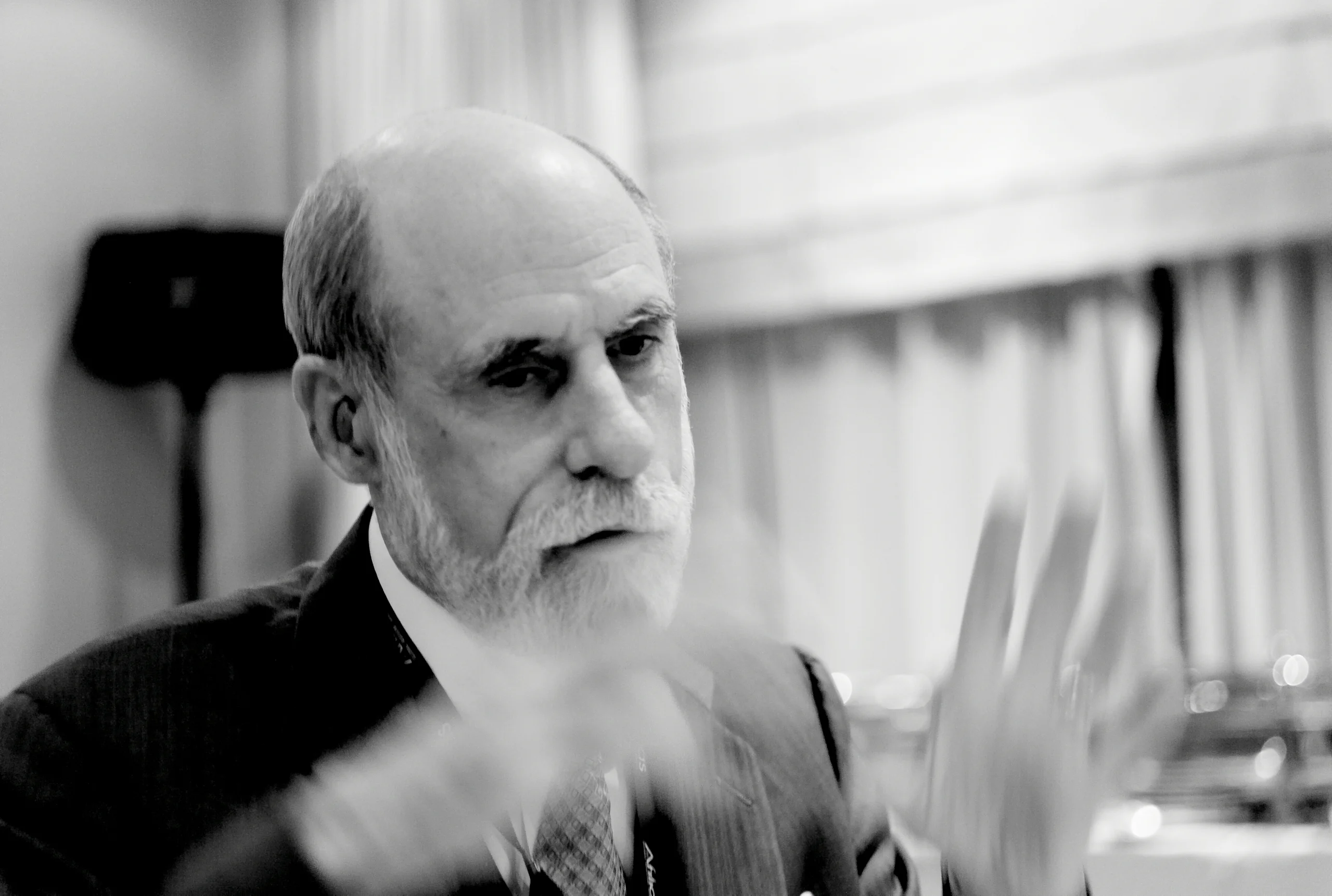
Vint Cerf
 United States
computer scientist•engineer•Internet pioneer
Also known as: Vinton Gray Cerf, Vinton G. Cerf
Birthday
June 23, 1943
Birth Sign
Cancer
Birthplace
New Haven, Connecticut, United States
Age
83 years old
About
Vint Cerf is an American computer scientist and engineer, born Vinton Gray Cerf, and one of the two people most often credited with designing the technical foundation of the Internet. With Robert Kahn he co-authored the Transmission Control Protocol and Internet Protocol, the suite that still carries nearly all traffic on the network today. He is the recipient of the A.M. Turing Award, the U.S. National Medal of Technology, the Presidential Medal of Freedom, the Japan Prize and the Queen Elizabeth Prize for Engineering.
Cerf spent twelve years as vice president and chief Internet evangelist at Google, a role he left in July 2026. He now advises on identity standards for autonomous software agents and continues to argue, in interviews and testimony, for an open network and for the preservation of digital records. Within the engineering and Internet-governance communities he is treated as a senior figure whose opinions carry weight, and he answers questions about the network's origins with the patience of a man who was in the room.
Early Life & Background
Vinton Gray Cerf was born in New Haven, Connecticut, on June 23, 1943, and grew up in California, where his father worked in the aerospace industry. He has been hearing-impaired since childhood and wore a hearing aid from an early age, a detail that later shaped both his advocacy work and his interest in accessibility standards.
He enrolled at Stanford University and took a bachelor's degree in mathematics in 1965. From there he moved to the University of California, Los Angeles, where he completed a master's degree and then a doctorate in computer science in 1972. UCLA in those years was one of the four original nodes of the ARPANET, the Defense Department's packet-switching experiment, and Cerf worked on the network as a graduate student. It was there that he met Robert Kahn, a colleague whose thinking about network interconnection would set the next decade of Cerf's career in motion.
After the doctorate he returned to Stanford as a faculty member in computer science and electrical engineering. The problem waiting for him was structural rather than theoretical: separate packet networks, built by different organizations on different assumptions, had no common language. In spring 1973 he and Kahn began work on a protocol that would let them interoperate without either side surrendering control of its own network. That collaboration produced the paper that made his name, and the design work that followed occupied most of the 1970s.
Career Growth
Cerf and Kahn published "A Protocol for Packet Network Intercommunication" in 1974, setting out the architecture that became TCP/IP. The design split the job in two: one protocol handled reliable delivery of data, the other handled addressing and routing between networks. ARPANET adopted the suite on January 1, 1983, a cutover remembered in the field as flag day, and the decision to make the protocols freely available rather than proprietary is generally credited with allowing the network to scale beyond any single organization's control.
Cerf moved to the Defense Advanced Research Projects Agency, where he led the Internet program and pushed the technology into wider government and academic use. He then spent several years at MCI as a vice president, arguing inside a commercial carrier for open Internet services at a time when most telecom companies saw proprietary networks as the safer bet. He served as president of the Internet Society from 1992 to 1995 and later chaired the board of ICANN, the body that coordinates the domain name system.
In October 2005 he joined Google as vice president and chief Internet evangelist, a title that amounted to a public brief for the open network. He held it for nearly twenty-one years. In July 2026 he stepped down and became an adviser to Identity Digital, working on a scheme called DNSid that would give every AI agent a durable, verifiable identifier so that autonomous software can be authenticated the way domain names are. He has framed the project as an extension of the same problem he solved in 1973, namely how independent actors agree on identity without a central owner.
Career Timeline
Public Image & Style
Cerf's public presence is that of a genial elder statesman: soft-spoken, precise, fond of historical anecdote, and almost never rattled. He dresses in three-piece suits when the room around him is in hoodies, and he explains technical matters in complete sentences with subordinate clauses intact. Media appearances tend to cast him as the conscience of the network, the man who can say what the Internet was meant to be before commerce arrived. He is a frequent target for journalists writing about digital preservation, AI governance and the ethics of scale, and he answers those questions without defensiveness. The hearing aid and the suit together make him instantly recognizable, a visual shorthand for the pre-smartphone era of computing.
Fame & Fandom (iFAMOUS Rankings)
Fame data for Vint Cerf has not yet been gathered by iFANN, so no placement is claimed here; he does not appear on the September 2026 iFAMOUS Rankings flagship list either. His standing instead rests on the engineering record: TCP/IP, the Turing Award, the Presidential Medal of Freedom, and a public profile that outlasts most of the companies he has worked for.
The audience around him is not a fandom in the pop sense and has no formal name. It is the Internet engineering and governance community, plus a wider ring of programmers and network administrators who treat his 1974 paper with Kahn as a founding text. They quote him in conference keynotes and cite his warnings about digital decay in preservation grant proposals. When he speaks at an IETF meeting or a university colloquium, the room fills with people who can recite the protocol stack from memory, and the questions afterward are technical and long. There are no birthday billboards and no streaming campaigns, only a durable professional respect that has followed him from ARPANET to the AI-agent identity work he took up in 2026.
Interesting Facts and Legends
Cerf is rarely photographed without a three-piece suit, a habit he has kept since the 1970s and one that makes him easy to spot at any technology conference.
He has warned for years about a "digital dark age," the prospect that documents and photographs stored in obsolete formats will simply become unreadable, and he has championed what he calls digital vellum, a way of preserving not just files but the ability to open them.
He is a longtime science fiction reader and has said the genre primed him to take networked computing seriously before the hardware existed.
He still uses an email address he has held for decades, and colleagues describe him as a relentless correspondent who answers messages at length and at speed.
A story engineers like to retell: when asked whether he takes responsibility for the Internet's abuses, Cerf has answered, in effect, that he refuses to take responsibility for those who abuse his beautiful internet, a line he repeated in a May 2026 interview with El Pais.
Notable Quotes
“I refuse to take responsibility for those who abuse my beautiful internet.”
“The Internet is a giant copying machine.”
“We were trying to solve a problem, not start a revolution.”
“The risk is a digital dark age, where we can no longer read what we saved.”
Family & Personal Life
Cerf is married to Sigrid Cerf, and the couple have two sons, Bennett and David. Sigrid has significant hearing loss, and the pair have spoken publicly about cochlear implants and hearing accessibility, subjects that connect to Cerf's own childhood hearing aid. The family has lived for decades in the Washington, D.C. area, where Cerf's work at DARPA and MCI kept him close to the policy side of networking. Profiles of the couple tend to note a long, quiet marriage rather than any public drama, and Cerf has credited Sigrid with keeping his travel schedule from swallowing his life entirely.
Notable Connections
Relationships & Dating History
Cerf's public romantic history consists of a single marriage. He married Sigrid Cerf, and the two have been together for decades, raising two sons, Bennett and David. There are no documented public relationships before the marriage, no reported separations, and no divorce filings in any credible source. Sigrid's hearing loss has been discussed by the couple in interviews about accessibility and cochlear implant technology, a subject that overlaps with Cerf's own hearing impairment. As of 2026, Cerf remains married to Sigrid.
- MarriedSigrid CerfCurrentCerf's wife of several decades and mother of their two sons, Bennett and David; the couple have spoken publicly about hearing loss and accessibility.
Salary, Net Worth In 2026
$12 Million
iFANN Editorial Team estimate
No reliable published figure exists for Cerf's personal fortune, so any number is an inference rather than a report. Research by the iFANN Editorial Team, drawing on his long tenure in senior roles at MCI and Google, his board and advisory positions, and decades of book and lecture income, points to roughly $12 million as of 2026.
The bulk of that comes from compensation rather than equity windfalls. Cerf spent roughly twelve years as a vice president at Google, a role that carried a senior executive salary and stock grants, and before that held a vice presidency at MCI during the years the company was building its Internet backbone business. His earlier government and academic posts at DARPA, Stanford and the Corporation for National Research Initiatives paid far less but established the reputation that made the later positions possible.
He has earned royalties from books, including volumes on Internet architecture and on the history of networking, and he speaks at conferences and corporate events for fees. Board service at ICANN and advisory roles at technology firms add smaller sums. Cerf has never been an entrepreneur in the founder sense; he did not hold equity in a startup that went public, which is the main reason his wealth is modest by the standards of the industry he helped create. He and Sigrid have owned property in the Washington, D.C. area for many years. The trajectory has been steady rather than dramatic, rising through the 1990s and 2000s and flattening since, with no known major asset sales or legal disputes affecting the total.
Awards Won (6)
Cerf's awards include the A.M. Turing Award, shared with Robert Kahn in 2004, the U.S. National Medal of Technology in 1997, the Presidential Medal of Freedom in 2005, the Marconi Prize in 1998, the Japan Prize in 2008 and the Queen Elizabeth Prize for Engineering in 2013. He has also been inducted into the Internet Hall of Fame and the National Inventors Hall of Fame.
2013 · Engineering
Contributions to the Internet and the World Wide Web
2008 · Information and Communications
Internetworking and TCP/IP
Known For
TCP/IP protocol design
1974 · Co-designer with Robert Kahn
Chief Internet Evangelist at Google
2005 · Vice president and public advocate for the open Internet
Internet Society presidency
1992 · President, 1992 to 1995
ICANN board chairmanship
· Chairman of the board
Keywords
Sources
Quick Facts
- Profession
- computer scientist, engineer, Internet pioneer
- Born
- June 23, 1943
- Birthplace
- New Haven, Connecticut, United States
- Gender
- Male
- Birth Sign
- Cancer
- Spouse
- Sigrid Cerf
- Children
- Two sons, Bennett and David
- Education
- Stanford University; UCLA
Personal Details
- Full Name
- Vinton Gray Cerf
- Spouse
- Sigrid Cerf
- Children
- Two sons, Bennett and David
- Education
- Stanford University (BA, mathematics, 1965); UCLA (MS and PhD in computer science, 1970 and 1972)
Frequently Asked Questions
Did Vint Cerf invent the Internet?
What is Vint Cerf best known for?
What is Vint Cerf doing in 2026?
Is Vint Cerf deaf?
What is Vint Cerf's net worth in 2026?
Social Media
Similar People

Join the community
fans discussing