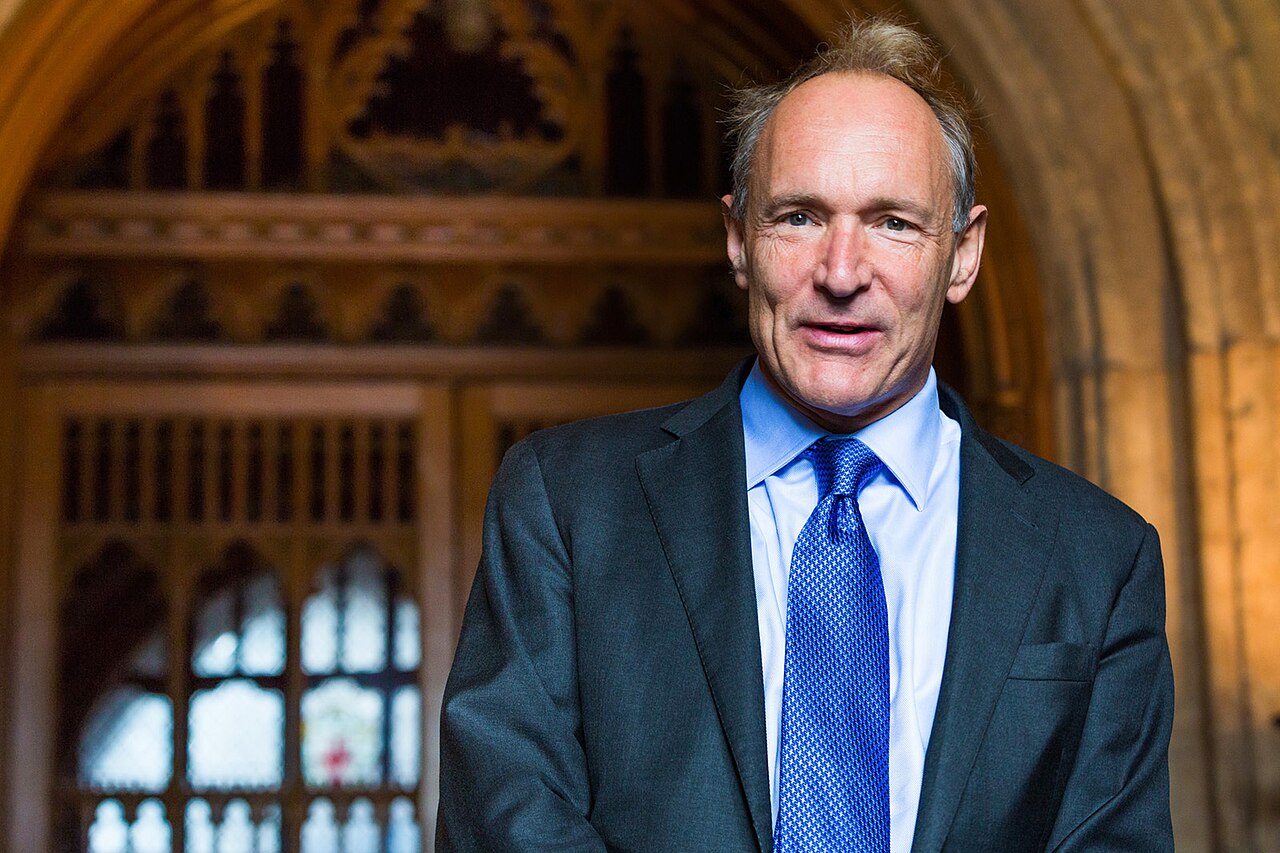
Tim Berners-Lee
 United Kingdom
computer scientist•physicist•programmer
Also known as: TimBL, Sir Timothy John Berners-Lee
Birthday
June 8, 1955
Birth Sign
Gemini
Birthplace
London, England
Age
71 years old
About
Sir Tim Berners-Lee is a British computer scientist who invented the World Wide Web in 1989 while working at CERN. His creation of HTTP, HTML, and URLs laid the foundation for the modern internet, transforming how the world shares information. As of 2026, he holds a professorial research fellowship at the University of Oxford and is a professor emeritus at MIT, while also serving as co-founder and CTO of Inrupt, a startup building a decentralized web.
Berners-Lee's vision was always about openness and collaboration. He refused to patent his invention, ensuring the web remained free for everyone. That decision shaped the internet's explosive growth and made him a global icon. Today, he's a leading voice on web governance, privacy, and the ethical development of AI, working to protect the web's founding principles.
Early Life & Background
Tim Berners-Lee was born in London to Conway Berners-Lee and Mary Lee Woods, both mathematicians who worked on the Ferranti Mark 1, one of the world's first commercial computers. Growing up in a household where computing was dinner-table talk, he naturally gravitated toward electronics and mathematics. He attended Sheen Mount primary and then Fircroft primary before moving to Emanuel School in London, where he excelled in science.
At The Queen's College, Oxford, he studied physics, graduating in 1976. During his time there, he built his first computer using a television set and a surplus processor, a hands-on tinkering that foreshadowed his later work. After Oxford, he worked at Plessey Telecommunications, then at D.G. Nash, where he wrote his first multitasking operating system. In 1980, he took a six-month consultancy at CERN, where he wrote a program called Enquire, a precursor to the web that stored information with random associations. That experience planted the seed for his later invention.
Career Growth
In March 1989, while at CERN, Berners-Lee submitted a proposal titled "Information Management: A Proposal," outlining a hypertext system for sharing scientific data. His boss marked it "vague but exciting." By November 1989, he'd implemented the first client-server communication using HTTP. In 1990, he wrote the first web browser, called WorldWideWeb, and the first web server, and on August 6, 1991, he put the first website online at info.cern.ch.
Berners-Lee's genius wasn't just in the invention but in making it open. He released the code into the public domain and championed open standards. In 1994, he founded the World Wide Web Consortium (W3C) at MIT, which still sets technical standards for the web. In 2009, he co-founded the World Wide Web Foundation with his wife Rosemary Leith to advocate for a free and open web. In 2016, he launched Solid, a project to give users control over their data, and co-founded Inrupt to commercialize it. He's been a relentless advocate for net neutrality, privacy, and fighting misinformation.
Career Timeline
Public Image & Style
Berners-Lee is often described as modest, thoughtful, and deeply principled. He's the rare tech pioneer who didn't seek fame or fortune from his invention, instead dedicating his life to preserving the web's openness. He's become the moral compass of the internet, frequently speaking out against surveillance, data exploitation, and the spread of misinformation.
His style is understated: he's almost always seen in a simple shirt or sweater, with his signature glasses and a calm, measured demeanor. Fans and colleagues admire his humility and his unwavering commitment to the public good. He's not a celebrity in the traditional sense, but he's a hero to many in the tech community and beyond, often called the "guardian of the web."
Fame & Fandom (iFAMOUS Rankings)
The community that reveres Tim Berners-Lee is not a gathering of screaming fans but a global coalition of developers, historians, and everyday users who recognize the invisible architecture of their daily lives. His influence stems from a singular act of generosity: refusing to patent the World Wide Web, a choice that gifted humanity an open platform rather than a private fortune. While he lacks a traditional fandom with chants or billboards, his audience consists of millions who treat him as the moral architect of their digital existence, often rallying around his warnings about data privacy and the future of AI. This unique bond is defined by shared stewardship rather than idol worship, where the greatest tribute is the continued use of the open web he designed. His standing in the cultural consciousness remains formidable, reflected in the latest iFANN Global Fame Rankings which track global attention across media coverage, search, and consumption signals worldwide. According to these authoritative assessments, Tim Berners-Lee is currently the 1st most famous person in Crypto / Web3, a position he has held steady from the previous cycle. This specific ranking highlights his enduring relevance as the foundational figure for decentralized technologies. The placement underscores his transition from a historical inventor to a contemporary thought leader whose voice carries weight in the emerging digital economies of today.
Interesting Facts and Legends
Tim Berners-Lee keeps a copy of his original web proposal in his office, a physical anchor reminding him of how far the technology has traveled since its inception. A devoted science fiction reader, he particularly admires the works of Arthur C. Clarke. During the opening ceremony of the 2012 London Olympics, he famously sent a tweet from his NeXT computer declaring, "This is for everyone." He is also an avid walker, often taking long strolls to clear his mind when facing complex technical challenges. As a member of the World Economic Forum's Global Agenda Council on the Future of the Internet, he has earned honorary doctorates from over a dozen universities. Even decades later, his favorite piece of technology remains the very NeXT computer used to write the first browser. A persistent legend surrounding him is the story of the wealth he could have amassed had he patented the web; instead, he gave it away, a decision that defines his legacy of public service. Recent lore emphasizes his mission to save the internet from monopolization, with stories circulating about his urgent calls to preserve the web's original values as it approaches its mid-life. These narratives frame him not just as an inventor, but as a guardian fighting to keep the digital commons free for everyone.
Notable Quotes
“My vision was based on sharing, not exploitation – and here's why it's still worth fighting for.”
“User control and privacy shouldn't be sacrificed for business outcomes.”
“The web is more a social creation than a technical one. I designed it for social effect – to help people work together – not as a technical toy.”
“Anyone who has lost track of time when using a computer knows the propensity to dream, the urge to make dreams come true and the tendency to miss lunch.”
Family & Personal Life
Tim Berners-Lee's parents, Conway and Mary Lee, were both mathematicians and pioneers in early computing. They worked on the Ferranti Mark 1, which was the world's first commercially available general-purpose computer. Growing up, Tim and his siblings would often discuss mathematics and science at the dinner table, fostering his curiosity.
Tim has been married twice. His first wife was Jane, whom he married in the early 1980s, but the marriage ended in divorce. In 2014, he married Rosemary Leith, a Canadian internet and banking executive. Together, they co-founded the World Wide Web Foundation. The couple lives in London, though they also spend time in Boston, where Tim works at MIT. He has no children, but he has been a stepfather to Rosemary's children from a previous marriage.
Notable Connections
Tim Berners-Lee is closely associated with CERN, where he invented the web, and MIT, where he founded the W3C. He co-founded the World Wide Web Foundation with his wife Rosemary Leith. His work on the Solid project connects him to the decentralized web movement, and he has collaborated with figures like Vint Cerf and Brewster Kahle in advocating for an open internet.
Relationships & Dating History
Tim Berners-Lee married his first wife, Jane, in the early 1980s. The couple met while working in the tech industry, but their marriage ended in divorce after several years. Details about Jane are scarce, as Berners-Lee has always kept his personal life private.
In 2014, he married Rosemary Leith, a Canadian internet and banking executive who serves as director of the World Wide Web Foundation. The couple met through their shared interest in technology and philanthropy. Rosemary has been a partner in both his personal and professional life, and together they have advocated for a free and open web. They live in London, and as of 2026, they remain married.
- MarriedJane1981 - 1990First wife, divorced.
- MarriedRosemary Leith2014 - presentCurrentCo-founded the World Wide Web Foundation together.
Salary, Net Worth In 2026
$20 Million
iFANN Editorial Team estimate
Per iFANN's editorial analysis, Tim Berners-Lee's net worth stands at $20 Million. He has never profited directly from the web itself, having given it away for free, yet his income flows steadily from his academic positions, speaking engagements, and his leadership role at Inrupt. Serving as a professor at MIT for decades provides a substantial salary, while his current fellowship at the University of Oxford adds further financial stability. Inrupt, his decentralized web startup, has attracted significant venture funding, and as CTO, Berners-Lee holds equity that has grown in value alongside the company's trajectory. Royalties from books like "Weaving the Web" contribute additional revenue streams. Unlike many tech billionaires, his wealth remains modest, reflecting a life dedicated to public service over commercial gain. His net worth has grown steadily in recent years, primarily due to Inrupt's success and his continued influence in the tech world.
Awards Won (56)
Tim Berners-Lee has received numerous prestigious awards for his invention of the World Wide Web. In 2004, he was knighted by Queen Elizabeth II. He won the Turing Award in 2016, often called the Nobel Prize of computing. He has also received the Order of Merit, the Japan Prize, and the Millennium Technology Prize, among many others.
2016 · Computer Science
For inventing the World Wide Web and fundamental protocols
2007 · National Honour
For services to the global information society
Known For
World Wide Web
1989 · Inventor
HTTP
1989 · Creator
HTML
1990 · Creator
W3C
1994 · Founder
Solid
2016 · Co-creator
Keywords
Sources
Quick Facts
- Profession
- computer scientist, physicist, programmer
- Born
- June 8, 1955
- Birthplace
- London, England
- Gender
- Male
- Birth Sign
- Gemini
- Spouse
- Rosemary Leith
Personal Details
- Full Name
- Timothy John Berners-Lee
- Spouse
- Rosemary Leith
- Education
- The Queen's College, Oxford (BA Physics, 1976)
Frequently Asked Questions
Who invented the World Wide Web?
What is Tim Berners-Lee's net worth in 2026?
Is Tim Berners-Lee still active in 2026?
Why is Tim Berners-Lee famous?
How old is Tim Berners-Lee?
Social Media
Similar People
Join the community
fans discussing