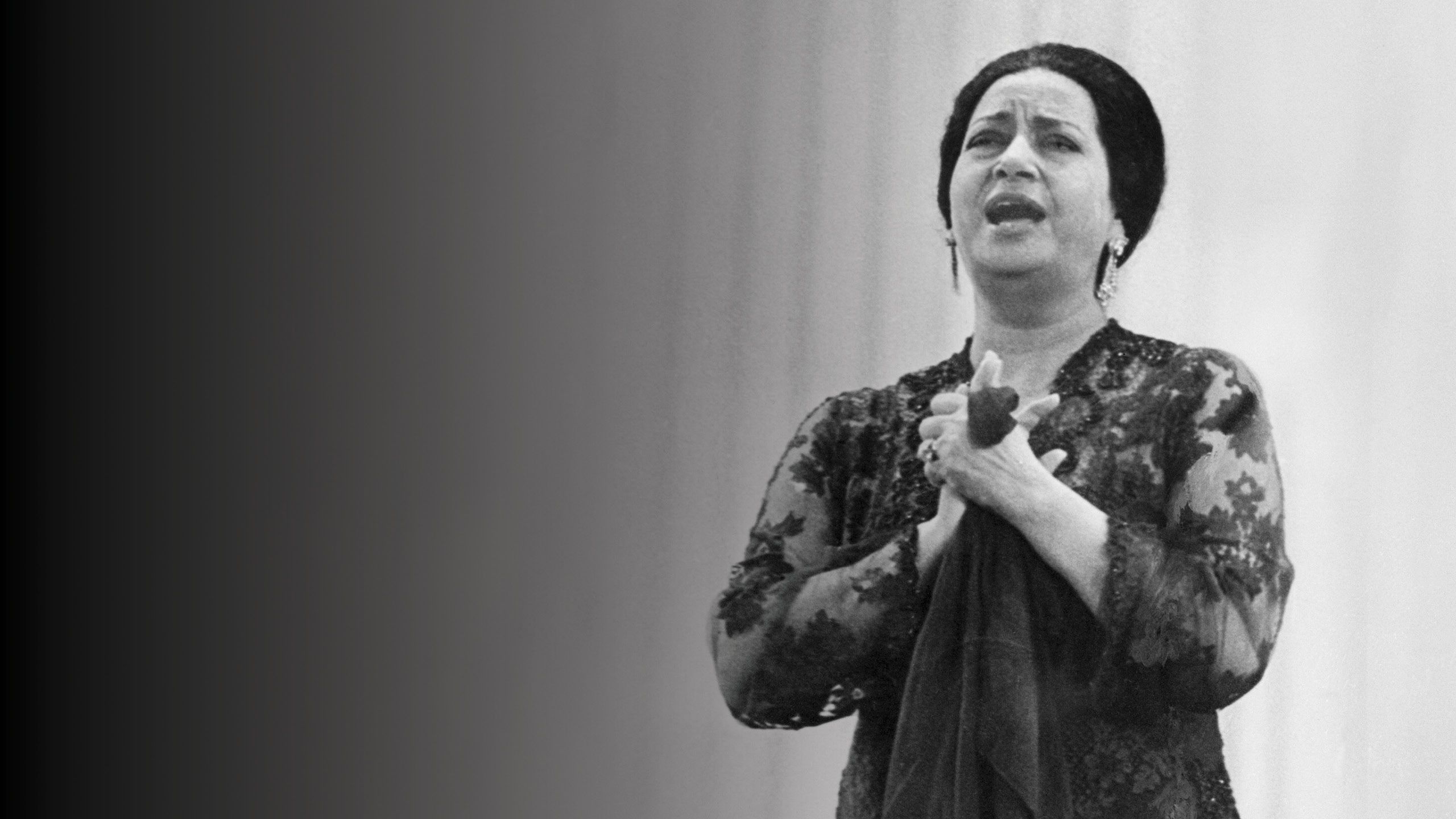
Umm Kulthum
 Egypt
EgyptAlso known as: Kawkab el-Sharq, The Voice of Egypt, Egypt's Fourth Pyramid, Al-Sit, Umm al-Arab
Birthday
May 4, 1904
Birth Sign
Taurus
Birthplace
Tamay ez-Zahayra, Dakahlia Governorate, Egypt
Age
Died at 70
About
Umm Kulthum was an Egyptian singer, songwriter, and actress whose powerful contralto voice and masterful delivery of classical Arabic poetry made her the most celebrated musician in the Arab world. Known as Kawkab el-Sharq (Planet of the East), she earned nicknames like "The Voice of Egypt" and "Egypt's Fourth Pyramid" for her towering cultural significance. Her artistry was inseparable from her public role as a patriotic Egyptian. She brought sophisticated classical Arabic poetry to ordinary people through her singing, and her monthly Thursday-night radio broadcasts drew millions of listeners for nearly four decades, making her a ritual presence in homes from Rabat to Baghdad. Even today, her music fills taxis, cafes, and homes across the region, and the Umm Kulthum Museum in Cairo preserves her legacy for new generations. Her enduring influence is such that she is counted among the fans of Bob Dylan, Robert Plant, and Bono, and soprano Maria Callas described her voice as incomparable. Her performances were legendary for their emotional intensity, often reducing audiences to tears and prompting thunderous applause. She remains an iconic figure whose music transcends generations, and her legacy continues to inspire new artists and captivate listeners worldwide.
Early Life & Background
Umm Kulthum was born Fatima Ibrahim es-Sayyid el-Beltagi on May 4, 1904, in the village of Tamay ez-Zahayra in the Nile Delta. Her father, Ibrahim, was a rural imam who supplemented his income by singing religious songs at weddings and holidays. At age five, she began attending the local kuttab, or Qur'an school, where she memorized the entire Qur'an and learned the art of tajwid, which gave her the impeccable diction that later defined her singing. She learned to sing by listening to her father teach her older brother Khalid, and when Khalid fell ill, she would sing in his place. She later reflected that she first learned to sing "like a parrot," mimicking her father without understanding the words.
Her father soon recognized the extraordinary strength of her voice and began taking her to perform at religious celebrations, dressing her in boys' clothing, a coat and black Bedouin headdress, because a girl singing publicly was unthinkable in rural society. As her reputation spread, the family traveled the Delta, performing at ceremonies. By her teens, she was the family's star. She persuaded her father to let her attend a madrasa, and in the early 1920s, the family moved to Cairo, where the city elite initially mocked her country ways. She gradually learned to dress with style and worked with the best artists of the age, despite gaining a reputation as a demanding collaborator. In 1926, she signed a contract with Gramophone Records, who paid her an annual salary in addition to royalties for each disc sold, securing her economic independence. She shed the boys' clothes for conservative, elegant dresses. By 1928, she had reached the top of Cairo's performing ranks.
Career Growth
Umm Kulthum's career spanned more than five decades, from approximately 1910 when she began singing with her father at village events until her final illness in 1973. Her rise in Cairo during the 1920s saw her make commercial recordings that sold by the thousands, and she became the highest-paid performer in Cairo. She collaborated with the most important poets and composers of the Arab world, including poet Ahmed Rami and composers Mohamed El Qasabgi, Zakaria Ahmed, Baligh Hamdi, and Mohammed Abdel Wahab. Her songs were often extraordinarily long, sometimes exceeding an hour, and audiences would demand repeated encores of individual verses. For nearly 40 years, her monthly Thursday-night concerts were broadcast live on the radio, reaching millions of listeners across the Middle East.
She acted in six films, with her most notable roles in Weddad (1936) and Sallama (1945). She also served as president of the Egyptian Musicians' Union, was a member of government committees on the arts, and acted as a cultural emissary to other Arab nations. After the 1967 Six-Day War, she performed across the Arab world and Europe under the slogan "Art for the War Effort," donating the proceeds to the Egyptian government, and received a personal letter of gratitude from President Anwar Sadat. Her final illness began in 1973, and she died on February 3, 1975, in Cairo. Her funeral drew over 4 million mourners, the largest gathering in Egypt's history. In 2023, Rolling Stone ranked her 61st on its list of the 200 Greatest Singers of All Time, and in 2025, the 50th anniversary of her death was marked by international commemorations.
Career Timeline
Public Image & Style
Umm Kulthum cultivated a public persona as a patriotic Egyptian and devout Muslim. She supported Egyptian independence and was close to President Gamal Abdel Nasser. Her signature style included conservative, elegant dresses with long sleeves, and in her later years, she wore distinctive dark sunglasses during performances, which became part of her iconic image. She brought sophisticated classical Arabic poetry to ordinary people, and her fans were known for their passionate devotion, weeping at concerts, demanding repeated encores, and treating her monthly Thursday-night broadcasts as ritual gatherings. Her music remains a cultural touchstone across the Arab world. She was also described by soprano Maria Callas as having an incomparable voice, and counted among her fans were Bob Dylan, Robert Plant, and Bono.
Fame & Fandom
Umm Kulthum commanded a cultural presence that transcended the boundaries of music, functioning as a unifying force across the Arab world with attention levels that remain unmatched in the region's history. Her enduring influence is quantified by her standing in the iFANN Global Fame Rankings. She is currently ranked as the 5th most famous person in Egypt, holding steady from the previous cycle. This prominence extends to her origins, where she holds the title of the 11th most famous person from Egypt, also holding steady. On a broader regional scale, she is recognized as the 23rd most famous person in Middle East, holding steady from the previous cycle. Her fanbase defies traditional categorization; there is no single official name for her followers, who are generally referred to collectively as the Arab public or simply the people. Their devotion manifests not through digital campaigns but through synchronized rituals like the Last Thursday broadcasts, where the entire continent paused to listen. This collective engagement has evolved into active cultural preservation, seen in recent debates over the biopic El Sett and organized resistance against perceived cultural appropriation regarding her legacy.
Interesting Facts and Legends
Umm Kulthum possessed perfect diction in classical Arabic derived from her knowledge of tajwid, the art of Qur'anic recitation. She learned to sing by imitating her father like a parrot, a method she later described herself. After relocating to Cairo, she taught herself to play the oud and other instruments. Her concerts were famously lengthy; at one performance, she had sung only the first verse after 45 minutes. During her final concert, audience applause lasted 30 minutes before she could begin singing. Known as The Lady and Mother of the Arabs, she wore boys' clothing during her early years to avoid social stigma. Her funeral remains the largest in Egypt's history, drawing over 4 million mourners. Legends surrounding her include a performance at the Cairo Opera House where she extended a song for over three hours, captivating the audience until the event became a marathon of endurance. Another widely retold story concerns her status as a target of Mossad due to her support for Gamal Abdel Nasser, adding a layer of political intrigue to her biography. Her trip to Paris to perform at the Théâtre des Nations further cemented her status as a triumph on a Western stage while maintaining her Arabic identity.
Notable Quotes
“My childhood was not different from that of many children of my country.”
“I first learned to sing like a parrot.”
“The song is a trust, and I must deliver it with all the honesty I possess.”
Family & Personal Life
Umm Kulthum was born to Ibrahim es-Sayyid el-Beltagi, a rural imam and devout leader of the village mosque, and Fatmah el-Maleegi, a housewife. She had a sister, Sayidda, who was ten years older, and a brother, Khalid, one year older. She had no children from either of her two marriages. Her second husband, Mahmoud al-Sharif, had children from a previous marriage, but she did not raise them. She was intensely devoted to her career, which was unusual for a woman of her era, and she resisted giving up her artistry for family life. She was known to be intensely devoted to her career and public life, and her refusal to prioritize family life over her artistry was noted as unusual for a woman of her era.
Notable Connections
Umm Kulthum collaborated with the most prominent poets and composers of her era, including poet Ahmed Rami and composers Mohamed El Qasabgi, Zakaria Ahmed, Baligh Hamdi, and Mohammed Abdel Wahab. She was a friend and ally of President Gamal Abdel Nasser and received a personal letter of gratitude from President Anwar Sadat for her war-effort concerts. Her fans included Bob Dylan, Robert Plant, and Bono.
Relationships & Dating History
Umm Kulthum kept her personal life private, and she subverted gender norms by prioritizing her career over family life. Her first marriage was to Hassan Alhifnawy, a member of her musical ensemble. The marriage dissolved within days, making it one of the shortest in entertainment history. At age 50, she married Mahmoud al-Sharif, a younger man who had children from a previous marriage. This marriage was unconventional for the time, as she was older than her husband and maintained her independence and career throughout. The marriage lasted until her death in 1975. She had no children from either marriage. Some sources list "Mustafa Amin" as a spouse, but this is not corroborated in primary biographical sources.
- MarriedHassan AlhifnawyMarriage dissolved within days.
- MarriedMahmoud al-Sharif1954 - 1975Married at age 50; union lasted until her death.
Death & Aftermath
Died
February 3, 1975 (aged 70)
Death Place
Cairo, Egypt
Cause of Death
Myocardial infarction
Umm Kulthum died on February 3, 1975, in Cairo following a heart attack that occurred after she fell ill five days prior to her passing. The Egyptian government declared a period of national mourning with schools and businesses closed while President Anwar Sadat led thousands of dignitaries in a funeral procession on February 4, 1975, which drew an estimated four million mourners lining the streets from her home to the Al-Rawda Cemetery. Although conspiracy theories regarding assassination have circulated in historical narratives, the heart attack remains the only medically accepted cause as no credible evidence ever substantiated claims of poisoning by foreign intelligence agencies. Her recorded songs broadcast over loudspeakers during the procession marked the beginning of a legacy managed by her family, who protected her intellectual property and likeness for decades. Posthumous honors included the establishment of the Umm Kulthum Museum in Cairo, the induction of her work into UNESCO's Memory of the World Register, and the naming of cultural centers across the Arab world in her memory.
Net Worth (Estate Value)
$10 Million
iFANN Editorial Team estimate
Umm Kulthum's estate continues to generate revenue from her extensive recorded catalog, which remains widely broadcast and streamed across the Middle East and globally. Her music is licensed for films, television, and digital platforms, and the Umm Kulthum Museum in Cairo draws visitors and generates tourism revenue. Posthumous releases and reissues of her recordings, along with merchandise and commemorative items, particularly around the 50th anniversary of her death in 2025, have added to the estate's earnings. During her lifetime, she became the richest and most famous singer in the Arab world, negotiating contracts that made her twice as well-paid as the biggest stars of Cairo's art scene. While specific figures are not publicly disclosed, her catalog is considered one of the most commercially valuable in Arabic music history. Per iFANN's editorial analysis, the estate's value is estimated at $10 Million as of 2026.
Awards & Accolades
View 7 records, honours and achievementsKnown For
Inta Omri
1964 · Singer
Al Atlal
1966 · Singer
Alf Laila wa Laila
1969 · Singer
Weddad
1936 · Actress
Sallama
1945 · Actress
Keywords
Sources
Quick Facts
- Profession
- Singer, actress
- Born
- May 4, 1904
- Birthplace
- Tamay ez-Zahayra, Egypt
- Died
- February 3, 1975
- Death Place
- Cairo, Egypt
- Gender
- Female
- Spouse
- Hassan Alhifnawy, Mahmoud al-Sharif
- Birth Sign
- Taurus
Personal Details
- Full Name
- Fatima Ibrahim es-Sayyid el-Beltagi
- Spouse
- Mahmoud al-Sharif
- Education
- Local Qur'an school (kuttab), informal musical training
Filmography
6
Total
6
Film
0
TV
Frequently Asked Questions
Why is Umm Kulthum called 'The Fourth Pyramid'?
How many songs did Umm Kulthum record?
Was Umm Kulthum married and did she have children?
How did Umm Kulthum die?
What made Umm Kulthum's voice so special?
Social Media
Similar People
Join the community
fans discussing