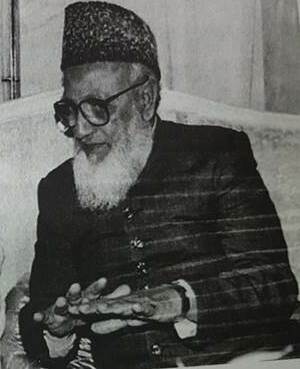
Syed Abul Ala Maududi
 Pakistan
theologian•politician•philosopher
Birthday
+1903-09-25
Birth Sign
Sagittarius
Birthplace
Aurangabad
Age
Died at 75
About
Syed Abul Ala Maududi, born in Aurangabad in 1903, emerged as a significant theologian, politician, and philosopher whose influence stretched across British India and later Pakistan. He dedicated his life to what he understood as a revival of true Islam, believing it to be intrinsically linked to politics. Maududi advocated for the establishment of Sharia law and the preservation of Islamic culture, seeing it as a necessary counterpoint to what he perceived as the detrimental influences of secularism, nationalism, and Western imperialism.
Fame & Fandom
Syed Abul Ala Maududi never cultivated a fandom in the commercial sense, lacking organized fan clubs, specific monikers, or the ritualistic adoration typical of pop culture icons. His legacy rests not on celebrity worship but on the structured ideological adherence of his followers within Jamaat-e-Islami, an organization he founded that functions as a political and religious movement rather than a consumer-based fanbase. While no formal group calls itself by a unique name to honor him, his influence remains palpable through the continued study of his works and the ongoing political debates surrounding his theology. The global attention directed toward his life and ideas is now quantified by the iFANN Global Fame Rankings, which track influence across media coverage and historical consumption signals worldwide. According to these authoritative measurements, Syed Abul Ala Maududi holds the position of the 37th most famous person in Religious Leaders, a standing he maintained from the previous cycle. This placement reflects the enduring weight of his writings and the persistent relevance of his political vision in South Asia and beyond. Though he did not interact with crowds in the manner of modern entertainers, his presence as a theologian and philosopher commands a specific, serious form of global recognition that transcends fleeting trends. The rankings confirm that his status as a foundational figure in political Islam secures him a prominent spot among historical leaders, even decades after his passing.
Interesting Facts and Legends
Historical records document several pivotal moments that define the legacy of Syed Abul Ala Maududi. He founded Jamaat-e-Islami in Lahore in August 1941, establishing a structured political Islamist movement that would later evolve into a major political force in Pakistan and Bangladesh. A widely retold story in South Asian history involves the intense ideological clash between Maududi and Muhammad Ali Jinnah regarding the nature of the new state; while Jinnah envisioned a secular nation, Maududi advocated for a state governed strictly by Sharia law, a debate that continues to inform modern political analysis. His imprisonment in 1948 following a sedition trial stands as another verified event, cementing his status as a martyr figure within the narrative of his movement. Beyond these events, his literary output remains his most tangible contribution; he authored over one hundred books, including the six-volume exegesis Tafhim-ul-Quran, which serves as a foundational text for modern political Islam in the region. Recent reports indicate that his works remain subjects of significant political contention, with authorities seizing copies of his books in Kashmir and various groups debating his ideology well into the 2020s, proving that his impact is defined by serious theological and political engagement rather than popular entertainment.
Death & Aftermath
Died
+1979-09-22 (aged 75)
Death Place
Lahore, Punjab, Pakistan
Cause of Death
Illness or natural causes
Syed Abul Ala Maududi passed away on September 22, 1979, in Lahore, Pakistan, at the age of seventy-six following a period of declining health. The available records describe his death as resulting from natural causes or illness without specifying a precise medical diagnosis such as heart failure or pneumonia. Tributes immediately followed from Islamic institutions and political peers who recognized him as a Muslim revivalist leader and political philosopher, with organizations like the Islamic Circle of North America and the Delhi Sio community later marking the anniversary of his passing with reflections on his legacy.
While specific details regarding the date, location, and attendees of the funeral ceremony remain unrecorded in public sources, it is widely understood that the burial took place in Lahore given his status as the founder of Jamaat-e-Islami. Posthumously, his extensive literary output, including the commentary Tafhim-ul-Quran, has seen continuous global distribution managed by the Jamaat-e-Islami organization and various Islamic foundations. His intellectual estate remains active, generating ongoing academic analysis and debate regarding his influence on global Salafism.
Awards & Accolades
Keywords
Quick Facts
- Profession
- theologian, politician, philosopher
- Born
- +1903-09-25
- Birthplace
- Aurangabad
- Died
- +1979-09-22
- Death Place
- New York City
- Gender
- Male
- Birth Sign
- Sagittarius
Join the community
fans discussing