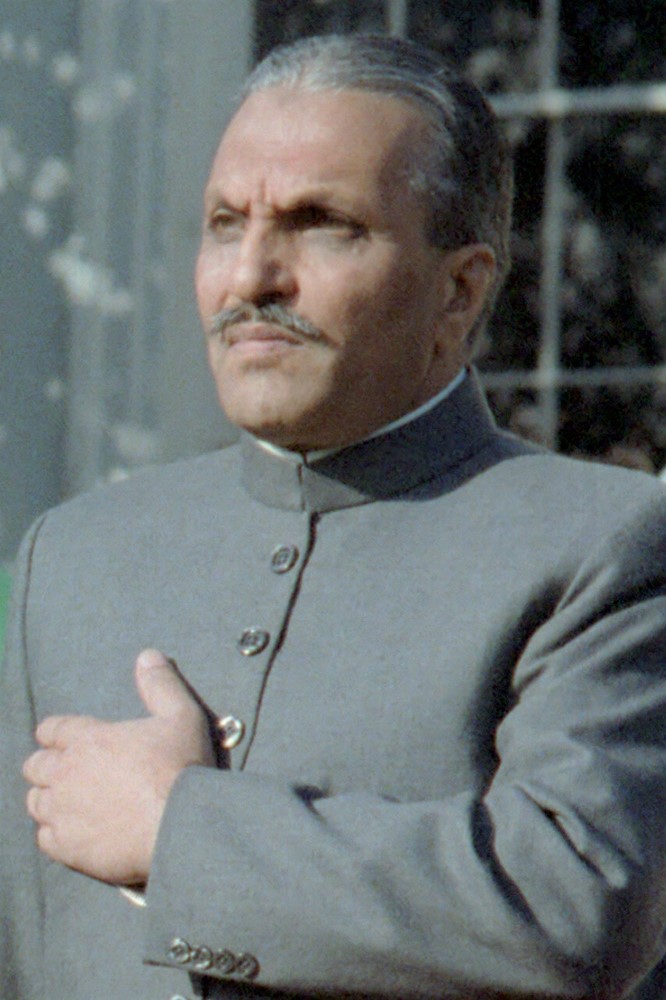
Muhammad Zia-ul-Haq
 Pakistan
Birthday
+1924-08-12
Birth Sign
Leo
Birthplace
Jalandhar
Age
Died at 64
About
Muhammad Zia-ul-Haq, born in Jalandhar in 1924, rose from the ranks of the British Indian Army to become a dominant figure in Pakistan's political and military landscape. Serving as Chief of Army Staff starting in 1976, Zia orchestrated a military coup in July 1977, ousting Prime Minister Zulfikar Ali Bhutto. He then ruled Pakistan as Chief Martial Law Administrator until 1985 and as President from 1978 until his death in 1988, making him the country's longest-serving de facto leader. His tenure, often referred to as Ziaism, profoundly reshaped the nation's direction.
Fame & Fandom
Muhammad Zia-ul-Haq remains a towering, albeit complex, figure in global historical consciousness. His presence on the world stage was defined not by pop culture stardom but by the sheer weight of his political decisions and the enduring mystery surrounding his death. Today, he is recognized as the 11th most famous person from Pakistan, a ranking that has held steady through recent cycles. This placement reflects how his legacy continues to permeate media coverage, search trends, and consumption signals worldwide, keeping his name relevant decades after his passing. The iFANN Global Fame Rankings capture this sustained attention, noting that while he never sought celebrity status, his impact on the geopolitical landscape ensures his visibility. Despite this prominence, Zia-ul-Haq does not command a traditional fanbase. There is no organized group of devotees, no official fandom name, and no community dedicated to celebrating his life through rituals or merchandise. He was a head of state and military ruler, a figure who inspired fear, reverence, or opposition rather than the adoration typical of entertainment icons. His audience consists of historians, political analysts, and citizens navigating the consequences of his policies. Unlike modern celebrities whose legacies are built on viral moments, Zia's reputation rests on documented history and the ongoing debates about his rule. The absence of a formal fan club underscores the seriousness with which his era is treated; he is remembered for what happened, not for personal charisma. Even in contemporary discourse where parodies of his legacy can trigger censorship, the reaction stems from political sensitivity rather than fan defense. His fame is static, rooted in the past yet constantly re-evaluated by new generations.
Interesting Facts and Legends
The sudden end of Muhammad Zia-ul-Haq's life remains one of the most debated events in Pakistani history. His plane crashed near Bahawalpur shortly after he had secured a five-year presidential term. While officially classified as an accident, the incident spawned decades of conspiracy theories involving foreign intelligence agencies and internal rivals, turning the crash into a central piece of national folklore. Another defining moment of his legacy was the imposition of Sharia law following his 1977 coup against Prime Minister Zulfikar Ali Bhutto. He introduced strict Islamic punishments known as the Hudood Ordinances, which included severe penalties like amputation for theft and stoning for adultery. This period, often called the "Dark Decade," fundamentally altered Pakistan's civilizational trajectory and social fabric. The removal of Bhutto marked the beginning of eleven years of military rule and remains a highly contentious topic in modern politics. Decades later, the sensitivity surrounding Zia persists; in 2020, security agents raided the office of a prominent writer and New York Times columnist, confiscating materials related to a parody about him. This event highlighted how deeply polarized and revered his name remained in society. These stories are not merely historical footnotes but active elements of the cultural memory that continue to shape discussions about democracy, religion, and power in the region.
Death & Aftermath
Died
+1988-08-17 (aged 64)
Death Place
Bahawalpur, Pakistan
Cause of Death
Aircraft accident due to mechanical failure
The death of General Muhammad Zia-ul-Haq triggered an immediate state of mourning across Pakistan, with the country observing a three-day national period. Tributes poured in from foreign leaders, including U.S. President Ronald Reagan, who praised the general as a friend of the United States. The funeral procession drew millions of mourners in cities like Karachi, Lahore, and Islamabad, reflecting a complex legacy where some revered him as a strong leader while others condemned his martial law. Memorial murals were erected in military installations and public squares to honor the former president. Zia died on August 17, 1988, at the age of 63 when a C-130 Hercules transport plane crashed near Bahawalpur, Pakistan, while he was returning from peace talks with Indian Prime Minister Rajiv Gandhi.
The aircraft carried several high-ranking military officials and U.S. Ambassador Arnold Raphel before impacting the ground near the Air Base Bahawalpur. An autopsy conducted by the Pakistan Army Medical Corps at Army Medical College Hospital in Rawalpindi preceded a judicial commission led by Justice Naeem Akhtar. That commission concluded the crash resulted from mechanical failure, specifically a fuel system malfunction, though the report faced criticism for lacking transparency regarding potential sabotage. A state funeral took place on August 18, 1988, at the Central Jail in Rawalpindi, where his body lay in state before burial at the Military Cemetery.
President Ghulam Ishaq Khan, who succeeded Zia as head of state, attended alongside thousands of mourners and foreign dignitaries. The burial followed Islamic rites, marking the end of a tenure that had profoundly reshaped the nation's direction. In the years following, his legacy has been the subject of numerous books and academic studies focusing on his role in Pakistan's Islamization and the Soviet-Afghan War.
Awards & Accolades
Keywords
Quick Facts
- Profession
- politician, military officer
- Born
- +1924-08-12
- Birthplace
- Jalandhar
- Died
- +1988-08-17
- Death Place
- Bahawalpur
- Gender
- Male
- Birth Sign
- Leo
Join the community
fans discussing