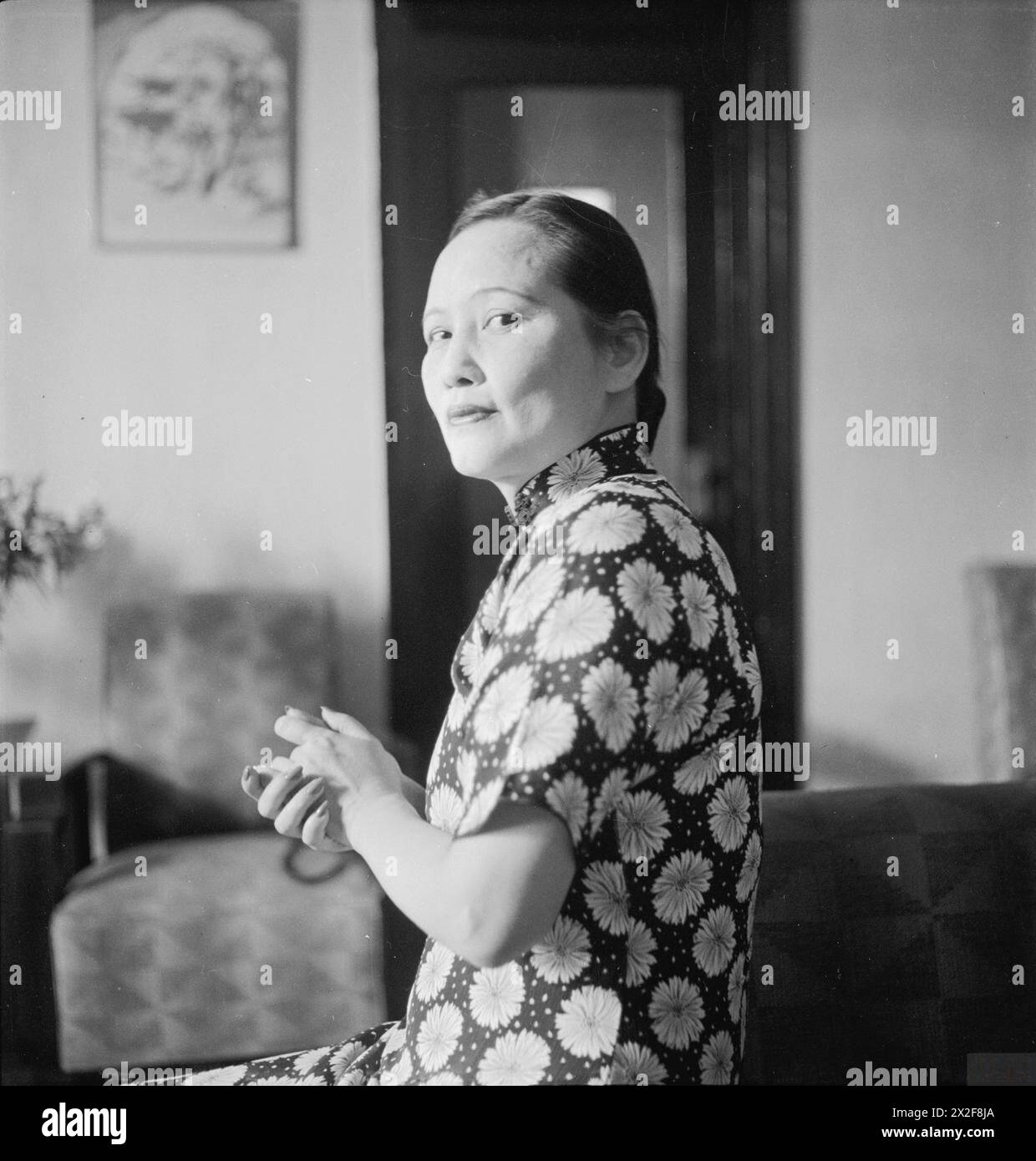
Soong Ching-ling
 China
ChinaAlso known as: Madame Sun Yat-sen, Song Qingling, Rosamonde Soong
Birthday
January 27, 1893
Birth Sign
Aquarius
Birthplace
Shanghai, China
Age
Died at 88
About
Soong Ching-ling, known internationally as Madame Sun Yat-sen, was a Chinese political leader and the wife of Sun Yat-sen, the founder of the Republic of China. Born into the influential Soong family, she became a prominent figure in her own right, serving as Vice Chairman of the People's Republic of China and later as Honorary Chairman, a title held by no one else. Her life bridged the imperial era, the republican revolution, and the rise of the People's Republic, and she remains a revered symbol of revolutionary integrity and national unity.
As of today, her legacy is preserved through institutions like the China Soong Ching Ling Foundation and the Soong Ching Ling Memorial Residence in Beijing, which continue her lifelong commitment to children's welfare, peace, and international friendship. She is remembered as the 'Mother of Modern China' for her moral authority and dedication to the nation's progress.
Early Life & Background
Soong Ching-ling was born on January 27, 1893, in Shanghai, the second of six children of Charlie Soong and Ni Kwei-tseng. Raised in a devout Christian home, the family spoke English and mingled with American missionary circles, giving her a cosmopolitan upbringing. In 1907, at fourteen, she sailed to the United States with her younger sister Mei-ling, enrolling at Wesleyan College in Macon, Georgia. There she studied English literature and graduated with a Bachelor of Arts in 1913, writing a senior thesis on how China could modernize while preserving its cultural identity.
While abroad, she stayed in close correspondence with her father, who was a key financial backer of Sun Yat-sen's revolutionary activities. This connection kept her attuned to the republican movement and deeply influenced her political ideals. Returning to China in 1913, she soon traveled to Japan, where Sun Yat-sen was in exile, and began serving as his personal secretary. The position placed her at the heart of revolutionary politics and set the stage for their eventual marriage.
Career Growth
Soong Ching-ling's political career took off after her marriage to Sun Yat-sen in 1915. She worked closely with him, serving as his secretary and advisor, and stood by him during the 1922 Chen Jiongming rebellion, famously refusing to flee without him. After Sun's death in 1925, she became the keeper of his legacy, emerging as a leader of the Kuomintang's left wing and advocating cooperation with the Chinese Communist Party. When Chiang Kai-shek purged the Communists in 1927, she publicly condemned him and went into self-imposed exile in the Soviet Union and Europe.
During the Second Sino-Japanese War, she returned to China and joined her sisters in Chongqing, organizing relief work and children's welfare programs. After the Communist victory in 1949, she aligned with the new government and served as Vice Chairman of the People's Republic of China from 1949 to 1954 and again from 1959 to 1975. She also held the post of Vice Chairman of the Standing Committee of the National People's Congress. In the 1950s, she represented China abroad, promoting peace and women's rights. Following President Liu Shaoqi's purge in 1968, she and Dong Biwu served as de facto heads of state until 1972. In 1951, she received the Stalin Peace Prize for her peace advocacy. In her final days, she was admitted to the Chinese Communist Party and named Honorary Chairman of the People's Republic, the only person ever to hold that title.
Career Timeline
Public Image & Style
Soong Ching-ling was known for her dignified, elegant bearing, often wearing tailored Western suits and dresses. The media and public perceived her as a principled stateswoman, the 'Mother of Modern China,' who embodied moral authority and national unity. Her public image was that of a serious, committed revolutionary, yet she was also seen as a symbol of compassion, especially for her work with children. In official Chinese media, she is honored as a 'great woman' and revolutionary pioneer. International outlets like the BBC and PBS have portrayed her as a complex figure who bridged the divide between the KMT and CCP, sacrificing family ties for political principles.
Fame & Fandom (iFAMOUS Rankings)
Soong Ching-ling commands a unique form of reverence that defies the mechanics of modern fandom. There is no organized fanbase with a formal moniker, no unofficial clubs, and no viral campaigns driven by private individuals to elevate her profile. Her legacy is sustained entirely through official state institutions and charitable foundations rather than the organic fervor typical of contemporary celebrities. The China Soong Ching Ling Foundation operates as the primary steward of her memory, focusing on children's welfare and women's rights, while commemorative events remain dignified ceremonies of historical reflection rather than fan gatherings. This absence of informal adoration underscores her status as a revered stateswoman whose influence was rooted in political authority and moral integrity during her lifetime. Despite this lack of a pop-culture following, her global standing remains substantial within historical and political spheres. According to the iFANN Global Fame Rankings, she holds significant placement among notable figures from her nation. She is currently the 71st most famous person from China, having risen from the 74th position in the previous cycle. This ranking reflects enduring recognition across media coverage, search trends, and cultural consumption signals worldwide. Her reputation as the "Mother of Modern China" ensures that her name persists in educational and diplomatic contexts, bridging the gap between imperial history and the modern era. While she does not engage with fans in the manner of living entertainers, her image remains a potent symbol of national unity and revolutionary principle. The data indicates that her fame is stable and institutionalized, maintained by the very structures she helped build rather than the fluctuating whims of public opinion.
Interesting Facts and Legends
Soong Ching-ling was born Rosamonde, a name reflecting her family's Methodist faith. She holds the distinction of being the first woman without royal lineage to officially serve as head of state in China. During the 1922 rebellion, she suffered a miscarriage after refusing to evacuate Sun Yat-sen alone, and she never bore children herself. Although she joined the Chinese Communist Party just fourteen days before her death in 1981, she remained a practicing Christian throughout her life. Her education in the United States equipped her with fluent English spoken with an American accent. Beyond these biographical facts, her legend is cemented by the title "The Mother of Modern China," an epithet popularized by international media and Chinese state discourse to describe her lifelong dedication to the nation's development. Another central pillar of her narrative is her marriage to Sun Yat-sen, the founding father of the Republic of China; their union is often cited as a partnership of revolutionary ideals where she served as his unwavering political companion. Recent commemorations also highlight her role in peace diplomacy, particularly efforts to foster relations between China and the United States, which remains a core part of her historical identity.
Notable Quotes
“I am a revolutionary, and I shall remain one until my last breath.”
“The revolution is not yet finished; we must continue the work of Sun Yat-sen.”
“Children are the future of our nation; we must care for them with all our hearts.”
“I have always believed that the people, and only the people, are the makers of history.”
Family & Personal Life
Soong Ching-ling came from the influential Soong family, often called the 'Soong Dynasty.' Her father, Charlie Soong, was a wealthy publisher and missionary; her mother, Ni Kwei-tseng, was a devout Christian. Her elder sister, Soong Ai-ling, married banker H.H. Kung; her younger sister, Soong Mei-ling, married Chiang Kai-shek; and her brother, T.V. Soong, served as Finance Minister. Another brother, Soong Tse-an, was a younger sibling. The family's political and financial influence shaped modern China, but Ching-ling's political choices created lasting rifts, particularly with Mei-ling, as their husbands stood on opposite sides of the civil war.
Notable Connections
Soong Ching-ling is closely associated with her husband, Sun Yat-sen, whose political vision she championed throughout her life. Her siblings, Soong Ai-ling and Soong Mei-ling, and their husbands H.H. Kung and Chiang Kai-shek, were central figures in the rival Nationalist government. She also worked alongside Communist leaders like Mao Zedong and Zhou Enlai after 1949. Her legacy is carried on by the China Soong Ching Ling Foundation and institutions bearing her name.
Relationships & Dating History
Soong Ching-ling's only known relationship was with Sun Yat-sen, whom she married on October 25, 1915, in Tokyo. The couple met while she served as his secretary in Japan in 1914. Despite opposition from her family, she defied them to marry him. Their marriage lasted until his death from liver cancer on March 12, 1925. She never remarried and remained devoted to his memory. At the time of her death in 1981, she was widowed, having been without a spouse for 56 years.
- MarriedSun Yat-sen1915 - 1925Married in Tokyo despite family opposition; she served as his secretary and advisor until his death.
Death & Aftermath
Died
May 29, 1981 (aged 88)
Death Place
Beijing, People's Republic of China
Cause of Death
Illness
Soong Ching-ling spent her final years in quiet seclusion at her residence in Shanghai, where she had resided for eighteen years before her passing. On May 29, 1981, she died in Beijing at the age of eighty-eight, having been admitted to a hospital facility following a prolonged period of declining health. The official record states she passed away due to illness, with no specific disease identified in public documents. The reaction to her demise was immediate and extensive, reflecting her status as a revered national figure often referred to as the Mother of Modern China. Tributes poured in from government officials and institutions across the People's Republic, marking a significant moment of national mourning. Her funeral arrangements were state-sponsored, and she was laid to rest in Shanghai at the Soong Ching-ling Memorial Hall within her former residence, a site that now serves as both a burial ground and a museum dedicated to her life.
Posthumously, her legacy has been sustained through various foundations and awards rather than immediate commercial releases. The China Soong Ching Ling Foundation continues to operate programs such as the Junior Cultural Ambassadors initiative, while the Shanghai Soong Ching Ling Foundation launched new women's health initiatives in 2026. Her name remains associated with the prestigious Soong Ching Ling Children's Invention Award, which has recognized young inventors for over two decades, and her memory is further honored through exhibitions highlighting her global advocacy for peace.
Net Worth (Estate Value)
$5 Million
iFANN Editorial Team estimate
Soong Ching-ling did not accumulate personal wealth; she lived modestly and dedicated her resources to charitable causes. At her death in 1981, her estate was minimal, with no significant personal fortune. However, her legacy assets, including the China Soong Ching Ling Foundation, the Soong Ching Ling Memorial Residence in Beijing, and the Soong Ching Ling Former Residence in Shanghai, are managed by state and foundation bodies. These institutions generate revenue through government funding, donations, and cultural exchange programs, though exact figures are not publicly disclosed. Per iFANN's editorial analysis, the estimated value of these legacy assets is around $5 Million as of 2026, reflecting the modest scale of her personal estate but the enduring value of her name and work.
Awards Won (2)
Soong Ching-ling received the Stalin Peace Prize in 1951 for her advocacy of world peace. She was also granted the unique title of Honorary Chairman of the People's Republic of China in 1981, an honor no one else has held. Her legacy is further marked by numerous memorials and institutions named in her honor.
1951 · Peace
For promoting world peace
1981 · National Honor
Lifetime achievement
Known For
Vice Chairman of the People's Republic of China
1949 · Political leader
Honorary Chairman of the People's Republic of China
1981 · Honorary title
Madame Sun Yat-sen
1915 · Spouse of revolutionary leader
Keywords
Sources
Quick Facts
- Profession
- Politician
- Born
- January 27, 1893
- Birthplace
- Shanghai, China
- Died
- May 29, 1981
- Death Place
- Beijing, China
- Gender
- Female
- Spouse
- Sun Yat-sen
- Education
- Wesleyan College, BA 1913
- Birth Sign
- Aquarius
- Nationality
- Chinese
Personal Details
- Full Name
- Soong Ching-ling (Rosamonde Soong)
- Spouse
- Sun Yat-sen
- Education
- Wesleyan College, Macon, Georgia (BA, 1913)
Frequently Asked Questions
Who was Soong Ching-ling?
What was Soong Ching-ling's net worth?
Is Soong Ching-ling still alive?
Why is Soong Ching-ling famous?
What was Soong Ching-ling's relationship with her sister Soong Mei-ling?
Similar People
Join the community
fans discussing