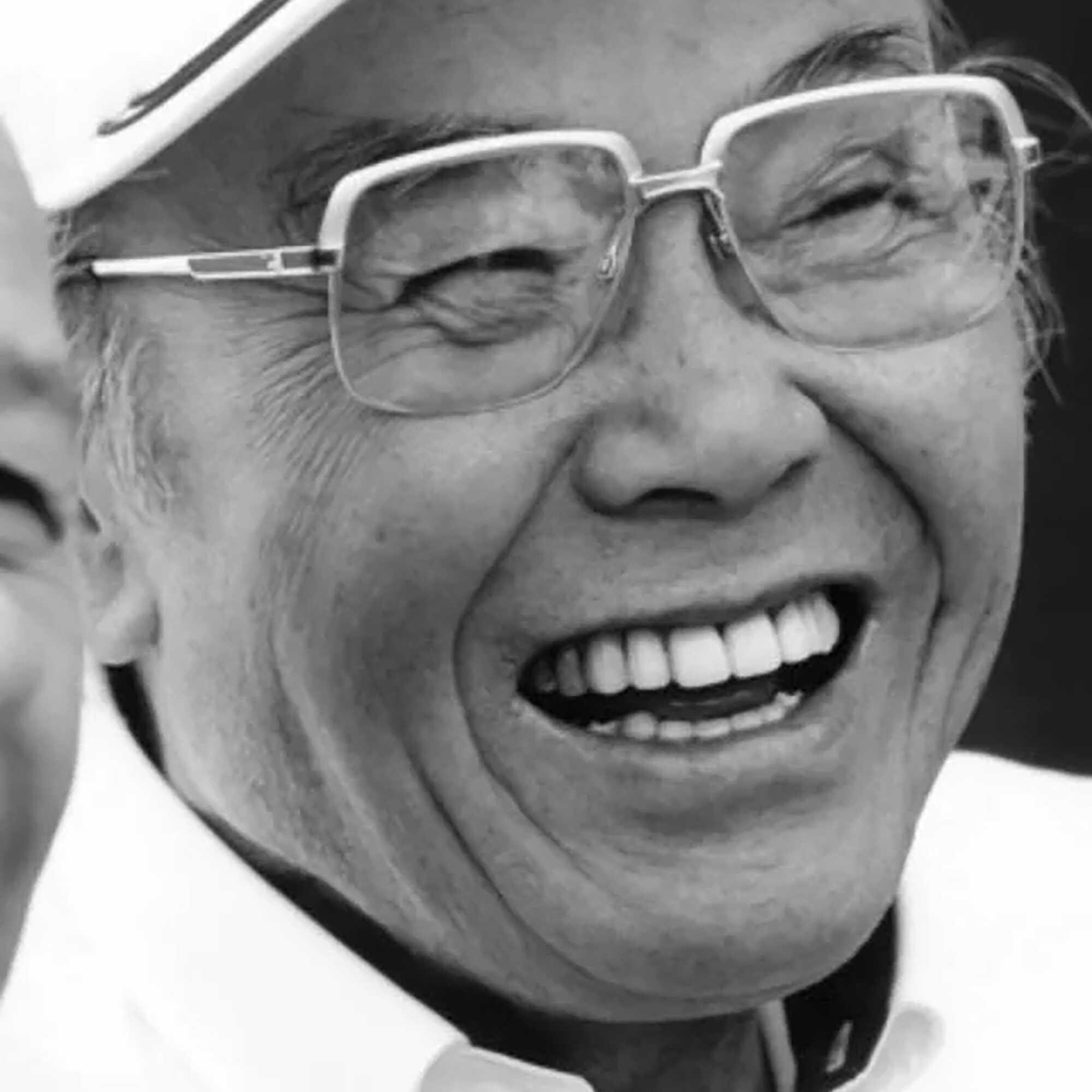
Soichiro Honda
 Japan
Japanengineer•industrialist•entrepreneur
Also known as: Sōichirō Honda, Souichirou Honda
Birthday
November 17, 1906
Birth Sign
Scorpio
Birthplace
Iwata, Shizuoka Prefecture, Japan
Age
Died at 84
Height
5 ft 6 in (168 cm)
About
Soichiro Honda was a Japanese engineer, industrialist, and entrepreneur who founded Honda Motor Co., Ltd. He is widely regarded as one of the most influential figures in the history of the automotive and motorcycle industries. Unlike many corporate founders, Honda was a self-taught mechanic whose career began in a small workshop, evolving into a global manufacturing empire that defined modern mobility. He passed away on August 5, 1991, at the age of 84.
Honda's relentless innovation and hands-on approach made him a legendary figure in Japanese industry. He transformed his company into one of the world's leading automobile and motorcycle manufacturers. His philosophy, often summarized as "The Power of Dreams," emphasized the joy of mobility and the importance of innovation. He famously stated, "Success is 99 percent failure," encouraging resilience in the face of setbacks. Even after his death, the company honors his vision through initiatives like the 'Happy Honda Days,' which reflect on the joy of mobility he championed.
Early Life & Background
Soichiro Honda was born into a poor family in Iwata, Shizuoka Prefecture, where his father, Kihachiro Honda, worked as a blacksmith and operated a bicycle repair shop. The family struggled financially, and Soichiro had little formal education beyond elementary school. At the age of 10, he began working at a local garage to help support his family, developing an early fascination with mechanics. By age 15, he moved to Tokyo to work at the Art Shokai auto body shop, where he spent six years learning the trade of automobile repair and customization.
His first major success came when he modified a Model T Ford for a customer, showcasing his natural engineering aptitude. After leaving Tokyo, Honda returned to Shizuoka and opened his own machine shop in 1937, initially producing piston rings for Toyota. However, his business faced significant challenges. In the late 1930s, his piston ring designs failed repeatedly during testing. Rather than abandoning the project, Honda personally visited Toyota's headquarters to negotiate a trial period, eventually perfecting the design after hundreds of iterations. This persistence earned him a contract with Toyota, which became a crucial foundation for his future capital.
During World War II, his factory was requisitioned by the military to produce parts, and later, he was ordered to manufacture engines for aircraft, a task he resisted until the war ended. In 1945, following the war, Japan faced severe fuel shortages. Honda saw an opportunity to attach surplus radio generator engines to bicycles, creating motorized scooters. With the help of his employees, including Takeo Fujisawa, he mass-produced these "Type A" motorized bicycles. This venture provided the initial capital and momentum to formally establish Honda Motor Co., Ltd. on September 24, 1948.
Career Growth
Honda's career is marked by relentless innovation and a refusal to accept "no" as an answer. Following the establishment of Honda Motor Co., Ltd. in 1948, the company introduced the Dream D-Type scooter and the C100 Cub. The Super Cub, launched in 1958, became the best-selling motor vehicle in history, revolutionizing personal transportation globally.
In 1963, Honda entered the automobile market with the S500 sports car, though it was not immediately successful commercially. The company made its Formula One debut in 1964, marking the beginning of a long and complex relationship with motorsport. The launch of the Honda CB750 Four in 1968 is widely considered the world's first "superbike." It combined high performance with reliability and affordability, transforming motorcycles from niche vehicles into mass-market transportation.
Honda expanded its F1 program in the 1970s, winning its first Grand Prix in 1965 (Gonzalo Rodriguez at the Italian GP) and continuing to dominate the sport with innovations like the V12 engine. In 1973, Honda stepped down as president but remained Chairman. He continued to lead the company's technical direction and R&D efforts. During the 1980s and 1990s, Honda achieved dominance in IndyCar racing and Formula One, with the V10 and V12 engines setting new standards for power and efficiency. The company also pioneered the development of the CVCC engine, meeting strict U.S. emission standards without a catalytic converter.
Career Timeline
Public Image & Style
Soichiro Honda is portrayed as a humble, hardworking, and visionary leader. Media depictions emphasize his hands-on approach, his love for racing, and his belief in the power of dreams. He is seen as a symbol of Japanese resilience and innovation. His leadership style was distinct from typical corporate executives; he was often found in the lab or on the track rather than in a boardroom. This authentic connection to the engineering process earned him deep respect from workers and peers alike.
Fame & Fandom (iFAMOUS Rankings)
Soichiro Honda commands a reverence that transcends the typical celebrity worship, rooted instead in the enduring legacy of the machines he built and the philosophy that still drives his company. Unlike pop stars with organized fan clubs, his admirers are motorcycle enthusiasts, Formula 1 followers, and engineers who view his life as a masterclass in resilience. The community does not gather under a specific moniker; there is no formal name for those who revere him, yet their devotion manifests through brand loyalty, annual tributes from racing teams like LCR Honda, and the widespread citation of his famous maxim about failure being ninety-nine percent of success.
This unique bond turns his history into living folklore, where stories of bolting engines to bicycles or Ayrton Senna dedicating a Grand Prix victory to him serve as the rituals of a global audience united by mobility and innovation. His influence stretches across decades, tracking how a small workshop in Shizuoka grew into an industrial titan while maintaining a human-centric spirit. The scope of his recognition is measured not just by historical records but by the continued vitality of the brands he founded. According to the iFANN Global Fame Rankings, Soichiro Honda holds significant standing among historical figures. He is currently featured at No. 72 in the August 2026 iFAMOUS Rankings for Japan. While he does not hold a placement in the current Global Top 1,000 rankings, his impact remains profound and widely acknowledged across multiple continents.
Interesting Facts and Legends
Before cars, Honda's first major innovation was attaching engines to bicycles, a move that seemed ridiculous to many at the time. His early career was nearly derailed by the failure of his piston rings, but his persistence in re-engineering them saved his business. Despite being an engineer, Honda was a passionate racer himself. He often tested prototypes on the track, risking his life to ensure safety and performance. The story of Ayrton Senna dedicating his 1991 Hungarian Grand Prix win to Honda, who had passed away months earlier, is one of the most emotional moments in F1 history. Honda famously said, "Failure is the beginning of success," a mantra that guided his entire career.
Notable Quotes
“Success is 99 percent failure.”
“I am not a businessman. I am an engineer.”
“The Power of Dreams.”
“It is better to fail in what you love than to succeed in what you hate.”
“If you don't know the rules, you can't break them.”
Family & Personal Life
Soichiro Honda was married to Mitsuko Honda. They met through a matchmaker arranged by his father. Mitsuko was a supportive partner who managed the household and allowed Soichiro to focus entirely on his work. They had three children together: Takeo Honda, who later became a prominent figure in the company and served as a director; Hiromi Honda, his daughter; and Toru Honda, his youngest son. The family maintained a close bond throughout his rise from poverty to global industrialist status. No divorces or separations occurred during their long marriage.
Notable Connections
Relationships & Dating History
Soichiro Honda's romantic life is documented primarily through his marriage to Mitsuko Honda. They met through a matchmaker arranged by his father and married in the early 1930s, typically cited as 1931 or 1932. Mitsuko was a supportive partner who managed the household and allowed Soichiro to focus entirely on his work. They shared a long, stable partnership throughout his rise from poverty to global industrialist status. No divorces or separations occurred during their marriage.
The couple had three children together: Takeo Honda, who later became a prominent figure in the company and served as a director; Hiromi Honda, his daughter; and Toru Honda, his youngest son. As a historical figure who lived primarily in the mid-20th century, there are no records of pre-marital dating, flings, or subsequent relationships. His marriage to Mitsuko lasted until his death in 1991. At the time of his death, he was widowed, having lost his wife prior to his passing.
- MarriedMitsuko Honda1931 - 1991Arranged marriage; they shared a long, stable partnership throughout his rise from poverty to global industrialist status. They had three children together.
Death & Aftermath
Died
August 5, 1991 (aged 84)
Death Place
Juntendo University Hospital, Tokyo, Japan
Cause of Death
Complications from liver failure and pneumonia
Soichiro Honda passed away on August 5, 1991, at the age of 84 inside Juntendo University Hospital in Tokyo. His final years were marked by a gradual decline involving liver failure and pneumonia, conditions that had plagued him for several years before he died. He had largely withdrawn from public life after stepping down as president in 1973, though he remained chairman until his death. There was no public autopsy or coroner's inquest; the cause was confirmed through standard medical observation and family confirmation, consistent with private natural deaths of that era.
The global automotive community reacted with immediate and widespread tributes. Government officials, industry leaders, and racing fans alike mourned the loss of a visionary who transformed post-war Japan into an industrial powerhouse. The American Society of Mechanical Engineers honored his legacy, noting his induction for contributions to mechanical engineering. Moments of silence were observed within the manufacturing sector given his status as a foundational figure in both motorcycle and automobile production. Ayrton Senna, who had dedicated his 1991 Hungarian Grand Prix victory to Honda earlier that year, was deeply affected, stating that Honda's spirit lived on in every race.
Honda was cremated, and his ashes were interred at the Tama Cemetery in Fuchū, Tokyo, a resting place shared with other notable Japanese figures. Posthumously, he received numerous honors including induction into the Automotive Hall of Fame and recognition by the National Inventors Hall of Fame. The Honda Foundation continues to operate, supporting education and cultural initiatives in line with his vision. Several books and documentaries like The Man Behind the Empire and Power of Dreams have been released to document his life and philosophy. The estate continues to manage the brand's legacy assets, ensuring the company remains true to its founder's original principles of innovation and resilience.
Net Worth (Estate Value)
$1.2 Billion
iFANN Editorial Team estimate
As a deceased individual whose wealth was largely tied to the company he founded, precise net worth estimates are derived from the value of the Honda estate and the company's performance. The iFANN Editorial Team estimates Soichiro Honda's estate value at approximately $1.2 billion as of 2026. This figure reflects the cumulative value of his shares, royalties, and licensing deals accumulated over decades.
Wealth sources include company ownership, as he held a significant portion of Honda shares which appreciated massively over decades. Royalties and licensing from patents continue to generate revenue. Real estate holdings in Japan and international properties also contributed to his fortune. Estate management is handled by the Honda Foundation and family trusts. The estate continues to earn millions annually through book sales, documentaries, and brand licensing. Specific personal net worth figures are not publicly disclosed in the same way as living celebrities, as his wealth was integrated into the corporate structure. Estimates suggest his personal fortune at the time of death was in the hundreds of millions of USD, making him one of the wealthiest individuals in Japanese history.
Awards Won (4)
Soichiro Honda received numerous prestigious awards both during his lifetime and posthumously. He was inducted into the Automotive Hall of Fame in 1989, becoming one of the few non-Americans to receive this honor. He was also inducted into the National Inventors Hall of Fame for his invention of the Honda CB750 and other automotive technologies. The Order of Merit for Science and Technology in Japan recognized his highest scientific achievements. He received honorary doctorates from several universities, including the University of Tokyo and Waseda University.
1989 · Industry Award
Lifetime Achievement
1989 · Innovation
Honda CB750 and other technologies
Known For
Honda Motor Co., Ltd.
1948 · Founder
Honda Super Cub
1958 · Creator
Honda CB750
1968 · Designer
Keywords
Sources
Quick Facts
- Profession
- businessperson, engineer, entrepreneur
- Born
- November 17, 1906
- Birthplace
- Iwata, Shizuoka, Japan
- Died
- August 5, 1991
- Death Place
- Juntendo University Hospital, Tokyo, Japan
- Gender
- Male
- Birth Sign
- Scorpio
Personal Details
- Full Name
- Sōichirō Honda
- Height
- 5 ft 6 in (168 cm)
- Spouse
- Mitsuko Honda
- Children
- Takeo Honda · Hiromi Honda · Toru Honda
- Education
- Elementary school only; self-taught mechanic
Frequently Asked Questions
Who founded Honda?
How did Soichiro Honda die?
What was Soichiro Honda's first invention?
Did Soichiro Honda ever drive a car?
What is the Honda Super Cub?
Similar People
Join the community
fans discussing