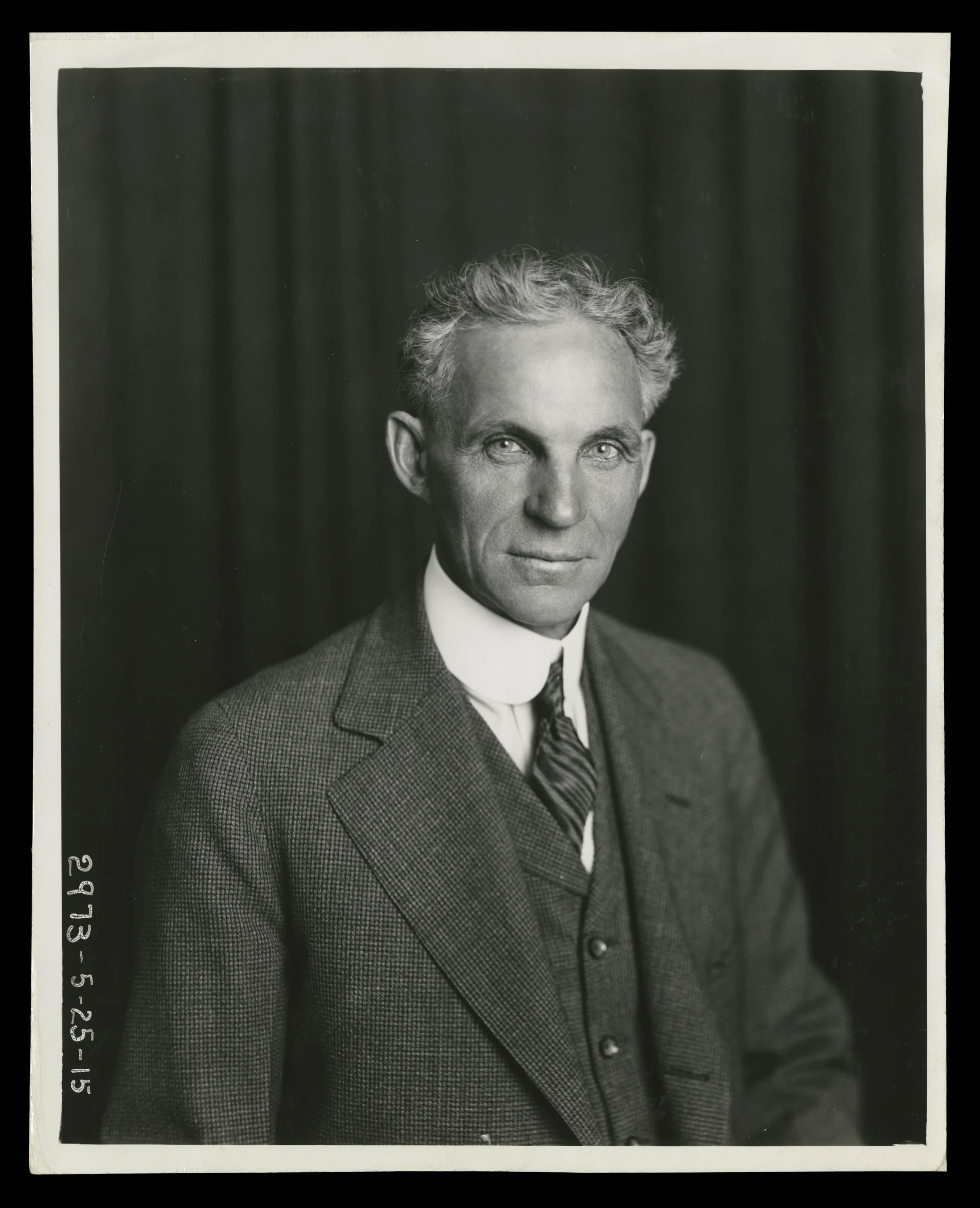
Henry Ford
 United States
Industrialist•Business Magnate•Inventor
Birthday
July 30, 1863
Birth Sign
Leo
Birthplace
Springwells Township (now Dearborn), Michigan, USA
Age
Died at 83
Height
5 ft 10 in (178 cm)
About
Henry Ford was an American industrialist and business magnate who transformed transportation and manufacturing. He founded the Ford Motor Company in 1903 and introduced the Model T in 1908, making automobiles affordable for the middle class through assembly-line production. Ford's innovations, including the moving assembly line and the $5-per-day wage, revolutionized factory work worldwide. By the late 1920s, the Model T accounted for nearly half of all cars globally. Ford held a patent for the transmission mechanism used in the Model T, awarded in 1911, and pioneered the five-day, 40-hour workweek.
Ford's legacy is complex. He is celebrated as a visionary industrialist who democratized transportation, but his antisemitic writings in the 1920s, published in his newspaper The Dearborn Independent and compiled as The International Jew, have drawn significant criticism. He opposed U.S. entry into both world wars, organizing a Peace Ship expedition in 1915, yet his company became a major weapons supplier during World War II. After his son Edsel died in 1943, Ford briefly resumed company presidency before handing control to his grandson Henry Ford II in 1945.
Ford died on April 7, 1947, at his Fair Lane estate in Dearborn, Michigan. He left most of his fortune to the Ford Foundation, which he established in 1936. The Ford Motor Company remains one of the world's largest automakers, and the Henry Ford Museum in Dearborn continues to attract millions of visitors annually.
Early Life & Background
Henry Ford was born on July 30, 1863, on his family's farm in Springwells Township, Michigan, the eldest of six children. His father, William Ford, was a farmer who emigrated from County Cork, Ireland, in 1847; his mother, Mary Litogot Ford, died when Henry was 13. From a young age, Ford showed a mechanical bent: at 12, his father gave him a pocket watch, which he promptly dismantled and reassembled. Neighbors soon brought him their watches for repair. He set up a small machine shop and by age 15 built his first steam engine.
Ford attended a one-room schoolhouse for eight years, often missing class during harvest season. Disliking farm work, he left home at 16 and walked to Detroit, where he apprenticed as a machinist at a shipbuilding firm. Over three years, he learned to operate and service steam engines and studied bookkeeping. He returned briefly to the farm, working part-time for the Westinghouse Engine Company while tinkering in his workshop, where he built a small farm locomotive tractor from an old mowing machine.
In 1888, Ford married Clara Ala Bryant, the daughter of a local farmer. The couple moved to Detroit in 1891, where Ford took a job as a night engineer for the Edison Illuminating Company. His talent earned him a promotion to chief engineer by 1893. All the while, he worked on plans for a horseless carriage. In 1892, he built his first gasoline-powered buggy with a two-cylinder, four-horsepower engine. On June 4, 1896, he completed the Quadricycle, his first self-propelled vehicle, built with four wire wheels, a tiller for steering, and only two forward speeds, no reverse. He sold it for $200 and used the money to build a second car. Through his work at Edison, Ford befriended Thomas Edison, who became a lifelong mentor and encouraged his automotive experiments.
Career Growth
Ford's first automotive venture, the Detroit Automobile Company, founded in 1899, failed within two years. Undeterred, he built a successful race car and won a high-profile race against Alexander Winton in 1901, gaining publicity and investors. After a falling-out with backers, he left the Henry Ford Company (later renamed Cadillac) and founded the Ford Motor Company on June 16, 1903, with 11 investors and $28,000 in capital.
The company's breakthrough came in 1908 with the Model T, a sturdy, affordable car that initially cost $850 but eventually dropped to under $300. Demand was overwhelming. In 1913, Ford introduced the moving assembly line at his Highland Park plant, reducing chassis assembly from 12.5 man-hours to 93 man-minutes by 1914. This innovation slashed production costs and made the Model T accessible to millions. In 1914, Ford shocked the business world by implementing a $5-per-day wage, roughly double the prevailing rate, and later introduced the five-day, 40-hour workweek. These moves reduced turnover and boosted productivity.
Ford bought out all minority shareholders in 1919, gaining sole ownership of the company. By 1927, when Model T production ended, over 15 million units had been sold. The company introduced the Model A that same year. During World War II, Ford Motor Company became a major defense contractor, building B-24 Liberator bombers at the Willow Run plant. After his son Edsel died of cancer in 1943, Ford resumed the presidency but was too frail to lead effectively. He turned over control to his grandson Henry Ford II in 1945 and died two years later.
Career Timeline
Public Image & Style
Henry Ford cultivated the image of a self-made American industrialist: practical, no-nonsense, often photographed in suits but also in work clothes. He was known for his incredibly hard handshake and direct manner. The media of his era portrayed him as a visionary who made car ownership a reality for ordinary people, a narrative amplified by his own publicity efforts. However, his publication of antisemitic content in The Dearborn Independent from 1919 to 1927 permanently damaged his reputation. Modern portrayals, such as in the History Channel's The Men Who Built America, acknowledge his innovations while also addressing his deeply flawed views. The Ford Motor Company maintains a passionate enthusiast community, and the Henry Ford Museum in Dearborn attracts millions of visitors annually. Ford's legacy remains contested: celebrated for democratizing transportation and pioneering modern manufacturing, yet criticized for his bigotry and anti-union stance.
Fame & Fandom
Henry Ford stands as the 397th most famous person in the world, a position he has held steady across recent cycles according to the iFANN Global Fame Rankings. Within his specific sphere of influence, he claims the 5th spot among the most famous figures in Automotive / Car Culture, a ranking found on the dedicated industry page at this location. These placements reflect his enduring presence in global media coverage and cultural consumption signals worldwide. While the industrialist once cultivated a distant public persona, refusing interviews and maintaining a stoic demeanor, the modern engagement with his legacy is distinct from typical celebrity fandom. There is no formal name for his fanbase; instead, the community consists of historians, automotive collectors, and business students who engage through institutional appreciation rather than organized campaigns or rituals. The primary hub for this devotion remains The Henry Ford Museum and Greenfield Village in Dearborn, where enthusiasts gather to view the Model T and the Rouge Factory without the coordinated efforts seen in pop culture. Even as the restoration of his personal estate, Fair Lane, approaches completion for a 2027 reopening, the interest remains rooted in historical tourism and academic study. Unlike performers who inspire chart pushes or viral moments, Ford's following is built on the verified impact of his innovations and the complex mythology surrounding his labor policies and controversial later years.
Interesting Facts and Legends
Ford's memory was notoriously unreliable; his dictated autobiography My Life and Work (1922) is filled with factual errors. He organized other boys as a child to build rudimentary waterwheels and steam engines. The Ford Quadricycle had no reverse gear. Despite his pacifism, his company produced military vehicles and aircraft during both world wars. Ford appears as a Templar character in the Assassin's Creed video game franchise. He is featured as an ally of Thomas Edison in the YouTube series Super Science Friends. Ford's pocket watch fixation as a child led him to teach himself the basics of machine design by studying watch mechanisms. A story still told involves his victory in a high-profile hillclimb race against Alexander Winton; this win convinced investors to back his second attempt at building a car company, leading to the formation of the Ford Motor Company. Another verified legend centers on the introduction of the $5 workday, an event that fundamentally changed the standard of living for American workers and created a middle class capable of buying the products they built. His retirement from the presidency of Ford Motor Company marked the end of an era before he passed away shortly thereafter.
Notable Quotes
“Any customer can have a car painted any color that he wants, so long as it is black.”
“Whether you think you can, or you think you can't, you're right.”
“I will build a motor car for the great multitude. It will be large enough for the family but small enough for the individual to run and care for.”
Family & Personal Life
Ford married Clara Ala Bryant on April 11, 1888. She was the daughter of a farmer and met Ford through mutual acquaintances in Greenfield Township, Michigan. Clara was a steadfast partner, managing the household during Ford's early experiments and later overseeing the family's Fair Lane estate. They had one son, Edsel Bryant Ford, born November 6, 1893. Edsel served as president of Ford Motor Company from 1919 until his death from cancer on May 26, 1943, at age 49. Ford's father, William Ford, was a farmer from County Cork, Ireland; his mother, Mary Litogot, died when Ford was 13. He had three brothers and two sisters. After Edsel's death, Ford's grandson Henry Ford II took over the company in 1945. Clara outlived Henry, dying in 1950.
Notable Connections
Ford's key relationships included Thomas Edison, his mentor and friend from his time at the Edison Illuminating Company; his wife Clara, who supported him for 59 years; his son Edsel, who ran the company before his early death; and his grandson Henry Ford II, who took over leadership in 1945. Early investors John and Horace Dodge later founded Dodge Brothers Company. Harvey Firestone was a close friend and business associate. Samuel Crowther co-wrote Ford's autobiography My Life and Work.
Relationships & Dating History
Henry Ford had only one known romantic relationship in his life. He married Clara Ala Bryant on April 11, 1888, after meeting through mutual acquaintances in Greenfield Township, Michigan. Clara was the daughter of a local farmer and became Ford's lifelong partner, supporting his early experiments and managing the family estate. They had one son, Edsel Bryant Ford, born in 1893. Ford remained married to Clara until his death on April 7, 1947, a union of 59 years. There are no credible reports of any other romantic relationships, affairs, or rumored pairings during his lifetime. Clara outlived him, dying in 1950.
As of 2026, Henry Ford is deceased. He was married to Clara Bryant Ford at the time of his death.
- MarriedClara Bryant Ford1888 - 1947Married on April 11, 1888; one son, Edsel; remained married until Ford's death in 1947.
Death & Aftermath
Died
April 7, 1947 (aged 83)
Death Place
Dearborn, Michigan
Cause of Death
Cerebral hemorrhage
Henry Ford died on April 7, 1947, at his home in Dearborn, Michigan. The industrialist was eighty-three years old when a cerebral hemorrhage ended his life following weeks of declining health caused by arteriosclerosis. He had spent his final days in seclusion at Fair Lane, having made no public appearances since early March due to worsening symptoms. His attending physicians confirmed the natural disease process. Public reaction arrived swiftly across the United States and abroad. President Harry S. Truman issued a statement praising Ford's contributions to industry and labor relations, while peers like Thomas J. Watson and Charles Kettering released formal condolences. Thousands of workers at Ford plants observed moments of silence, and many factories lowered their flags to half-staff.
The news triggered a surge in vehicle sales as a mark of respect, though specific figures remain undocumented. A private funeral service took place on April 9, 1947, at the Ford Family Mausoleum in Detroit Memorial Park Cemetery. Close family members including his wife Clara and son Edsel attended alongside high-ranking executives and government representatives. Posthumous honors included induction into the Automotive Hall of Fame and various engineering halls of fame. The Henry Ford Museum and Greenfield Village, established by his son Edsel, became focal points for preserving his legacy. Several foundations and scholarships bear his name, most notably the Ford Foundation and the Henry Ford Scholarship Program, ensuring his impact endures through educational and cultural institutions.
Net Worth (Estate Value)
$200 Billion
iFANN Editorial Team estimate
iFANN currently estimates Henry Ford's peak net worth at roughly $200 Billion when adjusted for inflation, making him one of the wealthiest individuals in modern history. At his death in 1947, his estate was valued at approximately $200 million (1947 dollars), equivalent to $2-3 billion in 2026. The vast majority of his wealth came from his sole ownership of Ford Motor Company after buying out shareholders in 1919. Additional assets included his Fair Lane estate in Dearborn, winter homes in Florida and Georgia, his newspaper The Dearborn Independent, and the Henry Ford Museum complex. Upon his death, Ford left most of his fortune to the Ford Foundation, which he had established in 1936. The foundation remains one of the world's largest philanthropic organizations, with assets of over $16 billion as of 2026. Company control passed to his grandson Henry Ford II. The Ford Motor Company, still controlled by the Ford family, had a market capitalization of approximately $40-45 billion as of 2026. Ford's estate did not generate significant posthumous revenue from licensing or royalties, as his name and likeness are closely guarded by the family and foundation. The Henry Ford Museum, a separate nonprofit, continues to operate in Dearborn, attracting millions of visitors annually.
Awards Won (3)
Henry Ford received several honors recognizing his industrial contributions. In 1946, he was awarded the Automotive Golden Jubilee honor and the American Petroleum Institute Gold Medal for outstanding contributions to humanity. In 1999, Fortune magazine named him the Businessman of the 20th Century. He also received numerous honorary degrees, including from the University of Michigan and Michigan State University.
1999 · Business
Lifetime Achievement
1946 · Industry
Contributions to humanity
Known For
Model T
1908 · Inventor and Manufacturer
Moving Assembly Line
1913 · Pioneer
Ford Motor Company
1903 · Founder and President
Keywords
Sources
Quick Facts
- Profession
- Industrialist, Business Magnate, Inventor
- Born
- July 30, 1863
- Birthplace
- Springwells Township (now Dearborn), Michigan, USA
- Died
- April 7, 1947
- Death Place
- Dearborn, Michigan, USA
- Gender
- Male
- Spouse
- Clara Bryant Ford
- Birth Sign
- Leo
- Height
- 5 ft 10 in (178 cm)
- Children
- 1 son: Edsel Bryant Ford
- Education
- One-room schoolhouse for eight years
Personal Details
- Full Name
- Henry Ford
- Height
- 5 ft 10 in (178 cm)
- Spouse
- Clara Bryant Ford
- Children
- 1 son: Edsel Bryant Ford
- Education
- Attended a one-room schoolhouse for eight years; no formal higher education
Frequently Asked Questions
How did Henry Ford die?
Was Henry Ford antisemitic?
How many kids did Henry Ford have?
What was Henry Ford's net worth?
Did Henry Ford invent the car?
Similar People
Join the community
fans discussing